

What Does a GEO Rollout Plan Actually Decide?
A GEO rollout plan is a sequence of decisions. It covers what to build, what to observe and where to put resources next. A fixed calendar of 12 months of content skips those decisions.
A wider business-to-business (B2B) GEO programme still needs content, citation, technical and measurement layers working together. The roadmap gives those layers an order. The team then avoids scaling production before it knows what the first work changed.
What Should a 12-Month GEO Implementation Timeline Look Like?
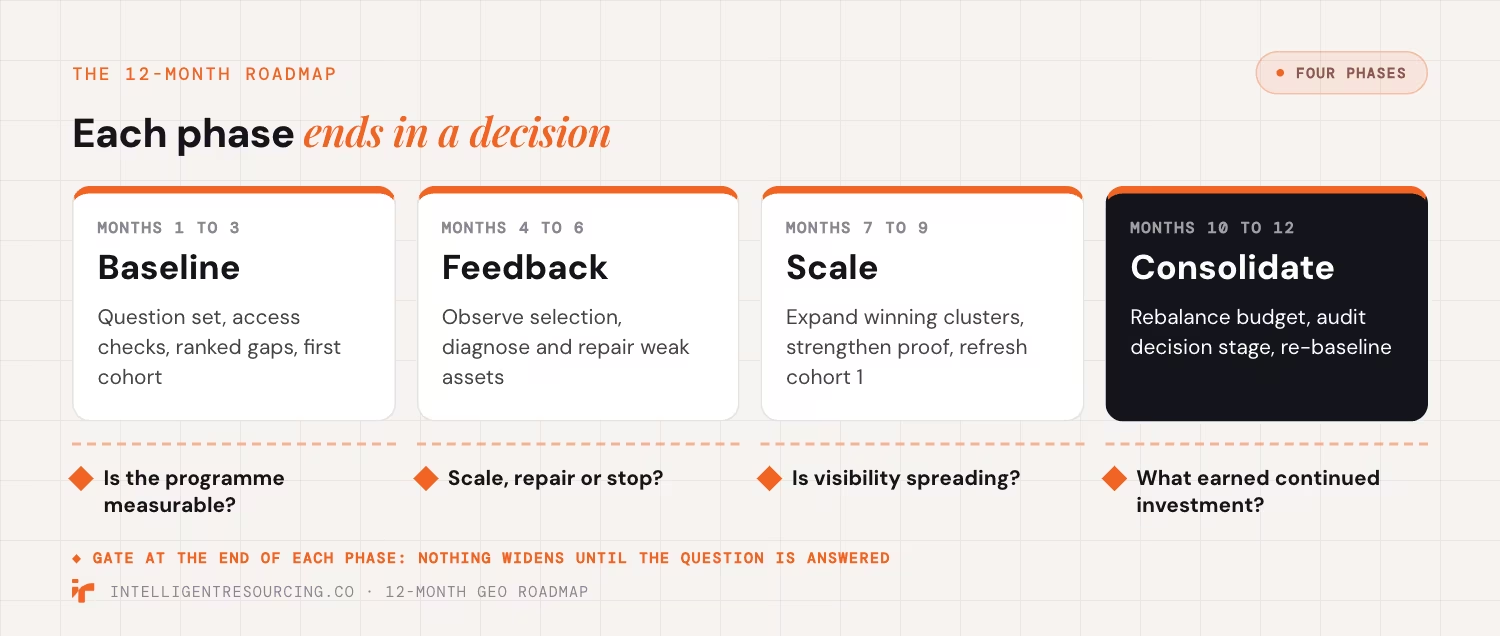
Divide the year into learning phases. Equal blocks of production teach little. Each phase needs a defined output and a decision before the programme widens.
| Month | Primary job | Required output | Decision |
|---|---|---|---|
| 1 | Establish visibility baseline | Buyer-question set, competitor benchmark, access checks | Where are we absent? |
| 2 | Prioritise gaps | Ranked opportunities and page-level interventions | What deserves investment first? |
| 3 | Launch first cohort | New or improved evidence-led assets | Is the programme measurable? |
| 4 | Observe selection | Citation and inclusion review | What is being selected or skipped? |
| 5 | Repair weak assets | Evidence, relevance or access improvements | What is actually blocking selection? |
| 6 | First allocation gate | Half-year cohort review | Scale, repair or stop? |
| 7 | Expand winning clusters | Second content and evidence cohort | Where will depth improve coverage? |
| 8 | Strengthen proof | Case studies, methodology, data or comparisons | What would make the answer more defensible? |
| 9 | Refresh and widen | Updated first cohort and adjacent questions | Is visibility spreading? |
| 10 | Rebalance resources | Winners, stalled work and low-value assets separated | What should stop receiving budget? |
| 11 | Strengthen decision-stage coverage | Comparison, fit, risk and implementation content | Are high-intent questions covered? |
| 12 | Re-baseline | New benchmark and next-year roadmap | What earned continued investment? |
The timeline front-loads measurement and prioritisation. Suppose the team cannot explain what changed. Suppose it cannot name the question each asset was meant to influence. More output then only makes attribution harder.
Why Does a GEO Roadmap Need 12 Months if Citations Can Move Sooner?
The year builds a repeatable system. Feedback arrives well before month 12.
Intelligent Resourcing's position is simple. Each answer is a fresh source choice. A page that is findable and eligible can enter consideration. Eligibility and selection are separate steps.
Some pages earn their first AI citations within weeks of publishing. Others take months. Intelligent Resourcing tracks both.
That variation is why Intelligent Resourcing gives no standard time to first citation. Timing varies by page, engine and question. One number would mislead. Record what happens page by page.
The practical value of speed is feedback. A team can see which pages, evidence formats or topics are entering answers during the programme. It can then change what it funds next. It need not wait for an annual review.
GEO can create learning inside an active retainer or operating cycle. That is why speed matters. Do not expect every page to follow the same citation clock.
Some providers quote a typical time to first citation. Ask which cohort produced the number. Ask whether publication dates were recorded consistently. Without that evidence, the number is a forecast.
Months 1 to 3: Build the Baseline Before Scaling Production
The first quarter answers 2 questions. What are we trying to change? Can the engines reach the assets involved?
Month 1: Establish the starting state
Build a fixed set of buyer questions that matter commercially. Record which brands appear. Record which uniform resource locators (URLs) are cited and which rivals recur. Reuse the same questions later, so the team compares like with like.
The baseline should use the same AI visibility and Share of Voice measures across the programme. This ties citation rate, mentions and competitive presence to the questions the business cares about.
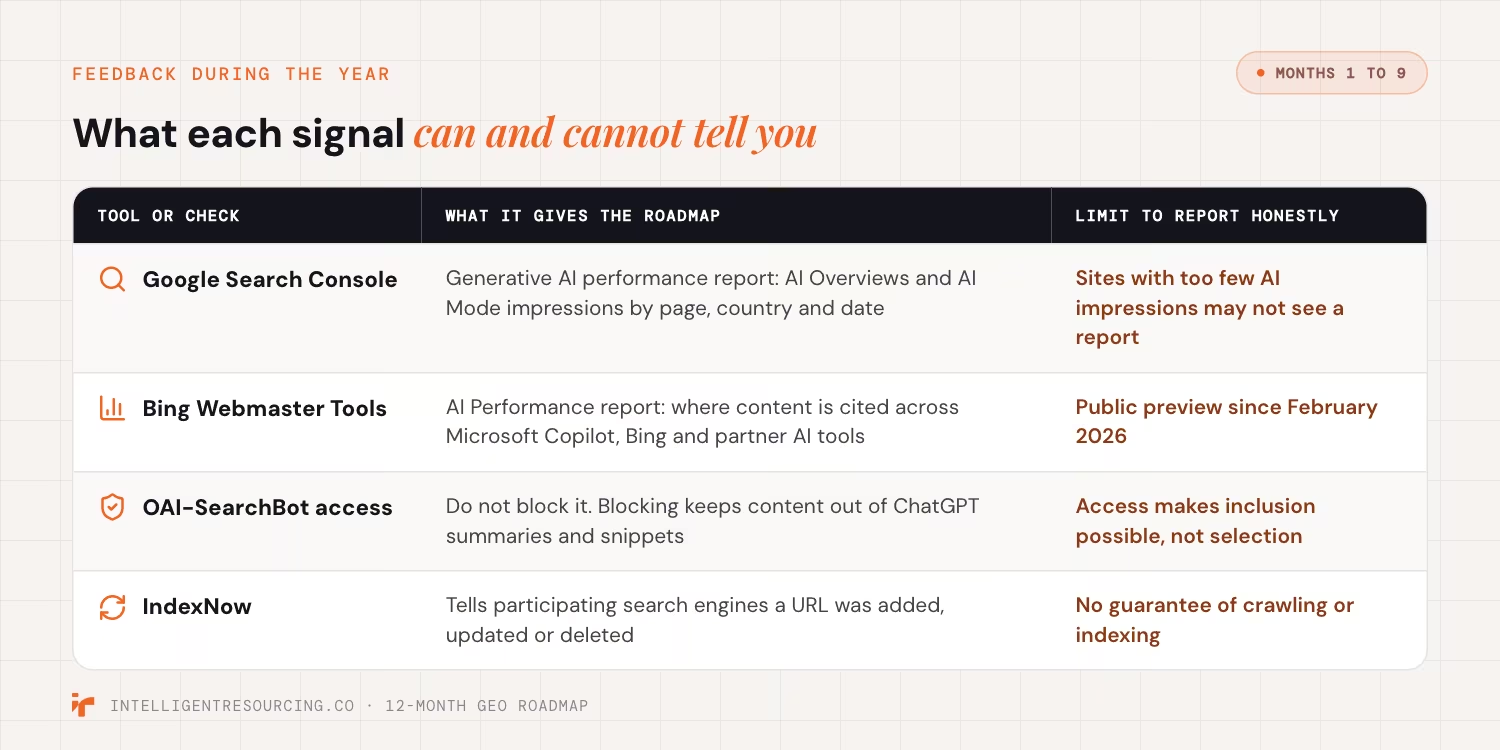
Technical access belongs in month 1 as well. OpenAI's crawler documentation says publishers should not block OAI-SearchBot. Blocking it keeps content out of ChatGPT search answers.
Access makes inclusion possible but it does not guarantee selection.
Month 2: Decide where to intervene
Not every absence needs a new article. Some gaps come from weak pages or missing proof. Others come from thin coverage, technical access or sources dominated by third parties.
This is where question mining for AI search becomes useful inside the rollout. Real questions from sales, support and buyer calls separate meaningful gaps from topics that look good in a tool. Those topics rarely influence a decision.
Month 2 should end with a ranked queue of interventions. Each item names the buyer question and the current answer gap. It also names the asset likely to fix the gap and the reason the work deserves priority.
Month 3: Launch the first controlled cohort
Publish or improve a small group of priority assets. A small cohort makes learning easier. The team can tell whether a change in evidence, structure or coverage moved the answer.
The publishing process still needs combined search engine optimisation (SEO), answer engine optimisation (AEO) and GEO checks. Intelligent Resourcing's single SEO, AEO and GEO workflow is useful here. A sound page can still fail if the answer is buried or the evidence is weak. It can also fail if sign-off treats ranking and citation as separate jobs.
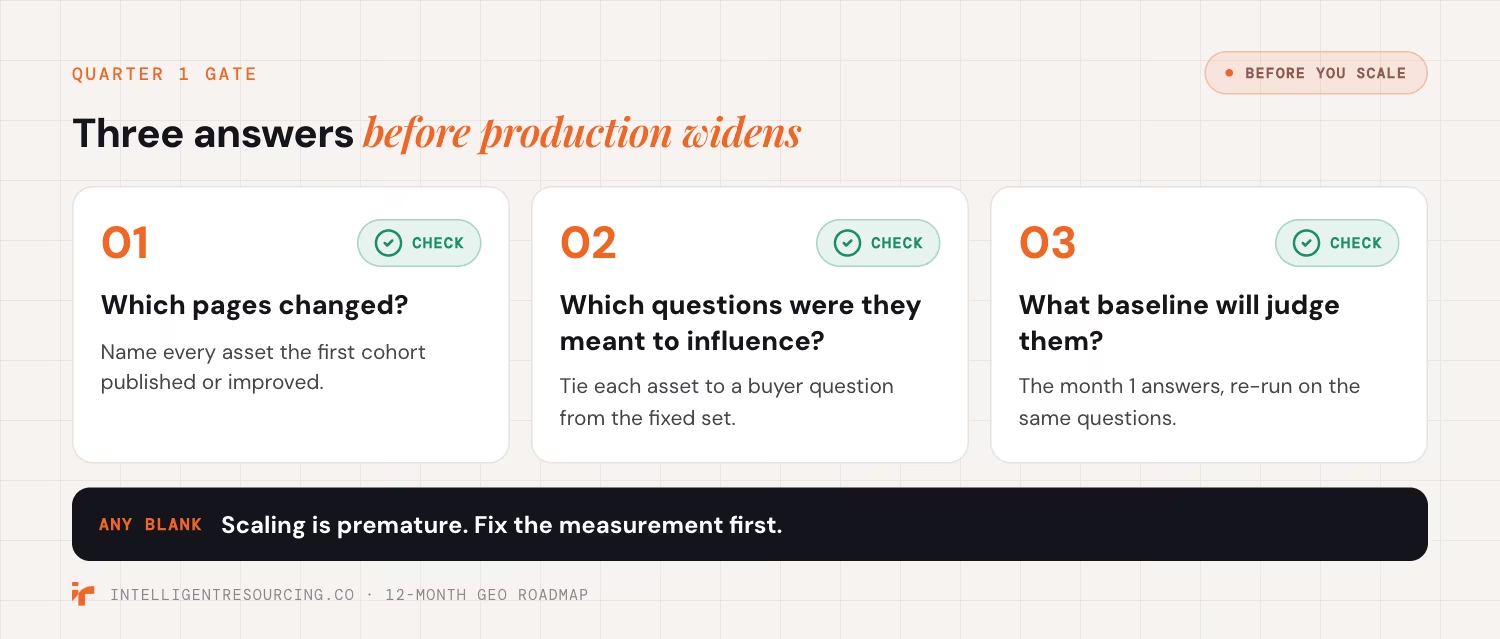
Quarter 1 ends with a simple gate. Can the team state which pages changed? Can it name the questions they were meant to influence and the baseline that will judge them? If not, scaling is premature.
Months 4 to 6: Turn Source Selection Into Feedback
In the second quarter the roadmap stops looking like an editorial calendar. Publishing and traffic are no longer the question.
Inspect what happened inside the answers. A page can be cited, named indirectly or absent. It can win on 1 engine and lose on another. It can also appear for educational questions and stay absent from evaluation queries.
Month 4: Observe before reacting
Do not rewrite a page just because it earned no citation right away. No reliable evidence supports a fixed time window. Short-term absence alone does not diagnose failure.
Use the baseline to record movement instead. Google now provides a Generative AI performance report in Search Console. It shows impressions from AI Overviews and AI Mode by page, country and date.
Google says it rolled these insights out to all websites worldwide as of 31 August 2026. Sites with too few AI impressions may not see a report.
Microsoft's Bing Webmaster Tools also reports AI visibility. Its AI Performance report launched in public preview in February 2026. It shows where content is cited across Microsoft Copilot, Bing and partner AI tools.
Month 5: Diagnose the reason for weak selection
Weak performance has different causes. Each needs a different response. A page with good evidence but poor access needs one fix. An open page that adds nothing new needs another.
Use month 5 to separate the causes. They include access problems, weak evidence, poor question fit, shallow supporting coverage and too little observation time. The aim is diagnosis. Cosmetic rewriting solves none of these problems.
Month 6: Make the first allocation decision
Every first-cohort asset moves into 1 of 3 states.
| Decision | When it applies | What happens next |
|---|---|---|
| Scale | The asset or cluster is producing useful selection signals | Extend adjacent coverage and reinforce what is working |
| Repair | The commercial question still matters but a correctable weakness is visible | Fix the evidence, access, structure or supporting coverage |
| Stop | The opportunity is weak, repeatedly unproductive or no longer commercially useful | Reallocate effort elsewhere |
This scale, repair or stop gate stops the original content calendar from becoming a sunk-cost commitment.
Months 7 to 9: Scale What the Evidence Supports
By the second half of the year the team knows more than at launch. The roadmap should change because of it.
Month 7: Expand clusters that have earned further investment
If several assets around 1 buying decision begin to appear, expand into the adjacent questions needed to deepen that coverage. This is the point where topical authority for AI engines becomes an investment decision. It stops being a reason to produce a large cluster in advance.
The key is sequence. Build depth where the first cohort shows the subject is worth owning. Treat each theoretical fan-out question as optional until data supports it.
Month 8: Strengthen the proof layer
Look at what the selected sources have that your weak assets lack. They may hold clearer methodology, original data, customer evidence or useful comparisons. Another generic explainer will not close that gap.
Month 8 should therefore focus on evidence assets. Depending on the question, that can mean a case study, first-party benchmark, transparent process or detailed comparison. Ask what would make the answer more defensible. Ask that before asking what to publish next.
Month 9: Return to the first cohort
Revisit the assets changed in quarter 1. Update claims, evidence and internal support where needed. Check whether visibility has spread across the topic or depends on 1 successful page.
Freshness tools can help engines find updates. Microsoft's IndexNow lets publishers tell participating search engines when a URL is added, updated or deleted. Microsoft states that submission does not guarantee crawling or indexing, as the IndexNow documentation explains.
Faster notification is useful operationally. Do not report it as guaranteed retrieval or citation.
Months 10 to 12: Consolidate What the Programme Has Proved
The final quarter is the wrong time to publish everything left on the original roadmap. The programme should now behave like a portfolio.
Month 10: Rebalance resources
Separate work that performs from work that is only planned. If a question has weak commercial value, stop. If repeated intervention has produced no signal, stop. Sunk effort is no reason to continue.
Check whether the strongest gains sit in a few page types, topics or evidence formats. Those patterns should shape the final 2 months.
Month 11: Audit the decision stage
A GEO programme can look healthy and still be absent from the questions nearest a buying decision. Review comparison, fit, risk, implementation, proof and vendor-selection questions. Keep them separate from educational visibility.
Say the brand is cited for definitions but vanishes when a buyer asks which option to choose. The rollout has built awareness without decision-stage influence. Month 11 should fix that imbalance. Add coverage where buyer consequences are highest.
Month 12: Re-baseline the programme
Run the same core question set used at the start of the year. Compare the new answers with the original baseline. Keep the set fixed, because visibility moves on its own.
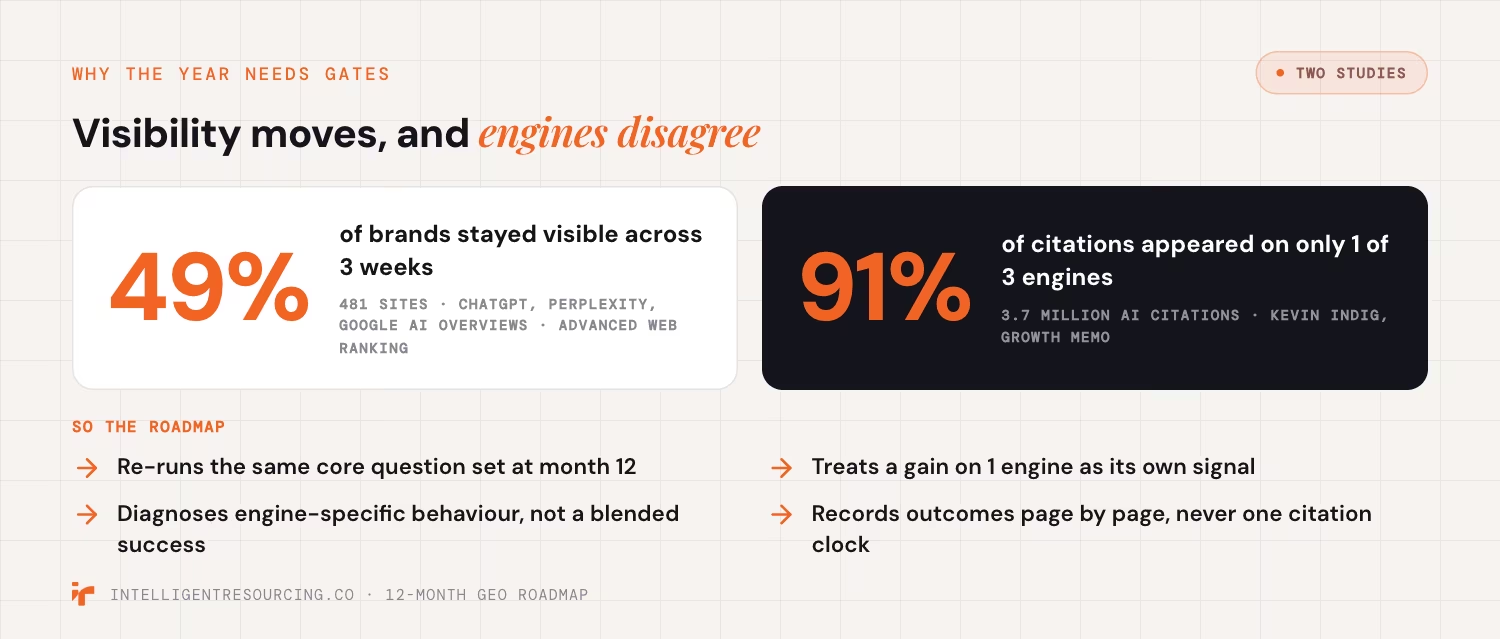
Advanced Web Ranking's 481-site volatility study found that only 49% of brands stayed visible across 3 weeks. It covered ChatGPT, Perplexity and Google AI Overviews. Its sites were in finance, education, health and software as a service (SaaS).
The review should show which clusters gained visibility and which pages became sources. It should show where rivals still dominate. It should also show which interventions changed nothing.
The next rollout plan should come from those observations. Do not copy the first year's calendar.
Month 12 ends the year and starts the next. Here GEO stops being a planning hypothesis. It becomes a budget decision informed by a year of evidence.
What Should Make You Change the GEO Rollout Plan Early?
A roadmap creates sequence. It should still leave room to respond to evidence. Change the programme when observed behaviour contradicts the original assumption.
| Signal | Response |
|---|---|
| Pages begin earning citations | Expand adjacent questions and reinforce the evidence supporting them |
| Brand is named but pages are rarely cited | Investigate third-party corroboration, source authority and page-level evidence |
| Pages remain absent across engines | Re-check access, relevance, evidence and whether the opportunity was genuinely winnable |
| One engine improves while others do not | Diagnose engine-specific behaviour rather than reporting a blended success |
| Traffic rises but AI presence does not | Avoid attributing the traffic gain to GEO without stronger evidence |
| High-intent questions remain weak | Shift resources from low-value informational coverage towards decision-stage gaps |
Engines also disagree. Kevin Indig's study of 3.7 million AI citations found that 91% of citations appeared on only 1 of ChatGPT, Perplexity and Google AI Overviews. That is why the table treats a gain on 1 engine as its own signal.
The calendar exists to make evaluation disciplined. A strong GEO implementation timeline says when to review evidence. It also gives the team permission to stop, repair or scale before the year ends.
What Does a Good GEO Rollout Plan Manage?
A good GEO rollout plan manages learning velocity. Publishing velocity matters less.
The team needs consistency to know what changed. It needs patience to avoid declaring a page dead too early. It also needs discipline to stop funding work that produces no signal.
Timing differs page by page. The value comes from recording outcomes, comparing them and using the difference to decide what happens next.
That is why the annual roadmap and the wider B2B GEO strategy belong together. The strategy defines the content, citation, authority and technical system. The roadmap sets the order in which those parts are built, tested and funded.
If GEO is already on the agenda but the team does not know what quarter 1 should contain, book a GEO strategy session with Intelligent Resourcing to turn the current answer gaps into an implementation sequence.
Content Creation
To turn your current AI answer gaps into an implementation sequence, book a GEO strategy session with Intelligent Resourcing.
FAQs
How long does GEO take to work?
There is no reliable universal time to first citation. Timing differs by page, so measure it by cohort and do not turn it into a fixed promise.
What should happen in the first 3 months of GEO?
The first quarter should set the AI visibility baseline and check technical access. It should rank the answer gaps that matter commercially and launch a controlled first cohort. The aim is a measurable programme before production scales.
When should a GEO programme scale content production?
Scale when the first cohort shows which topics, asset types or proof formats deserve further investment. Increasing production before that learning exists can multiply the wrong approach.
How often should GEO performance be reviewed?
Monitoring can run continuously, but resource decisions benefit from defined gates. A quarterly scale, repair or stop decision gives enough structure. It avoids reacting to every short-term swing. It still lets the programme change during the year.
Should GEO replace the existing SEO roadmap?
No. GEO should run alongside the search foundation. Discoverability, indexation, authority and useful content still decide whether a page can enter the candidate set. GEO adds the work needed to compete for selection inside generated answers.