

How Do You Measure GEO ROI?
Measure GEO ROI by comparing the gross profit attributable to AI-driven enquiries with the full cost of the programme. AI visibility shows whether a brand appears in relevant answers. Analytics and customer relationship management (CRM) records show which enquiries become profitable customers.
The formula is:
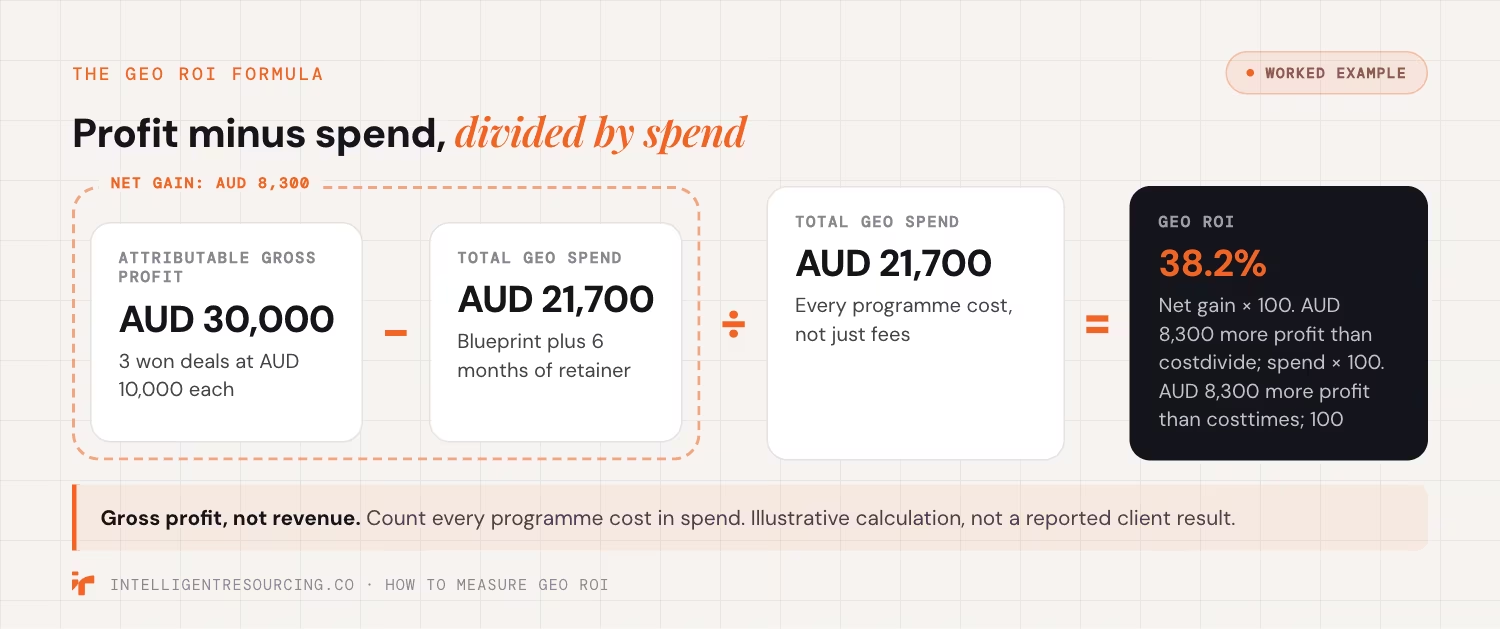
GEO ROI (%) = [(Attributable gross profit − Total GEO spend) ÷ Total GEO spend] × 100
For example, a B2B company invests AUD 21,700 (Australian dollars) in a 6-month GEO programme. The programme is credited with 3 won deals, each earning AUD 10,000 in gross profit:
GEO ROI = [(AUD 30,000 − AUD 21,700) ÷ AUD 21,700] × 100 = 38.2%
The company earned AUD 8,300 more in attributable gross profit than the programme cost. This is an illustrative calculation and no reported Intelligent Resourcing client result. It assumes all 3 deals meet the company's attribution rules and that AUD 21,700 covers every programme cost.
To reproduce the calculation, record 5 inputs:
- Total programme expenditure: Agency fees, audits, software and internal delivery costs.
- AI visibility: Named, linked or absent brand appearances, split by prompt type, service line and engine.
- AI-originated enquiries: Identifiable referrals and self-reported AI discovery recorded in the CRM.
- Attributable gross profit: Gross profit from closed-won deals credited to GEO under a consistent attribution policy.
- Time to payback: The month when cumulative attributable gross profit meets or exceeds cumulative programme spend.
The B2B GEO playbook explains how content, citation signals and AI discovery work together. Being cited differs from earning profit, and ROI becomes measurable only when discovery signals connect to financial outcomes.
Is GEO Worth It?

GEO is worth the investment when relevant buyers use AI tools to research your category, your brand has a measurable visibility gap and the gross profit from new customers can justify the full cost. It is harder to defend when the sales cycle outlasts the investment horizon or enquiries cannot be traced to a source.
Before committing, answer 3 questions:
- Are buyers asking about your category? Test relevant commercial questions across the AI engines your customers use. Record which brands appear and where yours is absent.
- How many deals would repay the investment? Divide the total programme cost by the expected gross profit per won deal, then round up. A 6-month programme costing AUD 21,700 needs 3 deals earning AUD 10,000 gross profit each to break even.
- Can the business track opportunities to revenue? Review analytics, enquiry forms and CRM records before expecting a reliable ROI report.
Click volume is an incomplete indicator. A Pew Research Center study of Google AI summaries found that users clicked links inside those summaries in just 1% of visits where one appeared. The finding covers Google searches in its United States (US) study sample and says nothing about the conversion rate or return of GEO programmes.
The test is whether the programme creates opportunities that become profitable customers within an acceptable payback period.
How Much Does Generative Engine Optimisation Cost?
The cost of GEO covers the initial assessment, ongoing optimisation, software and internal delivery time. For ROI, use the full investment across the measurement period and include more than the monthly retainer. A programme looks more profitable than it is when part of its spend is left out.
Intelligent Resourcing's Strategic Blueprint costs AUD 2,500 plus goods and services tax (GST), one-off, and every engagement starts with it. Cited-Core starts at AUD 3,200 a month plus GST. Cited-Scale starts at AUD 3,700 a month plus GST. Ask any provider for its minimum term in writing, because the term sets the size of the commitment.
If your quote has a 6-month term, the starting commitments are:
| Programme | 6-month commitment, including Blueprint |
|---|---|
| Strategic Blueprint + Cited-Core | AUD 21,700 |
| Strategic Blueprint + Cited-Scale | AUD 24,700 |
These amounts exclude software and internal costs. Use ex-GST figures where GST is recoverable.
The GEO monthly cost breakdown explains the relationship between retainer fees, asset volume and programme scope. For ROI, add any software licences, internal staff time, external production expenses and other incremental costs before calculating return.
How Do You Measure AI Visibility?
Measure AI visibility by testing a fixed set of buyer questions across relevant AI engines and recording whether your brand is present or absent. Record named mentions and visible source links separately. Neither one proves that an answer led to an enquiry or a commercial outcome.
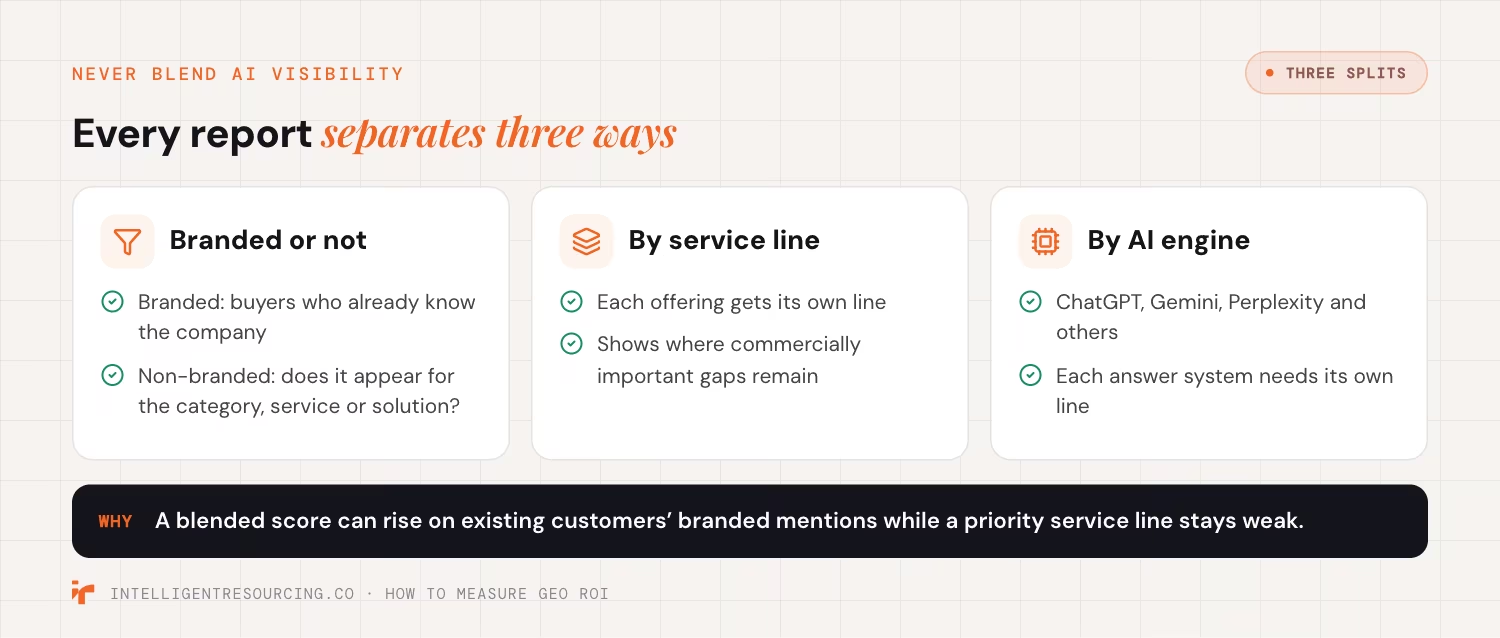
Intelligent Resourcing never publishes one blended AI-visibility number. Every report separates:
- Branded and non-branded prompts. Branded questions test visibility among buyers who already know the company. Non-branded questions show whether the company appears when buyers search for a category, service or solution.
- Individual service lines. Splitting offerings shows where visibility is strong and where commercially important gaps remain.
- Individual AI engines. ChatGPT, Gemini, Perplexity and other answer systems each need their own line.
A blended score can rise because existing customers mention your brand more often, even while non-branded visibility in a priority service line stays weak.
What Today's AI Visibility Tools Can and Cannot Show
AI answers are an unstable layer. Responses can change between runs, and a brand that appears today can vanish tomorrow. Dated, repeated observations beat a single screenshot or a headline score.
| Measurement | What it establishes |
|---|---|
| Brand named in a sampled response | Observed brand presence |
| Brand linked as a source | Observed citation presence |
| Branded and non-branded coverage | Where visibility occurs within the tested questions |
| Service-line and engine breakdown | Where visibility gaps are concentrated |
| Accuracy of the AI's description | Needs separate validation beyond presence and absence |
| Role of the brand within the answer | Needs contextual assessment beyond a mention count |
| Revenue earned from appearing in an answer | Cannot be established from visibility tracking alone |
As at 15 October 2026, Intelligent Resourcing measures the presence or absence of brands in AI answers, including observable naming and citation signals. Its measurement says nothing yet about whether an answer is accurate or whether a brand was recommended or merely mentioned.
Microsoft's post introducing AI Performance in Bing Webmaster Tools shows the same limit. Its citation metrics show how often pages are cited. They give no ranking, authority or role for a page within an individual answer.
How Do You See ChatGPT Traffic in Google Analytics?
You can identify some ChatGPT traffic in Google Analytics 4 (GA4) by reviewing session sources and referrals. Look for visits tagged chatgpt.com, then examine the landing pages, engagement and enquiries linked to those sessions. This covers 1 engine and only the clicks, so mentions without a click stay invisible.
For a practical setup:
- Review session sources in GA4. Examine Session source / medium and find the recorded AI referrals.
- Group identifiable AI referrals. Create a consistent segment for sources such as ChatGPT and Perplexity. Validate each source before including it.
- Track enquiry conversions. Link form submissions and other conversion events to the recorded visit where attribution data exists.
- Preserve source information in the CRM. Record the original source, landing page and enquiry date against the contact or opportunity.
- Ask how buyers found the business. Add a self-reported source field with an option such as "AI assistant" beside search engines, referrals and other channels.
Google's GA4 traffic-source documentation explains how sources, mediums and session attribution are recorded. Referral reports capture identifiable visits only, so they miss the buyer who reads an AI answer and later searches your brand directly.
OpenAI's publishers and developers FAQ says publishers who allow OAI-SearchBot can track referral traffic from ChatGPT in analytics platforms, and that ChatGPT adds the parameter utm_source=chatgpt.com to its referral links. It gives no figure for how many answers lead to a click.
Crawler access and referral traffic are different signals. Allowing a crawler does not show that a page was cited or that a visitor arrived.
Self-reported discovery fills part of the gap. A buyer may remember only the last source they used, or may have met the brand through several channels. Use identifiable referrals and declared sources together, and keep their different levels of evidence apart.
How Do You Track AI Citations?
Track AI citations with a fixed set of commercially relevant questions, a dated baseline and a consistent testing method. The aim is to spot directional changes in brand presence, and 1 AI response gives no permanent ranking. Start with 15 to 30 buyer questions across the services and buying decisions that matter.
Record this for each observation:
| Field | What to record |
|---|---|
| Buyer question | The exact prompt tested |
| Prompt category | Branded or non-branded |
| Service line | The offering or commercial category |
| AI engine | The platform tested |
| Observation date | When the test was run |
| Brand presence | Named, linked or absent |
| Source page | The cited uniform resource locator (URL), where one is visible |
Repeat the checks on a consistent schedule and keep the same prompt set, engine roster and testing conditions. If the questions or conditions change, note the change and avoid treating the new result as a directly comparable continuation.
Google's generative AI performance report in Search Console is another source of evidence. It reports impressions for supported Google AI search features, including AI Overviews and AI Mode. These are impressions of links shown to users, and they give no universal measure of how often an AI engine recommends a brand.
Keep platform impressions and your own prompt observations apart. They use different collection methods and should never merge into 1 visibility score.
Changes in citations can point to better discovery coverage. Only downstream commercial evidence shows whether that coverage produced profitable business.
How Do You Attribute Revenue to GEO Without Double-Counting?
Attribute GEO revenue by connecting identifiable AI discovery to CRM opportunities and their financial outcomes. B2B buyers use many channels before they buy, so not every deal an AI assistant touched counts as GEO-sourced. Sort opportunities into 4 categories and agree the rules before reporting results.
| Attribution category | Evidence | ROI treatment |
|---|---|---|
| Confirmed AI-sourced | Identifiable AI referral connected to the original enquiry and opportunity | Eligible for primary GEO ROI reporting under the agreed rules |
| Self-reported AI discovery | Buyer names an AI assistant as a discovery source | Report separately or include under a disclosed attribution policy |
| AI-assisted | AI was involved, and another source originated the opportunity | Report as influenced and keep its gross profit out of sourced ROI |
| Unattributed | No reliable evidence connecting discovery to GEO | Exclude from attributable GEO ROI |
The CRM should keep the enquiry's original source, self-reported discovery source, opportunity identifier, close date and gross-profit value. Agree the attribution rule before reporting results.
Consider a buyer who finds a company through ChatGPT, later searches its brand on Google and eventually submits an enquiry. If the original AI referral can be linked to the opportunity, it can qualify as AI-sourced under the agreed policy. If the company only knows that the buyer used ChatGPT at some point in an established sales conversation, report the opportunity as AI-assisted. Giving AI and another channel full credit for the same deal inflates the return.
Use realised gross profit for realised ROI. If a newly signed contract will earn profit over several years, report that amount as forecast gross profit until it is earned.
A defensible GEO report keeps confirmed sourced outcomes, self-reported discovery, assisted opportunities and unverified influence in separate lines.
What Is a GEO Payback Period?

A GEO payback period is the time it takes for cumulative attributable gross profit to equal or exceed cumulative programme spend. It depends on total programme cost, gross profit per attributable won deal and the time needed to earn that profit. Visibility metrics cannot show it, because only financial return recovers the investment.
Take Intelligent Resourcing's published starting prices: a Strategic Blueprint at AUD 2,500, then Cited-Core at AUD 3,200 a month or Cited-Scale at AUD 3,700 a month, all excluding GST. If your quote has a 6-month term, the starting commitments are AUD 21,700 for Blueprint plus Cited-Core and AUD 24,700 for Blueprint plus Cited-Scale, before software and internal costs.
How Many Won Deals Does GEO Need to Break Even?
These figures are illustrative. Replace the assumed deal values with your own gross-profit figures.
| Gross profit per won deal | Deals to repay Blueprint + 6 months Cited-Core (AUD 21,700) | Deals to repay Blueprint + 6 months Cited-Scale (AUD 24,700) |
|---|---|---|
| AUD 5,000 | 5 | 5 |
| AUD 10,000 | 3 | 3 |
| AUD 25,000 | 1 | 1 |
| AUD 50,000 | 1 | 1 |
When Does the Programme Actually Pay Back?
The break-even deal count shows how many deals repay the cost and says nothing about when the return arrives.
Assume a 6-month Cited-Core programme costing AUD 21,700 earns 3 attributable deals. Each adds AUD 10,000 in realised gross profit, at different times:
| Month | Cumulative spend | Cumulative gross profit | Net position |
|---|---|---|---|
| 6 | AUD 21,700 | AUD 10,000 | −AUD 11,700 |
| 7 | AUD 21,700 | AUD 20,000 | −AUD 1,700 |
| 8 | AUD 21,700 | AUD 30,000 | +AUD 8,300 |
In this hypothetical case, payback arrives in month 8 and ROI at that point is 38.2%. The example assumes no GEO spend after the first 6 months and that the gross profit has been earned.
A longer B2B sales cycle or delayed profit recognition pushes payback later. One high-margin deal can recover the investment sooner.
Agree a measurement window before signing, because a programme judged at 3 months can show credible opportunities without having finished a sales cycle. A positive visibility trend shows progress. Payback arrives only when attributable gross profit has recovered the investment.
Check Your AI Visibility Before You Commit
Find out where your brand is missing from AI answers and whether the gaps are worth fixing before you commit to a retainer.
Content Creation
Find out where your brand is missing from AI answers and whether the gaps are worth fixing before you commit to a retainer.
FAQs
How do you calculate GEO ROI?
Subtract total GEO spend from attributable gross profit, divide by total spend and multiply by 100. Include the full cost of the engagement and apply a consistent attribution policy to decide which gross profit counts. Report forecast returns separately from realised results.
Is GEO worth it for a B2B company?
GEO can be worth it when buyers use AI tools to research your category, visibility gaps exist and the expected gross profit from new customers justifies the programme cost. Test the case against your sales cycle and your ability to track enquiries to their source before you commit.
What is a good GEO payback period?
There is no universal benchmark. A good payback period fits the company's sales cycle, cash-flow needs and acquisition economics. Work out when cumulative attributable gross profit should recover cumulative spend, then compare that expectation against actual results.
Can you measure whether AI describes your brand correctly?
Presence and citation tracking cannot show whether an answer is accurate or what role a brand plays in it. As at 15 October 2026, Intelligent Resourcing measures observable presence and absence, including named and linked mentions. Checking accuracy and recommendation context needs separate validation by reading the answers.
What does GEO cost?
Intelligent Resourcing's Strategic Blueprint costs AUD 2,500 plus GST, one-off, and every engagement starts with it. Cited-Core starts at AUD 3,200 a month plus GST, and Cited-Scale starts at AUD 3,700 a month plus GST. Ask any provider for the minimum term in writing, and add software and internal costs to the total.