

What Changes When Content Marketing Adds GEO?

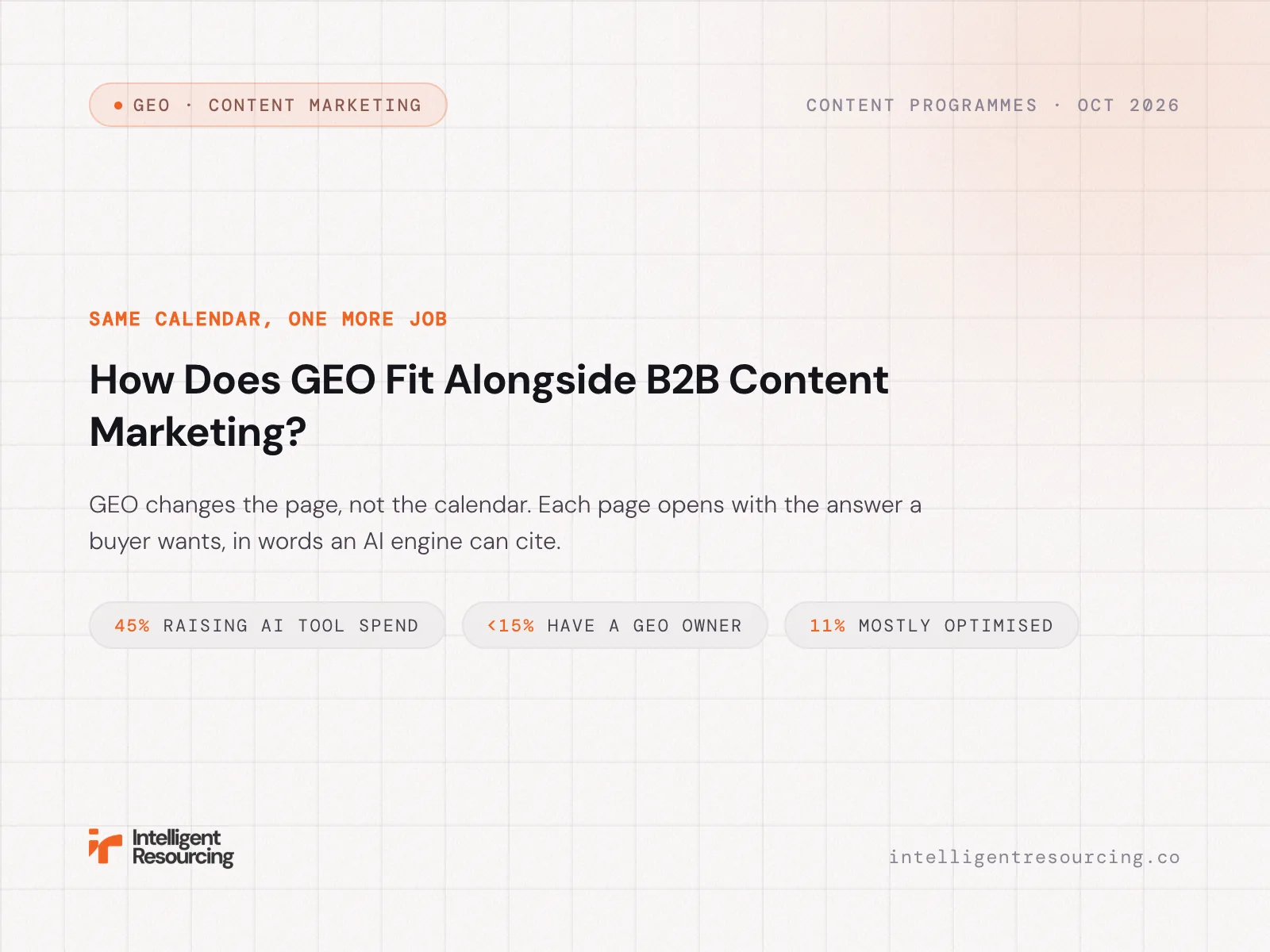
Generative engine optimisation (GEO) changes the page, not the calendar. The team still plans around buyer questions and funnel stages. Each page now opens with its answer, in wording an artificial intelligence (AI) engine can lift out and cite.
Content Marketing Institute's 2026 research found business-to-business (B2B) marketers most often plan to raise investment in AI-powered tools, at 45%. GEO gives part of that spend a specific job.
Three structural changes do most of the work:
- Answer first: each section states the answer before any supporting detail.
- Named facts: figures and sources replace adjectives wherever a claim can be specific.
- Schema markup: structured data labels the page so an engine can read it without guessing.
None of this asks a content team to write more. It asks the same content to open with the answer. Our generative engine optimisation service covers the page-level mechanics.
Who Should Own GEO in a Content Team?
No single function owns GEO yet. GNW and Demand Metric's 2026 State of GEO survey found fewer than 15% of companies have a dedicated GEO role that sets strategy and targets. Marketing Operations leads most of the activity alongside content, search and brand teams. No function has emerged as the clear owner.
In our view, a content lead who already owns the calendar and the buyer questions is the natural owner of GEO structure. It adds a review step to the brief, not a new hire.
| Situation | Likely owner |
|---|---|
| The content lead owns the calendar and buyer questions | The content lead adds a GEO check to the brief |
| Marketing operations runs tools and tracking | Operations tracks citation, and the content lead owns page structure |
| Little published content | No GEO owner yet, so build coverage first |
How Does Question Mining Change the Content Brief?

A keyword brief asks what the audience searches for. A question-led brief asks what the buyer needs answered before signing, and the page answers it in its first paragraph.
TrustRadius's 2025 buyer survey of 2,058 technology buyers found 49% named transparent pricing as the one thing they would change about buying software. Sales calls surface questions like this long before a keyword list does.
Our guide to question mining for AI search covers the full workflow and sources.
Each line in the brief carries three things:
- The buyer's question: worded the way the buyer asks it.
- The answer position: the first paragraph of the section it belongs to.
- The evidence: a named figure or source a reader can check.
What Order Should You Reshape Existing Pages In?

Start with the pages the sales team already sends to buyers. Then reshape pricing and comparison pages, where buyers expect a direct answer. Pages ranking on page one for commercial searches come next, and everything else follows by traffic.
10Fold's 2025 survey of B2B marketers across four countries found 93% are developing or testing AI-optimised content. Only 11% have 75% to 100% of their content optimised for AI search. The gap sits in shaping existing content, not producing new content.
- Sales-linked pages: buyers already read them, so a clearer answer pays off fastest.
- Pricing and comparison pages: the questions an engine is most likely to be asked.
- Page-one commercial pages: proven demand, and a result the team has already earned.
Reshaping only works where coverage exists around the page. Our guide to which discipline comes first sets out the thresholds for when an archive is ready.
How Do You Measure GEO Inside a Content Programme?

Measure in two layers. Traffic and rankings show how pages do in classic search. Citation rate and named brand share show whether AI engines choose to use them.
Google's own reporting blends the two. It added a dedicated generative AI view in Search Console in June 2026, yet those impressions still count inside the overall performance totals. A content team needs its own view of citation beside it.
| What to track | What it tells the team |
|---|---|
| Organic traffic and rankings | Whether the page still works in classic search |
| Citation rate by engine | Whether ChatGPT, Gemini and Perplexity use the page |
| Named brand share | Whether the brand is named, not just cited |
| Repeat citation over time | Whether one win holds across new prompts |
Our guide to measuring GEO returns covers prompt sets, baselines and payback.
What Is the First Step for a Content Team?
Pick the ten pages your sales team sends most, and read how an AI engine answers the questions they target. That shows whether reshaping or new coverage comes first.
Find out how your current content reads to an AI engine. Scope an AI visibility check through our answer engine optimisation service.
Content Creation
Find out how your current content reads to an AI engine. Scope an AI visibility check with Intelligent Resourcing.
FAQs
Does GEO replace a content marketing strategy?
No. GEO adds a structural need to content a team already produces. The calendar, the buyer personas and the funnel stages stay the same. What changes is how each page opens and how clearly it answers its question.
Who should run GEO if we don't have a dedicated hire?
The content lead who knows the buyer's questions is a sensible starting owner. If marketing operations already runs tools and tracking, it can own citation tracking. Most companies fold GEO into existing roles, so a new hire is not needed first.
How much of our existing content needs rewriting for GEO?
Start with pages the sales team sends and the pricing and comparison pages, not the whole archive. Reshaping the highest-intent pages first shows results sooner than spreading effort evenly across everything published.
What should we check before investing in GEO?
Check whether the site has real topical coverage of its core subject. A thin archive reshaped for citation earns little trust from an engine. Build the coverage first, and write each new page answer-first meanwhile.
How should a content team brief freelance or agency writers for GEO?
Give them the buyer's question, the place the answer should sit, and one named figure or source to cite. Ask for the answer in the first paragraph of each section, and for evidence a reader can check. The brief changes, and the writer's job does not.