
How Do I Do B2B Market Research on a Small Budget?
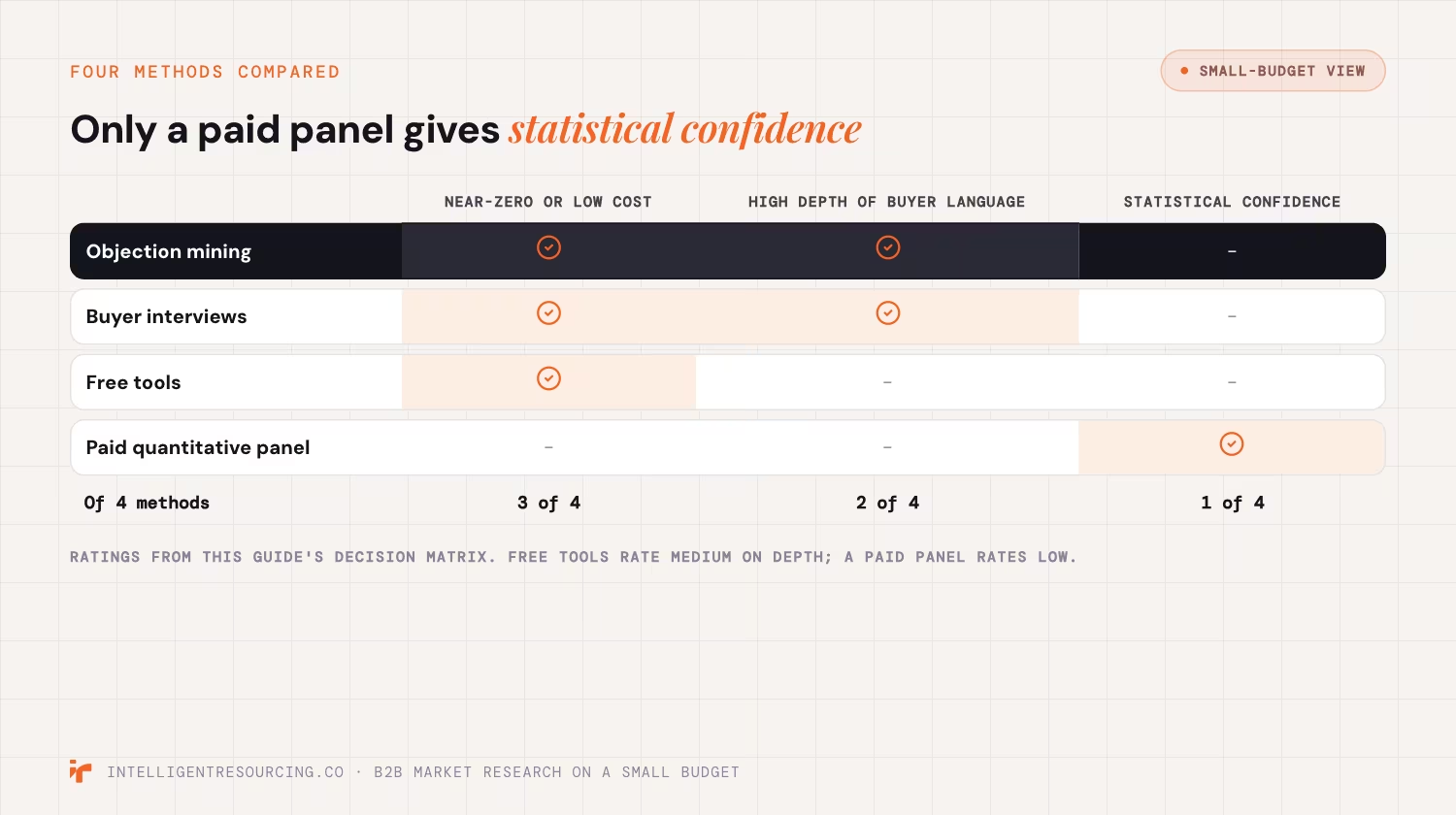
Start with conversations you already have, not surveys you have to commission. Every sales call holds the objections, hesitations and comparisons buyers raise before they decide.
This works because objections are not random. A buyer only raises a concern that matters to them. So you already know which questions to ask.
- Pull transcripts or notes from your last 15 to 20 sales calls
- Log every objection, hesitation or comparison a buyer raises, word for word
- Group them into 3 to 5 recurring themes
- Write short, direct answers to each theme and publish them as content

Question mining for AI search covers the next step: turning these objections into content that artificial intelligence (AI) search engines can lift directly. Which content types get cited is covered in content types that get cited in AI search.
Structured interviews fill the gaps a sales call cannot reach. On a call, a prospect is being sold to. They are not asked open questions about their situation.
What Are B2B Market Research Methods?
B2B market research methods split along two independent lines. Knowing both stops a small team from picking the wrong method for the question in front of them.
- How the data is collected: primary research, which you collect yourself, versus secondary research, which someone else published
- What kind of data it is: qualitative research, which captures words and reasons, versus quantitative research, which captures numbers and scale
- Named sub-categories: branding, customer, competitor and product research all sit on these same two lines, not as separate systems

A small-budget team rarely needs all of these at once. Most messaging and content decisions need only primary, qualitative research. Quantitative and secondary research earn their place only when the decision calls for a number or a pattern.
Once you publish these findings, this guide to measuring generative engine optimisation (GEO) return on investment (ROI) covers how to check whether the content earns citations, not just views.
What Is the Difference Between Primary and Secondary Research?
Primary research is data you collect yourself. Secondary research is data someone else collected and published. For a small budget, the difference is cost versus specificity.
| Primary research | Secondary research | |
|---|---|---|
| Who collects it | You, directly | Already published by someone else |
| Cost | Time, not money | Free or cheap |
| Specificity | Answers your exact question | Generic, industry-wide |
| Best used for | The question nobody else has asked about your buyers | Scoping the landscape before you commit time |
Business Wales's guide to market research, updated May 2026, makes the point simply. Secondary research is a great place to start, and primary research fills the gaps it leaves.
For a small budget, the order matters. Scope the market with secondary research first. Then spend limited primary-research time on what secondary sources could not tell you.
This scoping step is part of a wider content strategy system, not a one-off exercise.
When Should I Use Qualitative or Quantitative Research?
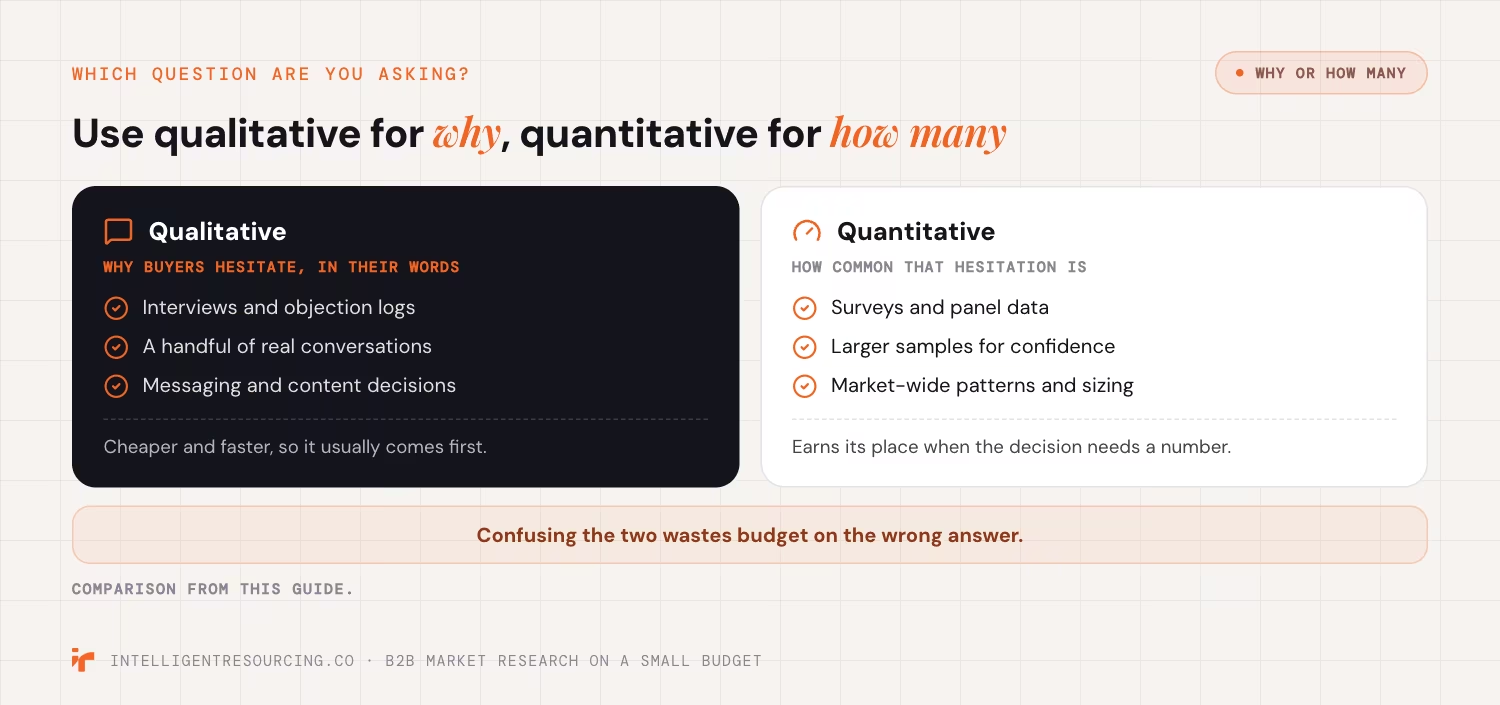
Use qualitative research when the question is why. Use quantitative research when the question is how many. Confusing the two wastes budget on the wrong answer.
| Qualitative research | Quantitative research | |
|---|---|---|
| Answers | Why buyers hesitate, in their own words | How common that hesitation is |
| Format | Interviews, open-ended objection logs | Surveys, panel data |
| Sample size | Small, a handful of real conversations | Larger, for statistical confidence |
| Best for | Messaging and content decisions | Market-wide patterns and sizing claims |
Greenbook's 2026 GRIT Insights Practice Report, published in June 2026, tracks the methods insights teams use.
For a small-budget team, qualitative research usually comes first. It is cheaper and faster. It is also closer to the real decision most teams are making: messaging or content, not a market-size claim.
How Do I Find Out What B2B Buyers Want?
Ask about a specific, recent decision, not a general opinion. Buyers rarely know what they want in the abstract. But they can describe exactly what happened last time they chose, delayed or rejected a vendor like yours.
This is the core move in jobs-to-be-done interviews. Reconstruct the moment a buyer switched or decided, not what features they wanted. The Clayton Christensen Institute explains why: people "pull" products and services into their lives to make progress, and demographics do not explain the choice.
- Ask what prompted them to start looking
- Ask what else they considered, and why it was ruled out
- Ask what almost stopped them from choosing
- Ask what they would have done if nothing had worked
Combine this with the objection log from your sales calls. The two sources check each other. A theme that shows up in both is a genuine pattern, not a one-off. Once confirmed, these patterns anchor a generative engine optimisation content plan.
Which Free and Low-Cost Research Tools Are Worth Using?
Free tools cover most of the directional research a small budget needs. The goal is to spot patterns, not a statistically valid number. The main categories are community platforms, search-behaviour tools and your own CRM data.
| Tool type | What it answers | Cost |
|---|---|---|
| Reddit and forums | Unfiltered buyer complaints and comparisons | Free |
| Review platforms (G2 and similar) | What buyers say after choosing a competitor | Free to browse |
| Search-behaviour tools | What buyers are actively searching for | Free tier available |
| Your own CRM notes | Recurring objections and lost-deal reasons | Already owned |
A 2026 market research tools roundup lists free-tier tools for startups, so check each vendor's current pricing. Many early-stage questions can be answered with free, public sources like these.
Intelligent Resourcing's guide to Reddit comment monitoring covers a related but distinct job. It turns the same raw community chatter into product insights, not published content.
Treat these tools as confirmation, not discovery. If a theme from your calls and interviews also shows up unprompted in a Reddit thread, that is a strong signal. If it only shows up once, treat it as a hypothesis, not a finding.
Content Creation
Turn the objections you have already logged into content buyers and AI search engines can find.
FAQs
How do I do B2B market research on a small budget?
Start with sales calls you already have. Log the recurring objections, group them into themes, then run a handful of structured buyer interviews to fill the gaps a sales call cannot reach. Both are free or near-free and answer your exact question rather than a generic one.
What are B2B market research methods?
Methods split along two lines: primary versus secondary (who collected the data) and qualitative versus quantitative (what kind of data it is). Most small-budget teams need primary, qualitative research first, and add the other types only when the decision calls for them.
How do I find out what B2B buyers want?
Ask about a specific past decision rather than a general opinion. What prompted them to look, what else they considered, and what nearly stopped them choosing at all. This is the jobs-to-be-done approach, and it works better than asking buyers to describe their wants in the abstract.
What are the 7 types of marketing research?
Common breakdowns list primary, secondary, qualitative, quantitative, branding, customer, competitor and product research, though the exact count varies by source. All of them sit on the same two underlying lines: how the data was collected, and what kind of data it is.
Which free or low-cost tools work for B2B market research?
Reddit and forums, review platforms, search-behaviour tools and your own CRM notes cover most directional research needs. Treat them as confirmation for patterns you have already found in calls and interviews, not as a starting point on their own.