

Why Isn't There One Best SaaS Content Type for AI Search?
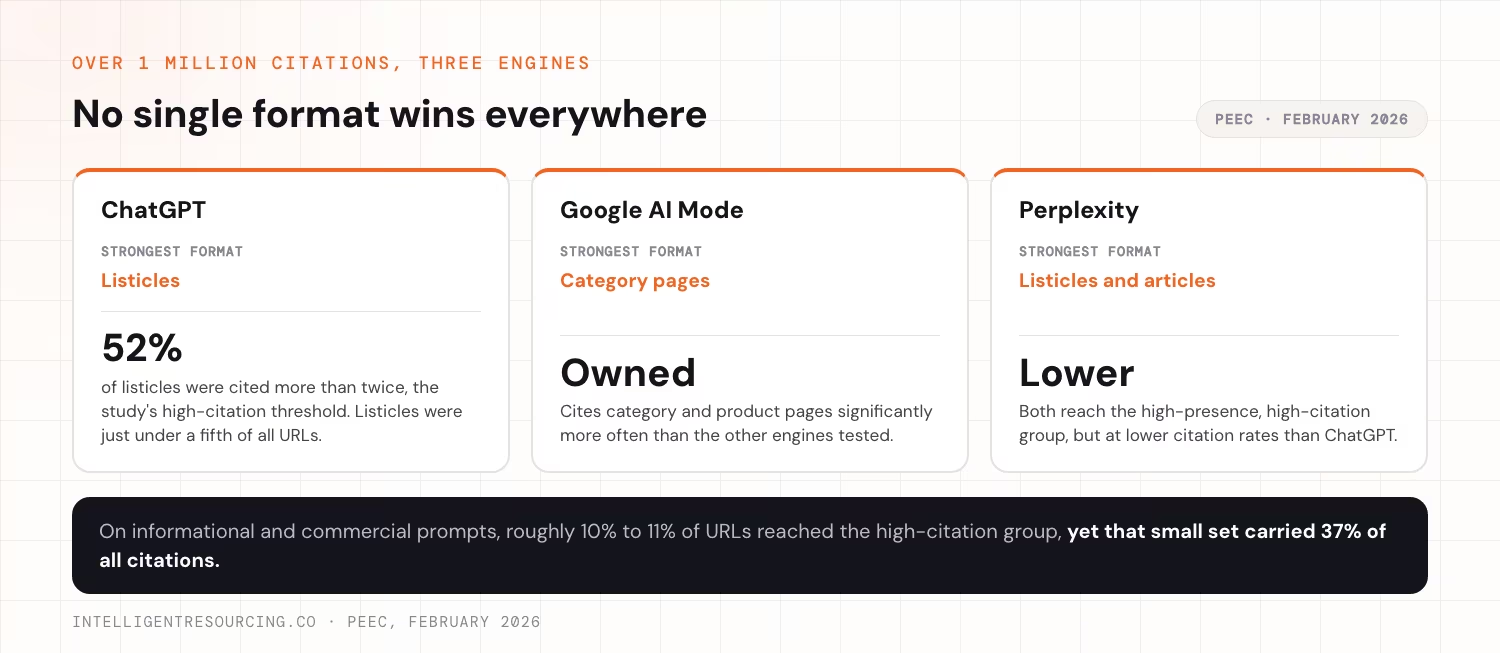
There is no single winning content format, because AI engines behave differently and buyer prompts require different evidence.
Peec analysed more than 1 million citations across ChatGPT, Google AI Mode and Perplexity, published in February 2026. In its qualifying dataset, 52% of ChatGPT listicles were cited more than twice, which is the threshold the study set for its high-citation group, and listicles made up just under a fifth of all the URLs it looked at. Google AI Mode behaved differently: category pages were its strongest qualifying format, and it cites category and product pages significantly more often than the other engines do. Perplexity put listicles and articles in its high-presence, high-citation group, though at lower citation rates than ChatGPT.
The same study found that informational and commercial prompts concentrate citations far more heavily than transactional and navigational ones. For those intents, only about 10% to 11% of URLs reached the high-citation group, but that small set accounted for 37% of all citations. That matters for SaaS, because product evaluation is full of commercial prompts: "best CRM for X", "Product A versus Product B", "alternatives to X" and "software for Y".
The practical lesson is not "publish more listicles". It is to match the page type to the job inside the prompt.
Why Do Comparison and List Pages Get Cited for Commercial SaaS Queries?
Comparison pages perform well because they already contain the decision structure an AI engine needs to answer a buyer choosing between products.
A buyer rarely asks only "What is project management software?". They are more likely to ask "Which project management platform is best for a 50-person consultancy that needs Microsoft Teams integration and single sign-on (SSO)?". That answer requires several products to be evaluated against the same criteria.
A useful comparison page makes those criteria explicit:
- Price and packaging: What does each product cost, and where do important features sit?
- Company fit: Is the tool built for startups, mid-market teams or enterprise buyers?
- Integrations: Does it work with the systems already in the buyer's stack?
- Security: Which authentication, access and compliance controls are available?
- Implementation: How difficult is migration, setup and adoption?
- Best-fit condition: Under what circumstances is one option stronger than another?
The format alone is not enough.
| Type | Example | Why it matters |
|---|---|---|
| Positioning | "Product A is the best choice." | Makes a claim without explaining when or why it is true. |
| Decision logic | "Product A fits smaller teams that need X, while Product B fits enterprises requiring Y." | Gives the AI engine clear conditions, trade-offs and best-fit criteria it can reuse in an answer. |
That second structure is more useful because it gives the engine a condition it can reuse.
The same principle behind structuring content for AI citation becomes especially important on comparison pages. Each comparison block should still make sense when retrieved without the paragraphs above it.
What Makes a SaaS Comparison Page Citable?
A comparison page becomes useful when factual differences are separated from marketing opinion.
An AI engine can verify:
- a published price,
- an integration,
- a plan limitation,
- an API capability,
- a security certification,
- an implementation requirement,
- or whether a feature is included in a specific tier.
Claims such as "most powerful", "easiest to use" or "best-in-class" are difficult to verify without supporting evidence. A stronger comparison uses explicit conditions instead. Rather than saying "Product A is better than Product B", explain that "Product A is better suited to teams that need X without an enterprise contract, while Product B becomes stronger when Y and Z are required." That gives the AI engine clear trade-offs and boundaries it can reuse, while making the comparison more credible to buyers.
Why Do Product and Category Pages Matter More in Google AI Mode?
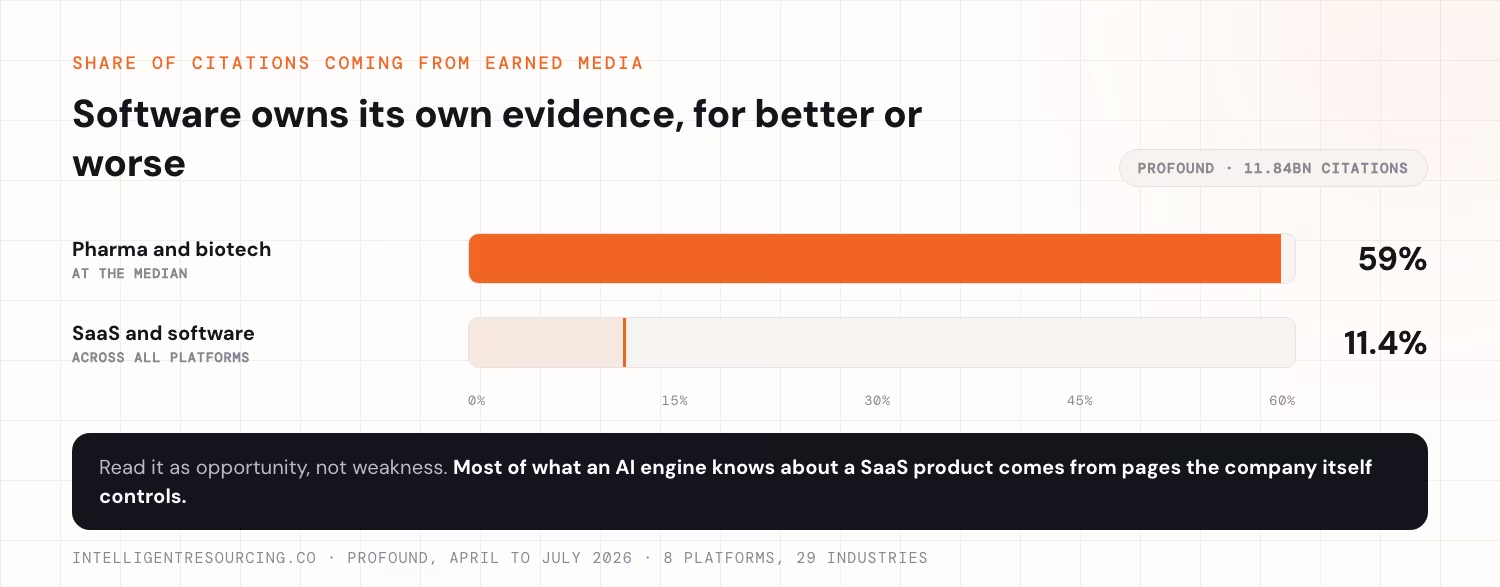
Product and category pages matter because Google AI Mode shows a stronger preference for official brand-owned sources than ChatGPT does. In the Peec data, category pages were the strongest qualifying content type in Google AI Mode, and it cited category and product pages significantly more often than the other engines.
For SaaS companies, that makes the core product layer unusually important. Profound analysed 11.84 billion citations across 8 AI platforms and 29 industries between April and July 2026. SaaS and software sat at the opposite end of the spectrum from sectors such as pharma and biotech: only 11.4% of SaaS and software citations came from earned media, against 59% at the median for pharma and biotech.
That does not mean third-party coverage is unimportant. It means SaaS companies have substantial opportunity to influence what AI engines understand through company-operated web properties.
A strong product page should state plainly:
- what the product is,
- who it serves,
- the problems it solves,
- its core capabilities,
- key integrations,
- important constraints,
- relevant security or compliance details,
- and where it fits within the broader category.
"An intelligent platform that transforms how modern businesses operate" is difficult to retrieve against a specific buyer question. "A workforce management platform for multi-site hospitality teams that combines scheduling, time tracking and payroll export" establishes product category, audience and function immediately.
That level of specificity makes the page more useful as evidence.
Why Does Product Documentation Matter for AI Citations?
Documentation becomes important when a buyer's question requires an exact technical fact. Product marketing can establish what a tool broadly does. Documentation can prove whether a feature works in a particular way.
Consider these prompts:
- Does this customer relationship management (CRM) tool support bidirectional Salesforce sync?
- Does the API have a request limit?
- Can users be provisioned through System for Cross-domain Identity Management (SCIM)?
- Is SSO included in the business plan?
- Can the product export data in a specific format?
- What permissions are available to contractors?
These are verification questions. An AI engine needs a precise source rather than a general benefits page.
Good documentation creates narrowly scoped, factual pages that match these questions directly. It also reduces the chance that an AI engine has to infer how a feature works from broad marketing copy. This is where product pages and documentation should work together: the product page establishes the claim, and documentation verifies it.
For SaaS teams, documentation should therefore be treated as part of the generative engine optimisation (GEO) content system rather than as a separate support asset.
Why Are Integration Pages Important for SaaS AI Search?
Integration pages answer constraint-based buyer questions.
These are often high-intent prompts:
- CRM that integrates with Xero and Slack
- Human resources software compatible with Microsoft Entra ID
- Project management platform with Jira migration
- Support software that connects to Salesforce
- Accounting platform with HubSpot integration
The buyer is no longer asking about the whole software category. They are asking whether a specific relationship between two systems exists. A dedicated integration page gives an AI engine a clear connection between those entities.
A useful page should state:
- what systems connect,
- what data moves between them,
- whether the sync is one-way or bidirectional,
- which plans support it,
- whether another connector is required,
- important limitations,
- and where setup instructions live.
Generic claims such as "integrates with your favourite tools" give an AI engine little to work with. Specific statements are more useful, such as "syncs HubSpot contacts and companies into Product X every 15 minutes on Business and Enterprise plans". The more detailed the buyer's prompt becomes, the more important focused integration content becomes, because it gives the engine a clear feature, system connection and plan-level condition to verify.
When Do Pricing Pages Become Citation Sources?
Pricing pages become useful citation sources when a buyer's question includes price, packaging or plan eligibility. A broad prompt such as "What is CRM software?" does not require pricing evidence, but "Which CRM includes SSO and automation for under £60 per user?" does. For those commercial queries, SaaS pricing pages should make plan costs, limits and feature availability visible in text or tables rather than hiding them behind tooltips, sales forms or interactive widgets.
| Information | Weak implementation | Stronger implementation |
|---|---|---|
| Starting price | Contact sales | Published starting price where commercially possible |
| Billing model | Unclear | Per user, account, workspace or usage |
| Plan limits | Hidden across interface elements | Visible by tier |
| Enterprise features | "Advanced features" | SSO, SCIM, audit logs and service level agreement named |
| Pricing freshness | No date or context | Current pricing clearly maintained |
Not every SaaS company can publish a fixed enterprise price. That does not prevent the business from explaining its pricing model, minimum commitments, feature boundaries or which plans require a custom agreement. The goal is to remove ambiguity where the buyer is actively comparing commercial fit.
Why Does Original Research Get Cited Differently?
Original research creates evidence that other content cannot reproduce independently. A comparison page helps an AI engine choose between options, while a research asset gives it a fact, benchmark or trend it can use to support the answer. For a SaaS business, that might mean original data on:
- implementation times,
- adoption patterns,
- productivity,
- churn,
- security incidents,
- workflow behaviour,
- support volumes,
- conversion benchmarks,
- or category-specific operational performance.
When Google published its guide to optimising for generative AI features in May 2026, it listed "guidance on the importance of providing valuable, unique, non-commodity content" first, alongside "information about why SEO best practices remain relevant and foundational to success with our generative AI features". Original data fits that model because it creates information gain. A payroll platform's hiring benchmark may support an answer about workforce trends, a cybersecurity vendor's dataset may support a question about phishing risk, and a customer-support platform's ticket data may support a benchmark on response times. In each case, the software company gains visibility because it owns the underlying evidence.
The Methodology Is Part of the Asset
A strong research page should state:
- Sample: Who or what was analysed?
- Period: When was the data collected?
- Method: How were the figures calculated?
- Population: What market, company size or geography does the finding represent?
- Limits: What should the reader not infer from the result?
A statistic without methodology is easy to repeat but harder to trust. A documented benchmark gives both human researchers and AI systems more context for attribution.
What Role Do SaaS Case Studies Play?
Case studies provide evidence that a product has worked in a specific business context. They may not be the highest-cited format across AI engines, but they answer an important middle-of-funnel question: has this worked for a company like mine? The strongest case studies make that proof easy to extract by showing:
- the customer's starting situation,
- the industry or company type,
- the problem,
- what was implemented,
- the timeframe,
- and the measured outcome.
A vague statement such as "Acme improved productivity with the platform" gives an AI engine little usable evidence. A specific result such as "Acme reduced average support resolution time from 11 hours to 7 hours within 4 months after migrating 120 agents onto the platform" provides a defined customer, intervention, timeframe and measurable outcome.
That makes the case study useful beyond the page itself. A product page can explain what the software does, while the case study provides evidence of what happened when a customer actually used it.
Do AI Engines Prefer Blogs or Commercial Pages?
AI engines do not consistently favour blogs over commercial pages. ChatGPT and Perplexity often surface listicles and articles, while Google AI Mode shows a stronger preference for category and product pages. For SaaS brands, that means the real issue is usually not content volume but content coverage across the buyer journey.
A "best CRM for agencies" article cannot compensate for an unclear product page. A product page cannot answer a detailed integration question if the documentation is missing. Documentation cannot prove return on investment if customer outcomes have never been published, and a comparison page cannot verify pricing when the pricing page itself is vague.
The goal is therefore not to publish more blog content by default. It is to build complete evidence around each buyer question, with the right page type supporting each part of the decision.
Why Does Semantic Relevance Matter as Much as Content Type?
A page can be the correct format and still fail to get cited if the engine does not recognise it as relevant to the question.
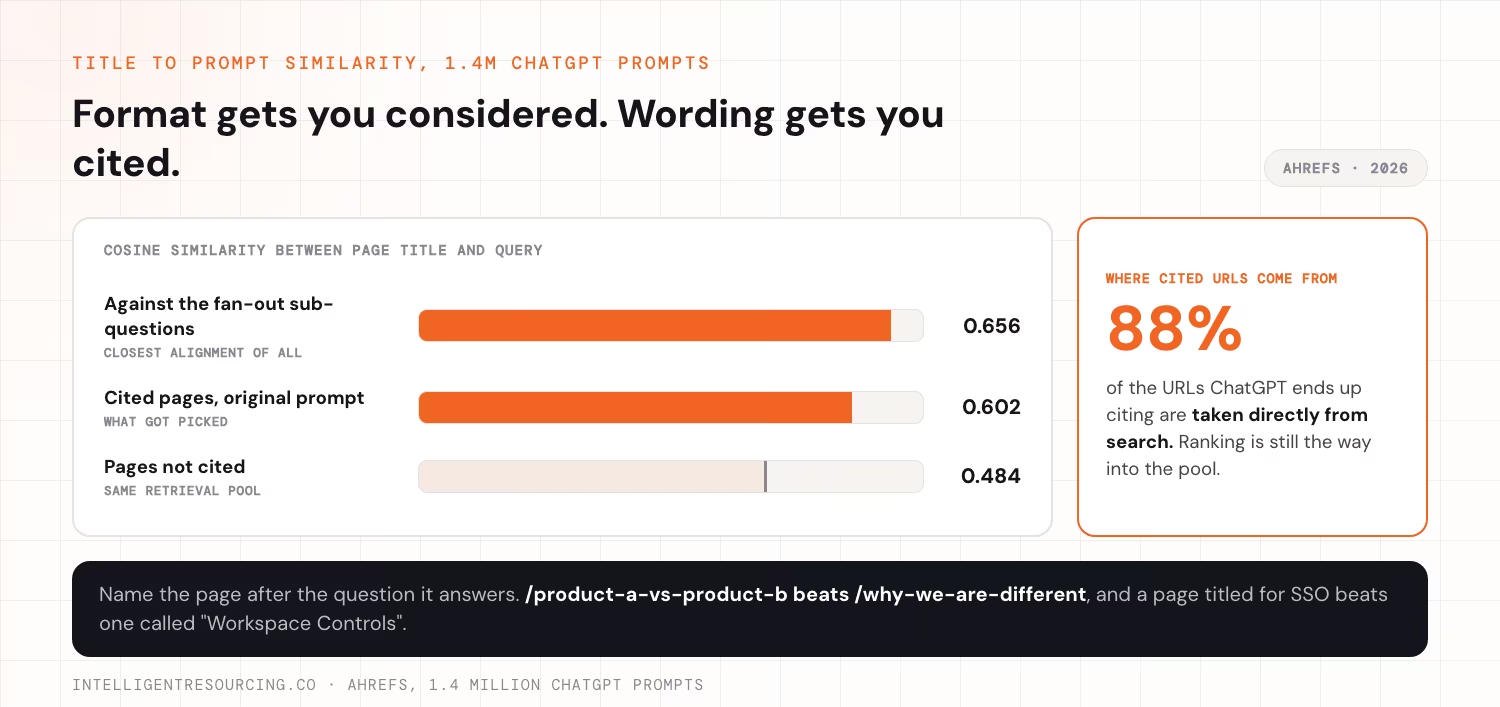
Ahrefs analysed 1.4 million ChatGPT prompts and found cited pages had consistently closer semantic alignment between their titles and the prompt, at a cosine similarity of 0.602 against 0.484 for pages that were not cited. Alignment was closer still against the fan-out queries ChatGPT generates around the original question, peaking at 0.656. The same analysis found 88% of the URLs ChatGPT ends up citing are taken directly from search.
That gives SaaS teams a practical rule. Name the page according to the question it actually answers. A path like /why-we-are-different is less explicit than /product-a-vs-product-b. A documentation page called "Workspace Controls" is less obvious for a question specifically about SSO than a clearly scoped page whose title names SSO.
The page type gets you into the right part of the conversation. Semantic clarity helps the engine understand which question that page answers.
The distinction between answer engine optimisation, GEO and traditional search engine optimisation matters here, because ranking and citation are connected rather than interchangeable. Search visibility helps a page enter the retrieval environment, while relevance and extractability affect whether that page becomes useful inside an answer.
How Should SaaS Pages Be Structured for Citation?
Structure each important SaaS page so its useful passages can stand alone when retrieved.
Use 5 rules:
- Answer first. Put the direct answer before background or explanation.
- Name entities precisely. Use exact product, plan, feature, integration and standard names.
- Keep claims focused. One paragraph should establish one main fact or relationship.
- Use structured comparisons. Put feature differences, plan limits and compatibility into text or tables rather than screenshots.
- Date volatile information. Pricing, features and integrations need clear maintenance, because they change.
The Ahrefs finding above is the reason. ChatGPT retrieves a far larger candidate set than it ultimately cites, and closer alignment with its generated sub-questions raised citation likelihood in the analysed data.
That makes the grounding chunk the useful unit. A passage about SSO should identify the product, plan and limitation inside that passage. It should not depend on 5 paragraphs above it to reveal which software is being discussed.
Does Schema Markup Help SaaS Pages Get Cited?
Schema can clarify what a page contains, but it does not create an AI citation on its own.
Google's own documentation on AI features is direct about this: "There are no additional technical requirements", and "You don't need to create new machine readable files, AI text files, or markup to appear in these features. There's also no special schema.org structured data that you need to add." What a page does need is to be indexed and eligible to be shown with a snippet. Google's other two recommendations are making sure important content is available in textual form, and making sure structured data matches the visible text on the page.
For SaaS pages, schema should therefore describe information that is already accurate and visible. That can include product identity, organisation information, breadcrumbs and other supported structured data where appropriate.
If the visible pricing says one thing and the structured data says another, the markup has not improved clarity. It has introduced another inconsistency.
Build a Citation Portfolio, Not a Content Calendar
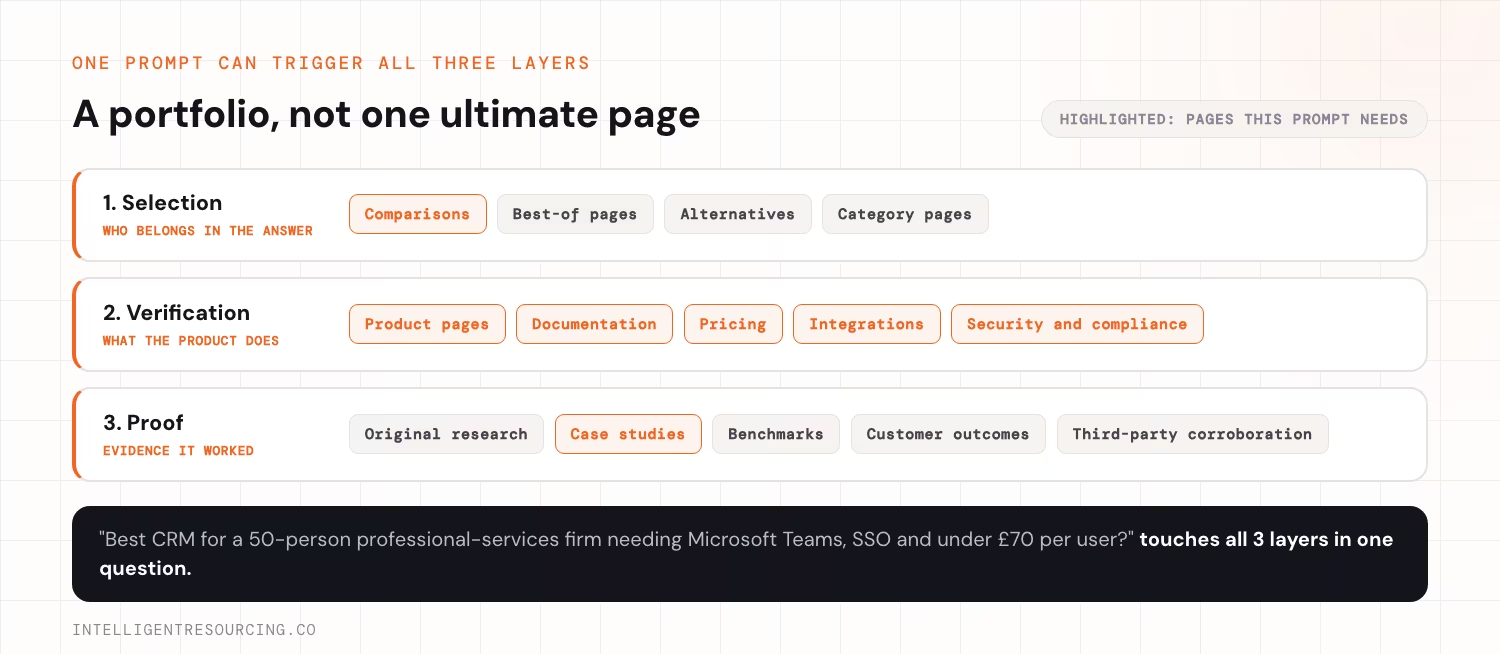
The strongest SaaS AI-search strategy uses several page types together. Think in 3 layers.
1. Selection layer
This is the content that helps an AI engine decide which products belong in the answer: comparisons, best-of pages, alternatives and category pages.
2. Verification layer
This is the content that verifies what the product actually does: product pages, documentation, pricing, integrations, and security and compliance pages.
3. Proof layer
This is the content that supports the recommendation with evidence: original research, case studies, benchmarks, customer outcomes and credible third-party corroboration.
A single SaaS buyer prompt can trigger all 3. Consider: "What is the best CRM for a 50-person professional-services firm that needs Microsoft Teams, SSO and a budget below £70 per user?"
The engine may need a comparison page to identify candidates, a product page to understand positioning, an integration page to verify Microsoft Teams, documentation or security content to verify SSO, a pricing page to test the budget, and a case study to support suitability for professional services.
No single page needs to perform every job. The mistake is expecting one long article to carry the entire evidence chain.
Which SaaS Content Should You Fix First?
Fix the page type associated with the high-intent buyer questions where your brand is currently absent.
Start by grouping real prompts into 6 areas: category and "best" questions, competitor comparisons, pricing, integrations, technical requirements, and proof and outcomes. Then test those prompts across the AI engines your buyers actually use.
For each one, record:
- Which brands are named?
- Which URLs are cited?
- What type of page supplied the evidence?
- Which evidence does the cited competitor have that you do not?
The output is a gap map. If your product appears in general category questions but disappears when the buyer adds an integration requirement, the missing layer is probably integration or documentation content. If Google AI Mode cites your product pages but ChatGPT never includes you in "best tool" prompts, the selection layer may be weak.
If you appear in comparisons but the engine gets pricing wrong, improve the pricing source rather than publishing another comparison article. If the same generic claims appear everywhere but no source proves an outcome, build the proof layer.
That is a more useful content plan than publishing a fixed number of blogs every month.
When Does Execution Become the Bottleneck?
Execution becomes the bottleneck when the team understands the gaps but cannot maintain accurate product, comparison, documentation and proof content at the same time. That is a different problem from strategy.
It requires a system that can scale content while keeping product facts current, comparison claims sourced, pricing aligned, internal links maintained, schema consistent, and human review in place.
That is the more useful lens when assessing B2B content automation agencies. The question is not whether an agency can produce more articles. It is whether it can maintain a connected evidence system without allowing accuracy to degrade as volume increases.
See Which SaaS Pages AI Engines Already Trust
Do not start by guessing which content format you need more of. Establish the baseline first. A free AI visibility audit can show which buyer questions already surface your SaaS brand, which competitors are being cited instead, and which page types are supplying the evidence behind those answers.
That turns the next content decision into a specific action. If the gap is comparison content, build comparison pages. If the gap is technical proof, strengthen documentation. If the issue is product clarity, improve the product layer. If the missing piece is evidence, publish the proof.
Content Creation
Get a free AI visibility audit and see which buyer questions surface your brand, which competitors are cited instead, and which page types supply the evidence.
FAQs
Which SaaS content type gets cited most by ChatGPT?
Listicles perform particularly strongly in current cross-industry ChatGPT citation research. Peec found 52% of qualifying listicles in its dataset were cited more than twice, its threshold for a high citation rate. For SaaS, comparison, best-of and alternatives content is therefore especially relevant to commercial shortlist prompts.
Which SaaS content performs best in Google AI Mode?
Google AI Mode shows a stronger preference for official brand content. Peec found category pages were the strongest qualifying content type in its dataset, and that Google AI Mode cites category and product pages significantly more often than the other engines it tested.
Do SaaS companies need comparison pages if they already have product pages?
Yes. Product pages and comparison pages solve different problems. A product page proves what the software does. A comparison page explains how products differ and under which conditions one option may be a better fit.
Does product documentation help SaaS companies appear in AI search?
Documentation is particularly useful for detailed questions about integrations, limits, configuration, security and implementation. It gives AI engines precise evidence that broad product marketing pages may not contain.
Is original SaaS research worth creating for AI search?
Yes, when it produces genuinely new evidence. Proprietary benchmarks and datasets give AI engines a fact with a clear source rather than another summary of information already published elsewhere. The methodology, sample and limits should be published with the result.
Does schema make a SaaS page more likely to be cited?
Schema can help machines understand what a page represents, but it does not guarantee citation. Google states plainly that there is no special schema.org structured data you need to add for AI Overviews or AI Mode, and that structured data should match the visible text on the page.
Should SaaS teams prioritise blogs or commercial pages for AI search?
Prioritise the page type that closes the current evidence gap. Commercial prompts may require comparisons, product pages, pricing, integrations and documentation before another generic blog article. The right format depends on what the buyer is asking and what evidence the engine currently lacks.