
What Has Changed in B2B Email Marketing?
Google now enforces email authentication, and the rules depend on how much you send. Google's email sender guidelines set 2 tiers. Every sender to Gmail needs Sender Policy Framework (SPF) or DomainKeys Identified Mail (DKIM) authentication. Every sender must keep user-reported spam below 0.30%. Senders of more than 5,000 messages a day to personal Gmail accounts also need domain-based message authentication (DMARC) and one-click unsubscribe on marketing mail. Google recommends a spam rate below 0.10%.
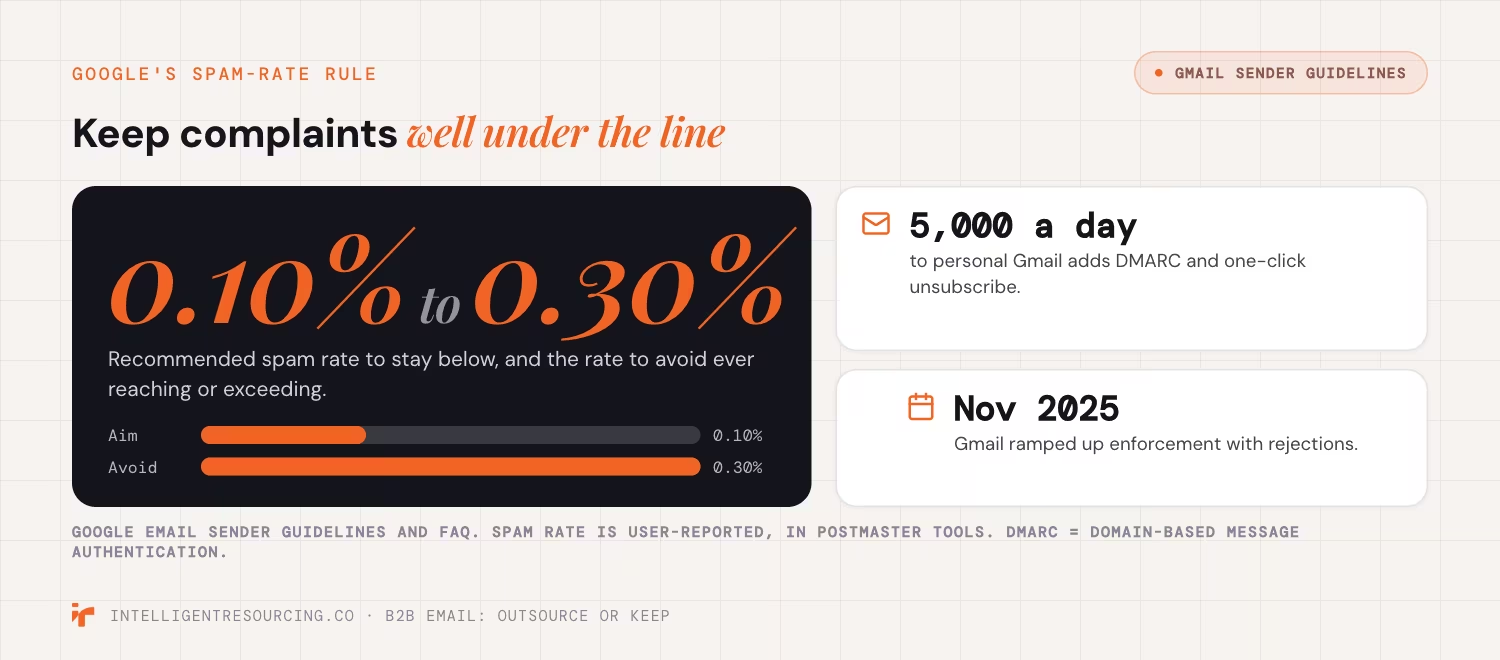
Enforcement increased from November 2025, per Google's sender guidelines FAQ, with temporary and permanent rejections for non-compliant mail. Most B2B senders sit below 5,000 a day, so the first tier applies to them. Either way, authentication, list quality and complaint rates now decide whether mail reaches the inbox. Sending more is no substitute for sending better.
For B2B firms, the outsourcing question changes. It becomes whether outside expertise can improve delivery and results while you keep control. Marketing teams that do not know their own sending setup are the likeliest to need help. A scorecard for the rest of the pipeline sits in the B2B lead generation strategy checklist.
Should I Outsource B2B Email Marketing?
Outsource when you have a clear market, a credible offer and enough customer data, and you lack the skills or capacity to run campaigns well. Outsourcing is premature when you have not decided who to reach, why they should respond or what counts as a qualified opportunity. The deciding factor is capability, and company size matters less.
Take an Australian B2B software firm with a clear ideal customer profile (ICP) and an experienced sales team. Marketing knows the audience and cannot build nurture campaigns, keep the sending setup healthy or measure engagement across systems. An outside specialist can fix those execution gaps while the firm keeps the commercial direction.
The main benefits are:
- Specialist technical knowledge: Experienced providers understand authentication, sender reputation and testing.
- More capacity: Agencies can run production and reporting when your team is stretched.
- Documented processes: Written workflows reduce dependence on single employees.
- Steadier optimisation: Dedicated staff monitor results and adjust campaigns.
The main risks are an agency that does not know your customers, a focus on activity numbers, and contracts that leave you without data or access.
Salesforce's 2026 State of Sales research found that 51% of sales leaders using artificial intelligence (AI) say disconnected systems slow that work. So ask how an outside team will connect to your CRM before you sign.
A hybrid model keeps targeting, approvals and data with your team and gives delivery to specialists, as in signal-led lead generation.
What Do B2B Email Marketing Services Include?
B2B email services cover planning, production, delivery and optimisation. The scope depends on whether the provider is a generalist agency, an email specialist or a go-to-market (GTM) engineering partner. Not every programme needs every service.
Common services include:
- Campaign planning and segmentation: Turning approved customer profiles and lifecycle stages into audiences.
- Copywriting and design: Building messages, templates and calls to action that fit your positioning.
- Deliverability and authentication: Setting up SPF, DKIM and DMARC, watching sender health and tracing failures.
- Marketing automation: Building nurture sequences and approved behavioural triggers.
- CRM integration and data management: Linking email activity to customer records and suppression lists.
- Testing and reporting: Judging message relevance, qualified engagement and pipeline contribution.
A firm that sends 1 monthly newsletter can need only production help. A firm with complex buying committees across markets can need integrated automation.
Speed matters once a reader shows interest. RevenueHero's study of 1,000 B2B software company sites found that only 365 of those sites replied to a demo request, and the average reply took 1 day, 5 hours and 17 minutes. It counted automated replies, so it shows response gaps and says little about quality.
A guide to building a signal-led prospecting system covers the follow-up steps. This article focuses on who should own and deliver the work. For the outbound side of email, see cold email playbooks.
What Should I Outsource and What Should I Keep In House?
Keep the commercial decisions and customer data. Outsource specialist execution where an outside team can deliver a measurable gain. That split gives you technical skill without giving up control of your go-to-market plan. One technical reason matters. Google counts every message to personal Gmail accounts from the same primary domain towards its 5,000-a-day limit, and Google's sender guidelines FAQ says bulk sender status is permanent once reached. Whoever sends on your domain affects your reputation.
The B2B Email Ownership Framework
| Activity | Keep in-house | Outsource |
|---|---|---|
| Ideal customer profile | Define and approve | Recommend refinements |
| Positioning and offers | Own the commercial message | Draft campaign copy |
| Unsubscribe and suppression lists | Own the rules and the records | Run approved processes |
| CRM and customer data | Own accounts, records and access | Configure integrations |
| Sending domain and platform | Keep administrative control | Configure and monitor |
| Campaign production | Approve priorities and messaging | Design, build and run |
| Automated workflows | Set the business rules | Build and test |
| Performance measurement | Own pipeline and revenue targets | Supply attribution and analysis |
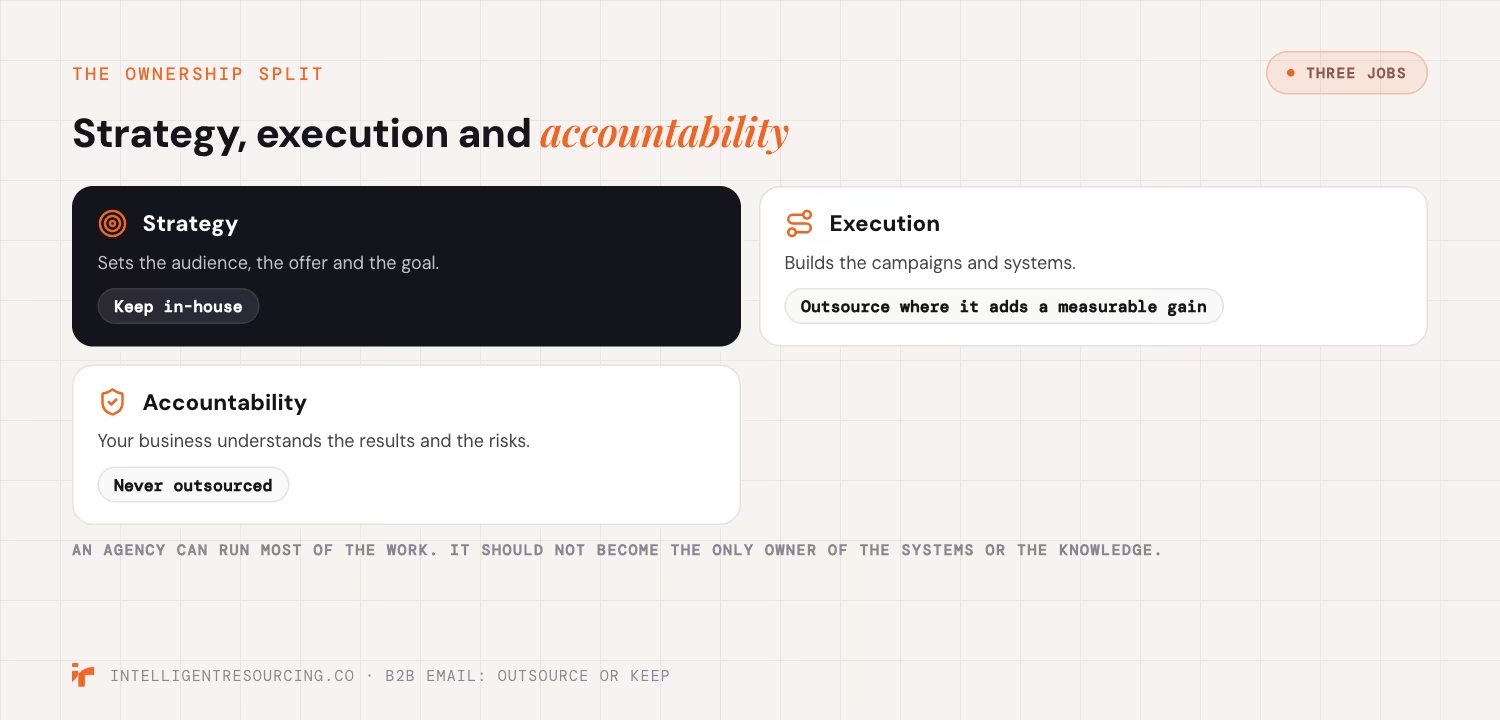
The framework separates 3 jobs: strategy, execution and accountability. Strategy sets the audience, the offer and the goal. Execution builds the campaigns and systems. Accountability means your business understands the results and the risks.
An agency can run most of the work. It should not become the only owner of the systems or the knowledge needed to run the programme.
Consider a hypothetical software firm that sells enterprise tools to operations directors. Its team knows the buying committee and has a reliable CRM, and campaign production is patchy.
A specialist agency can build email sequences, set up authentication, run approved automation and report engagement. The firm still decides which accounts to target, what content suits each stage and when sales steps in. If the agency leaves, the firm keeps its records, domain access, campaign history and written workflows.
How Do I Choose a B2B Email Marketing Agency?
Choose an agency for its ability to improve your commercial results, and not for the volume of campaigns it promises. Demandbase's 2025 buyer research found that 72% of B2B purchases involve complex buying groups. So look for 4 capabilities:
- Relevant B2B experience. It understands long sales cycles, several decision-makers and the gap between engagement and real intent.
- Technical deliverability skill. It can explain authentication, reputation monitoring, suppression handling and how it responds to failures.
- CRM and systems integration. Campaign activity connects to your customer records and sales process.
- Reporting discipline. Results are measured by qualified opportunities and pipeline, with honest limits on attribution.
Ask for an example of a comparable problem the agency solved. A credible provider explains the starting point, what changed and how the results were measured. Be wary of agencies that guarantee inbox placement, suggest buying contact lists or promise a fixed number of leads with no definition of qualified.
What Should I Ask Before Signing?
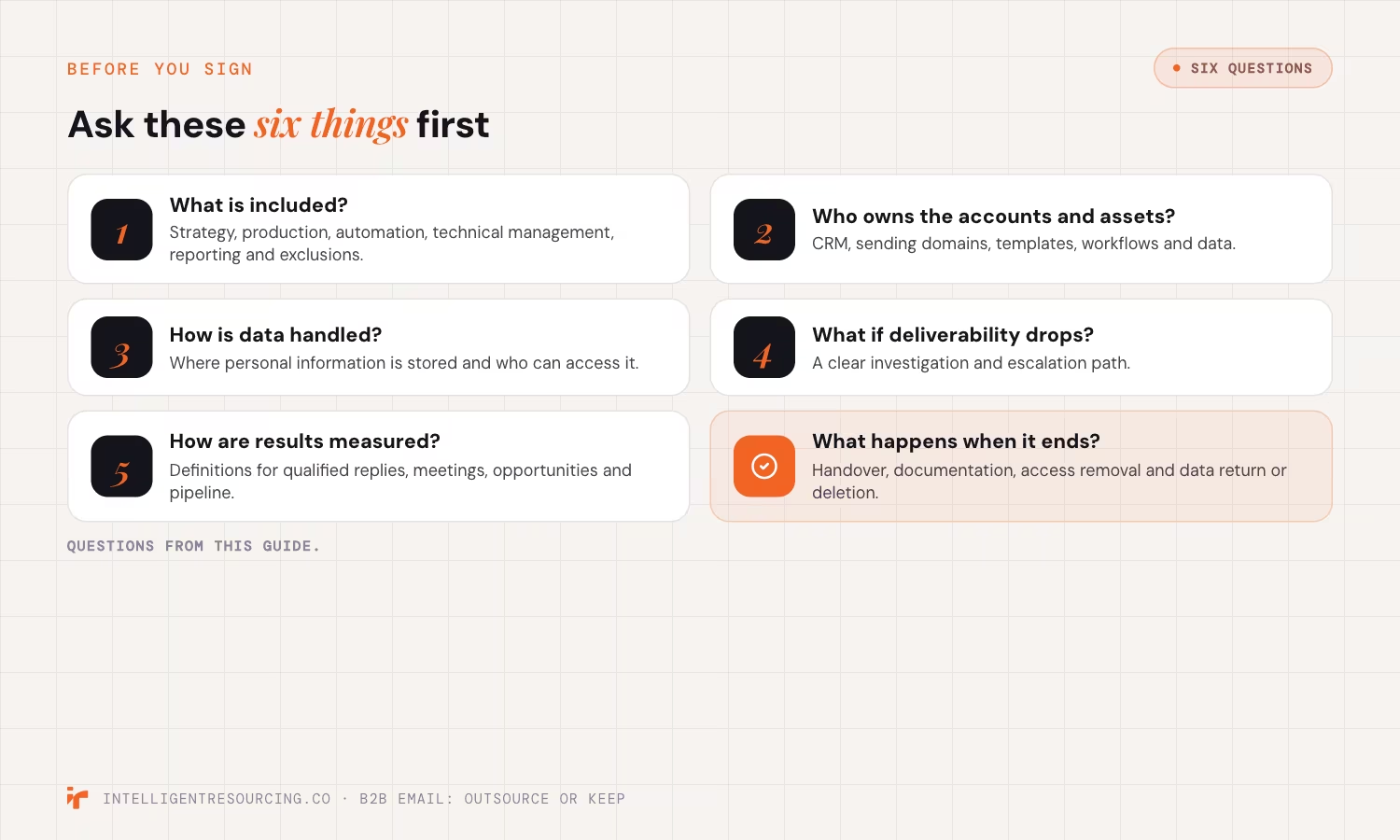
Before you sign, ask these questions:
- What is included? Clarify strategy, production, automation, technical management, reporting and exclusions.
- Who owns the accounts and assets? Confirm you keep access to your CRM, sending domains, templates, workflows and data.
- How is data handled? Ask where personal information is stored and who can access it.
- What happens if deliverability drops? Require a clear investigation and escalation path.
- How are results measured? Agree definitions for qualified replies, meetings, opportunities and attributed pipeline.
- What happens when the contract ends? Confirm handover, documentation, access removal and data return or deletion.
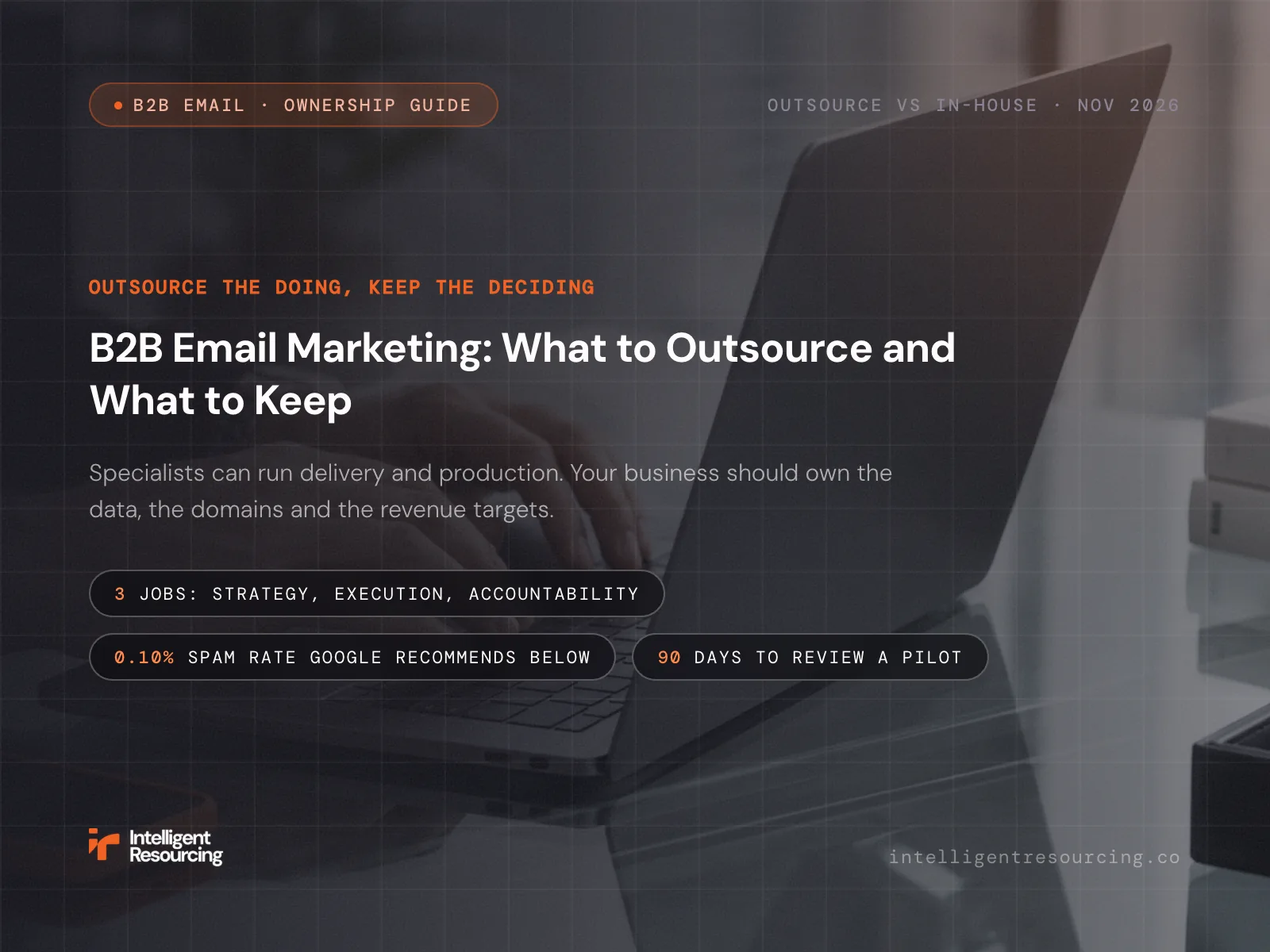
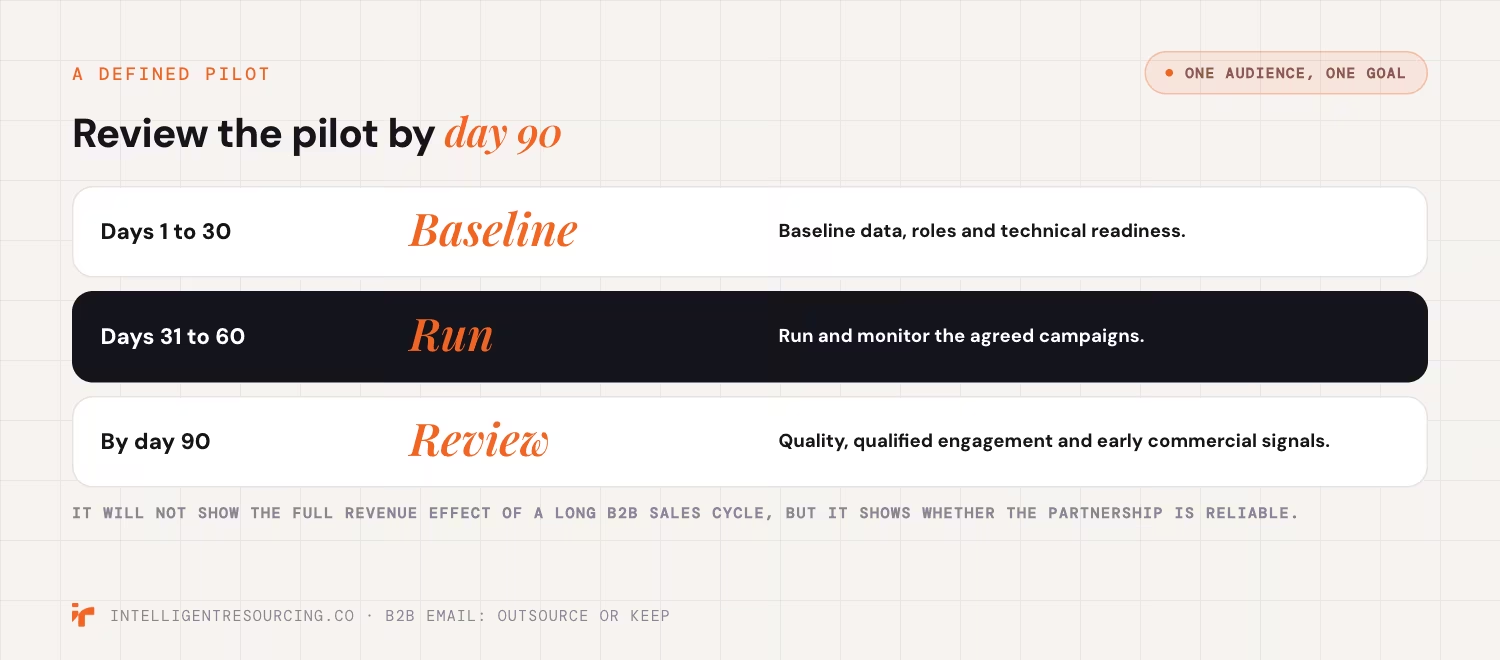
Start with a defined pilot: 1 audience, 1 campaign goal and an agreed period. Use the first 30 days for baseline data, roles and technical readiness. Run and monitor the agreed campaigns in the next 30 days, and review quality, qualified engagement and early commercial signals by day 90.
A 90-day review will not show the full revenue effect of a long B2B sales cycle. It does show whether the partnership is reliable and aligned. A fuller scorecard sits in choosing a B2B lead generation agency.
Does Outsourcing Email Marketing Make Sense for Australian Businesses?
Yes. Australian B2B businesses can benefit from specialist email marketing services when internal teams lack technical capacity or execution consistency. Outsourcing does not transfer legal responsibility under the Spam Act 2003. Businesses remain accountable for consent, sender identification and unsubscribe obligations regardless of which company manages the sending process. The Australian Communications and Media Authority (ACMA) investigates and enforces against the businesses that send, or have messages sent for them.
Under the Spam Act 2003, commercial electronic messages generally require consent, accurate sender identification and a functional unsubscribe mechanism. Consent may be express or inferred in qualifying circumstances, but businesses must be able to substantiate it.
The ACMA states that these obligations apply even when another company sends marketing messages on your behalf. Unsubscribe requests must generally be honoured within 5 working days.
These requirements are not interchangeable with Google's email authentication standards. SPF, DKIM and DMARC help establish sender authenticity, but they do not establish legal permission to contact someone.
Content Creation
Talk it through with Intelligent Resourcing before you brief an agency.
FAQs
Should I outsource B2B email marketing?
Outsource when you have a clear target market and strategy and lack the skills or capacity to run campaigns steadily. Keep customer data, positioning and revenue targets in-house. A hybrid model usually works better than handing over complete control to an agency.
What do B2B email marketing services include?
They can include campaign planning, segmentation, copywriting, design, deliverability management, CRM integration, automated sequences, testing and reporting. Some agencies run full campaigns, and others specialise in technical delivery or automation. The right scope depends on what your team can already do.
How do I choose a B2B email marketing agency?
Choose an agency with relevant B2B experience, proven technical skill, sound data handling and clear commercial reporting. Ask how it handles deliverability problems, CRM access and campaign ownership. Start with a defined scope and measurable goals before you commit to a long agreement.