


What Did AEO Originally Mean, Before AI Chat Existed?

Answer Engine Optimisation (AEO) originally meant structuring a page to win Google's featured snippet: the boxed answer above the first organic result, which Google introduced in January 2014. AEO is the oldest of the three AI-era search disciplines, and AEO, GEO and LLMO explained covers how the three relate to each other today.
The voice search era and position zero
The same period put voice assistants into ordinary households. Amazon's Echo, running Alexa, arrived in 2014. Google Home followed in 2016. Both read a single answer aloud, which made the boxed answer on a results page far more valuable than the ten blue links beneath it.
Practitioners coined their own shorthand for that slot: position zero, a box sitting above the first ranked result that took the attention before anyone scrolled. The name stuck because it described the prize exactly. There was one box, and either you held it or a competitor did.
What original AEO work actually involved
Snippet-era AEO meant question-format headings with direct answers placed right underneath, plus clean lists, tables and schema markup. All of it was built for one outcome on one engine.
Worth noting what the work could never do. Google's own documentation is explicit that its systems decide whether a page makes a good featured snippet and elevate it automatically. There has never been a markup tag that opts a page into the box. Even at its peak, AEO was an influence exercise rather than a control one. Worth remembering before anyone promises guaranteed placement inside an AI answer today.
How Did Teams Measure AEO Success Before Citation Rate Existed?
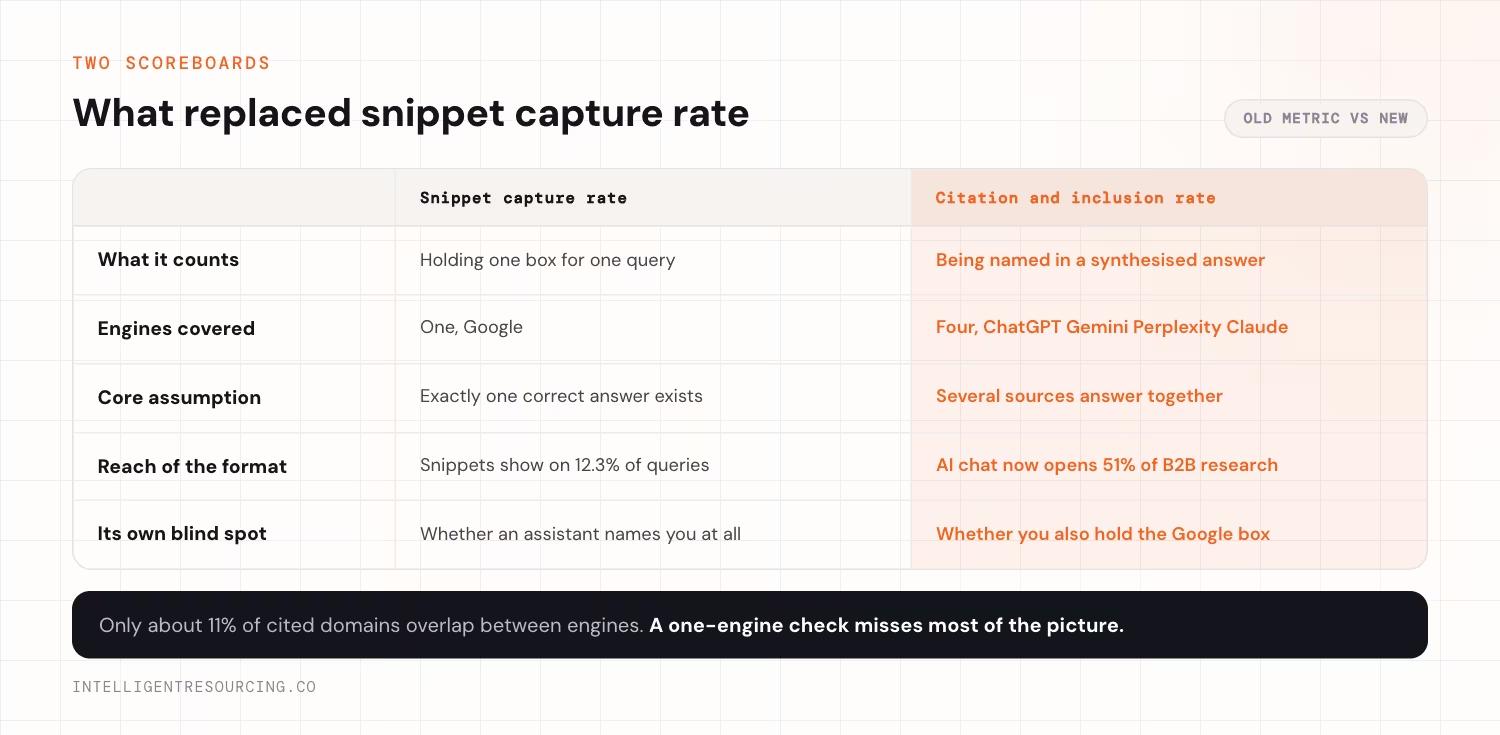
AEO success was measured by snippet capture rate: whether a page held Google's featured snippet for a target query. That metric assumed exactly one ranked answer existed per query, an assumption a synthesised, multi-source AI answer breaks by design.
The single-position assumption
Rank-tracking tools built for ordinary SEO watched where a page landed for one target keyword. The model was sound for the surface it described: one query, one box, one answer to capture. A tool built on that assumption has nowhere to record a result where four engines each name a different set of five sources.
The prize was also narrower than the attention it received. Ahrefs studied two million featured snippets. A snippet appears on 12.3% of search queries and takes 8.6% of clicks. It comes from a page already ranking first 30.9% of the time. Most snippets went to pages that were already winning.
What citation tracking replaced
Citation tracking changed the unit of measurement from position to presence. A cross-engine AI citation audit records whether a brand is cited or merely mentioned. It runs across ChatGPT, Gemini, Perplexity and Claude at once, because only about 11 percent of cited domains overlap between engines. A single-engine check describes a small fraction of the picture.
What Changed When AI Chat Assistants Became the Answer Engine?
A featured snippet was one ranked box pulled from one page. An AI chat answer is synthesised across several sources with no single position to hold. G2's Answer Economy research, reported by Demand Gen Report, surveyed 1,076 B2B software buyers in March 2026. It found 51% now begin the purchase process in an AI chatbot rather than a search engine.
From one box to many sources
A synthesised answer can cite a brand, quote it, or simply describe it without ever showing a clickable box. Ranking for the snippet and appearing in the answer became two separate outcomes rather than one, which is the same split covered in GEO versus SEO for pipeline.
What the buyer shift actually means
The same research found 83% of buyers feel more confident in their final choice when a chatbot formed part of the research. Another 69% chose a different vendor than they had originally planned. That is not a channel moving. That is the shortlist being assembled somewhere a snippet tracker cannot see.
Does Targeting a Single Featured Snippet Still Work for ChatGPT?

Schema built to win one Google snippet does not automatically transfer into a synthesised, multi-source AI answer. Both surfaces reward clear structure, but only one of them has a box to win.
The wider trend has been running for years. SparkToro's clickstream analysis found that 68% of United States Google searches ended without a click in the first four months of 2026, up from 60% in 2024. For every 1,000 searches, only 276 clicks now reach the open web. Winning the box matters less when the box increasingly answers the question outright.
The gap between snippet position and AI inclusion
A page can hold the Google snippet for a query and never get named inside ChatGPT or Perplexity. Those answers draw on a wider source set than one results page. The reverse happens just as often. A page with no snippet at all can be cited inside an AI answer if it answers the question clearly enough.
Neither outcome shows up in a rank tracker. That is why Intelligent Resourcing's GEO service reads both surfaces rather than treating one as a proxy for the other.
The practical measurement gap
A team checking only its Google snippet position learns nothing about the AI answer. It cannot tell whether it appears, is described accurately, or is missing entirely. All three look identical from a rank-tracking dashboard, and two of them are problems.
What Does Modern AEO Actually Require Now?
Modern AEO means answering the risks, comparisons and objections a buyer raises before they raise them. The answers go in public content an assistant can lift directly. Success is measured by inclusion across engines, not by one ranking position.
Tracking across engines, not positions
HubSpot's breakdown of AEO metrics sets out the new scoreboard. It lists AI citation frequency, share of voice against competitors, branded search volume, direct traffic growth, and referral traffic from answer engines. None of those existed as a category when AEO meant one snippet box.
The work changes shape to match. Instead of tuning one page for one high-volume query, the job is to cover every question a buyer works through, each with a direct answer an assistant can lift. Choosing an AEO agency sets out the criteria and red flags for finding a partner built for this version of the work rather than the 2014 version.
Is the Old Featured-Snippet Skillset Wasted, or Does It Still Help?
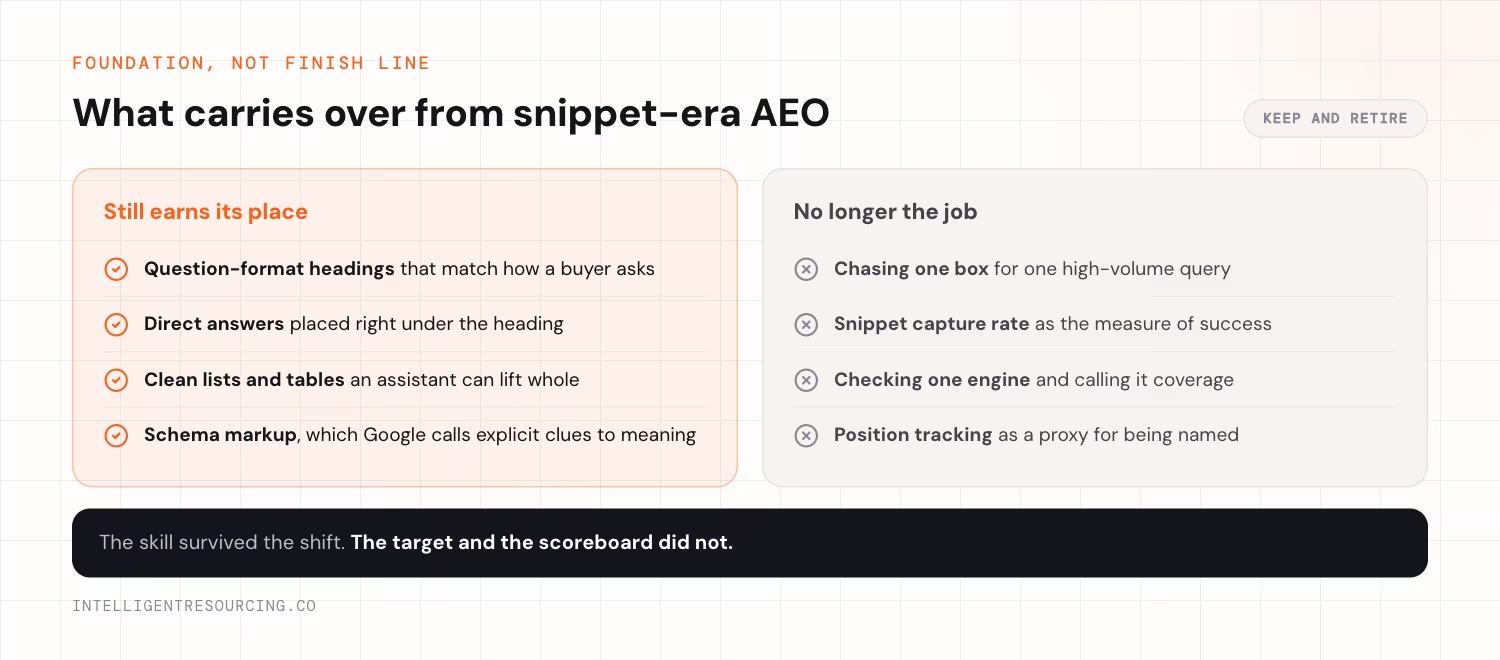
No, it is not wasted. An assistant still parses a clearly marked-up page more reliably than a vague one. The skill that won a Google snippet in 2016 still helps win a place in an AI answer in 2026.
Where the old skill still applies
Question-format headings, direct answers, clean tables and schema markup all still do work. Google's structured data guidance describes markup as explicit clues about the meaning of a page. It also says Google uses structured data found on the web to understand page content, and to gather information about the web and the world in general. That second half matters here. Structured data was never only feeding the snippet box.
The target and the scoreboard
What changed is the target and the scoreboard.
The target moved from one ranked box on one engine to a synthesised answer drawing on several sources across several engines. The scoreboard moved from snippet capture rate to citation rate, inclusion rate and share of voice, checked across engines rather than once on Google.
Old AEO skill is a foundation, not a finish line. A team that stops at "we still win the Google snippet" is playing a game that now decides a shrinking share of the buying conversation.
Content Creation
Most teams know their Google snippet position and have never checked whether an AI assistant names them at all. Book a GEO diagnostic call with Intelligent Resourcing and we will read both surfaces for your category, the snippet and the AI answer, and show you where the gap sits.
FAQs
What did AEO originally mean before ChatGPT and other AI chat tools existed?
AEO meant structuring a page to win Google's featured snippet, the boxed answer above the first organic result that Google introduced in January 2014. The target was one ranked box on one search engine, tracked with ordinary rank-tracking tools.
How was AEO success measured before AI citation tracking existed?
With snippet capture rate: whether a page held the featured snippet for a target query. That metric assumed one ranked answer per query, which does not describe how a synthesised AI answer gets assembled from several sources at once.
Do featured snippets still matter if AI chat assistants are the main answer engine now?
Yes, but as one input among several. Ahrefs found snippets appear on 12.3% of queries, so the box is real but narrow. A well-structured page can be lifted into an AI answer whether or not it holds a snippet, so the underlying formatting skill still earns its place.
What does AEO mean now that most answers come from a conversational AI assistant?
It means answering the risks, comparisons and objections a buyer raises before they raise them, in content an assistant can lift directly, then tracking brand inclusion and citation across engines rather than checking one ranking position on one search engine.
Does Intelligent Resourcing offer AEO as a separate service from GEO?
No. Intelligent Resourcing delivers AEO as part of Content Strategy through GEO, not as a third, separate service line. The work that wins a place in a synthesised AI answer is the same work that earns a citation.