

Why GEO Service Scope Varies So Much

A strong agency scope in 2026 covers technical work, content strategy, content, and off-page signals. Generative engine optimisation (GEO) work now sits inside that same brief, not bolted on as an extra. A survey of 494 agencies found 66% saw more client demand for artificial intelligence (AI) search work, a category the report tracked for the first time.
Few agencies deliver all of it under one fee. That is why "GEO service" means something different depending on who quotes it. Intelligent Resourcing's GEO programme lists every part it covers.
A buyer comparing providers rarely sees this gap until the work starts. The sales call talks about outcomes, not inclusions. By the time the first invoice lands, the scope is already set. Any missing part becomes a change order, not a starting condition.
Two scopes commonly get sold under the same name. One is a monthly citation report treated as the whole service. The other folds writing, schema work, and tracking tools into one retainer.
Neither approach is wrong on its own. The gap shows up the moment two quotes sit side by side and look like the same purchase, when they are not.
Why One Line Item Costs $750 Here, $4,000 There

Most published GEO prices come from agency blogs and informal surveys. Each one defines the service differently, a point eSEOspace makes on its own pricing page. One published price list alone spans more than a fivefold gap between its lowest and highest tier.
As one example, eSEOspace's own plans span five tiers, priced in USD. All sit inside one combined search engine optimisation (SEO) and GEO product:
| Tier | Hours per month | Price (USD) |
|---|---|---|
| Essential | 5 | $750 |
| Growth | 10 | $1,200 |
| Advanced | 20 | $2,500 |
| Pro | 25 | $3,000 |
| Concierge | 30 | $4,000 |
The lesson carries past any single agency. Two quotes with a similar fee can fund very different hour counts, asset counts, or engine coverage. A buyer can check what generative engine optimisation costs per month buys, asset by asset. That turns two quotes into a real comparison, not a guess.
Why Is Schema Markup the Most Oversold Inclusion?
Schema markup sits on almost every GEO service list and is often sold as the fastest route to AI citations. The controlled evidence does not back that pitch. Ahrefs' controlled schema test found no real citation lift from adding it on its own.
Schema tends to sit on pages that already do other things well, so it appears beside citations without driving them. We break the test down in our guide to answer engine optimisation (AEO) red flags with real evidence.
A fee built mainly around schema buys technical setup, not a citation guarantee. Ask what else sits beside it in the quote.
Why Do Buyers Forget Cross-Engine Tracking?
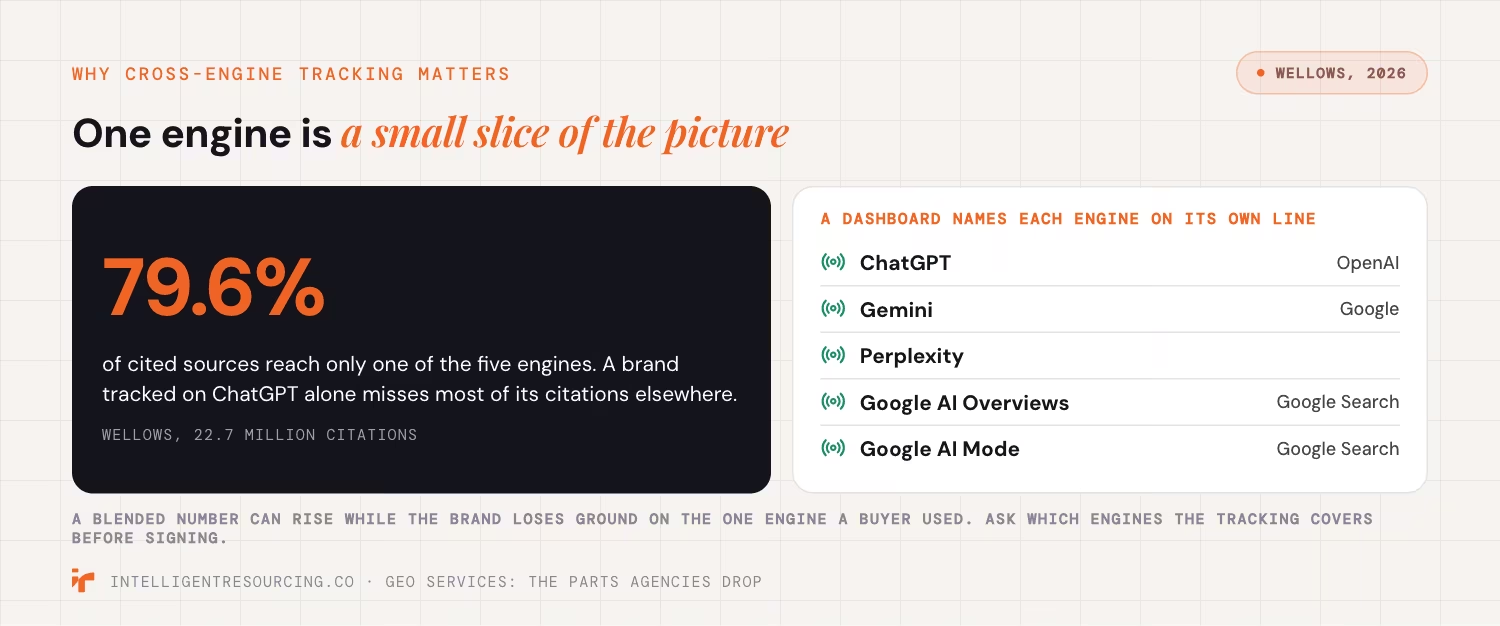
A service that reports citations from only one engine covers a small slice of where buyers look. Five major AI engines now shape how buyers research vendors. A quote that tracks only one or two of them leaves the rest unmeasured. That gap is easy to miss until a brand checks what the other engines are saying.
Wellows' study of 22.7 million citations spanned ChatGPT, Gemini, Perplexity, Google AI Overviews, and Google AI Mode. It found that 79.6% of cited sources reach only one of those five engines. A brand tracked on ChatGPT alone misses most of its citations elsewhere.
Checking engine coverage before signing takes two minutes and pays off fast. Ask which engines the tracking covers. Ask if the content plan fits how each engine picks its sources.
Full coverage means a dashboard that names each engine individually, not a single blended score:
- ChatGPT
- Gemini
- Perplexity
- Google AI Overviews
- Google AI Mode
A blended number can rise while the brand loses ground on the one engine a buyer used.
What Should You Ask Before Comparing GEO Quotes?
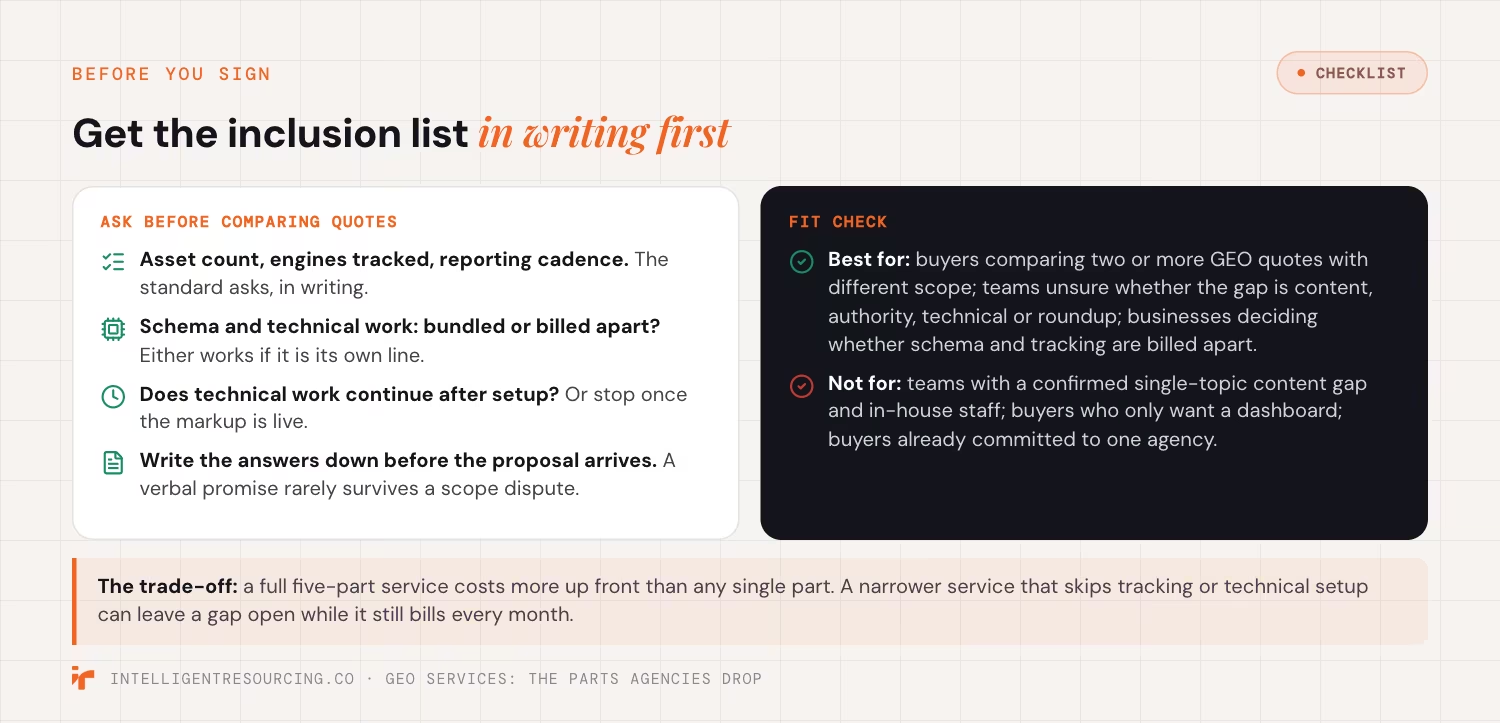
A quote with no stated inclusion list hides a dropped part. Two agencies rarely scope the same job the same way. Basis's 2026 agency research found 54% of agency professionals say client relationships are more strained than two years ago. Get the scope in writing before weighing the price.
The standard asks, such as asset count, engines tracked and reporting cadence, are covered in how to compare AEO agency proposals. Two questions about technical work get skipped more often:
- Are schema and technical work bundled into the fee or billed apart?
- If bundled, does technical work continue after setup, or stop once the markup is live?
Run the same checklist against any agency's proposal. A fee that drops tracking or technical setup is not always the wrong choice. But it does change what that fee pays for. That scope is what's worth negotiating, not the monthly total.
Write the answers down before the proposal arrives. A verbal promise about what's included rarely survives the first scope dispute. A written checklist settles it in one line.
Fit Check
Best for:
- Buyers comparing two or more GEO quotes with different scope, who need a checklist to compare them against.
- Teams that have not yet confirmed whether their gap is a content, authority, technical, or roundup problem.
- Businesses deciding whether schema and tracking should be billed apart or bundled into one fee.
Not for:
- Teams with a confirmed single-topic content gap and in-house staff to close it.
- Buyers who only want a citation dashboard, not production or technical work.
- Buyers already committed to one agency, with no competing quote to weigh it against.
The trade-off: a full five-part service costs more up front than any single part bought alone. A narrower service that skips tracking or technical setup can leave a gap open while it still bills every month. Matching the inclusion list to the real gap is what stops a business paying twice. It is also the one question a sales call will not always raise unprompted.
This kind of scope mapping sits inside Intelligent Resourcing's content strategy work, not as a bolted-on extra.
A DemandScience survey of 750+ business-to-business (B2B) marketing leaders found that 25% of marketing budget looks successful but never drives a real outcome. The report links that waste to weak signals, disconnected tools and content that fails to connect.
See What a GEO Programme Should Cover
Get the inclusion list mapped before any fee gets quoted. Answer Engine Optimisation services
Content Creation
Get the inclusion list mapped before any fee gets quoted. Intelligent Resourcing runs all five parts as standard: audit, content, technical setup, tracking and reporting.
FAQs
What is typically included in a generative engine optimisation service?
Most services bundle a citation-gap audit, content, technical and schema setup, cross-engine tracking, and regular reporting. Few agencies include every part as standard.
Does a GEO service need to include schema markup?
Schema helps machines read a page and supports rich results. Ahrefs' 2026 study found no direct citation lift from adding it. It should not decide which quote wins.
Should GEO tracking report each engine separately?
Yes. Most cited sources reach only one engine, so a blended score can rise while the brand loses ground on another. Each of ChatGPT, Gemini, Perplexity, Google AI Overviews and Google AI Mode needs its own line.
What's the difference between a GEO retainer and a GEO audit?
An audit checks the citation gap and its root cause as a one-off job. A retainer runs the ongoing content and technical work that closes it.
Should schema and technical work be billed apart from content?
Either works if the quote lists technical work as its own line. Billing it apart makes it easier to see when that work stops after setup.
Is a cheaper GEO quote ever the better choice?
Yes, when the gap is confirmed as narrow and content-only. It works best when the site already has the authority and technical base that a broader service would build.