
What Does B2B Data Enrichment Add to a CRM Record?
Business-to-business (B2B) data enrichment adds three kinds of data to a customer relationship management (CRM) record: company details such as industry and revenue, technology details such as the software a company runs, and contact details such as a verified email and job title. Demandbase's firmographic data definition lists these same company details, including industry, size, revenue and location.
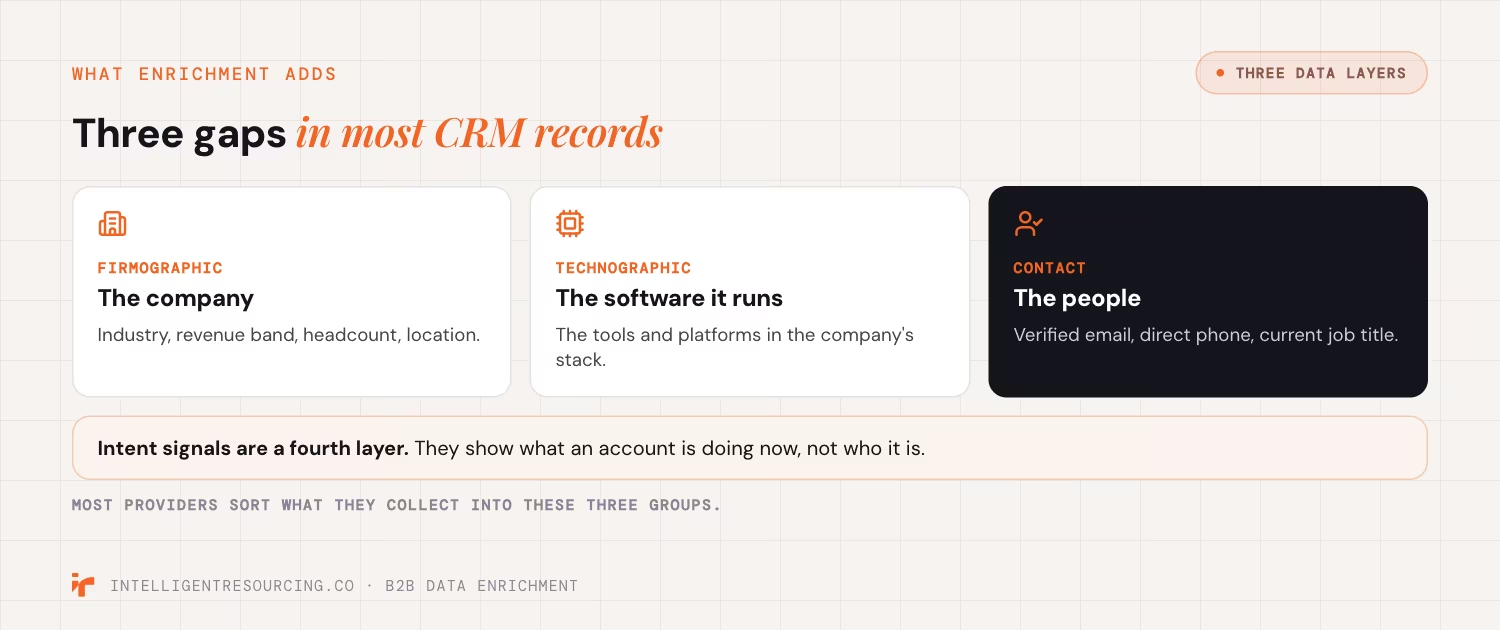
Providers usually sort what they collect into these three groups, whatever the vendor's name is:
- Firmographic data: industry, revenue band, headcount, location.
- Technographic data: the software a company runs.
- Contact data: verified email, direct phone, current job title.
A tool strong on contact details is often thin on technographic data, and the reverse is true too. That gap is why teams building their own data stack usually run more than one source, instead of picking one.
Intent signals, such as a company researching a topic or hiring for a role, are a fourth data layer, separate from the other three. Some teams now run this as continuous signal listening rather than a periodic check. It is not a replacement for the core record.
Who controls the record matters as much as what it holds. HubSpot briefly changed, then reversed, its own enrichment terms in 2026. The change would have let customer enrichment data feed a shared HubSpot dataset.
Why Does Enriched Data Need Refreshing, Not Just Adding Once?
Enrichment is not a one-off clean-up. The facts behind a record keep changing: people change jobs, companies change software, phone numbers get reassigned.
How fast depends on what counts as a change. Apollo's decay analysis, citing Only-B2B, puts the floor at about 2.1% a month, or roughly 22.5% a year. It cites Landbase research putting the range at 22.5% to 70.3% a year.
A 2026 test by data vendor Cleanlist sits at the high end. It re-checked 5,000 contact records every week for 13 weeks and counted a record as changed if a job title, company, email or phone changed. It found about 2.1% of records changing each week, several times the monthly floor, or roughly 67% a year.
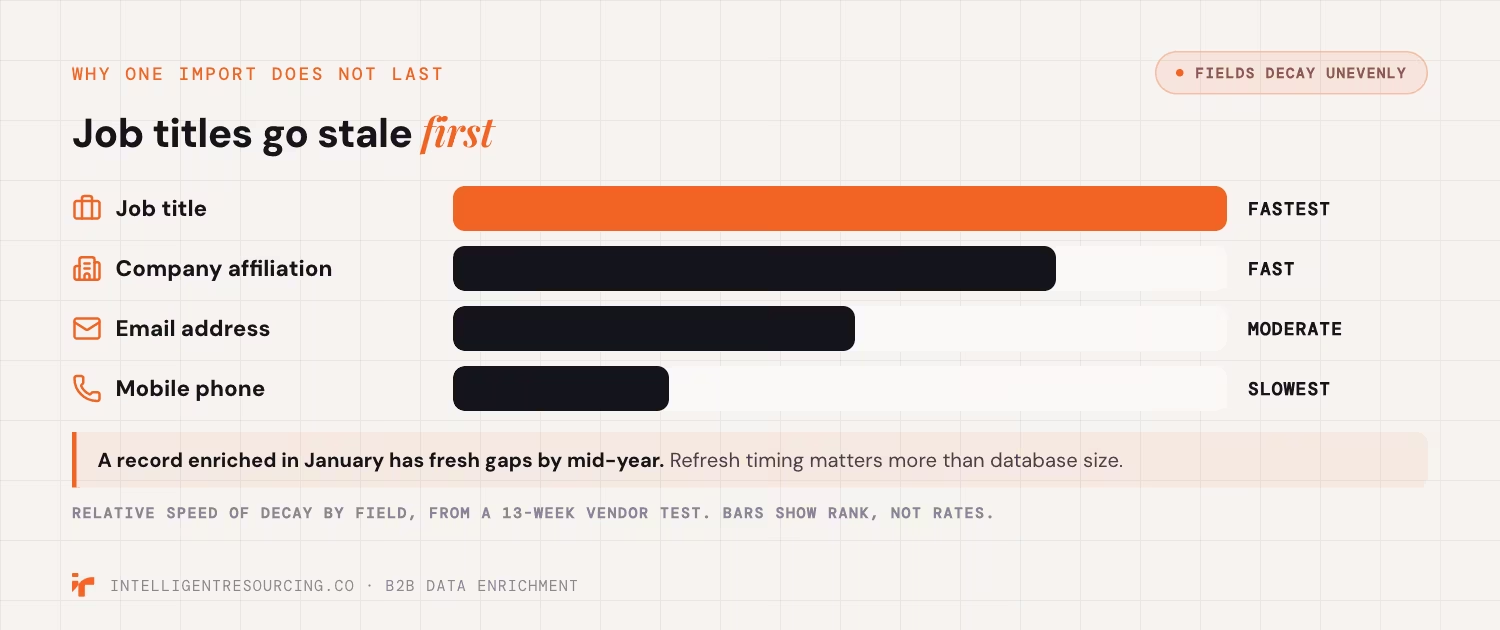
Not every field decays at the same speed. The same test ranked them like this:
| Field | Speed of decay |
|---|---|
| Job title | Fastest |
| Company affiliation | Fast |
| Email address | Moderate |
| Mobile phone | Slowest |
A record enriched in January has fresh gaps by the middle of the year. That is why refresh timing matters as much as database size.
Which Enrichment Method Actually Keeps Data Current?
Waterfall enrichment checks several data providers in sequence, rather than trusting one. This keeps data current because no single provider covers every company well. Clay reports that OpenAI more than doubled its inbound enrichment coverage, from the low 40s to the high 80s (percent), after moving from one provider to a waterfall. That is why many teams build this into a multi-provider workflow instead of running it ad hoc.
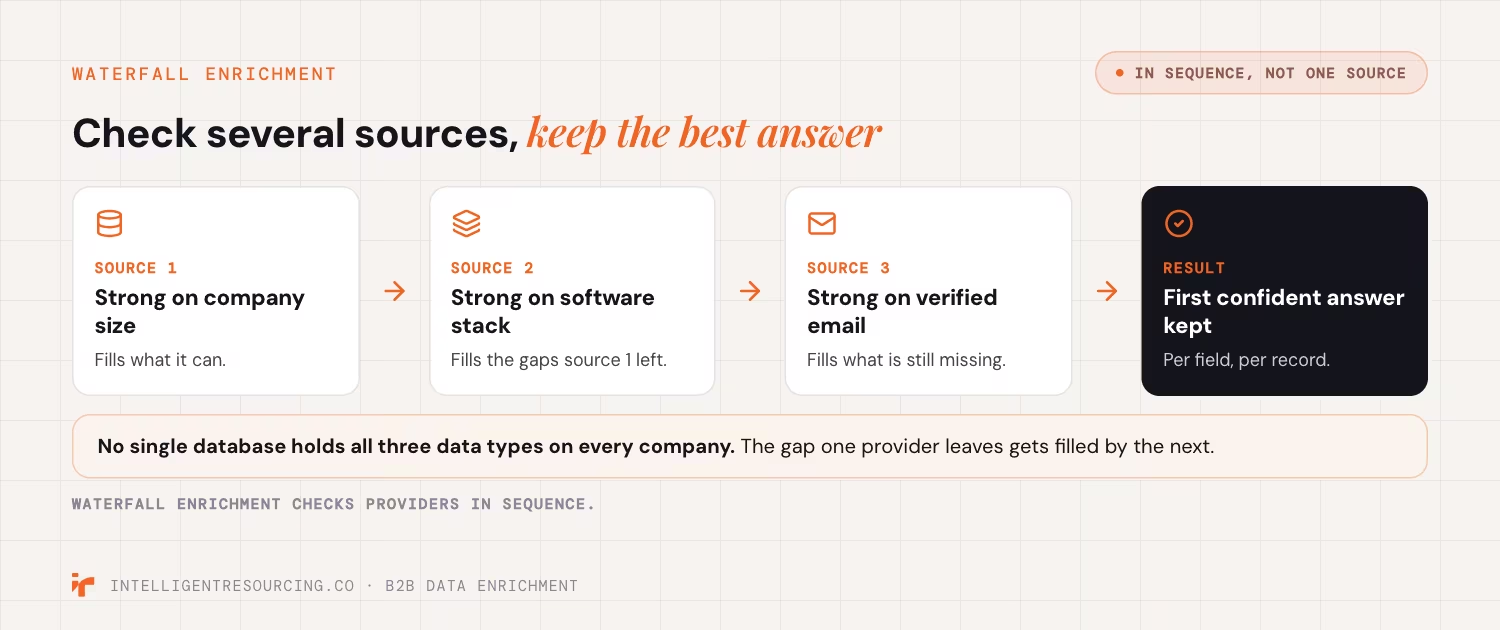
No single database holds all three data types on every company:
- One source is strong on company size.
- Another is strong on the software stack.
- A third is strong on verified email.
A waterfall checks each provider in order and keeps the first confident answer, as one workflow vendor's guide explains. The gap one provider leaves gets filled by the next.
This shift shows up in how artificial intelligence (AI) search engines now answer questions about enrichment, not just in vendor benchmarks. In Cleanlist's own prompt test, ChatGPT recommended a multi-provider approach in 64% of answers about accurate enrichment, and Perplexity in 71%.
Single-source enrichment still works. It is no longer the default.
When Does a Business Need Managed, Continuous Enrichment?
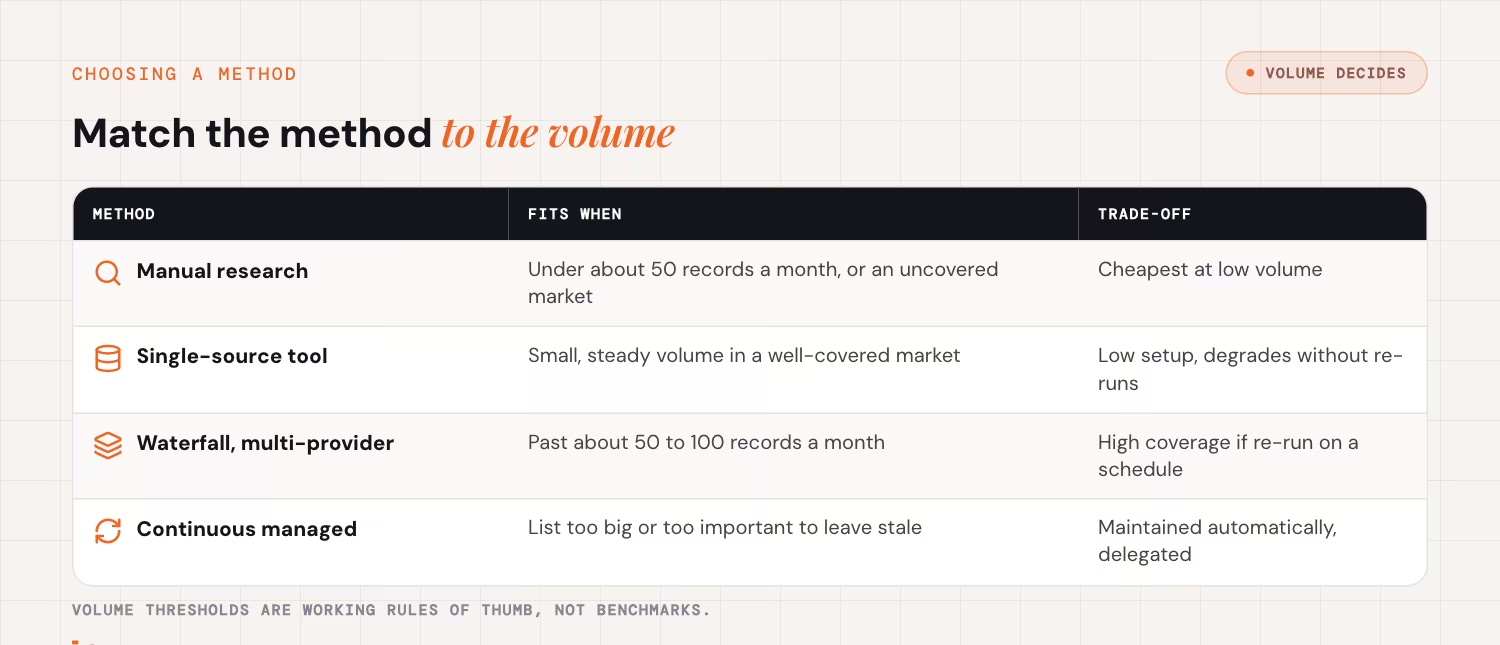
A business needs managed, continuous enrichment once its list is too large to re-check by hand. The list also becomes too important to leave stale between campaigns. As a working rule, not a benchmark, this usually happens past 50 to 100 records a month. Below that volume, a single tool or manual research is still the cheaper option.
Three signs it is time to move past a single tool:
- The list is too large for anyone to re-check by hand.
- Records go stale faster than the team can fix them.
- Deals have been lost to bad timing, not bad fit.
Most accounts are not ready to buy right now. LinkedIn B2B Institute's 95-5 rule puts the active buying share at around 5% of a market at any one time. This means enrichment must keep records current for the other 95% too, not only for accounts already buying.
This keeps records usable the moment an account is ready to buy. A system built on engineering signals instead of lists covers exactly this layer. It is the gap a one-off list purchase cannot close.
What Should You Do Next?
Teams ready to compare named options can start with our Australian B2B enrichment services piece. It compares what each provider costs, claims and suits.
Enrichment keeps your CRM data accurate on its own, not just between manual clean-ups. See CRM enrichment
Lead Generation
See how CRM enrichment keeps contact and company records accurate inside your own CRM, on a schedule.
FAQs
What is the difference between firmographic and technographic data?
Firmographic data describes the company itself: industry, revenue, headcount and location. Technographic data describes the software that the company runs. Most enrichment providers cover one better than the other, which is why teams often combine sources.
Can B2B data enrichment be done manually?
Yes, at low volume. As a rule of thumb, below about 50 records a month a person can research company size, software and contact details by hand. Past that, the time cost outweighs what a waterfall or managed process charges.
What is the difference between data enrichment and intent data?
Enrichment fills in facts about a company or contact, such as size, software and email. Intent data shows what an account is doing now, such as researching a topic or hiring. Enrichment keeps the record complete, and intent signals suggest when to act on it.
Does data enrichment replace a CRM?
No. A CRM stores and organises records. Enrichment keeps the information inside those records accurate and complete. The two work together, not as substitutes.
What does waterfall enrichment mean?
Waterfall enrichment checks several data providers in sequence for the same record and keeps the first confident match. It exists because no single provider has complete, current data on every company.