

How Much of a Purchased List Survives First Contact?
A purchased B2B list loses most of its value before outreach starts. Intelligent Resourcing ran a 700-contact purchased list through standard checks. The list looked complete on arrival, but it was never usable at that size.
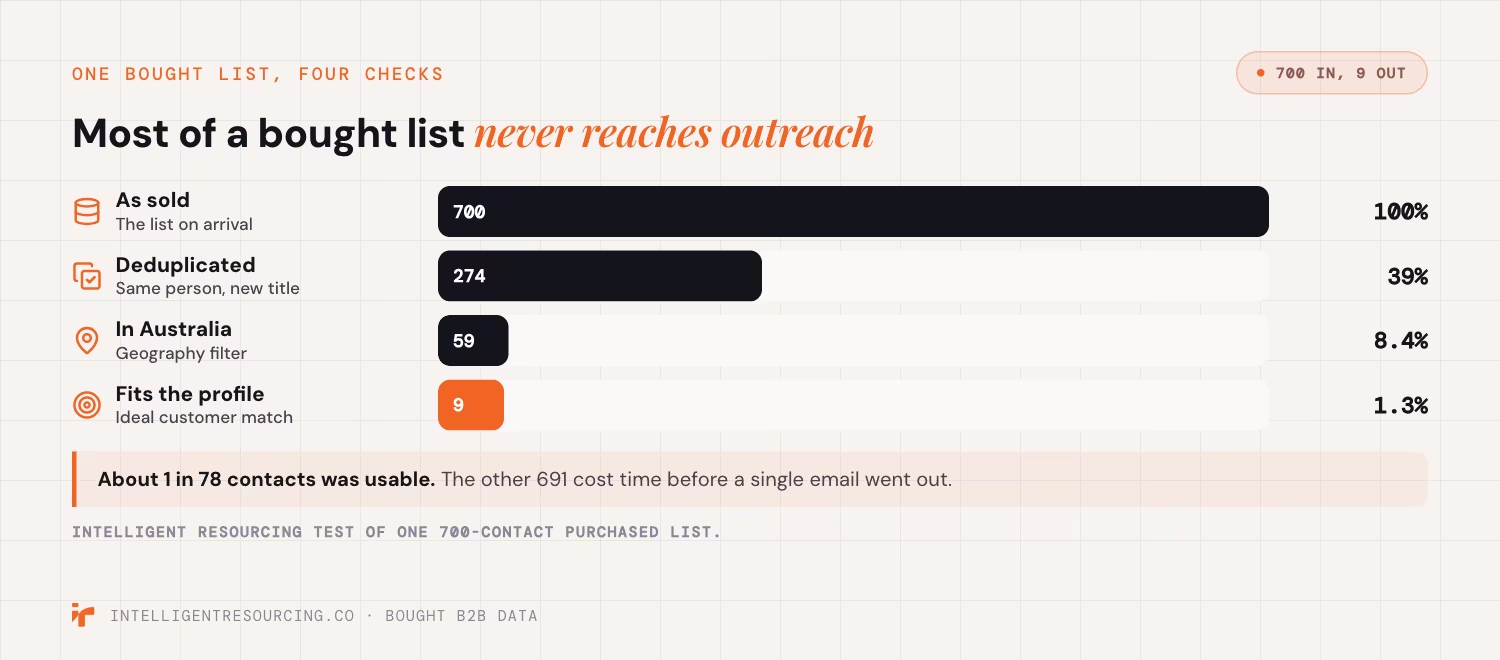
| Stage | Contacts remaining | What it removes |
|---|---|---|
| Starting list | 700 | The list as sold |
| After deduplication | 274 | The same contact sold under a different title |
| After geography filter | 59 | Contacts outside Australia |
| After ideal customer profile (ICP) match | 9 | Contacts outside the defined ICP |
Chasing down what survives still costs time. ZoomInfo's data quality guide puts the loss at roughly 27% of sales development rep selling time spent on bad data. In that test, only 9 of 700 contacts proved usable. That time is already spent before one reply arrives.
Lists built through signal-led Clay workflows start from owned data instead. That loss happens once, during enrichment, not every time someone buys a new list.
Why Do Purchased Lists Bounce More Than Lists You Build?
A purchased list bounces more because nobody on it opted in, and the gap is wide enough to damage a sending domain inside one campaign.
| List source | Typical bounce rate |
|---|---|
| Verified list, built from owned CRM | Under 1% |
| Purchased list, broker-sold | 10 to 20% |
Bounce rate is not just a wasted send. Mailbox providers read a high bounce rate as careless sending and throttle delivery in response. Instantly's provider comparison confirms the gap above. Every bounce makes the next real email less likely to land.
A small, focused target list feels this damage fast. That is why the Australian accuracy gap between providers matters more in a small market like Australia.
Why Can't You Trust the Company Size Fields on a Bought List?
Employee count and revenue fields on a purchased list are modelled guesses, not verified facts. A listed headcount can sit far from the real number, and nothing on the list shows which records are wrong.
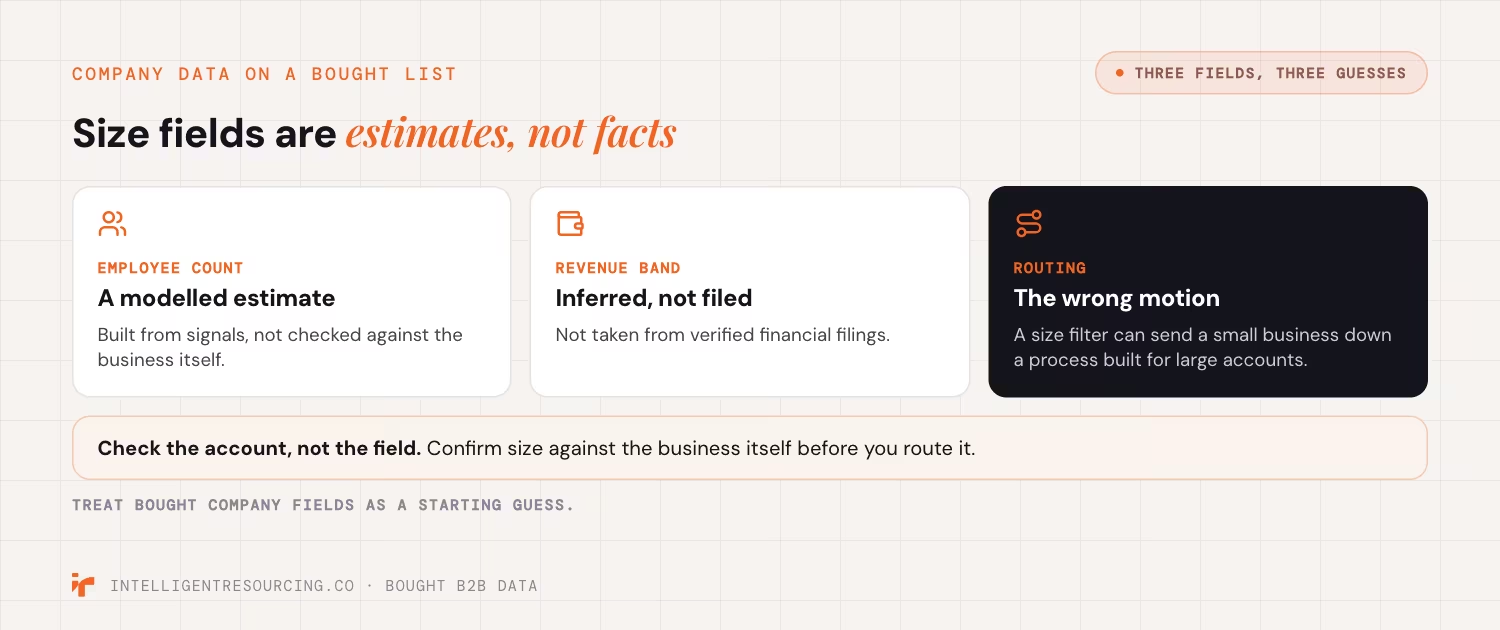
This is not a rare miss: Apollo's guide to company data fields says revenue and employee count fields are modelled estimates, not verified facts.
Three ways this plays out on a bought list:
- Employee count is a modelled estimate. Apollo puts global employee counts at plus or minus 20 to 40%.
- Revenue band for a private company is a modelled range, not a verified financial filing.
- A wrong field misroutes the account, not just mis-sizes it. Inside go-to-market (GTM) Engineering scoring, a 100-person filter can send a 9-person business down the wrong motion.
What Compliance Risk Comes With Buying an Australian Contact List?
Buying a contact list in Australia usually means buying a consent problem too, and the risk sits in three places.
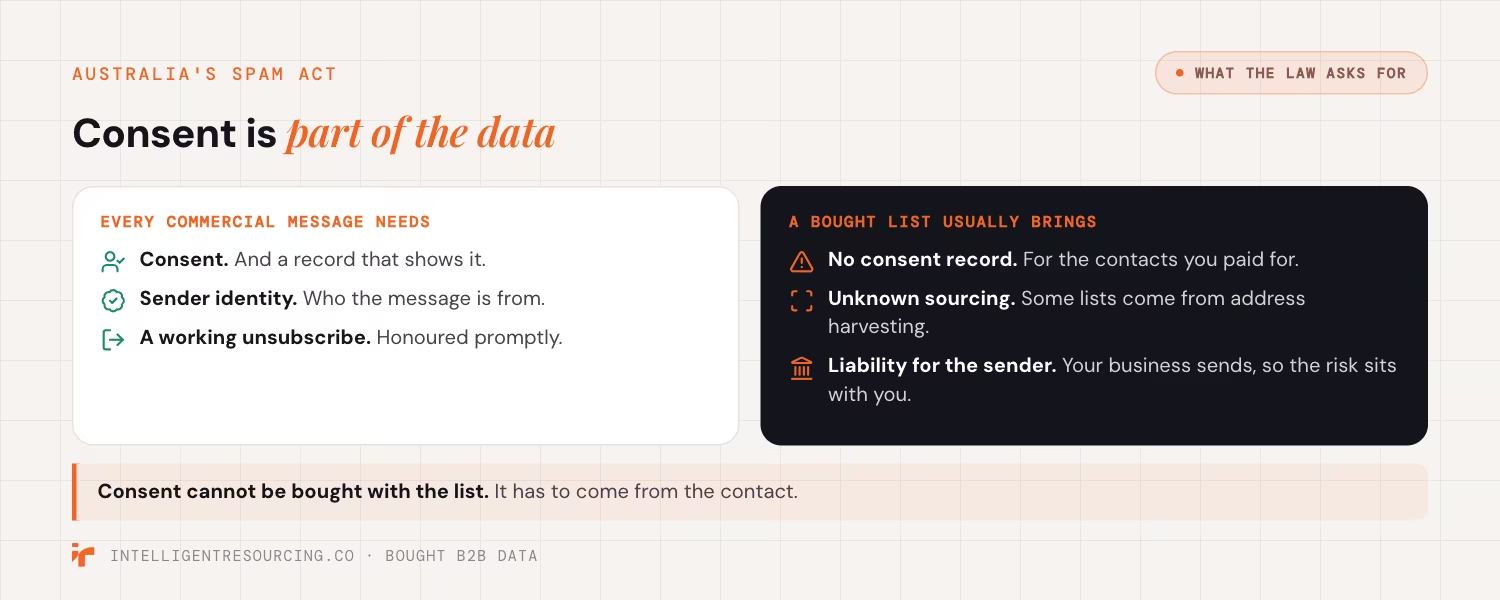
- No documented consent. The Spam Act 2003 requires consent, express or inferred, and the sender must be able to show it. Many purchased lists cannot.
- Harvested-address lists are banned for spam. Supplying, buying or using a harvested-address list to send spam breaks the Act, and some broker lists may be built this way.
- Enforcement is real, not theoretical. The Australian Communications and Media Authority fined Lululemon $702,900 in March 2026 for emails with no unsubscribe option. Businesses paid more than $6.7 million in spam penalties over the previous 18 months.
A bought list's compliance gap surfaces only once a complaint does, after the campaign has run. The same risk sits behind the cost covered in how B2B contact data decays. Contacts a business builds itself can carry a consent record from day one.
What Actually Fixes a Stale List, Buying Again or Enriching?
Buying a fresh list resets the clock on the same problem rather than fixing it; enrichment fixes the cause instead.
| Approach | What it does | Result |
|---|---|---|
| Buy a new list | Replaces the records once | Starts decaying again immediately |
| Enrich existing records | Updates records as they change | Stays accurate between campaigns |
The gap shows up fastest in who gets contacted. Adverity's 2025 survey of chief marketing officers (CMOs) found CMOs estimate 45% of the data behind marketing decisions is incomplete, inaccurate or outdated. A bought list already lost most contacts to deduplication and ICP mismatch. What survives is built to repeat that error.
Intelligent Resourcing's CRM Enrichment treats the record as something to maintain, not repurchase. Contacts stay accurate as roles and companies change. The next campaign starts from a list that is accurate today.
Stop paying for the same stale list twice. See how CRM Enrichment keeps Australian B2B contact data accurate between campaigns, not just on delivery day. See CRM Enrichment
Lead Generation
See how CRM enrichment keeps Australian contact and company records accurate between campaigns, inside your own CRM.
FAQs
What does it mean for B2B data to go stale?
Stale B2B data is a contact or company record that no longer matches reality. Examples: a person who changed jobs, a wrong company size, or an address that no longer works. A bought list can be stale on day one if nobody verified the records first.
How fast does a purchased B2B contact list lose accuracy?
A purchased list loses usable volume immediately, not gradually. In one 700-contact list, deduplication, geography and ICP checks cut the usable count to 9 contacts before outreach began. Separately, purchased lists bounce at 10 to 20%, against under 1% for verified lists.
Is it illegal to buy an email list in Australia?
Buying a list is not automatically illegal, unless it was built by address harvesting. Using it to send commercial messages can breach the Spam Act 2003 unless the recipients consented, and the sender must be able to show that consent. Many purchased lists cannot. That puts the buyer at legal risk, not just the seller.
Can enrichment fix a bought list, or do you need to start over?
Enrichment can repair salvageable records. It corrects firmographic fields and confirms contacts that are still accurate. It cannot create consent that was never obtained. A list with a genuine consent gap still needs replacing, with contacts built from owned, consented sources.
How do you check a list's quality before you buy it?
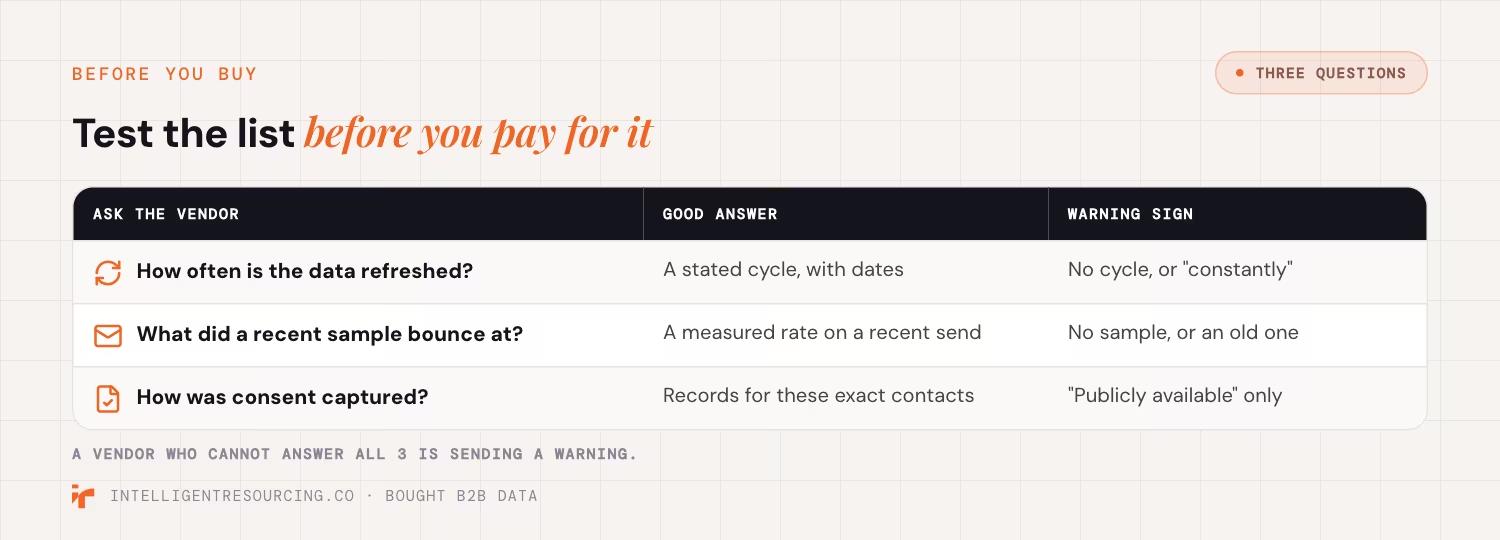
Ask the vendor for its refresh cycle, its bounce rate on a recent sample, and proof of how consent was captured for those exact contacts. A vendor who cannot answer all three is sending a warning. Expect the list to behave like the 700-contact example above.