

Why Is Solar Lead Generation Suddenly Its Own Marketing Category?
Rooftop solar installations hit their strongest 6 month total since 2021. The first half of 2026 saw 180,878 systems installed, up 35% on the year before. That growth is pulling specialist marketing agencies into the category. A solar buyer's decision looks nothing like a typical home services enquiry.
A typical 6.6kW home system costs $5,000 to $8,500 installed, and buyers compare several quotes. A generic marketing agency will not check the factors a solar buyer weighs:
- Roof orientation and shading
- Government rebate and scheme timing
- Whether the buyer owns or rents the property
Batteries are now installed faster than solar, at 153 for every 100 rooftop systems in the first half of 2026. That adds a second, targeted product to most campaigns.
That complexity is why agencies split their work by buyer type. Residential, commercial and battery storage buyers each get separate campaigns and keywords. Some agencies publish a separate case study for each.
What Should You Check Before Choosing a Lead Generation Model?
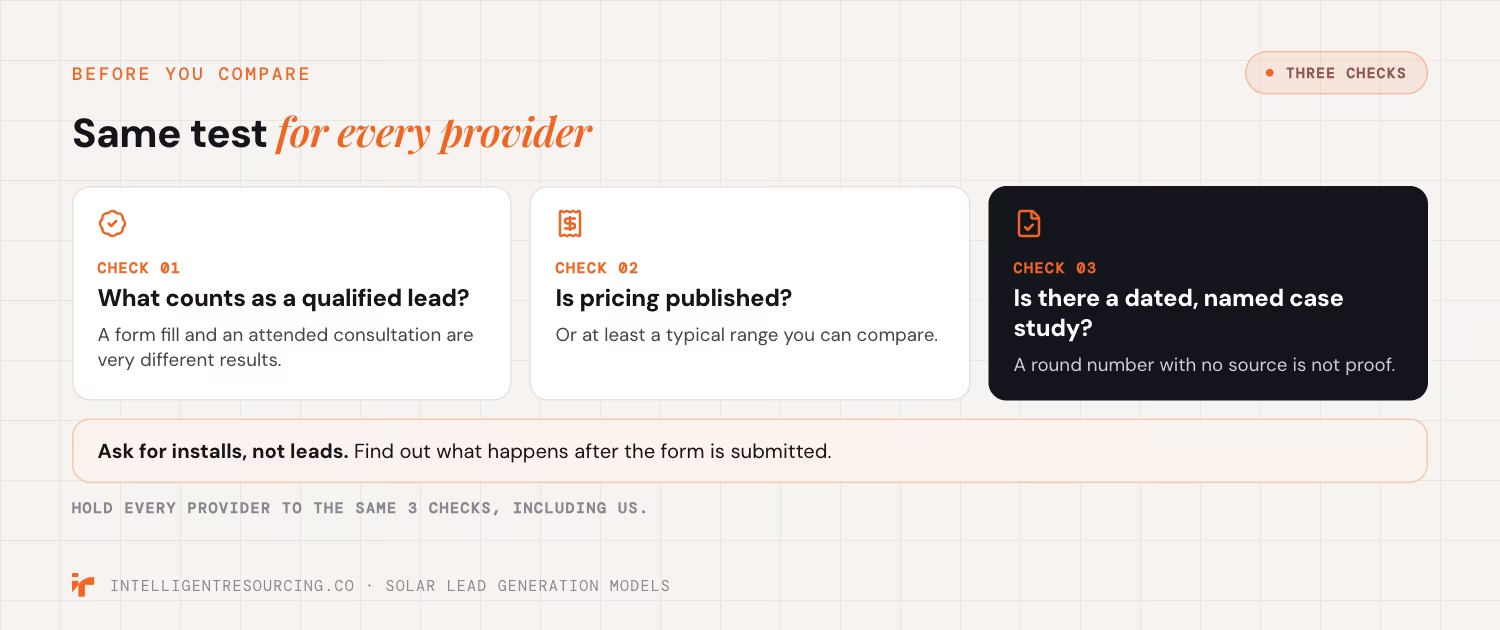
Check what each agency sells. Check whether it publishes pricing, the way Intelligent Resourcing publishes its rates. Check whether its proof is a dated case study or a round, unsourced number.
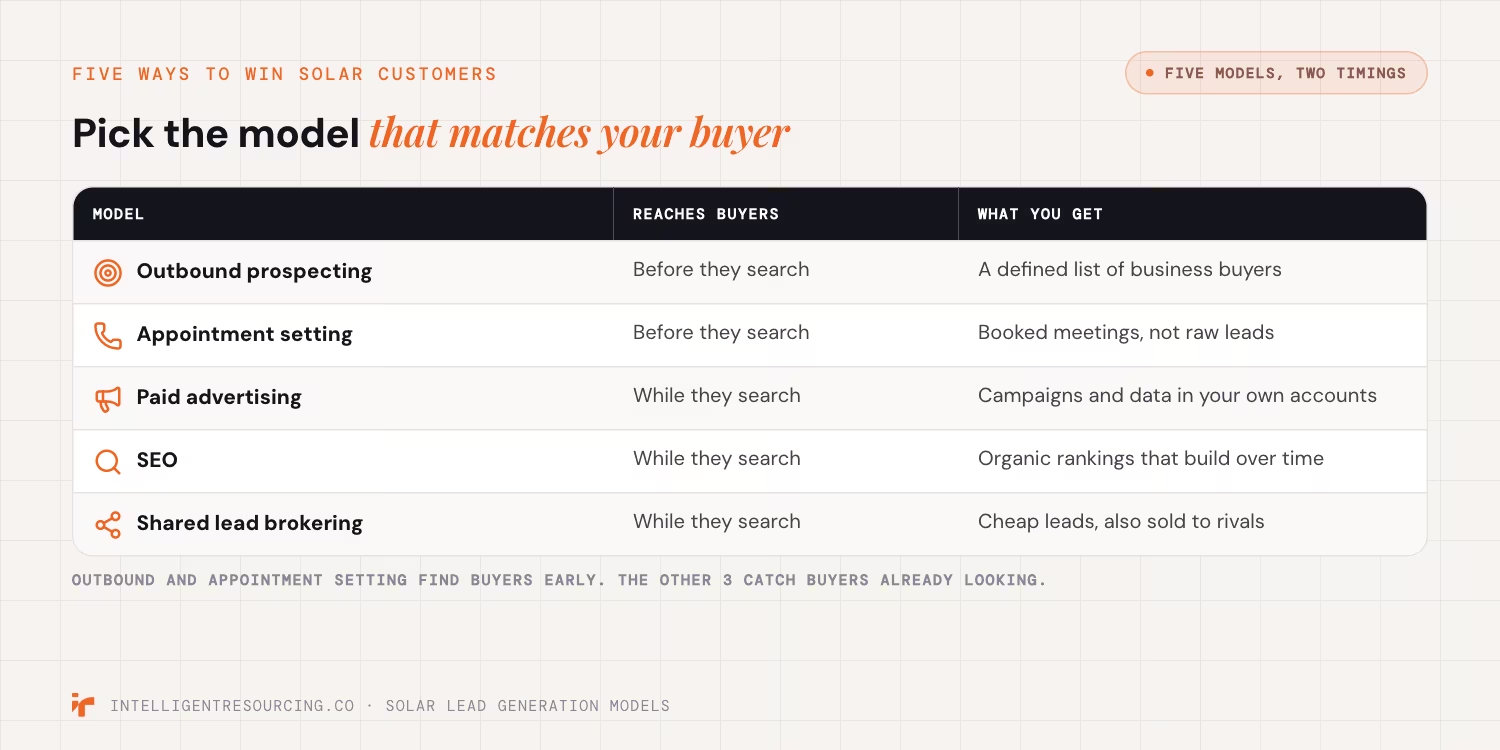
The list below starts with outbound prospecting, the most hands-on model. It ends with SEO, the narrowest single-channel service.
That ordering is a selection choice, not a performance ranking. Every claim below was checked on each agency's own site on 30 October 2026. Every agency, including Intelligent Resourcing, is held to the same test.
Run 3 checks before you sign:
- What counts as a qualified lead? A form fill and a booked, attended consultation are very different results.
- Is pricing published, or at least a typical range? The Australian Competition and Consumer Commission (ACCC) says any claim about cost, savings or rebate eligibility must be "accurate, truthful and based on reasonable grounds".
- Is there a dated case study naming a real client? A round number with no source is not proof.
Which Providers Run Each Solar Lead Generation Model?
Seven agencies run a dedicated solar marketing practice with enough published detail on their own site to check. 2 run outbound prospecting, 1 runs appointment setting, 3 run SEO or paid advertising, sometimes combined, and 1 sells shared leads at a flat rate.
Outbound model: Clean Energy Group
AI-driven outbound for large commercial solar deals.
Offices in Sydney, Houston and London. Clean Energy Group uses AI and a database of more than 79 million commercial property contacts. It finds decision makers, such as sustainability directors and facilities managers. It then books meetings for commercial solar projects from 30kW to over 5MW.
It uses cold email and LinkedIn outreach instead of paid advertising, with no lock-in contract (stated).
Best for: engineering, procurement and construction (EPC) firms and sales teams chasing large commercial or industrial solar contracts who want meetings booked directly with decision makers.
Limitation: its homepage calls it "the World's #1 Exclusive Solar Leads Agency", a claim with no named source. Its published results are global totals, such as "$1.8B of client pipeline created", not Australian figures.
For installers chasing residential volume rather than enterprise contracts, appointment setting is a closer fit.
Outbound model: Intelligent Resourcing
Signal-based outbound for solar businesses selling to other businesses.
Melbourne-based GTM Engineering firm. It builds systems that watch public business signals, such as new developments, facility expansions and compliance deadlines. They then score each account and route the best matches to outreach.
Intelligent Resourcing publishes signal-based outbound programmes for construction, logistics and manufacturing buyers, with attributed results shown for a logistics software client and a manufacturing client. Those buyers sell to other businesses, the same type as a commercial solar EPC.
Best for: commercial and industrial solar installers and EPCs selling to other businesses, not homeowners, who want a defined target list worked systematically instead of a stream of residential enquiries.
Limitation: no solar-specific case study is published yet. Its published GTM Engineering results are attributed by role and sector, not client name, so a solar-specific figure cannot be checked today.
For residential volume, appointment setting and paid-led models match buyer behaviour more closely.
Appointment-setting model: Energet
Phone-led appointment setting, with digital marketing as an add-on.
Established in 2021 and Australian-based. Energet works with solar and renewable energy retailers through telemarketing, email and short message service (SMS). Its team contacts homeowners and businesses directly. It discusses their energy situation and qualifies the enquiry.
It then books an appointment for an energy assessment and solar quote, and collects the customer's energy bill first. Pricing is pay-per-qualified-appointment, with no lock-in contract.
Best for: solar retailers without an in-house appointment-setting team who want booked meetings rather than raw leads to chase themselves.
Limitation: the company states it has generated "thousands" of leads and "millions of dollars" in client sales. It publishes no dated case study naming a specific client or figure.
Installers who want to run their own branded campaigns, rather than outsourcing the calling, need a different model.
Paid-ads model: Uprise Digital
Paid ads and search built for solar buyer psychology.
Melbourne-based agency running Google Ads, Meta ads, SEO and generative engine optimisation (GEO) for solar companies Australia-wide. It builds separate campaigns for residential, commercial and battery storage buyers. It writes its ad creative in-house. It reports qualified leads and return on ad spend (ROAS), not clicks.
Best for: established installers with a marketing budget who want an owned lead system instead of buying third-party leads.
Limitation: its headline 20.4 times ROAS and $58 cost per qualified lead are not tied to a named client. Its named solar case studies, X Tech Renewables and Macquarie Energy, report different figures, such as 150+ leads a month at $55 each.
For installers who want proven organic rankings instead of paid media, the next entry takes a different approach.
SEO model: Safari Digital
A Sydney SEO agency that publishes its own solar keyword rankings.
Sydney-based SEO agency running local SEO for Australian solar installers, manufacturers and comparison sites. Over 8 years, it states its in-house team has helped more than a dozen solar companies rank first for terms including "Solar Panels Sydney" and "Solar Battery." It focuses on local SEO, content, technical audits and link building, with no paid ads on its solar page.
Best for: installers who want organic-only growth and are comfortable waiting for SEO to build, rather than blending in paid media.
Limitation: its solar proof is one named case study, Captain Green Solar, with results dated November 2020 to November 2021, now five years old.
Installers wanting ads and after-hours automation alongside SEO have an option below.
Full-channel model: Itrootz
A Sydney-based team running SEO, ads and AI follow-up under one roof.
Full-stack digital agency based in Sydney, also serving Melbourne and Perth. It runs Google Ads, Meta ads, SEO and Google Business Profile management. An AI chatbot also answers and qualifies enquiries after hours. Itrootz sells tiered packages, named Starter, Growth and Authority, scaled to lead volume targets.
Best for: installers who want 1 team managing every channel, including after-hours lead response, without coordinating several vendors.
Limitation: the case studies shown on its own site, including a gym, a lighting retailer and a fitness brand, are not solar clients, so no solar-specific result can be independently checked.
Installers who would rather pay a flat fee per lead than retain an agency at all have 1 more option.
Shared-lead model: Solar Calculator
A consumer solar-education site that sells leads at a published, flat rate.
Runs a solar calculator, rebate guides and a short quote quiz aimed at homeowners researching solar, rather than selling marketing services to installers directly. Each completed quote request is passed to 3 installer companies at once, who then compete to win the job. Installers pay a flat per-lead fee with no contract or joining cost.
Best for: installers who want a transparent, published lead price and are comfortable competing against 2 other companies for the same enquiry.
Limitation: each lead goes to 3 installers, so it is a shared, not exclusive, lead model, and Solar Calculator requires that you "respond to the lead promptly".
What If You Already Know Your Solar Business Type?
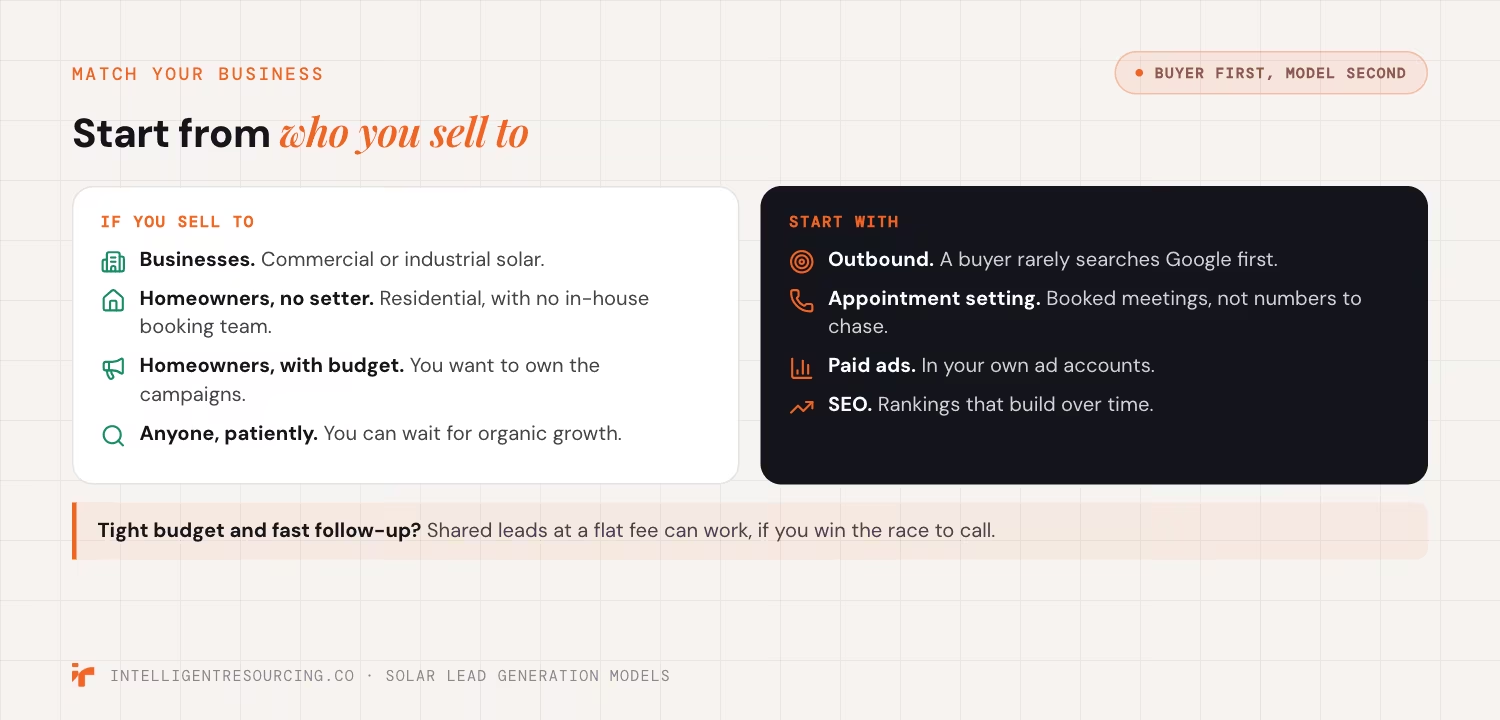
The right agency depends on who you sell to and whether you want to own the campaign or outsource it. Match your situation below rather than picking by price alone.
If You Sell Commercial or Industrial Solar to Other Businesses
Intelligent Resourcing and Clean Energy Group both fit this buyer type. Neither relies on a homeowner searching Google. Since 1 October 2026, the Small-scale Renewable Energy Scheme covers mid-scale solar systems from 100 kilowatts to 1 megawatt. The change aims to help businesses, farmers and community organisations install mid-scale solar.
Signal-based targeting suits this buyer better than a generic ad, since the account already shows a business trigger before anyone calls.
If You're a Solar Retailer Who Wants Booked Appointments
Energet suits installers without an in-house setter, since it hands over a booked meeting rather than a phone number to chase.
If You Want an Owned Lead System, Not Bought Leads
Uprise Digital fits installers with a marketing budget who want an owned lead system instead of buying third-party leads.
If You Need Every Channel Run By 1 Team
Itrootz combines SEO, ads, Google Business Profile and after-hours AI chat under 1 team. This suits multi-location installers who need 1 place to check whether a lead became an install.
If You Want Proven Organic-Only Growth
Safari Digital suits installers who want organic-only growth, without paid media in the mix.
If You've Already Decided On Signal-Based Outbound, Next Step
Book a strategy session with Intelligent Resourcing to map which commercial and industrial accounts in your service area are showing a buying signal right now.
If You're Already Paying An Agency, What Changes?
Check who owns your accounts and data before you sign with anyone new. An agency model only works long-term if that control stays with you, not the provider.
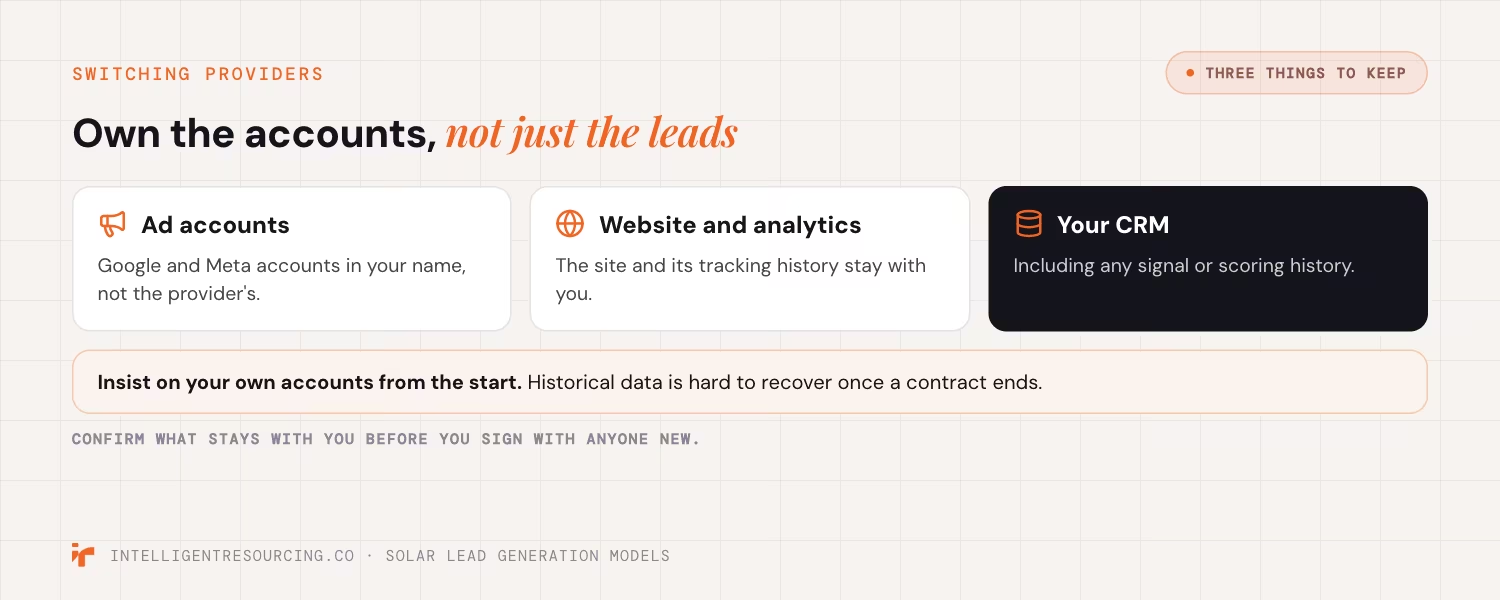
Before switching, confirm you keep:
- Your ad accounts, such as Google and Meta
- Your website and its analytics
- Your customer relationship management (CRM) system, including any signal or scoring history
Signal or intent-data systems, like Intelligent Resourcing's and Clean Energy Group's, feed your CRM. That CRM holds the signal history. Confirm it stays with you if you change providers.
Intelligent Resourcing already runs this same ownership model for construction lead generation, another vertical built on signal-based outbound.
Agencies that run campaigns under their own master account, not the client's, are a documented pattern in agency lock-in. Historical ad data and account access can be hard to recover once a contract ends. Insist on your own account from the start.
How Do You Choose a Solar Lead Generation Model?
- Clean Energy Group fits EPCs chasing large commercial contracts through AI-driven outreach to a global contact database.
- Intelligent Resourcing fits commercial and industrial solar sellers who want a signal-based target list worked through GTM Engineering.
- Energet fits solar retailers, residential or commercial, who want booked appointments from phone-led outreach.
- Uprise Digital fits installers who want an owned Google and Meta lead system, with a headline 20.4 times ROAS.
- Safari Digital fits installers who want organic-only growth, shown in its published number 1 ranking for "Solar Panels Sydney," a 2,400-search-a-month keyword.
- Itrootz fits installers who want 1 Sydney-based team running SEO, ads and after-hours AI follow-up.
- Solar Calculator fits installers willing to compete for shared leads at its published $40-plus-GST rate per solar lead.
For the same buyer-type split in an adjacent vertical, see our comparison of lead generation agencies for manufacturing and construction.
To judge whether any of these agencies are actually working, see how to measure lead generation results.
Lead Generation
See how signal-led lead generation finds commercial and industrial accounts showing a buying signal and routes them into your CRM.
FAQs
Which solar lead generation model is best in Australia?
It depends on who you sell to. Commercial and industrial sellers fit outbound specialists like Intelligent Resourcing or Clean Energy Group. Solar retailers without a setter, residential or commercial, fit Energet. Installers wanting an owned lead system fit Uprise Digital or Itrootz, and installers wanting organic-only growth fit Safari Digital.
How much does solar marketing cost in Australia?
Most agencies here do not publish a fixed fee. Intelligent Resourcing lists AUD$3,500 to $8,400 plus GST a month for GTM Engineering, Solar Calculator publishes $40 plus GST per solar lead, and Itrootz quotes Google Ads spend from $2,000 to $5,000 a month, before management fees.
Should a solar installer use outbound prospecting or SEO?
Neither wins everywhere. Outbound suits solar businesses selling to other businesses, where the buyer rarely searches Google first. SEO and paid ads suit residential solar, where homeowners already search for quotes.
How do I check if a solar lead generation agency's leads are actually exclusive?
Ask in writing how many installers receive each lead. Solar Calculator, for example, says each lead goes to 3 installers. Then ask when phone verification happens in the form. If a lead is verified before the form can be submitted, a fake or copied number cannot get through. If verification happens after the lead is captured, the number may already be false by the time it reaches you.
Is it better to buy solar leads or build an owned marketing system?
Buying leads is faster to start but ties ongoing cost to every enquiry. An owned system, built through SEO or signal-based outbound, costs more upfront. But the audience, data and campaign history stay with your business if you change providers.