

Should You Build an In-House Data Team or Buy a Data Enrichment Service?
Buy a service if enrichment is a repeatable job without a full-time workload, and build in-house if you have steady work, unique data and a clear owner. The decision turns on 4 things: cost, speed, coverage and accountability. Write down the job first, then test each option on your own records.

List the fields you need enriched, how many records, how often and who checks the results. A job that fits 1 afternoon a week does not justify a hire. A job that runs daily across several systems can.
The useful question is which model gives you accurate records for your buyers soonest, with a named owner for quality. The same build-or-outsource logic applies on the sales side, as building or outsourcing a revenue team shows.
How Much Does an In-House Data Analyst Cost in Australia?
An in-house data analyst costs about AUD 145,600 a year at the median once super is added, before recruitment, tools and management time. Robert Half's Australian data puts the median analyst base at AUD 130,000 and the median data engineer at AUD 145,000. The base salary is never the full cost.
Robert Half's data analyst salary range shows AUD 115,000, AUD 130,000 and AUD 145,000 at the 25th percentile, median and 75th percentile. Its data engineer range shows AUD 125,000, AUD 145,000 and AUD 160,000. Both exclude bonuses, benefits and superannuation. The Australian Taxation Office (ATO) puts the super guarantee rate at 12%.
| Role | 25th percentile, loaded | Median, loaded | 75th percentile, loaded |
|---|---|---|---|
| Data analyst | AUD 128,800 | AUD 145,600 | AUD 162,400 |
| Data engineer | AUD 140,000 | AUD 162,400 | AUD 179,200 |
Loaded means base plus 12% super. Payroll tax and workers' compensation where they apply, leave loading, recruitment, a data source, tools and management time all sit on top. The median analyst costs about AUD 12,100 a month.
What Does a Data Enrichment Service Cost?
Service costs follow 5 models, and few providers publish an Australian-dollar price. Compare the total yearly cost per usable record, and look past the plan headline. Subscriptions, credits, per-record fees, application programming interface (API) usage and retainers all bill differently, so match each quote to the same output.
| Model | You pay for | Check |
|---|---|---|
| Subscription | Seats or platform access | What the plan includes |
| Credits | Each lookup or verification | Whether credits expire |
| Per-record fee | Each record returned | Whether failed matches charge |
| API usage | Calls to the service | Rate limits and overage |
| Retainer | A managed pipeline or build | What the fee covers |
Intelligent Resourcing publishes go-to-market (GTM) engineering prices of AUD 3,500 to AUD 8,400 plus goods and services tax (GST) a month, which is AUD 42,000 to AUD 100,800 a year before GST, with an optional GTM strategy session at AUD 1,500 plus GST for teams that want to scope the work first. That is a pipeline service and no data-only product, and the monthly price includes tool licences, data credits and artificial intelligence (AI) token costs.
An in-house hire still needs a data source. The fair comparison is the loaded salary plus the data and tools, against the service fee, matched to the same output.
What Does the Full Cost Look Like Side by Side?
Add the data source, tools and management time to the loaded salary, then compare the total with the service fee for the same output. The sum below uses made-up planning assumptions to show the method. Replace every figure with your own quotes and salaries.

| Yearly cost item | In-house analyst | Service only | Hybrid |
|---|---|---|---|
| Loaded salary (median, with 12% super) | AUD 145,600 | None | AUD 14,560 (10% of an analyst) |
| Data source subscription | AUD 6,000 | Included | Included |
| Tools and software | AUD 3,000 | Included | AUD 1,000 |
| Service fee | None | AUD 60,000 | AUD 60,000 |
| Total | AUD 154,600 | AUD 60,000 | AUD 75,560 |
The service fee, data subscription and tool amounts are assumptions, and no quotes stand behind them. The gap in this example is AUD 94,600 between the in-house and service-only totals. It is real only if the service delivers the same coverage and quality, which the next sections test.
The example leaves out recruitment, management time and payroll tax for the hire, which push the in-house figure higher. It also leaves out the cost of weak coverage, which can exceed any fee difference.
Does an In-House Team Miss Accounts a Standard Database Cannot See?
It can, and for some buyers this matters more than cost. A team that builds lists from 1 database inherits its blind spots. This applies most where your buyers are physical sites such as depots, plants or branches, and less where they are digital-first companies a database indexes well.
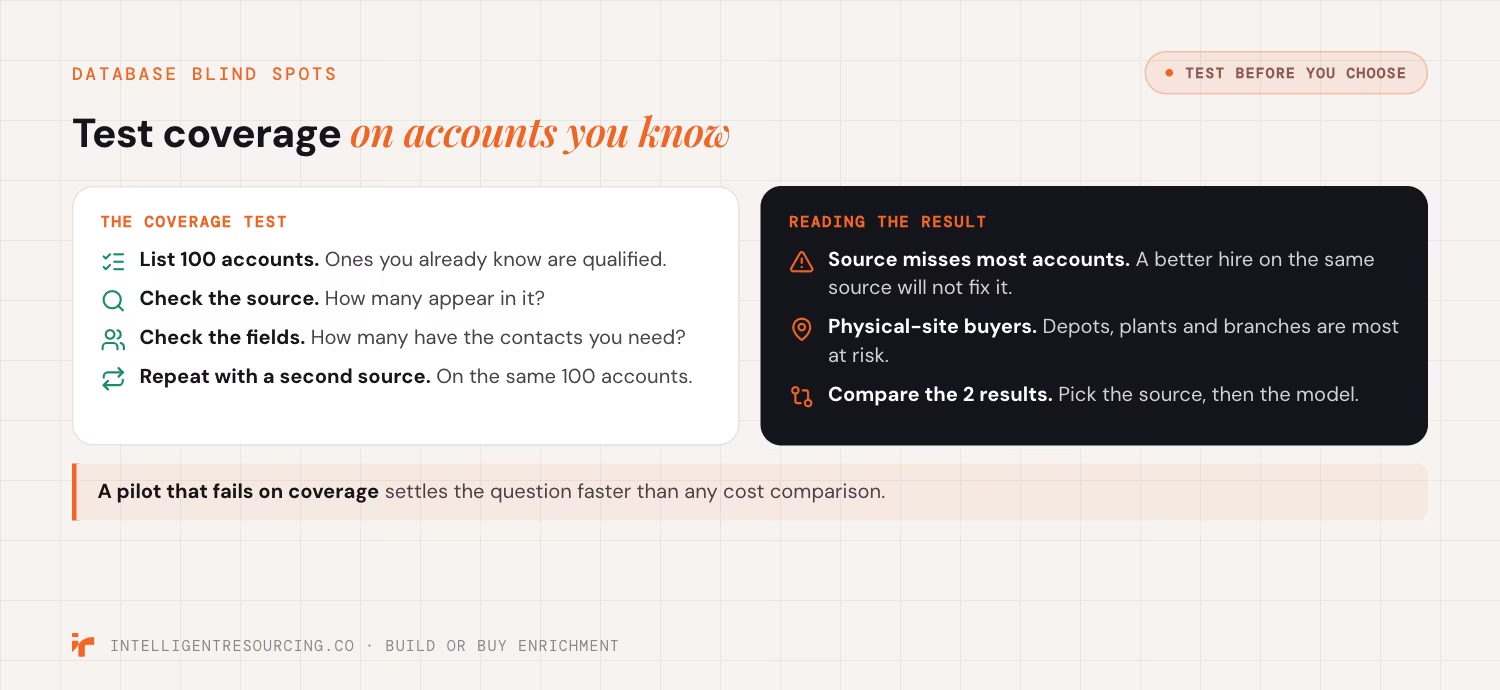
Test your own coverage before you choose either path:
- ☐ List 100 accounts you already know are qualified.
- ☐ Check how many appear in the database or provider you are considering.
- ☐ Record how many have the contact fields you need.
- ☐ Repeat with a second source.
- ☐ Compare the 2 results on the same 100 accounts.
If a source misses most of your known accounts, a better hire working from the same source will not fix it. A service that finds accounts from other sources, or a build that adds them, will. Database blind spots show up first in list-building, which is where AI prospecting and human list-builders differ.
Demandbase's 2025 buyer research found that 72% of business-to-business (B2B) purchases involve multi-stakeholder complex buying groups, so check whether each model maps several roles per account.
When Does a Hybrid Model Make Sense?
A hybrid fits many mid-sized teams: keep rules and quality control in-house and buy data and runs from a service. You hold the matching rules, protected fields and the review step, and the vendor supplies sources and scale. That keeps accountability and context with you and avoids paying for idle capacity.
| Task | In-house owner | Service role |
|---|---|---|
| Field priorities and rules | Revenue Operations (RevOps) | Advises |
| Source data and enrichment runs | None | Supplies and runs |
| Matching and overwrite rules | CRM administrator | Follows the spec |
| Quality checks and exceptions | RevOps | Fixes what fails |
| Privacy review and suppression | Privacy owner | Complies with the contract |
The test for a hybrid is simple: 1 named person owns quality, and the vendor can be switched without losing your rules. If you cannot name that person, neither model will keep the data accurate.
What Should a Pilot Test Before You Commit?
A pilot should test coverage, accuracy, fill rate, time to first run and contract terms on your own records. Run it with a service before you hire, or with a small sample before you sign a long contract. Set the pass marks in writing before the pilot starts, so a good-looking result does not change the standard.

- ☐ Coverage: how many of 100 known qualified accounts the source finds.
- ☐ Accuracy: how many matched records are correct on a hand-checked sample.
- ☐ Fill rate: the share of the fields you need that come back populated.
- ☐ Time to first run: days from start to a result that passes your checks.
- ☐ Terms: where data is processed, what happens on exit and who handles corrections.
A pilot that fails on coverage settles the question faster than any cost comparison. Data quality also depends on connected systems: Salesforce's 2026 State of Sales research found that 51% of sales leaders using AI said disconnected systems were slowing their AI work.
How Do You Decide?
Decide on 4 questions: how steady is the workload, how well does a standard database cover your buyers, who will own quality, and what does the full cost add up to? Answer them with your own numbers. If the answers point both ways, run a pilot with a service before you hire.
| If this is true | Then lean towards |
|---|---|
| The job is under a day a week | A service |
| The database misses most of your known accounts | A service or build that adds other sources |
| You have unique first-party data and steady work | In-house |
| You have no data owner | A service, with a named internal reviewer |
| Records include sensitive personal data or an offshore vendor | A contract review before either |
Tool and data costs sit outside the salary line, as the work on true GTM stack costs shows. Before deciding, compare loaded in-house cost with the service fee for the same output, include the ramp and ask the provider for a sample run on your own records.
CRM enrichment work keeps records accurate and tied to segmentation, and signal-led lead generation connects clean records to outreach. Intelligent Resourcing builds and manages the system inside the client's own CRM and documents the workflows so the system is the client's to own. Still ask for a written offboarding map that shows what stays in your CRM and what stops.
Lead Generation
See how CRM enrichment keeps records accurate inside your own CRM, with rules and quality checks you keep.
FAQs
Is an in-house data team cheaper than a data enrichment service?
It depends on the workload. A median analyst costs about AUD 145,600 a year with super before tools, recruitment and a data source, and a service fee wins only if it delivers the same coverage and quality. Compare both on cost per usable record, using your own quotes.
How long does it take an in-house team to deliver?
It depends on hiring and build time, and no measured ramp exists for a data role. Count recruiting, onboarding, rule building, a pilot and sign-off, then measure your own date for the first run that passes quality checks. A pilot on your records shows what a service can do faster.
How do you test coverage before choosing a model?
List 100 accounts you already know are qualified, check how many each source finds, and record the fields returned. Repeat with a second source and compare on the same accounts. A source that misses most known accounts will not improve by hiring a better analyst.
Who is responsible for privacy when I use a data enrichment vendor?
You remain accountable. Under Australian Privacy Principle (APP) 8, disclosing personal information to an overseas recipient requires reasonable steps to ensure the recipient follows the APPs, and the discloser stays accountable. Check processing location, contract terms and how corrections are handled before you upload any records.
When does a hybrid model work best?
When 1 named person owns quality and the matching rules, and the vendor supplies sources and runs. You keep control and context, avoid paying for unused capacity, and can switch the vendor without losing your rules. Without a named owner, neither model keeps the data accurate.