

What Is a First Revenue Team (and Who Belongs in It)?
A first revenue team is the group of go-to-market functions that converts a funded product into repeatable pipeline and closed revenue. It is not the finance team and it is not the product team. It is the revenue engine: the people and systems that find the right buyers, qualify them, close them, and make the whole motion measurable.
Treat it as a system rather than a stack of job titles. Hiring "a salesperson" buys busy activity. Building a repeatable path from stranger to signed contract buys a machine you can tune. The best-performing companies have already made that shift. ICONIQ's State of Go-to-Market 2026, drawing on 150 or more B2B software GTM leaders from early to late stage, found that high AI adopters run leaner GTM teams at every revenue band, and that the same revenue is being generated with fewer people. The advantage is going to teams that build leverage, not teams that add seats.
What Are the Core Roles and What Does Each Own?
A first revenue team runs on 5 roles, and each one owns a distinct piece of the motion from first touch through to signed contract. Of the 5, 2 generate demand, 1 closes, and 2 build and maintain the systems underneath. Early-stage teams rarely fill all 5 at once, but every one of these jobs gets done by someone, including the founder.
- SDR/BDR: top-of-funnel outreach and qualification. They start conversations and book meetings.
- Account Executive (AE): closing. They run discovery, manage the deal, and sign the contract.
- RevOps: systems, data, and process. They own the CRM, reporting, and the definition of a qualified lead.
- GTM engineer: tooling, enrichment, and automation. They build the plumbing that feeds the other roles with clean data and live buying signals.
- Lead generation: the demand and list-building function that fills the top of the funnel with the right accounts.
These are 5 disciplines with different economics, not 5 flavours of "salesperson". The closing role alone now carries its own annual benchmark study: The Bridge Group's 2026 AE research, collected across 158 B2B companies, tracks ramp, retention and quota for Account Executives separately from every other seat. Budget and manage each role on its own numbers.
The GTM engineering vs RevOps distinction trips up most founders. RevOps owns the system of record and the process. The GTM engineer builds the automated workflows that move data through it. Early on, one person covers both.
What Can You Leave Out at First-Revenue Stage?
You do not need a VP Sales or a CRO at first-revenue stage. Those are scaling hires: they earn their cost when there is a team to manage and a proven motion to multiply. Hiring senior leadership before you have a repeatable sale means paying executive salaries to invent a playbook from scratch. Prove the motion with operators first, then hire the leader to scale it.
If you need senior thinking without the senior salary, buy it by the hour. The Fractional Work Report 2026, built on 1,447 job postings and 1,733 survey responses, found a typical 10-hour-per-week fractional engagement costs roughly half the fully loaded cost of a full-time hire. Early-stage venture-backed startups are the largest buyer group in that dataset at 36% of tracked postings.
Why Does Build vs Outsource Matter More After a Funding Round?
The decision matters because a funding round changes the maths. Before the raise, you were spending your own runway. After it, you are spending investor capital against an explicit expectation of traction, and every hire changes your burn rate and your ramp timeline. CB Insights' venture capital funnel research, which tracked more than 1,100 US tech companies from their seed rounds onward, found nearly 67% of startups stall at some point in the VC process and fail to exit or raise follow-on funding.
The bar for traction has risen sharply since that research was published. CRV's Series A benchmarks report that median revenue at Series A reached US$2.5 million in 2025, roughly 75% higher than in 2021, and that the median gap between seed close and Series A close reached 616 days in Q2 2025. That is more than 20 months of runway to fund on a higher revenue bar. Every dollar spent on a slow or wrong hire is a dollar not spent closing that gap.
The build-or-buy question itself is older than any of this. Geyskens, Steenkamp and Kumar's transaction cost meta-analysis in the Academy of Management Journal synthesised the empirical research on make, buy and ally decisions and has been cited more than 900 times since. What changes after a raise is not the logic. It is the cost of getting it wrong.
What Does It Actually Take to Build a Revenue Team In-House?
Building in-house means owning the whole lifecycle: sourcing, recruiting, onboarding, ramping to productivity, and managing day to day. Done well, it buys control and institutional knowledge that compounds, because your team learns your product, your market, and your customers, and that knowledge stays in the building.
The cost is speed and front-loaded risk. Recruiting a strong SDR or AE in Australia takes weeks, and once hired, they do not produce on day one. The Bridge Group's 2025 SDR report puts average ramp time to full productivity at 3.0 months, the lowest since 2010 and down from a peak of 3.8 months in 2014. That is still 3 months of full salary for partial output, and the same research puts median SDR tenure at under 2 years with roughly 6 in 10 reps hitting quota. Add the founder-time cost, because someone senior must hire, onboard, coach, and manage that first team, and that is time not spent on product, customers, or the next raise.
Which Roles Should You Hire First?
Do not hire the whole team at once. Start with the 1 or 2 roles that produce the fastest pipeline signal. For most funded startups that means a strong AE, or a founder still running sales, paired with either an SDR for volume or a RevOps/GTM engineer for system efficiency.
Sequencing hedges against the churn and quota maths above. A 3.0-month ramp against median tenure under 2 years means a meaningful share of the employment period goes to getting productive rather than producing, and 4 in 10 reps do not reach quota at all. Hiring 5 people simultaneously multiplies that exposure and your burn before you know whether the motion works. Sequence the hires so each one proves value before the next arrives.
What Does It Cost to Build a First Revenue Team in Australia?
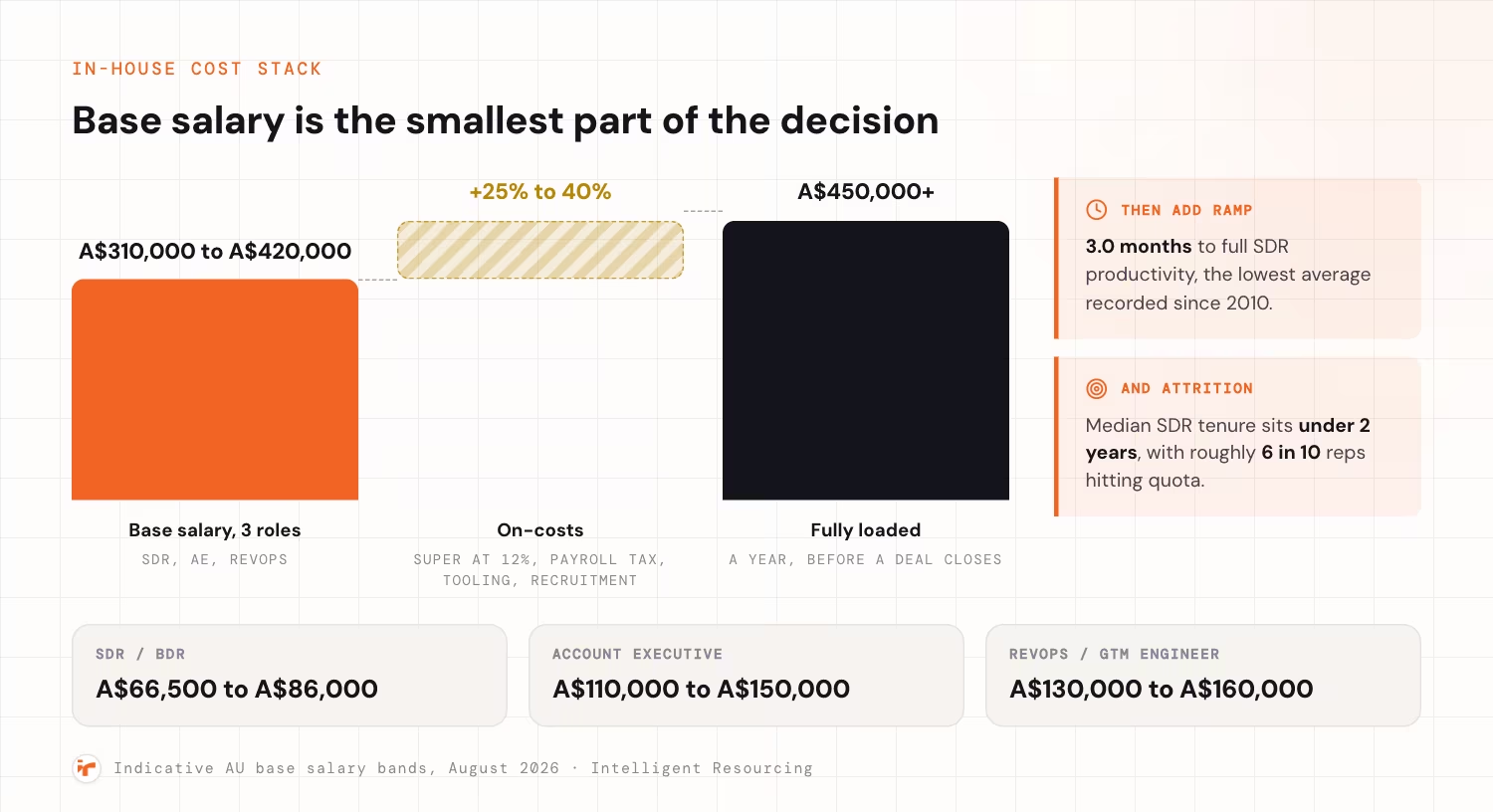
The loaded cost of a 2 to 3 person in-house revenue team in Australia is a material annual commitment, and base salary is the smallest part of the decision. On-costs, ramp lag, and recruitment fees sit on top of every band below. These are indicative base salary bands before on-costs, as of August 2026:
| Role | Indicative AU base (annual) | Notes on loaded cost |
|---|---|---|
| SDR/BDR | A$66,500 to A$86,000 | Add 25% to 40% for super, tooling, and ramp lag |
| Account Executive | A$110,000 to A$150,000 | Commission and OTE lift total well above base |
| RevOps / GTM engineer | A$130,000 to A$160,000 | Scarce skill set carries a recruitment premium |
QuotaClub's 2026 Australian SDR data puts SDR base at A$66,500 for junior roles rising to A$86,000 for senior. At the closing end, SEEK's salary data puts average Account Executive pay in information and communications technology at A$148,595 as of August 2026, at the top of the band above. Our own breakdown of GTM engineer cost puts a full-time GTM engineer at A$130,000 to A$160,000 in Australia, against A$250,000 or more to cover the same ground with separate specialists.
Superannuation, now 12% of ordinary time earnings since 1 July 2025, plus payroll tax, software licences, and recruitment fees together push the loaded cost 25% to 40% above base. A 3-person team therefore reaches or exceeds A$450,000 a year fully loaded, before anyone has closed a deal.
What Outsourcing Models Exist for a First Revenue Team?
Outsourcing is not one choice. It is 4, and they solve different problems. Buying the revenue function rather than building it is now mainstream rather than marginal: Deloitte's Global Outsourcing Survey for 2024, based on more than 500 executives, found 50% used outsourced services for front-office capabilities including sales and marketing, and 80% planned to maintain or increase third-party investment. In Australia the flexible-resourcing base is equally established, with the ABS Characteristics of Employment survey counting 1.1 million independent contractors in August 2025, or 7.6% of everyone employed.
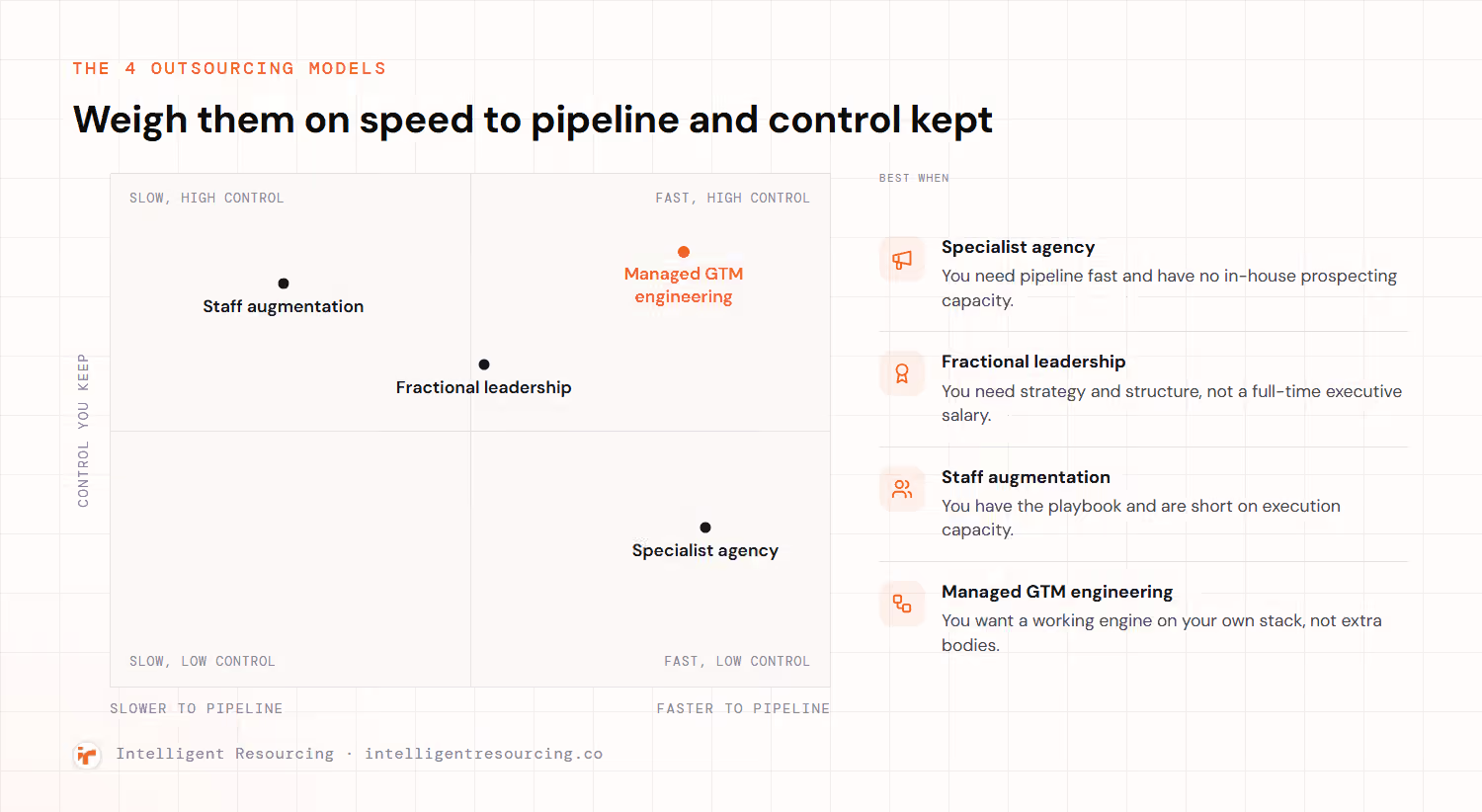
- Specialist agency (outbound/lead gen): a team that runs your top-of-funnel outreach end to end. Best when you need pipeline fast and lack in-house prospecting capacity. This is the model most lead generation engagements start with.
- Fractional leadership: a part-time senior operator such as a fractional Head of Sales or fractional RevOps. Best when you need strategy and structure but cannot justify a full-time executive.
- Staff augmentation: individual contractors who slot into your team and process. Best when you have the playbook but lack execution capacity.
- Managed GTM / GTM engineering: an external team that builds and runs your revenue systems and automation. Best when you want a working engine rather than extra bodies. Our roundup of GTM agencies for funded startups covers who operates this way in Australia.
How Do the Models Differ on Control and Speed?
Weigh the 4 models on 2 axes: how fast they produce pipeline, and how much day-to-day control you keep. Agencies produce pipeline fastest because they arrive with playbooks and tooling already working, and the trade is that you hand over more of the day-to-day. Fractional leadership keeps strategic control close while moving quickly, though execution capacity is capped by one person's hours. Staff augmentation keeps the most control because contractors work inside your process, and therefore it moves at the speed of your existing playbook rather than theirs.
What Does It Cost to Outsource Your First Revenue Team?
Outsourcing pricing comes in 4 shapes: monthly retainer for an agreed scope, per-qualified-lead, performance or success fee, and hybrid. Clutch's lead generation directory, updated August 2026, puts most engagements internationally in the US$10,000 to US$49,000 project band, with minimum project sizes starting at US$1,000.
Australian pricing is more useful read monthly. Our own B2B lead generation pricing breakdown puts the local market at A$2,500 to A$19,000 or more per month, splitting into 3 tiers: A$2,500 to A$5,000 for volume-led basic retainers, A$6,000 to A$10,000 for hybrid agency models, and A$11,000 to A$19,000 or more for premium programmes.
Compare that against the in-house equivalent on a like-for-like basis. Applying the 25% to 40% on-cost load to the SDR bands above puts a fully loaded in-house SDR at A$83,000 to A$120,000 a year, or roughly A$7,000 to A$10,000 a month, which buys 1 person carrying super, tooling, recruitment fees, and 3.0 months of ramp lag. The same monthly spend on a hybrid-tier retainer buys a team that is already ramped. Retainers suit teams that want predictable monthly cost and a consistent team. Per-lead models suit teams testing top-of-funnel economics with no long-term commitment. Performance models suit teams with clean deal data and a reason to share upside. Our breakdown of GTM partner ROI walks through modelling these side by side before you commit.
How Do Build and Outsource Compare Side by Side?
Here is the full comparison across the 7 factors a newly funded team weighs, with a Revenue Operations Studio shown against the 2 generic models:
| Factor | Revenue Operations Studio (Intelligent Resourcing) | Build in-house | Generic outsourcing |
|---|---|---|---|
| Speed to first pipeline | Weeks: systems installed on your existing stack | Slow: recruit plus ramp averages 3+ months | Fast: existing playbooks, weeks not months |
| Upfront cost | Low, retainer-based | High, front-loaded | Low, variable |
| Ongoing cost | Retainer | Fixed salary plus on-costs | Retainer or performance-based |
| Buyer intent signals | Yes: outreach fires on a Verified Buying Window | Only if you build the signal layer yourself | Rarely: volume-based sequencing |
| Full implementation | Yes: builds and runs the system, not just the campaigns | Yes, once the team has ramped | Campaign execution only |
| Works with any stack | Yes: runs on your existing CRM and automation stack, no rip and replace | Yes, at the cost of building it | Often locked to the vendor's tooling |
| Primary risk | Requires a defined ICP to fire signals against | Slow ramp, wrong hire, fixed burn | Vendor dependency, diluted narrative |
Outsourcing wins on speed, upfront cost, and flexibility, which are the constraints that bite hardest right after a raise. Building wins on long-term control and IP, which matters most once the motion is proven and worth owning. Erin Anderson set out the underlying logic in Marketing Science in The Salesperson as Outside Agent or Employee, a transaction cost analysis cited more than 550 times: whether a seller belongs inside the firm or outside it is a question about the cost of the transaction, not about loyalty. For a newly funded team with traction to show and runway to protect, the maths therefore argues for outsourcing the early execution while you decide what is worth building to keep.
What Are the Real Benefits of Outsourcing Your First Revenue Team?
The benefits are concrete rather than promotional, and each one traces back to a cost you avoid or a month you save. The gain is not cheaper labour. It is compressed time to a pipeline signal you can take to your next board meeting.
- Speed to pipeline: an experienced team arrives with playbooks, tooling, and process already working, therefore pipeline starts weeks rather than months after signing.
- Specialised expertise without the hiring cost: you access enrichment platforms, sequencing tools, and operators who use them daily, without buying the stack or funding the learning curve.
- Burn-rate flexibility: a retainer scales up or down with your needs, which protects runway in a way a salaried team cannot.
- Founder focus: outsourcing execution frees founders to stay on product, customers, and fundraising rather than recruiting and ramping a first team.
- Signal-led precision: at Intelligent Resourcing, outreach fires only when a Verified Buying Window opens, meaning a leadership change, a funding event, or a new tech install that signals a live buying opportunity. That precision separates signal-led execution from volume outreach that burns through your ICP list.
The biggest hidden cost of building first is where a new rep's week actually goes. Across multiple B2B clients, business development reps reported losing 40 to 60% of their working week to manual prospecting and data verification before the engine. One signed engagement is built to cut the time reps lose to research and validation from 50 to 60% of the week to under 15%. You are not just paying for a ramp period, you are paying a full salary for a half-time seller.
The output difference compounds from there. For one client brand, the engine produced 100 sales-ready account briefs in a single overnight run, each with verified site-level mapping. For a national multi-brand waste group, the engine delivered over A$3.5M in identified pipeline value across two brands, priced on the client's own formula. That is identified pipeline rather than booked revenue, and it is one engagement rather than a guarantee, but it is the scale of output a system produces while a first in-house hire is still in month one of a 3-month ramp.
The strategic point underneath these benefits is that scaling revenue does not require scaling headcount. Preserving runway by outsourcing execution early, rather than hiring ahead of proof, is the more durable path for a first revenue motion.
What Are the Risks of Outsourcing (and How Do You Manage Them)?
Outsourcing carries real risks, and every one of them is manageable with a contract term or an operating habit rather than a leap of faith. Here is an honest register, each risk paired with a concrete mitigation you can write into the agreement before you sign.
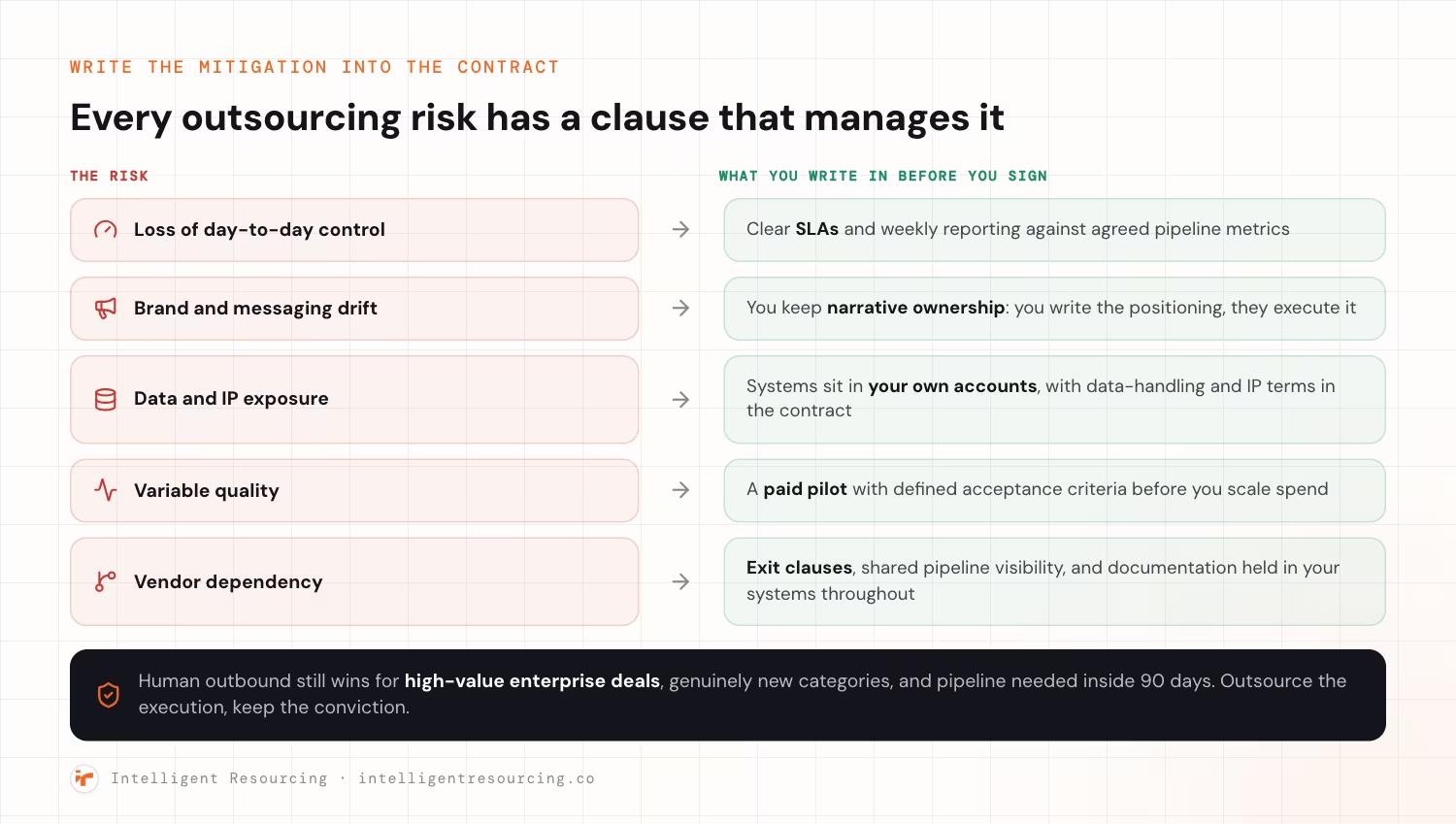
- Loss of day-to-day control: you see less of the execution. Mitigate with clear SLAs and weekly reporting against agreed pipeline metrics.
- Brand and messaging drift: an outside team dilutes your voice and ICP positioning over time. Mitigate by retaining narrative ownership, which means you write the positioning and they execute it.
- Data and IP exposure: your prospect data and playbooks leave the building. Mitigate with data-handling clauses, systems that sit in your own accounts, and clear IP terms in the contract.
- Variable quality: output swings between vendors and between operators inside the same vendor. Mitigate with a paid pilot and defined acceptance criteria before you scale spend.
- Vendor dependency: you become reliant on a partner you cannot easily replace. Mitigate with exit clauses, shared pipeline visibility, and documentation held in your own systems throughout the engagement.
There is also a category of work where outsourcing is the wrong call outright. Human outbound still wins for high-value enterprise deals, genuinely new categories, and pipeline needed inside about 90 days. If your motion sits in one of those 3, build the relationship in-house and outsource the systems around it instead. The principle otherwise holds: outsource the execution, keep the conviction. Hand over the work, not the strategy.
How Do You Decide Based on Your Round Size and Stage?
Make this a repeatable decision keyed to 3 inputs: round size, runway length, and GTM maturity. Round size matters more than it used to, because the capital is pooling at the top. The PitchBook-NVCA Venture Monitor reports US startups raised more than US$400 billion in the first half of 2026, with the overwhelming majority of that capital flowing to AI companies and mega-rounds. If your round was not one of those, you are competing for traction against teams that were, and spending discipline is the lever you control.
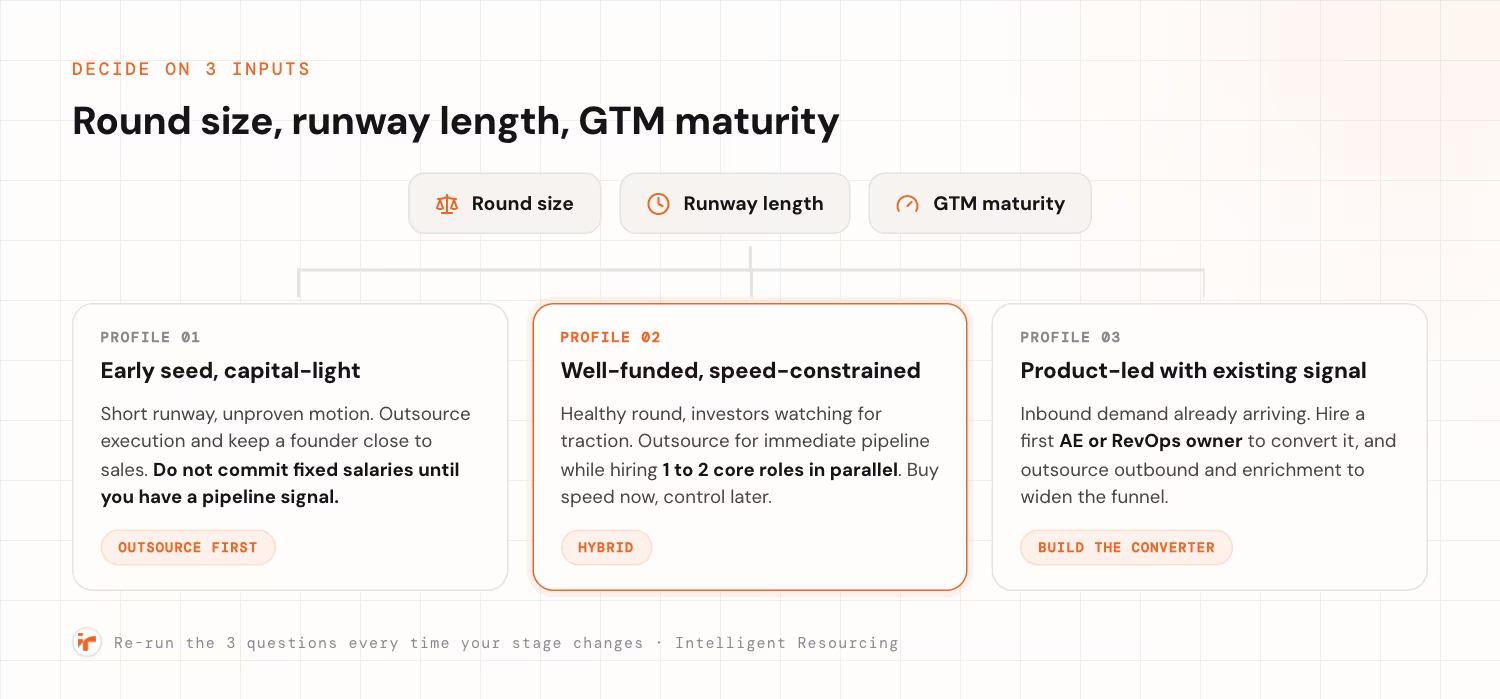
Run those 3 questions again every time your stage changes, because the right answer at seed is rarely the right answer at Series A. 3 profiles cover most funded teams:
- Early seed, capital-light: short runway, unproven motion. Default to outsourcing execution and keep a founder close to sales. Do not commit fixed salaries until you have a pipeline signal.
- Well-funded, speed-constrained: healthy round, investors watching for traction. Outsource for immediate pipeline while hiring 1 or 2 core roles in parallel. Buy speed now, control later.
- Product-led with existing signal: inbound demand already arriving. Hire a first AE or RevOps owner to convert it, and outsource outbound and enrichment to widen the top of the funnel.
What changes with stage is the ratio, not the framework. As the motion proves out and headcount grows, the case for building in-house strengthens, because the fixed cost is spread across a predictable volume of pipeline. The case for renting execution weakens at the same rate.
What Does a Hybrid Approach Look Like in Practice?
For most funded startups the pragmatic default is a hybrid: build the core, outsource the edges. Hire 1 or 2 roles in-house, typically a first AE or a RevOps/GTM engineer who holds your systems and strategy. Outsource the execution-heavy and specialist functions around them, which means outbound, enrichment, and GTM engineering delivered by a Revenue Operations Studio. This protects control and runway at the same time, because the decisions and the data stay with you while the capacity is rented.
Treating the outsourced side as permanent is the mistake. The same 2024 Deloitte survey found 70% of executives had selectively insourced scope previously held by a third party over the preceding 5 years, which makes bringing work back in-house the norm rather than a failure state. Plan for it from day one. The trigger is economic: internalise a function once its predictable pipeline volume justifies the loaded cost of a dedicated hire. Keep the documentation and systems current throughout the engagement so the handover is clean when the time comes.
Comparisons
Own the roles that compound, rent the execution you can buy off the shelf. Book a GTM audit with Intelligent Resourcing to design the build-vs-outsource mix that fits your round, your runway, and the motion you still need to prove.
FAQs
How much does it cost to build a first revenue team in-house in Australia?
Budget for loaded cost, not base salary. 2 to 3 roles covering SDR, AE, and RevOps or GTM engineer run from A$310,000 to A$420,000 in base pay. Superannuation at 12%, payroll tax, tooling, and recruitment add another 25% to 40% on top. That is a fixed annual commitment against your round, payable whether or not the motion is producing revenue.
What roles should my first revenue team include?
The core roles are SDR/BDR, Account Executive, RevOps, GTM engineer, and lead generation. You do not need all 5 on day one. Prioritise the 1 or 2 that produce the fastest pipeline signal, usually an AE to close and either an SDR or a GTM engineer to feed the funnel.
Is it risky to outsource your first revenue team?
Yes, and the risks are manageable. The main ones are loss of control, data and IP exposure, and variable quality. Mitigate them with clear SLAs, shared pipeline visibility, retained narrative ownership, a paid pilot, and exit clauses. Outsource the execution, keep the strategy.
When should you bring an outsourced revenue team in-house?
Use a trigger, not a date. Bring a function in-house once the pipeline is predictable, the playbook is documented and repeatable, and headcount has grown to the point where an in-house owner costs less and delivers more than the retainer. Selective insourcing is normal, so plan the handover at the start of the engagement rather than the end.
What is the difference between building and outsourcing a revenue team?
Building means you hire, own, and manage the team, which buys control and institutional knowledge but is slower and front-loaded. Outsourcing means you contract an external team, which buys speed and flexibility at the cost of shared control and vendor dependency. Most funded teams blend both: own the roles that compound, rent the execution you can buy off the shelf.