

What ROI benchmarks should a funded company expect from a GTM partner?
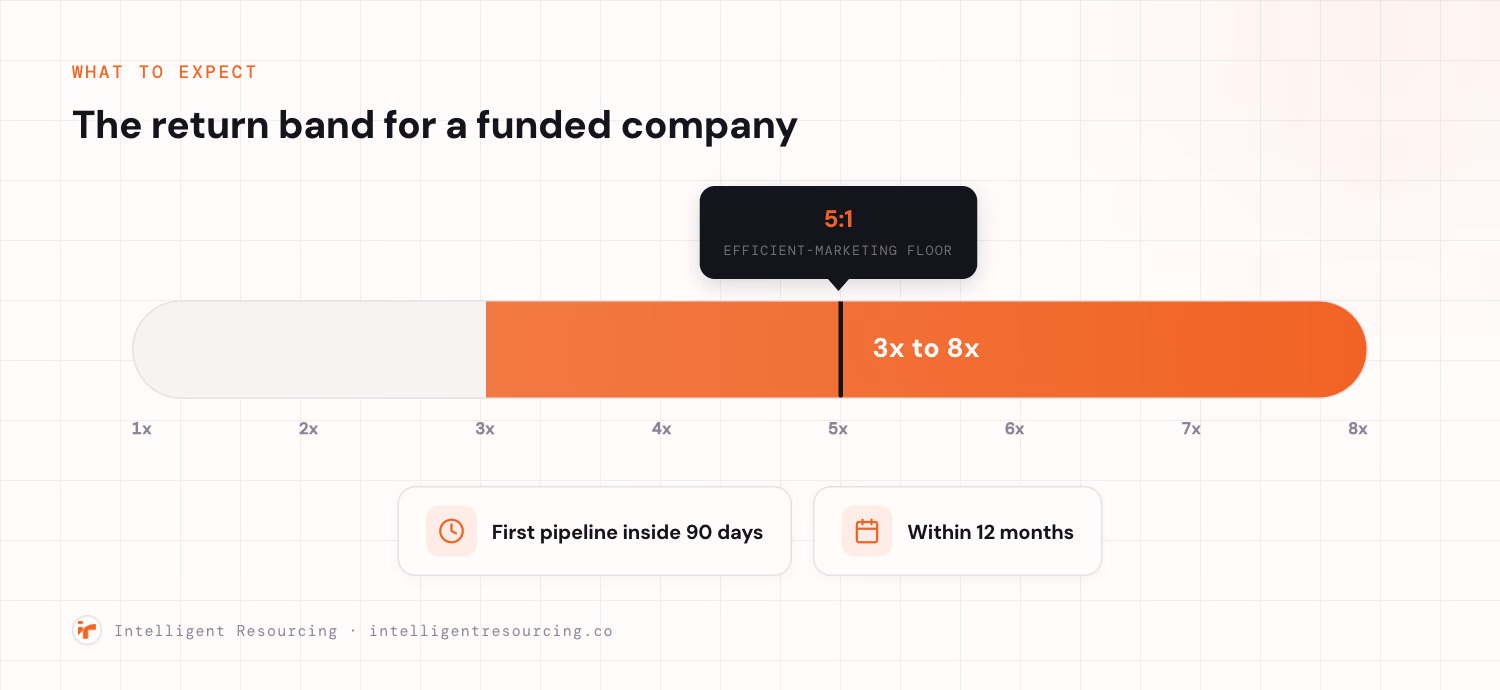
A funded company should expect a GTM partner to return 3x to 8x its cost. Signal-led motions return the first pipeline inside 90 days. At maturity, partnerships average 30% of total revenue across B2B companies, according to a Pavilion benchmark cited in Firmable’s 2025 guide, with 1.3x higher conversion than other channels. Funding stage shapes where you land: seed teams see faster payback on a smaller base; Series A and B teams post a larger absolute return.
Seed teams work off a smaller revenue base, so payback arrives fast but absolute dollars stay modest. Series A and B teams have more pipeline to convert. Their return is larger, though payback at those stages takes a full quarter.
Buyer patience is also shrinking, 57% of buyers now expect to see ROI from their software purchases in under 90 days, up from 47% who wanted it within 6 months a year earlier. The timeless principle underneath: payback windows keep compressing across B2B. A partner earning 3x to 8x is clearing a moving bar, not a fixed one.
How do you calculate GTM partner ROI?
GTM partner ROI compares the incremental revenue generated by the engagement with the total cost required to produce it. Count partner fees, tooling and supporting infrastructure in the investment, then measure sourced pipeline and closed revenue across the engagement. A clean numerator and an honest denominator produce a return you can defend to the board.
Per Digital Clarity’s 2025 guide, GTM ROI equals incremental revenue gain minus GTM investment, divided by total GTM investment.
GTM Partner ROI Formula
ROI = (Incremental Revenue − Total GTM Investment) ÷ Total GTM Investment
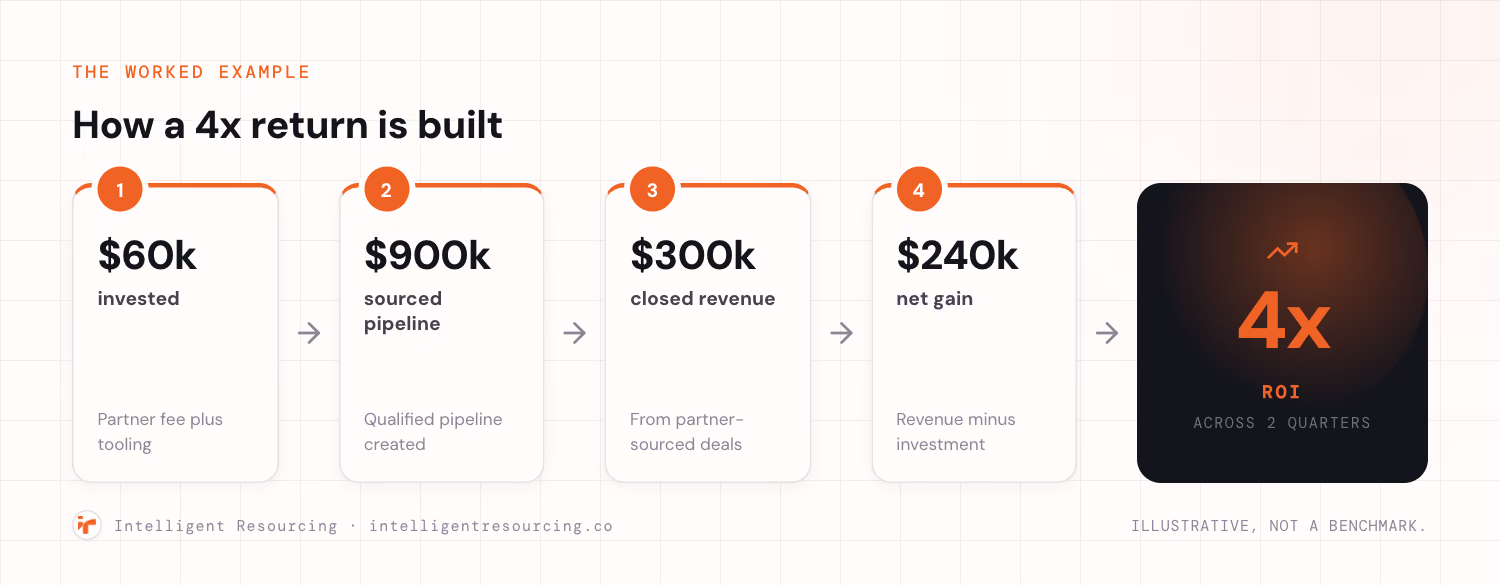
Take a simple illustrative case. A funded company invests $60k in a GTM engagement, including the partner fee and tooling. Over 2 quarters, the partner sources $900k in qualified pipeline, of which $300k closes as new revenue.
| ROI Input | Illustrative Amount | What It Measures |
|---|---|---|
| Total GTM investment | $60k | Partner fees, tooling and supporting costs |
| Partner-sourced pipeline | $900k | Qualified pipeline created by the engagement |
| Closed revenue | $300k | Revenue generated from partner-sourced opportunities |
| Net incremental gain | $240k | $300k revenue minus $60k investment |
| GTM partner ROI | 4x | $240k divided by $60k |
The result is a 4x ROI across 2 quarters. The example is illustrative, not a benchmark. The actual return depends on conversion rates, deal values, sales-cycle length and the quality of the underlying GTM motion. Intelligent Resourcing’s GTM engineering pricing provides the cost inputs needed to model the investment side accurately.
Small improvements also compound across the funnel. A higher inbound conversion rate increases the number of qualified opportunities entering the pipeline, while a higher close rate converts more of those opportunities into revenue. Their combined effect is larger because both improvements apply across successive stages of the same revenue system.
What does a GTM partner cost, and how does that compare to the return?
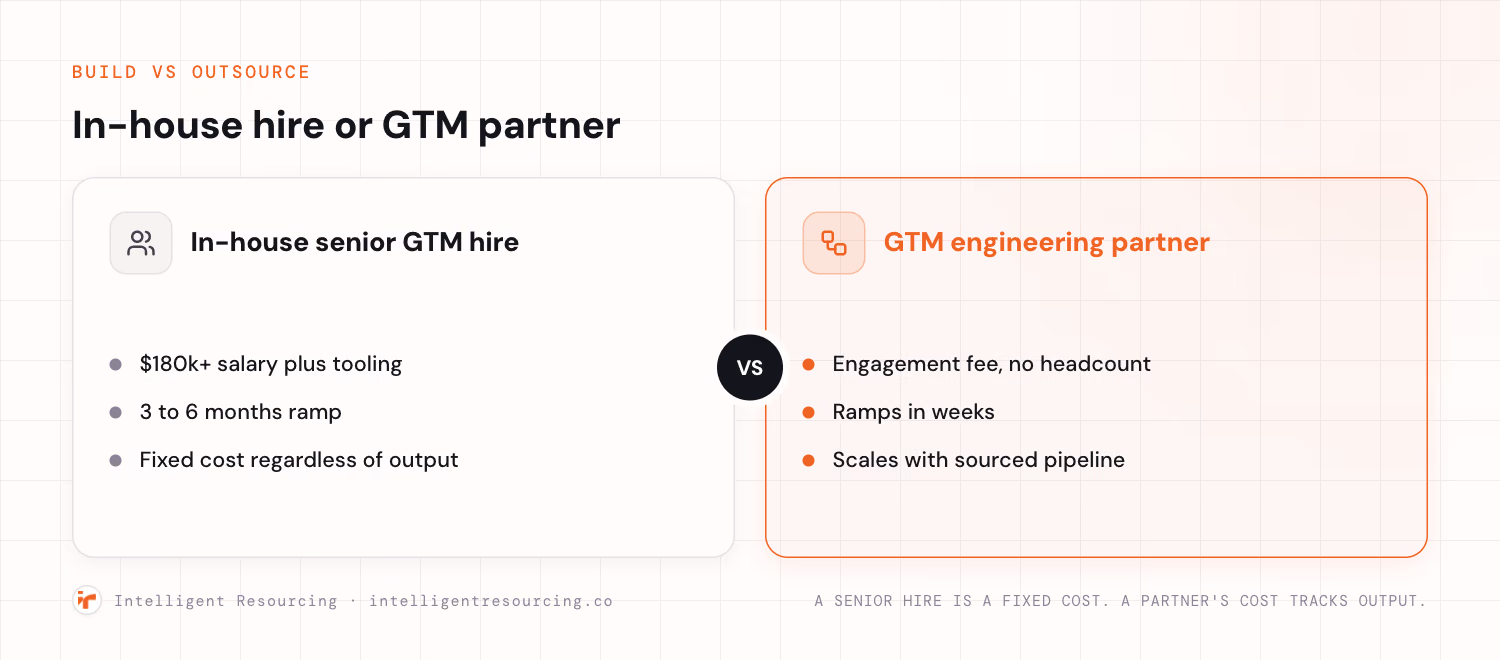
A GTM partner costs an engagement fee, not a headcount. A senior in-house GTM hire runs $180k or more in salary, plus tooling. The partner replaces several part-hired functions and shortens time-to-first-pipeline. An efficient B2B marketing motion returns roughly 5:1. A GTM engineering partner should clear that floor, because it targets sourced pipeline directly rather than campaign volume and sourced pipeline is a harder metric than campaign spend efficiency.
| Line item | In-house senior GTM hire + stack | GTM engineering partner |
|---|---|---|
| Annual cost (illustrative) | $180k+ salary plus tooling | Engagement fee, no headcount |
| Time to productive | 3 to 6 months ramp | Weeks |
| Return profile | Fixed cost regardless of output | Scales with sourced pipeline |
A senior hire is a fixed cost. You pay the salary whether the pipeline moves or not. A partner’s cost scales with sourced pipeline, so spend tracks output. Ramp matters: a new hire needs 3 to 6 months to reach productivity; a partner starts within weeks, which shortens time-to-first-pipeline.
Which Performance Metrics Prove a GTM Partner Is Working?
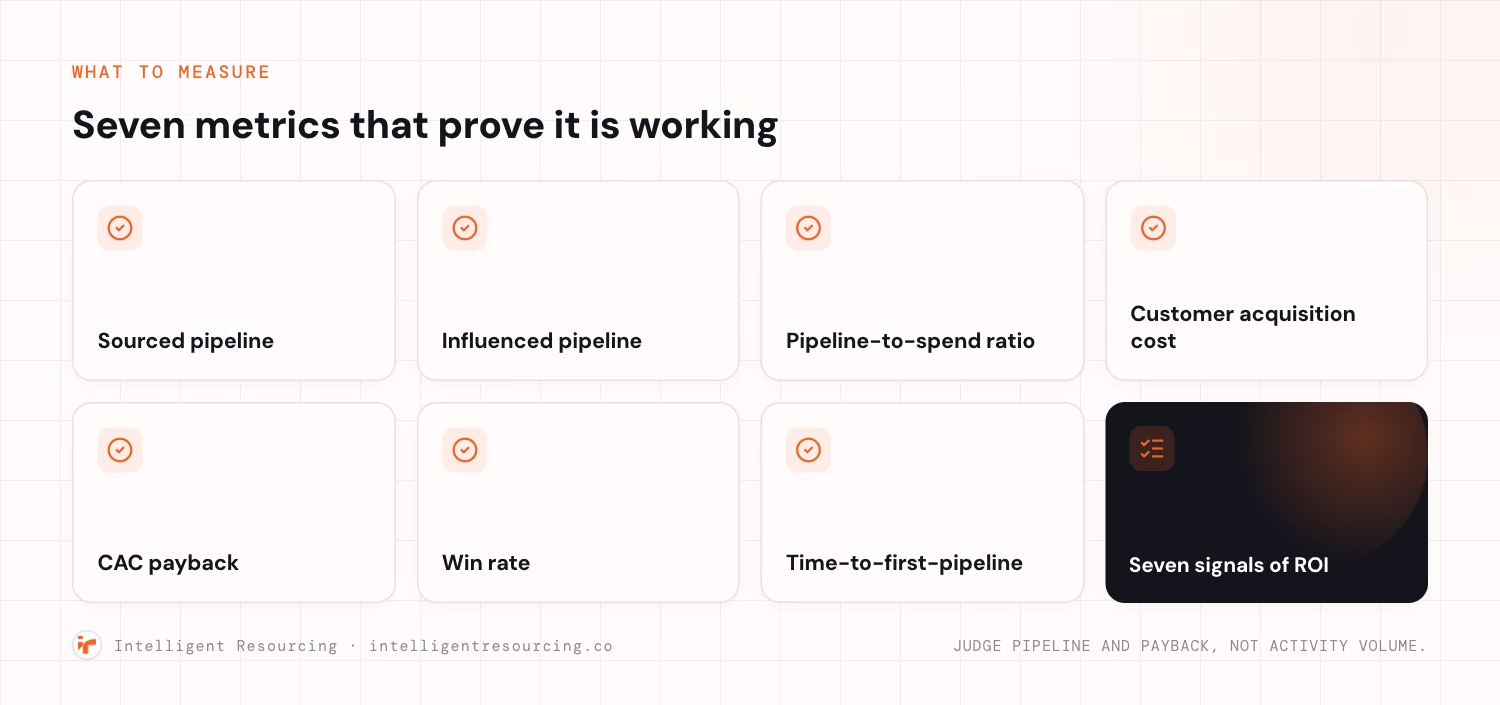
A GTM partner should be judged on pipeline creation, conversion efficiency and payback, not activity volume. The core metrics are sourced pipeline, influenced pipeline, pipeline-to-spend ratio, CAC, CAC payback and win rate on partner-sourced deals. Time-to-first-pipeline acts as the early signal that the motion is starting to work.
Track these metrics:
- Sourced pipeline: Pipeline created directly by the partner’s activity.
- Influenced pipeline: Existing opportunities that the partner helped progress but did not originate.
- Pipeline-to-spend ratio: Qualified pipeline generated relative to total engagement cost.
- Customer acquisition cost: The total cost required to acquire a new customer.
- CAC payback: How long it takes to recover acquisition cost from customer revenue.
- Win rate: The percentage of partner-sourced opportunities that close.
- Time-to-first-pipeline: How quickly the engagement creates its first qualified opportunity.
The best SaaS businesses maintain an LTV to CAC ratio above 3 and recover CAC in 5 to 7 months, per David Skok’s SaaS Metrics 2.0. Use these as reference points when evaluating whether the engagement is improving acquisition efficiency.
Cadence keeps the numbers honest. Review the metric set monthly and refresh the model every 60 to 90 days. A GTM engineer can connect buying signals from systems such as Clay into HubSpot so account scoring updates when funding, hiring or other relevant signals appear.
Attribution is the difficult part. Sourced pipeline is created by the partner, while influenced pipeline is only touched by it. Count them separately or the reported return becomes inflated.
The main failure mode is simple: MQLs rise while the sourced pipeline stays flat. Activity metrics reward motion, not revenue. If spend increases without a corresponding increase in sourced pipeline, pause and re-scope the engagement.
In one Intelligent Resourcing signal-led engagement for a Series A SaaS team, MQLs rose 40% in month 1, but sourced pipeline remained flat until week 6. After the model was re-weighted towards funding and hiring signals, sourced pipeline increased 3x by day 90. The lesson is to measure pipeline-to-spend, not MQL volume.
What Do Real GTM Partner ROI Examples Look Like?
Real GTM ROI varies by motion, sales cycle and attribution model, so published examples should be treated as reference points rather than guaranteed benchmarks. Vendor studies often report larger headline returns, while partner engagements should be judged on attributable pipeline, closed revenue and payback over a defined period.
GTMonday’s 2025 playbook cites several vendor-reported examples, including Vidyard at 6x ROI and 4x more meetings booked, ON24 generating $25M in pipeline in 1 year, and G2 reporting a 174% increase in ARR. These examples show what strong GTM performance can look like, but they measure different products, motions and attribution models, so they should not be used as direct partner benchmarks.
Partner engagements are better evaluated against the company’s own baseline. Compare total engagement cost with sourced pipeline, closed revenue and CAC payback, then track how those metrics change over time.
In one Intelligent Resourcing engagement for a seed-stage fintech, a Signal-to-Pipeline System returned 4.2x the engagement fee within 2 quarters, with the first closed revenue recorded on day 71. The result came from tighter signal-based targeting, which shortened the path from account identification to qualified pipeline.
Model Your GTM Partner ROI Before You Commit
The number that matters is your number, not a benchmark. Published floors and a 3x to 8x band are only starting points. Your funding stage, motion, and data quality decide where you land. Model the return before you sign anything, then book a call to pressure-test the numbers with our GTM engineering team.
GTM Engineering
Intelligent Resourcing connects buying signals, CRM workflows and outreach to measurable sourced pipeline, and models the return against your funding stage before you sign anything.
FAQs
What is a good ROI for a GTM partner?
A good return is 3x to 8x engagement cost within 12 months. Treat the 5:1 efficient-marketing benchmark as your minimum bar to clear. Where you land depends on 2 things: funding stage and motion maturity. Seed teams see faster payback; later-stage teams post larger absolute returns.
How long before a GTM partner pays for itself?
Signal-led motions return the first pipeline inside 90 days. That mirrors a broader buyer shift towards faster payback. Payback stalls when the offer is unclear, the ICP is wrong, or the data is stale. Fix targeting first, because clean signals shorten time-to-first-pipeline.
How much does a GTM partner cost for a funded startup?
A GTM partner costs an engagement fee, not a salary line. Compare that to a senior in-house GTM hire, which runs well over $180k fully loaded with tooling. The partner carries no headcount and ramps in weeks. For current pricing bands, see Intelligent Resourcing's GTM engineering page.
How do you measure GTM partner ROI?
Use incremental revenue minus investment, divided by investment. Track it against sourced pipeline and CAC payback, reviewed monthly. Count partner fees plus tooling in the investment. Separate partner-sourced revenue from partner-influenced revenue, or the multiple inflates and stops being defensible.
Is a GTM partner worth it for a seed-stage company?
It is worth it when 2 conditions hold: clear product-market-fit signal, and runway to convert. With both, a partner turns signal into pipeline fast. The exception is pre-PMF teams. There, founder-led selling beats any partner, because founders learn from every call while the motion is still forming.