

Why Do Solar Marketing Costs Matter More in 2026?
Solar marketing costs matter more in 2026 because a growing market does not make customer acquisition cheaper. Installers still compete for local visibility, trust and qualified installations. Residential buyers compare several installers, and commercial buyers need technical review, finance approval and internal agreement first.
The Clean Energy Council's rooftop solar and storage report counted a record 1.89 gigawatts (GW) of rooftop solar and 276,000 home batteries installed in the first half of 2026. Its chief executive, Jackie Trad, said the growth delivers "value and reliability for Australians".
The central question is how much a solar company should invest to win customers whose installations earn enough gross profit.
How Much Does Solar Company Marketing Cost in Australia?
Solar marketing cost combines advertising spend, management fees, content, website work, tools and lead handling. The total depends on which of these a business already does internally. The published figures come from agencies' own price lists and client data, so treat them as indicative and ask each agency for an itemised proposal. What a fee can leave out:
- Ad spend. Billed to Google or Meta as a separate line.
- Set-up and creative. Charged as extra one-off fees by some agencies.
- Tools and CRM. Some fees include them and some do not.
- Goods and services tax (GST). Many agency prices are quoted excluding GST, so confirm it.
- Your own time. Approving offers and following up leads.
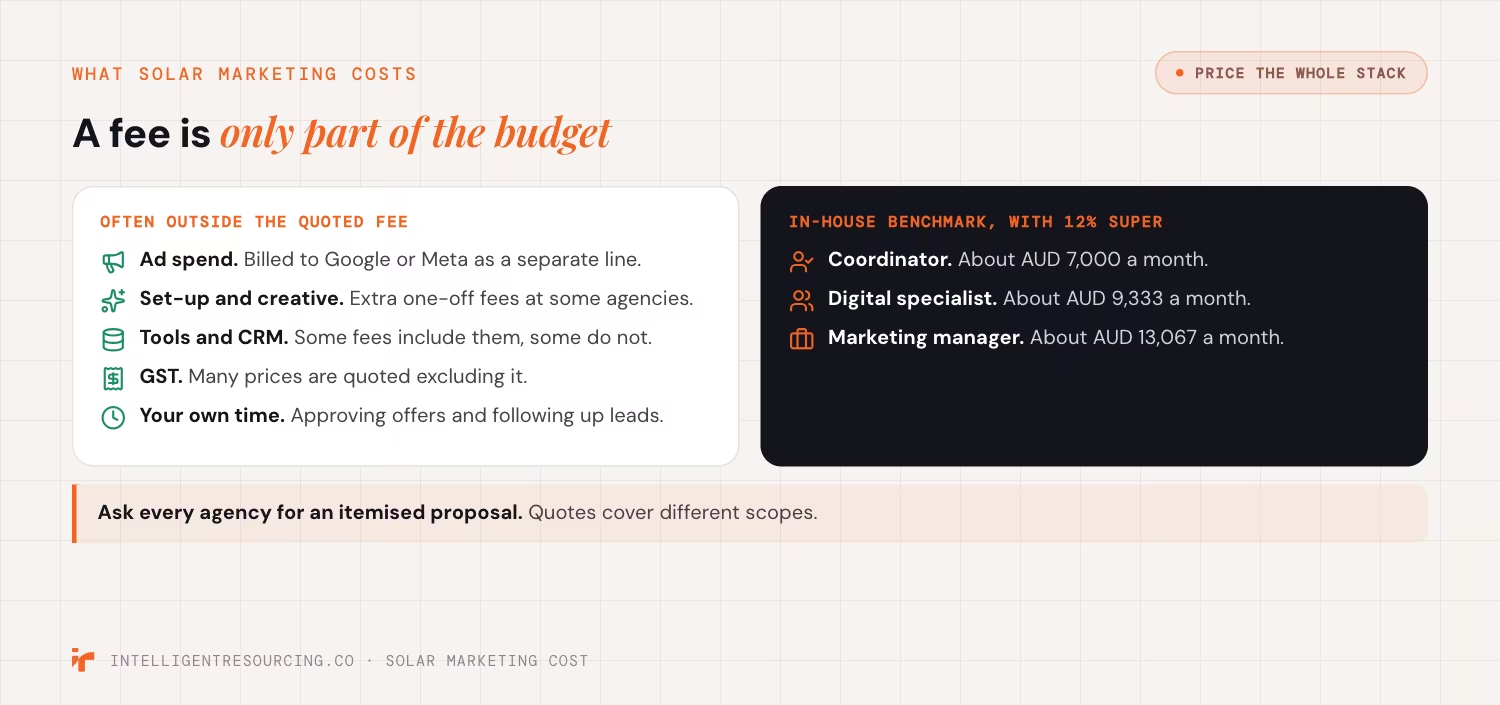
An in-house marketer is the verified benchmark. Robert Half's 2026 Australian marketing salary guide gives base salaries that exclude bonuses, benefits and superannuation. The Australian Taxation Office (ATO) super guarantee rates put the super guarantee at 12%.
| Role | Median base | With 12% super | Per month |
|---|---|---|---|
| Marketing coordinator | AUD 75,000 | AUD 84,000 | AUD 7,000 |
| Digital marketing specialist | AUD 100,000 | AUD 112,000 | AUD 9,333 |
| Marketing manager | AUD 140,000 | AUD 156,800 | AUD 13,067 |
The table is before payroll tax and workers' compensation where they apply, leave loading, recruitment and tools. Set the budget by working back from installation capacity, gross profit per project and target customer volume, and test it against real conversion data. A small installer should not generate more quotes than its sales and installation teams can handle.
Why Can Cheap Solar Leads Become Expensive Customers?
Cheap leads become expensive customers when the enquiry never had a chance to become an installation. The homeowner may live outside your territory, have an unsuitable roof, lack finance or be collecting information. Cost per lead measures the price of an enquiry, and installations earn the revenue.
Solar businesses need to separate 3 stages:
- Raw enquiry: A homeowner or business submits a form, calls or requests information.
- Qualified opportunity: The prospect meets requirements on location, installation suitability, budget and timeframe.
- Sales-accepted opportunity: The sales team has confirmed commercial potential and moved the prospect to a quote or technical assessment.
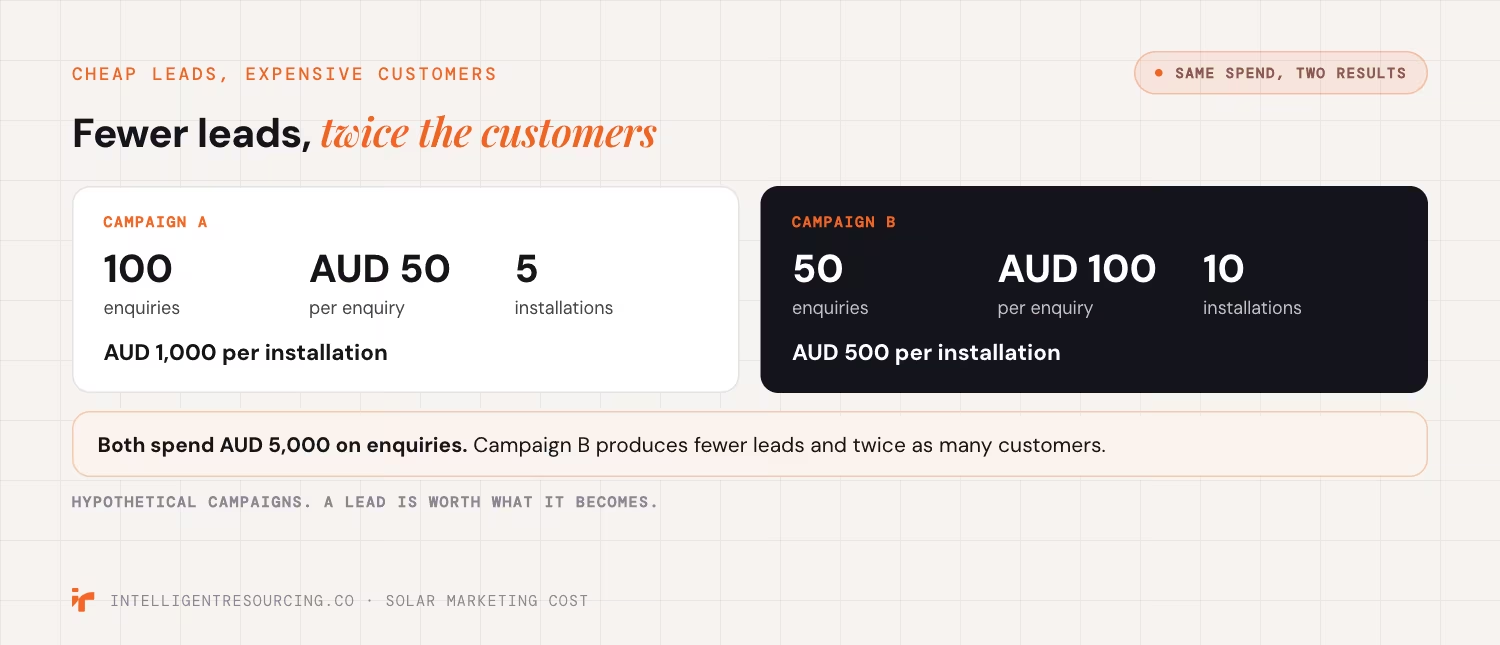
Consider 2 hypothetical campaigns. Campaign A generates 100 enquiries at AUD 50 each and converts 5 into installations. Campaign B generates 50 enquiries at AUD 100 each and converts 10. Both spend AUD 5,000 on enquiries, yet Campaign A spends AUD 1,000 per installation and Campaign B spends AUD 500. Campaign B produces fewer leads and twice as many customers.
For commercial providers, the same principle means finding organisations with credible signals of investment, such as expansion plans, energy infrastructure upgrades or active project evaluations. A lead is worth what it becomes. Response speed matters too: RevenueHero's study of 1,000 business-to-business (B2B) websites found that only 365 replied to a demo request, and the average reply took 1 day, 5 hours and 17 minutes. It counted automated replies, so it shows response gaps and says little about follow-up quality. A qualified lead still needs a quick, useful reply.
What Do Solar Marketing Channels Cost and Do?
Each channel plays a different role in the buying journey. Understanding those roles stops installers from putting every dollar into the channel with the lowest reported lead price. Judge each channel on qualified opportunities and installed customers, and treat clicks and enquiries as supporting figures.
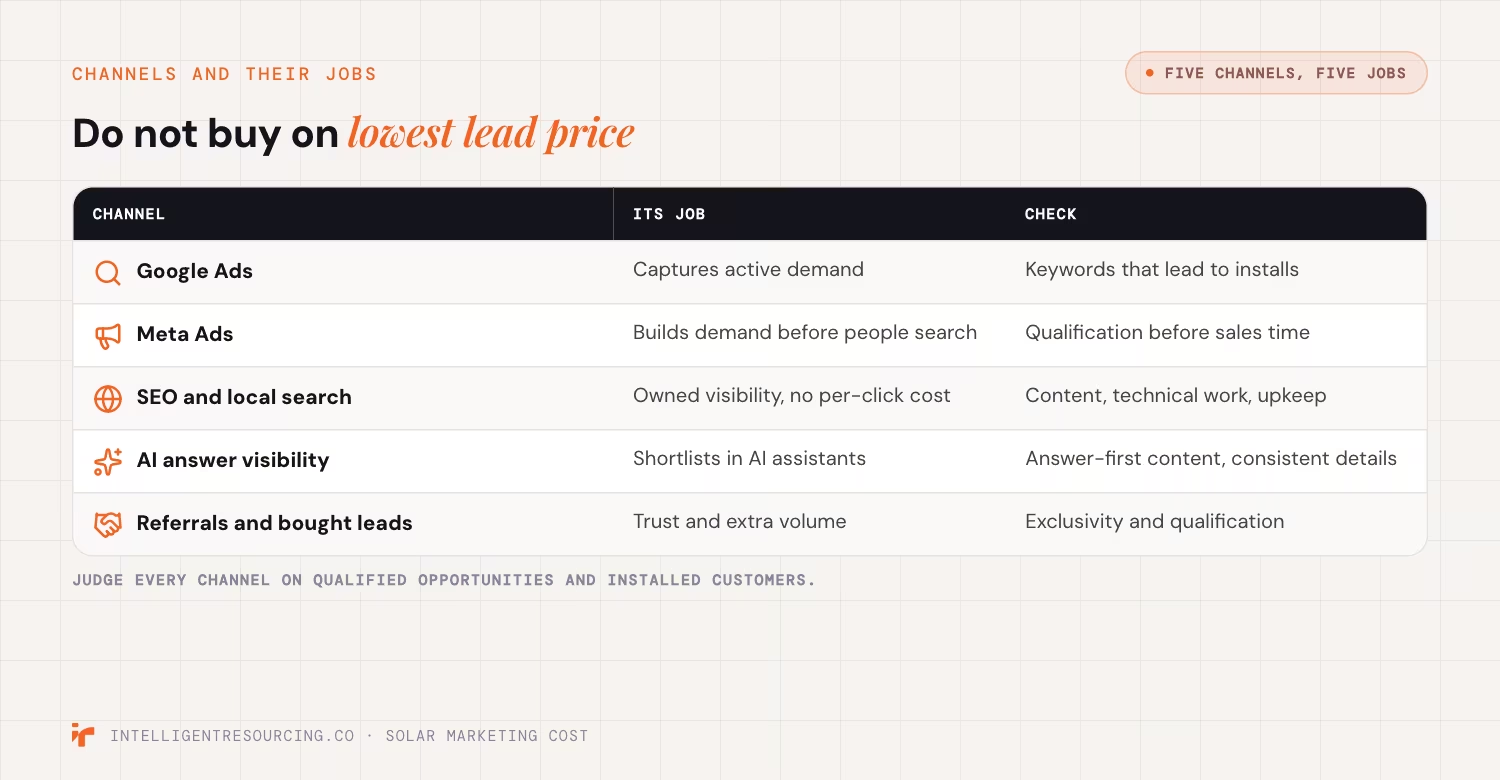
- Google Ads capture active demand. People searching for solar installation, battery upgrades or commercial quotes often have a near-term need. Target serviceable postcodes, separate residential and commercial campaigns, and track which keywords lead to installations.
- Meta Ads build demand before people search. Facebook and Instagram reach homeowners who have not yet chosen an installer. Prospects respond earlier in their research, so use educational pages and qualification questions before sales time is spent.
- SEO and local search build owned visibility. Organic rankings do not charge per click, and they still cost content, technical work and upkeep. Keep a complete Google Business Profile and service-area pages that answer real buying questions.
- Artificial intelligence (AI) answer visibility is a newer channel. Buyers also ask ChatGPT, Gemini and Perplexity which installers to shortlist. Answer-first content, consistent business details and credible evidence help, and generative engine optimisation (GEO) retainers price by asset volume and scope, which is why GEO cost per month varies widely.
- Referrals and purchased leads add volume. Referrals carry trust. Before buying leads, confirm whether each is exclusive, how interest was established and what qualification has happened. A low-cost shared lead can bring more competition and sales effort than a pricier exclusive one.
Providers differ on scope and proof, a split visible across solar marketing agencies in Australia.
How Do Residential and Commercial Solar Marketing Costs Differ?
Residential solar marketing targets homeowners making relatively straightforward purchasing decisions, while commercial solar marketing involves organisations with multiple stakeholders, longer evaluations and potentially higher-value contracts. These differences affect campaign targeting, qualification and customer acquisition costs.
| Factor | Residential Solar | Commercial Solar |
|---|---|---|
| Target audience | Homeowners in defined service areas | Property owners, industrial operators and businesses |
| Buying decisions | Installation price, electricity savings, batteries, incentives and reputation | Electricity usage, system suitability, financial returns and operational needs |
| Decision-makers | Homeowners and household members | Business owners, facilities managers and finance teams |
| Key marketing metrics | Qualified enquiry cost, quote conversion and profit per installation | Qualified opportunity cost, sales conversion and contract profitability |
| Acquisition approach | Local advertising, search visibility and enquiry forms | Target account research, buying signals and multi-stakeholder engagement |
Why Commercial Solar Leads Require Different Economics
Demandbase's 2025 buyer research found that 72% of B2B purchases involve complex, multi-stakeholder buying groups. Commercial solar marketing therefore needs to reach decision-makers beyond the person submitting an enquiry.
Technical suitability also shapes commercial purchasing decisions. Solar Victoria advises businesses to match system size to electricity consumption, while Queensland Government guidance highlights the value of daytime electricity use.
Higher acquisition costs can be justified when contracts generate sufficient profit after delivery costs. Rather than relying solely on enquiry forms, providers can identify suitable organisations and engage decision-makers when credible project signals emerge through signal-led lead generation.
How Do You Calculate Solar Customer Acquisition Cost?
Customer acquisition cost (CAC) is the total cost of winning 1 new customer. Cost per lead measures the price of enquiries, and CAC measures the price of customers. Include agency fees, ad spend, tools and the sales effort tied to new business.
Marketing cost per acquired customer = Total marketing expenditure ÷ New customers acquired
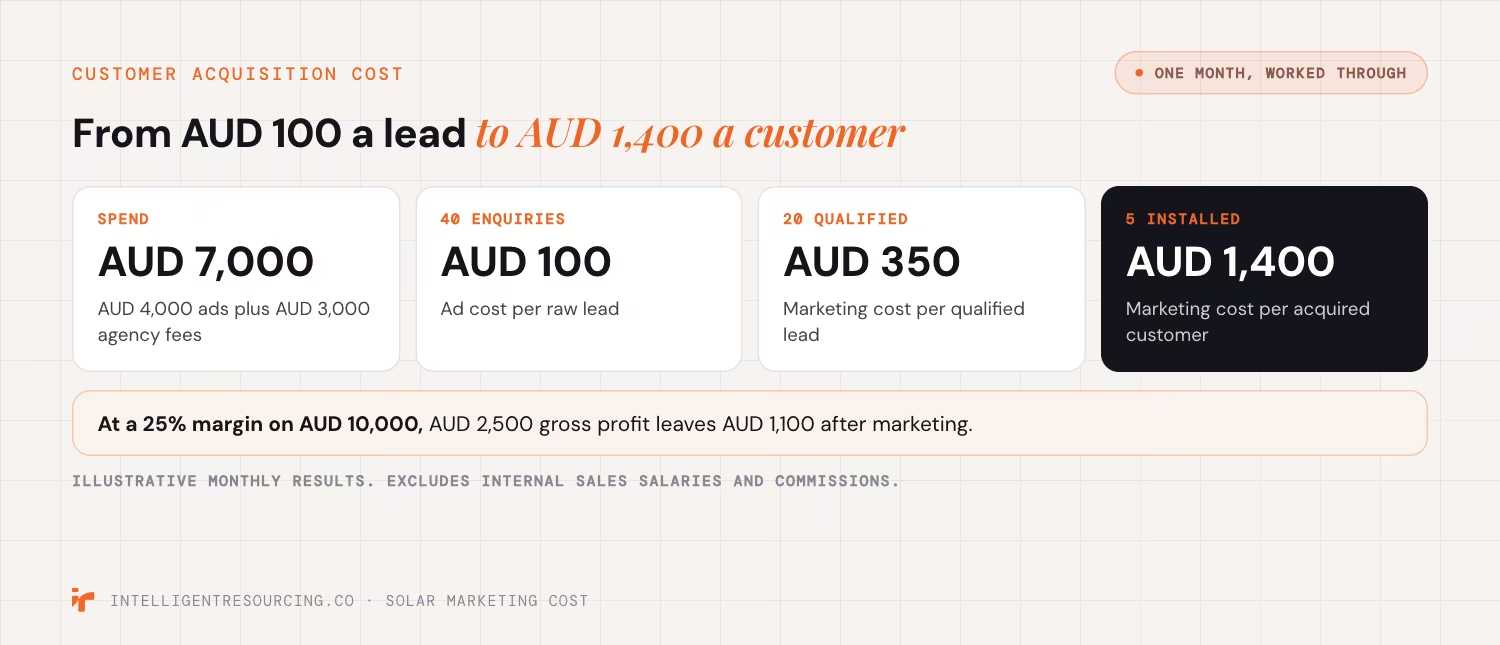
Consider a solar company with these illustrative monthly results:
| Metric | Monthly result |
|---|---|
| Google Ads spend | AUD 4,000 |
| Agency fees | AUD 3,000 |
| Total marketing expenditure | AUD 7,000 |
| Enquiries generated | 40 |
| Qualified enquiry rate | 50% |
| Qualified opportunities | 20 |
| Qualified lead-to-installation rate | 25% |
| Completed installations | 5 |
The sums give:
- Advertising cost per raw lead: AUD 4,000 ÷ 40 = AUD 100
- Marketing cost per qualified lead: AUD 7,000 ÷ 20 = AUD 350
- Marketing cost per acquired customer: AUD 7,000 ÷ 5 = AUD 1,400
That figure excludes internal sales salaries and commissions. Suppose an average installation earns AUD 10,000 in revenue at a hypothetical 25% gross margin, which is AUD 2,500 before acquisition costs. After AUD 1,400 of marketing, AUD 1,100 remains towards sales costs, overheads and profit.
Cost per lead alone cannot show whether a programme pays. Set the maximum acceptable acquisition cost from actual installation margins.
How Can Solar Companies Reduce Marketing Costs Without Hurting Lead Quality?
Better targeting, qualification and follow-up usually improve profitability more than a smaller ad budget. Most savings come from spending less time on enquiries that cannot become installations. Work through these 6 steps in order:
- Target installation-ready locations. Exclude postcodes outside your service area and account for travel costs and capacity.
- Qualify before sales handover. Capture property location, installation type, timeframe and technical requirements, without putting obstacles in front of genuine customers.
- Connect marketing and CRM data. Record qualification, quotes, deal progress and installations against each lead source.
- Use buying signals for commercial prospects. Facility expansion, energy infrastructure reviews and published sustainability goals give context, and none proves a company will buy.
- Measure conversion across the pipeline. Review enquiry-to-qualified, qualified-to-quote and quote-to-installation rates before raising ad spend.
- Keep claims accurate. The Australian Competition and Consumer Commission (ACCC) solar guidance says suppliers must not mislead buyers about costs, savings, rebates or benefits, so check every ad and quote against it.
A low conversion rate can point to targeting, qualification, quote competitiveness or follow-up. Raising ad spend before you know which amplifies the waste.
How Do You Build a Solar Marketing Budget?
Start with the number of profitable installations the business needs. Identify monthly installation capacity and average gross profit per project, set the maximum acquisition cost the business can sustain, then work back through your real qualification and conversion rates to the enquiries required. Only then choose channels.
A practical mix combines 4 jobs:
- Capture existing demand through search advertising and local discovery.
- Develop future demand with educational content, customer evidence and social campaigns.
- Convert enquiries through qualification, timely follow-up and connected CRM reporting.
- Evaluate outcomes using installations, contribution margin and total acquisition cost.
For commercial providers, add target accounts, decision-making structures and credible buying signals. A qualified lead means a site, roof rights and an approver, the checks behind qualified solar leads.
Intelligent Resourcing wrote this guide and sells signal-led pipeline work to B2B companies. It builds and manages the system inside the client's own CRM. The aim of any budget is a repeatable process that wins profitable customers without wasting sales or installation capacity.
Lead Generation
See how signal-led lead generation finds commercial solar accounts with real project needs and routes them into your CRM.
FAQs
How much should a solar company spend on marketing each month?
No single figure fits every installer. Work back from installation capacity, gross profit per project and the acquisition cost the business can sustain. Add agency fees, ad spend, tools and follow-up time, and compare that total with the AUD 7,000 to AUD 13,067 a month an in-house marketer costs with super.
What is the average cost per solar lead in Australia?
As at 30 October 2026, we found no independent Australian benchmark for solar cost per lead. Published figures come from agencies' own client data and vary by channel, market and lead definition. Track cost per qualified lead and cost per installed customer in your own accounts.
Is Google Ads or SEO better for solar companies?
Google Ads capture active purchase interest quickly, while SEO builds ongoing visibility for relevant searches. A company that needs enquiries soon can prioritise paid search, and one building a longer-term system benefits from both. Judge each channel on qualified opportunities and installed customers.
How much does a solar marketing agency charge?
Agencies price by scope, and many publish no price. Ask for an itemised proposal covering management fees, ad spend, set-up, creative, tools and GST, then compare the total with the loaded cost of an in-house marketer. Fees alone rarely show which option produces more installed customers.
How can solar installers lower customer acquisition costs?
Refine geographic targeting, qualify enquiries before sales handover, improve landing pages, connect marketing to CRM data and review conversion at each pipeline stage. Aim to reduce the cost per profitable installation, and treat a cheaper enquiry as a secondary goal.
Are purchased solar leads worth the cost?
They can be, when the provider offers qualified, exclusive enquiries and your team responds quickly. Value depends on exclusivity, conversion, sales effort and the resulting cost per installation. Compare completed sales across sources, and look past supplier lead prices.