

Why Is Solar Lead Generation So Difficult in Australia?
Solar lead generation is hard because market demand and sales-ready demand are not the same thing. Many Australian firms want lower power bills. Yet each solar job still needs the right site, a sound savings case and a team that can approve the work. Solar firms must find those buyers before rival installers do.
The Clean Energy Council's rooftop solar and storage report found a record 1.89 gigawatts (GW) of rooftop solar installed in the first half of 2026, across more than 180,000 installations. The Clean Energy Regulator reports around 269,000 small-scale solar systems and 2.8 GW installed in 2025, against 319,000 systems and 3.2 GW in 2024, in its small-scale scheme data.
Both figures cover the wider small-scale market. They say little about how easy commercial leads are to win.
The business market has its own barriers. A warehouse can have a large roof and low daytime power use. A tenant can have high power bills and no right to change the roof. A site owner can want solar and lack funds for the project.
These cases show why a simple contact form is not enough.
Why Do Commercial Solar Leads Fail to Convert Into Sales?
Commercial solar leads fail when sales teams treat early interest as a real project. A business can ask for a quote without having budget, site approval or a plan to buy. If these gaps appear late, the sales team has already spent time on calls, site checks and quotes that go nowhere.
Think of a food warehouse that asks about solar. Its manager wants to cut power bills. The roof has space, and the site uses power all day. On paper, it looks like a strong lead.
Yet the site is rented. The landlord must approve roof work. The firm also needs sign-off from its finance team. The first enquiry is not yet a sales-ready project.
The same issue affects farms, factories, cold stores and retail sites. Some need a new roof. Others have complex power bills or long lease terms.
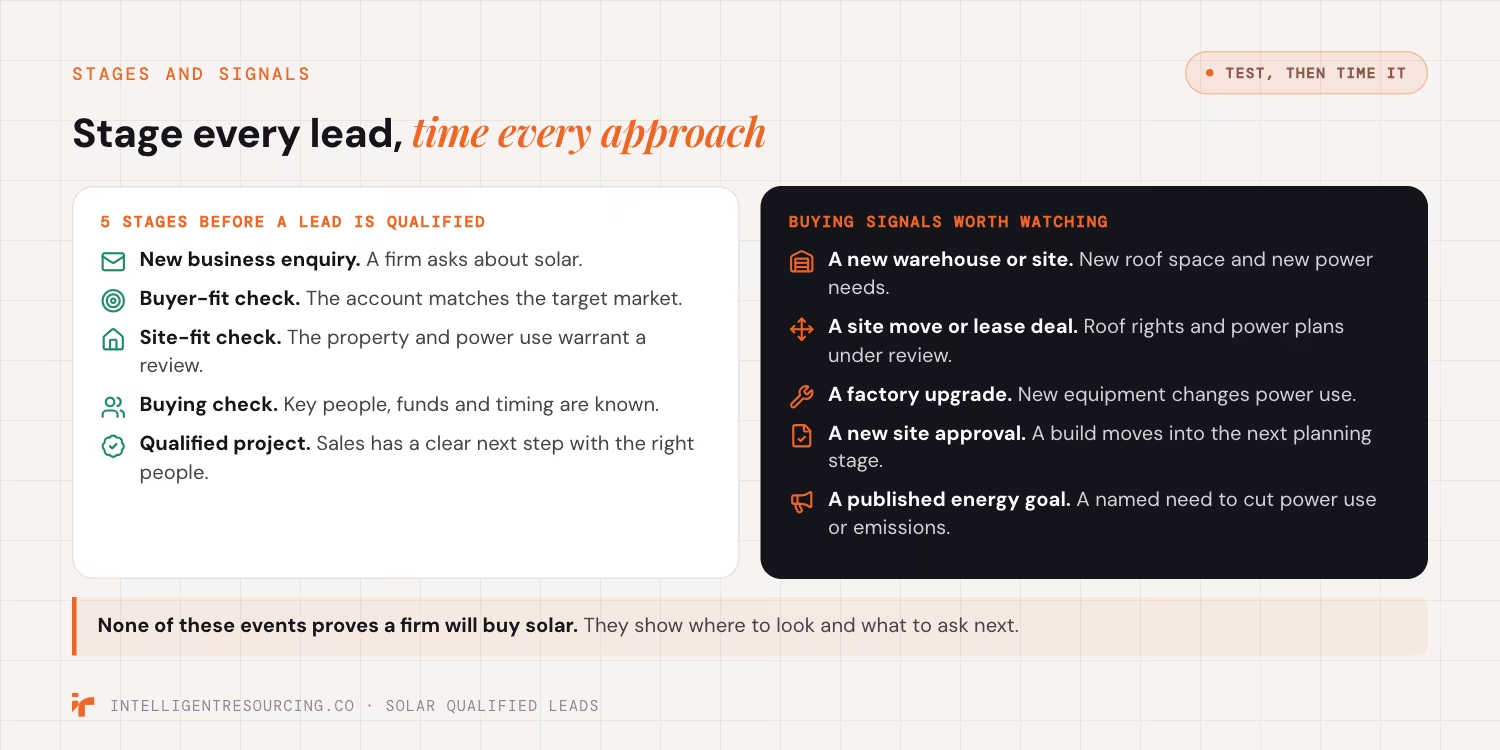
Split leads into clear stages:
- New business enquiry: A firm asks about solar.
- Buyer-fit check: The account matches the target market.
- Site-fit check: The property and power use warrant a review.
- Buying check: Key people, funds and timing are known.
- Qualified project: Sales has a clear next step with the right people.
This gives each lead a fair test and stops the sales team from treating every enquiry as a live deal.
What Makes a Qualified B2B Solar Lead?
A qualified business-to-business (B2B) solar lead is a business with a suitable site, a clear need and a path to approval. The contact must also be part of the buying process or able to bring in the right people. A strong lead has a valid reason to act, beyond an interest in cheaper energy.
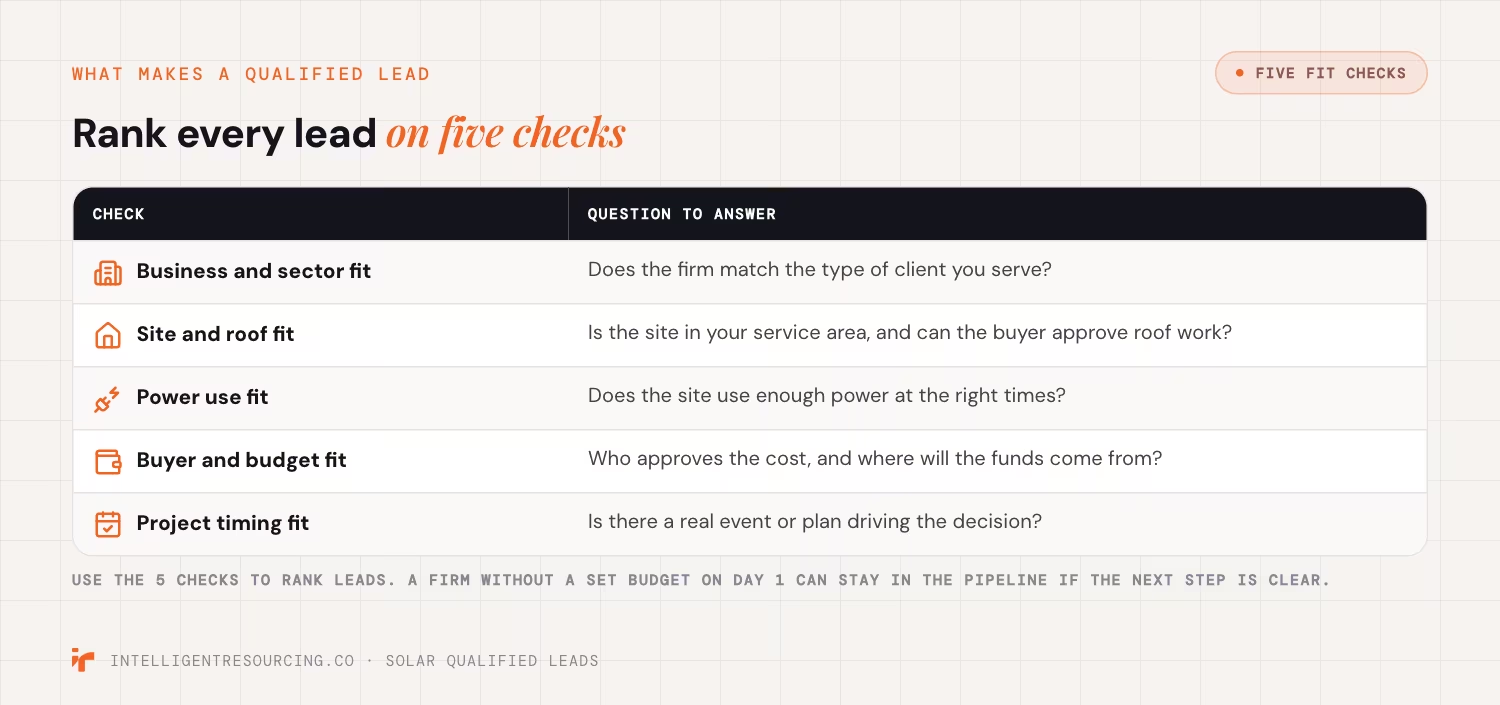
For commercial solar firms, 5 checks matter most:
- Business and sector fit: Does the firm match the type of client you serve?
- Site and roof fit: Is the site in your service area, and can the buyer approve roof work?
- Power use fit: Does the site use enough power at the right times?
- Buyer and budget fit: Who approves the cost, and where will the funds come from?
- Project timing fit: Is there a real event or plan driving the decision?
Solar Victoria's guide for businesses says the size of a system should match electricity use, and that roof space and weight can limit a commercial system. Queensland's business guidance adds that businesses using most of their electricity in daylight hours are more likely to get the best value.
Two sites with the same roof size can have very different needs. Use the 5 checks to rank leads, and keep a firm that lacks a set budget on day 1 in the pipeline if the next step is clear. A strong lead is one where the project has a sound chance of moving ahead.
Why Do Shared Solar Leads Often Fail to Convert?
Shared leads can fail because several solar firms contact the same buyer with similar offers. The buyer gets more calls and quotes, while each seller has less control over the first message. Shared data also says little about budget, site fit or timing. A valid phone number does not prove a live project exists.
This matters for firms that buy leads from outside vendors. A lead seller can check an email address or phone number. That helps, and it falls short of checking a project. The contact can still lack roof rights, budget or a real plan.
Exclusive leads solve one part of this issue. They limit how a vendor shares the enquiry under the agreed terms, and they do not prove that the project is ready to buy.
How Do Roof Access and Site Rules Affect Solar Lead Quality?
Roof access is a major lead quality test for commercial solar. A firm that pays the power bill does not always own the building. The landlord, site owner or body corporate can have the final say. Without the right approval, a good sales talk cannot move straight to an install plan.
This is common in warehouses, retail units and shared sites. A tenant has a clear reason to cut costs, and the roof belongs to someone else.
Queensland's business guidance notes that many small and medium businesses lease their premises, and that installing solar can involve building alterations, so a business should talk to its body corporate or landlord first. Renew describes the underlying split-incentive problem: one group bears the cost of the system while another enjoys the benefit.
That is why a solar firm needs to ask who owns the roof early. A leased site is not a bad lead by default. It follows a different sales path: bring the owner into the talks and work out who gains from the system.
For strata sites, body corporate approval is also part of the process. These checks save time and help sales teams set fair plans from the first call.
Why Do Some Solar Leads Fail After a Site Assessment?
Solar leads can fail after a site check when power use, roof work or grid rules change the project value. A site that looks ideal from a map can need extra work. The buyer then faces a new cost or a weaker savings case. Good early checks help prevent these late shocks.
Solar Victoria's guide says a business needs its electricity distributor's approval to connect a system to the grid, and that the connection process differs by system size and by whether the business exports power. For a commercial site, those rules can affect the size, cost and timing of a job.
A site with low daytime use can get less value from a large array. A roof can limit system size because of its weight.
Sales teams should ask for a recent power bill and site details early in the process. For larger sites, meter data can shape the first savings review.
Keep the first check simple. The goal is to find clear risks before a full design. A good sales process makes no promise of a final outcome from a rough quote.
Why Do Solar Buyers Delay Signing Quotes?
Solar buyers delay quotes when the business case is not clear or the right people have not agreed to the plan. A site manager can like the offer while the finance team questions the cost. A property owner can agree with the idea but need more proof. These are buying gaps, and many are recoverable.
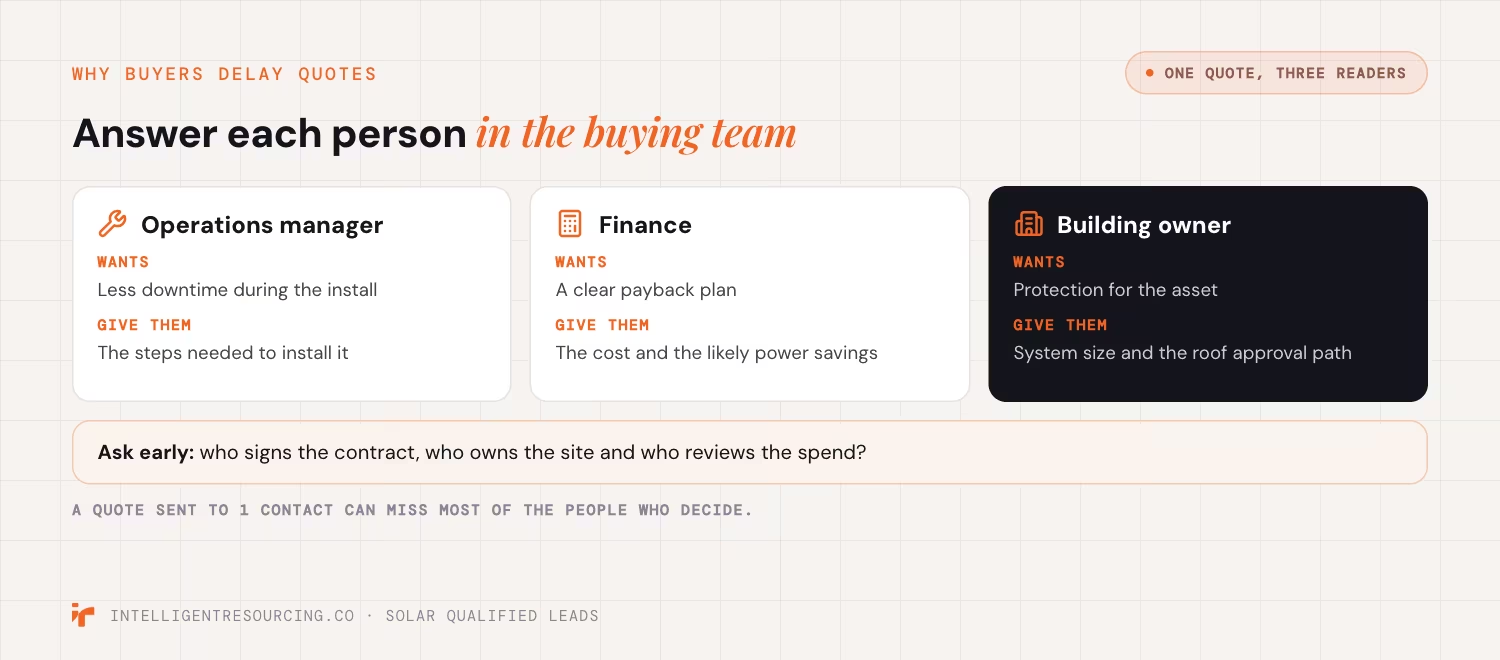
A commercial solar project often has several people involved. The operations manager wants less downtime. Finance wants a clear payback plan. The building owner wants to protect the asset. Each person needs a different answer.
Demandbase's 2025 buyer research found that 72% of B2B purchases involve multi-stakeholder complex buying groups, so a quote sent to 1 contact can miss most of the people who decide.
The solar firm should explain the size of the system, the likely power savings, the cost and the steps needed to install it. Ask who signs the contract, who owns the site and who reviews the spend. That turns a broad pitch into a clear plan for the buying team.
Why Does Timing Matter for Commercial Solar Lead Generation?
Timing matters because business plans change before a firm starts asking solar vendors for quotes. A new site, lease deal or plant upgrade can create a reason to review power costs. If a solar firm learns about the plan after suppliers are chosen, it has less time to shape the offer.
These changes are known as buying signals. A buying signal is a clear event that gives a firm a reason to review a service. For commercial solar, useful signals include:
- A new warehouse or site: A firm gains roof space and new power needs.
- A site move or lease deal: Roof rights and power plans come under review.
- A factory upgrade: New equipment changes power use.
- A new site approval: A build moves into the next planning stage.
- A published energy goal: The firm has named a need to cut power use or emissions.
None of these events proves that a firm will buy solar. They tell sales teams where to look and what to ask next.
Early project events matter before a supplier list is set, the pattern behind construction lead generation. Watching dated site and project events is the core of signal-based lead generation.
For solar firms, the aim is to find real changes, confirm buyer fit and make contact at a useful time.
How Does Slow Follow-Up Hurt Solar Lead Conversion?
Slow follow-up hurts solar sales when the buyer has to wait for a useful answer. A new enquiry can land in an inbox while the right sales person is out on site. By the time someone replies, the buyer has moved on to another quote or put the project aside.
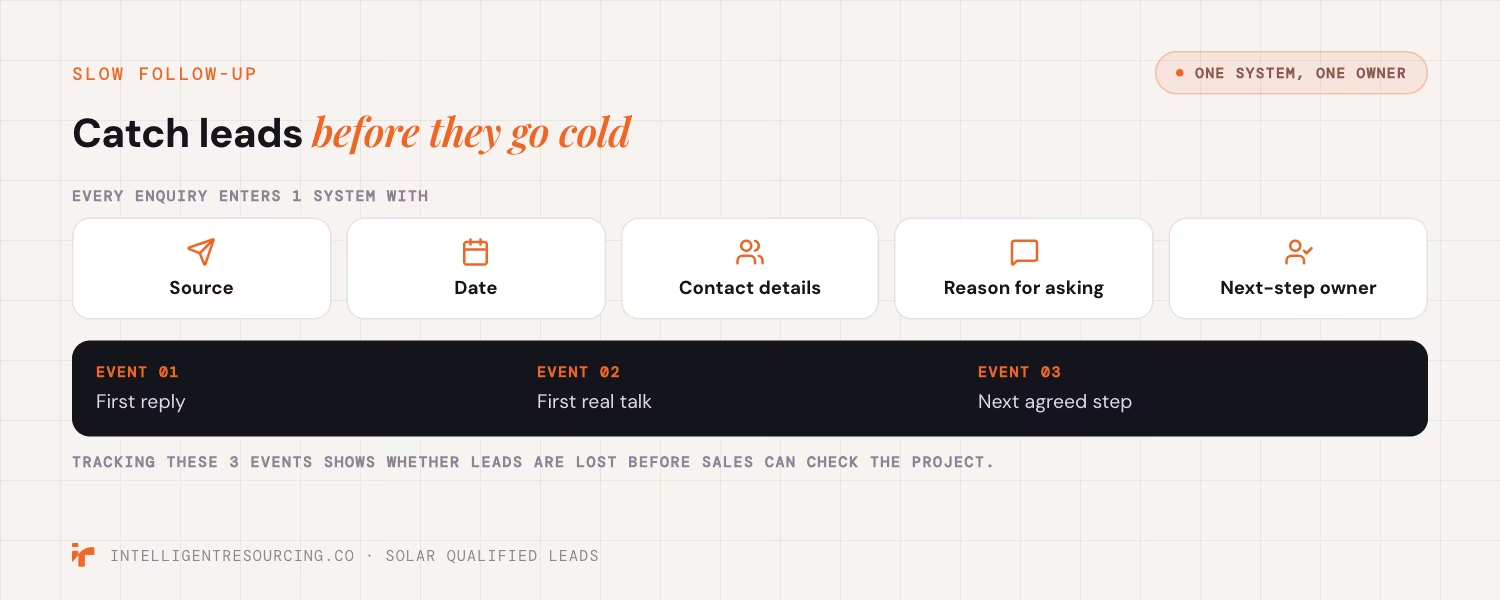
This often starts with poor handover. Web forms, paid ads and lead vendors send data into different tools. Sales teams then work from email, spreadsheets or old customer relationship management (CRM) records.
Response speed is a wider B2B problem. RevenueHero's study of 1,000 B2B websites found that only 365 replied to a demo request, and the average reply took 1 day, 5 hours and 17 minutes. It counted automated replies, so it shows response gaps and says little about follow-up quality.
A simple process fixes much of this waste. Every enquiry should enter 1 system with its source, date, contact details and reason for asking, and the record should show who owns the next step.
A good first reply should address what the buyer asked, with no mass message sent without context. Track 3 events: first reply, first real talk and next agreed step. That shows whether leads are being lost before sales can check the project.
Is Buying Solar Leads Better Than Building Your Own Pipeline?
Buying solar leads works when the vendor finds suitable buyers and your sales team can act on them. Building a pipeline in-house gives more control over targets, data and timing. Neither model is always best. The right choice is the one that leads to real projects at a cost the business can support.
Bought leads give sales teams a way to reach new contacts. They suit firms that know how to check fit and turn interest into deals, and each lead still needs a test. Judge them against the cost per installed customer, not the price of the lead.
An in-house system takes more work to set up. It also lets the team choose the sectors, sites and buying events that matter most. A solar engineering, procurement and construction (EPC) firm focused on cold stores can track new sites and site upgrades in its target area, which is more focused than buying a large list of all firms with commercial roofs.
An outside B2B partner can also run this process for the sales team. Suppliers differ on targeting, sales work and buyer signals, a split visible across B2B lead generation agencies in Australia.
The key test is whether the lead is tied to a viable project and a real buying need, whoever sends it.
How Can Solar Companies Build a More Reliable B2B Pipeline?
A reliable B2B solar pipeline starts with the right sites, the right people and the right time to talk. That means checking business fit, watching for project signals and linking each lead to a clear sales step. More contact records will not fix a poor sales process.
Firms with a full pipeline and no spare install capacity should focus on delivery first. Firms that rely on referrals and want more commercial work should first test where they miss new projects.
For commercial solar firms with a defined target market, signal-led lead generation links account research, buying events and verified contact data to the sales team's CRM.
The best next move is the one that gives the team more real sales chances.
Lead Generation
See how signal-led lead generation tracks site and project events and puts verified contacts into your own CRM.
FAQs
Why are solar lead generation problems common in Australia?
Solar leads need more than a name and phone number. Commercial projects also need the right site, power use, roof rights, funds and decision-makers. Leads fail when these checks happen too late or when the sales team reaches the buyer after other suppliers have been chosen.
What makes a commercial solar lead qualified?
A qualified lead is a business that fits the solar firm's target market and has a viable reason to review solar. Check the site, roof access, power use, buying team and timing. A qualified lead still needs a full site and technical review before the firm promises a result.
Are exclusive solar leads better than shared leads?
Exclusive leads reduce direct competition for the same enquiry under the vendor's terms, and they do not prove that the business is ready to buy. Shared leads can still work when the sales team responds well and wins on trust. In both cases, project fit matters most.
How quickly should solar firms follow up with leads?
Reply while the buyer's need is active, and set a clear response target. The best first reply answers the buyer's question and sets the next step. Track first response time, first real talk and sales handover. Fast contact works best when the lead is relevant to your target market.
How can solar installers find more B2B leads?
Focus on sectors with suitable sites and real power needs. Watch for new buildings, site moves, plant upgrades and energy plans, and check each account before outreach. Link the reason for contact to the firm's current project needs, and record every result in the CRM.