

What Does "Signal-Led" Actually Mean in Practice?
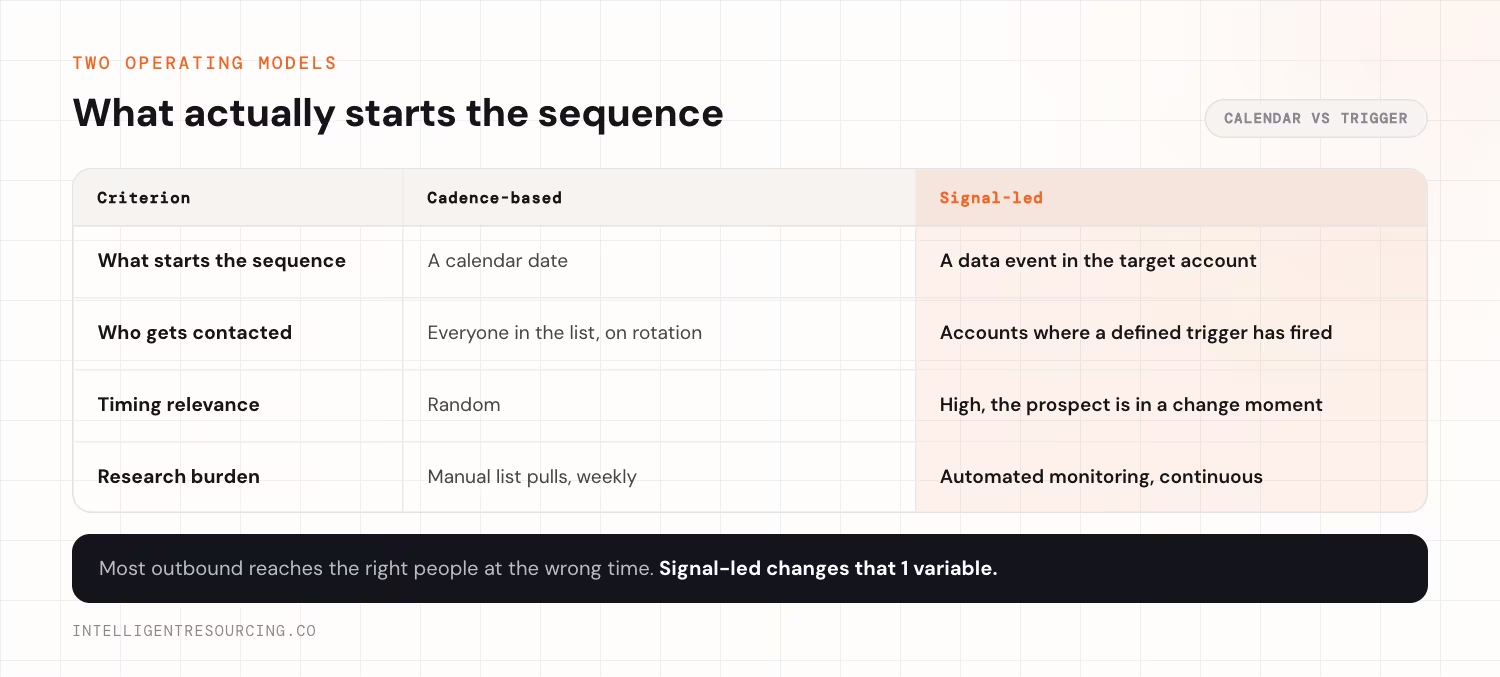
Signal-led prospecting means outreach is triggered by a data event, not a calendar date. A signal is a change in a target account's observable behaviour: a new hire, a funding round, a job posting for a specific role, a tech stack change. When the signal fires, the sequence starts.
The core difference between the 2 models:
| Criterion | Cadence-based | Signal-led |
|---|---|---|
| What starts the sequence | A calendar date | A data event in the target account |
| Who gets contacted | Everyone in the list, on rotation | Accounts where a defined trigger has fired |
| Timing relevance | Random | High, the prospect is in a change moment |
| Research burden | Manual list pulls, weekly | Automated monitoring, continuous |
How the monitoring layer works:
- Clay aggregates signals from LinkedIn company pages, Crunchbase funding data, job boards, and tech stack databases
- When a defined trigger event fires for a monitored account, Clay surfaces it and pushes the enriched record into HubSpot
- The outreach sequence is pre-written for the signal type. The trigger decides when it fires: not the rep, and not the calendar
How Is Signal-Led Prospecting Different From Intent Data?
Intent data scores an account's interest level based on content consumption across third-party publisher networks. Signal-led prospecting identifies a specific event that changes an account's circumstances. Intent data says "this company is researching this category." A buying signal says "this company just changed, and that change creates a real need right now."
The practical gap between the 2:
| Criterion | Intent data | Buying signal |
|---|---|---|
| What it measures | Content consumption across third-party sites | A specific event at a specific account |
| What it tells you | Who is researching a category | When a specific account entered a decision window |
| Timing signal | Weak, interest does not equal readiness | Strong, the event marks the window opening |
| Actionability | Tells you who to watch | Tells you when to act |
Why interest and need are not the same thing
A procurement team reading articles about CRM migration is interesting. That same team hiring a new VP of Revenue Operations is a need. The new VP arrives with:
- A mandate to review and reset vendor relationships
- A timeline set by their own 90-day plan
- A budget conversation already in progress with their CFO
That is a buying window. Intent data identifies the category interest, and the buying signal identifies the moment.
Used together, intent data identifies which accounts to monitor and signal data identifies when to act. 75% of B2B buyers prefer to gather information on products on their own before engaging a vendor, meaning most are deep into evaluation before any salesperson makes first contact. Interest scores indicate category attention, but a buying signal indicates a decision window.
What Counts as a Buying Signal in B2B?
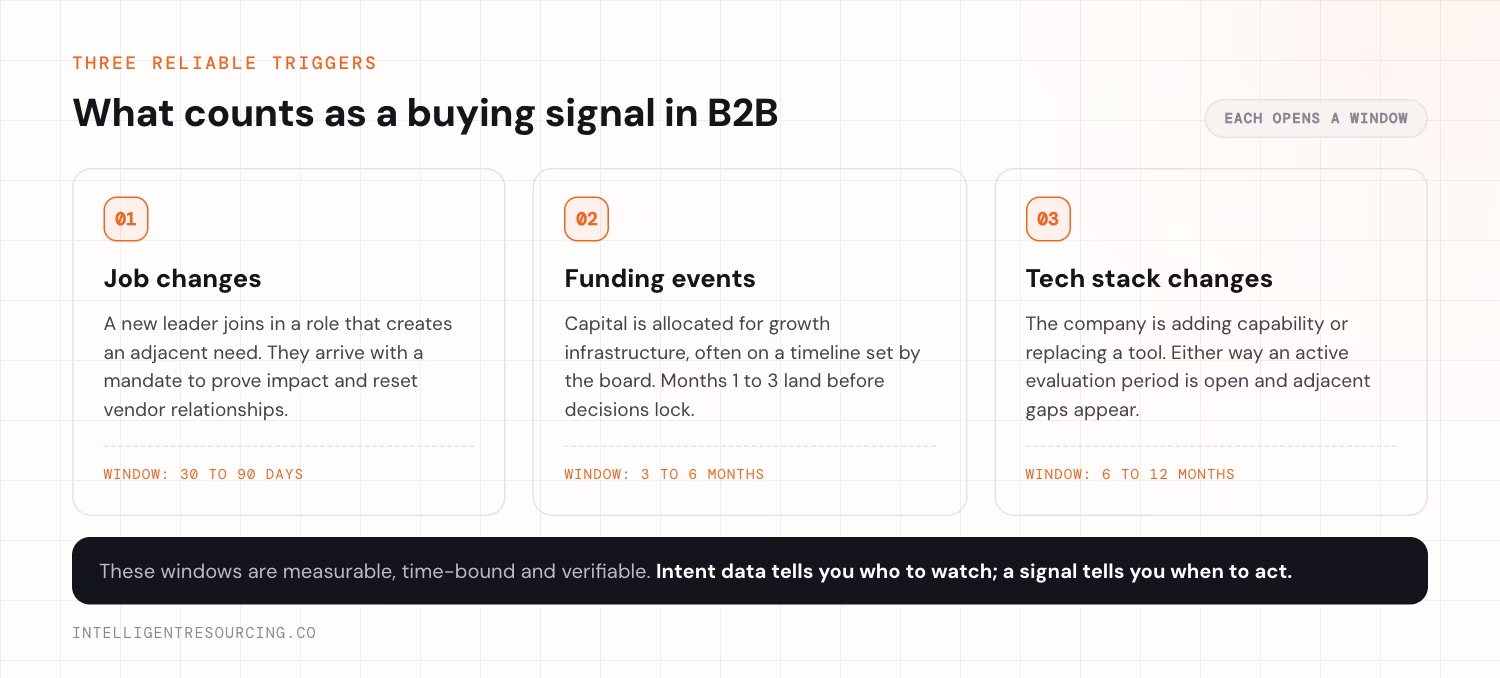
The 3 most reliable B2B buying signals are job changes, funding events, and tech stack changes. Each creates a specific window with a specific duration. These windows are measurable, time-bound, and verifiable through data sources that are available to any team with the right tooling.
Job changes
A job change signal fires when a new leader joins a target account in a role that creates an adjacent need for your product or service.
What makes it a signal:
- New leaders spend the first 30 to 90 days evaluating and resetting vendor relationships
- They arrive with a mandate to prove impact quickly, which means they are actively looking for tools and partners
- New executives spend 70% of their budget in the first 100 days, so the buying window opens when the hire is announced, not when the leader is settled in
Examples of job change signals by product type:
| New hire at target account | Signal for |
|---|---|
| New VP of Sales with Salesforce background | Sales enablement, Salesforce services, revenue operations |
| New Head of Marketing, no existing automation stack | HubSpot partner, marketing automation, demand generation agency |
| New CFO post-Series B | Financial reporting, FP&A tools, CFO advisory services |
| New VP Engineering expanding team | Developer tools, infrastructure, offshore engineering |
Funding events
A funding round signals that the company has capital allocated for growth infrastructure, often with a timeline set by the board.
Signal characteristics:
- Series A and Series B rounds typically trigger 3 to 6 months of active vendor evaluation
- By month 7 to 9 post-funding, most vendor decisions are made and the stack is being onboarded
- Outreach in months 1 to 3 post-announcement reaches the account before vendor decisions are locked
Where to find funding signals:
- Crunchbase (funding round announcements)
- LinkedIn company news (press releases shared by the company)
- Pitchbook (for more detailed round data)
- Google Alerts on company name plus "funding" or "raises"
Tech stack changes
A tech stack change signals an active evaluation period. The company is either adding capability or replacing an existing tool, both of which create adjacent gaps.
What to monitor:
- Job postings requiring experience with a specific tool indicate the company is adopting it
- LinkedIn updates from founders or heads of engineering often name tools being evaluated
- Tech intelligence tools like BuiltWith or Clearbit track installed technologies at the domain level
Example: A company posting 4 roles requiring Snowflake experience is building a data infrastructure that will need adjacent data engineering, visualisation, or analytics tooling within 60 to 90 days of those hires landing.
Other signals worth tracking:
| Signal type | What it indicates |
|---|---|
| Headcount milestone (50, 100, 200 employees) | Operational scaling, process formalisation, new tool categories opening |
| Office expansion or new market entry | Geographic sales resource, localisation, compliance tooling |
| Specific role postings (for example "Head of RevOps") | Signals a GTM infrastructure build is planned |
| Competitor contract renewal window | Based on typical contract lengths in your segment |
What Is a Verified Buying Window?
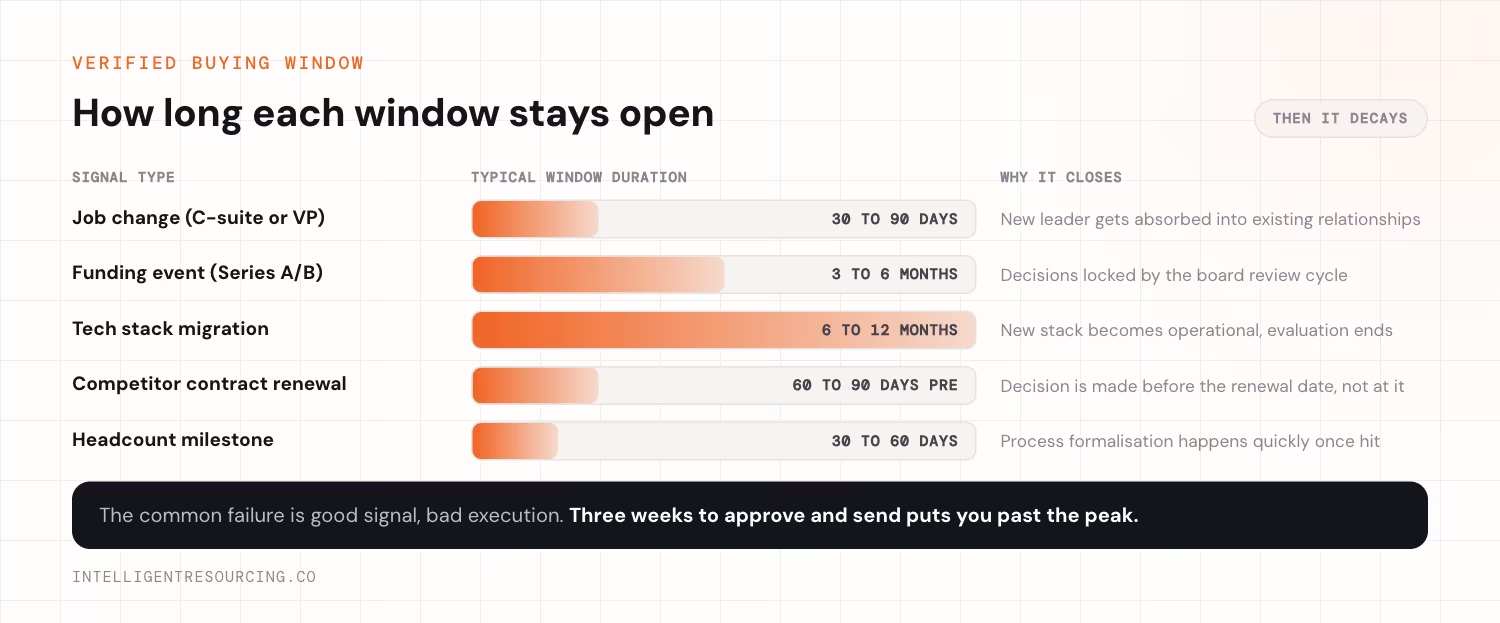
A Verified Buying Window is Intelligent Resourcing's framework for defining the period, triggered by a specific signal event, when a prospect is most likely to make a vendor decision. It combines the signal type, the typical window duration for that signal category, and the account's observable readiness indicators. Outreach outside the window is deprioritised.
Window duration by signal type:
| Signal type | Typical window duration | Why it closes |
|---|---|---|
| Job change (C-suite or VP) | 30 to 90 days from start date | New leader gets absorbed into existing relationships |
| Funding event (Series A/B) | 3 to 6 months from announcement | Vendor decisions are made and locked by the board review cycle |
| Tech stack migration | 6 to 12 months (phased migrations run longer) | New stack becomes operational and evaluation period ends |
| Competitor contract renewal | 60 to 90 days pre-renewal | Decision is made before the renewal date, not at it |
| Headcount milestone | 30 to 60 days around the trigger | Process formalisation happens quickly once the threshold is hit |
The most common failure mode is good signal, bad execution. The signal fires. The team identifies the event. The outreach takes 3 weeks to get approved, written, and sent. The window is already past its peak.
The Verified Buying Window framework solves this by:
- Assigning a decay estimate to each signal type in the CRM
- Automatically deprioritising accounts where the window has likely closed
- Routing new signals to the relevant sequence without a manual decision step
This removes the gap between signal identification and outreach execution that kills timing-based programmes before they demonstrate results. Salesloft found win rates rise 14% when timing is introduced early in the sales process. The same principle applies to outreach: reaching a prospect before their window closes changes the conversion trajectory from the first contact.
Which Tools Run Signal-Led Prospecting?
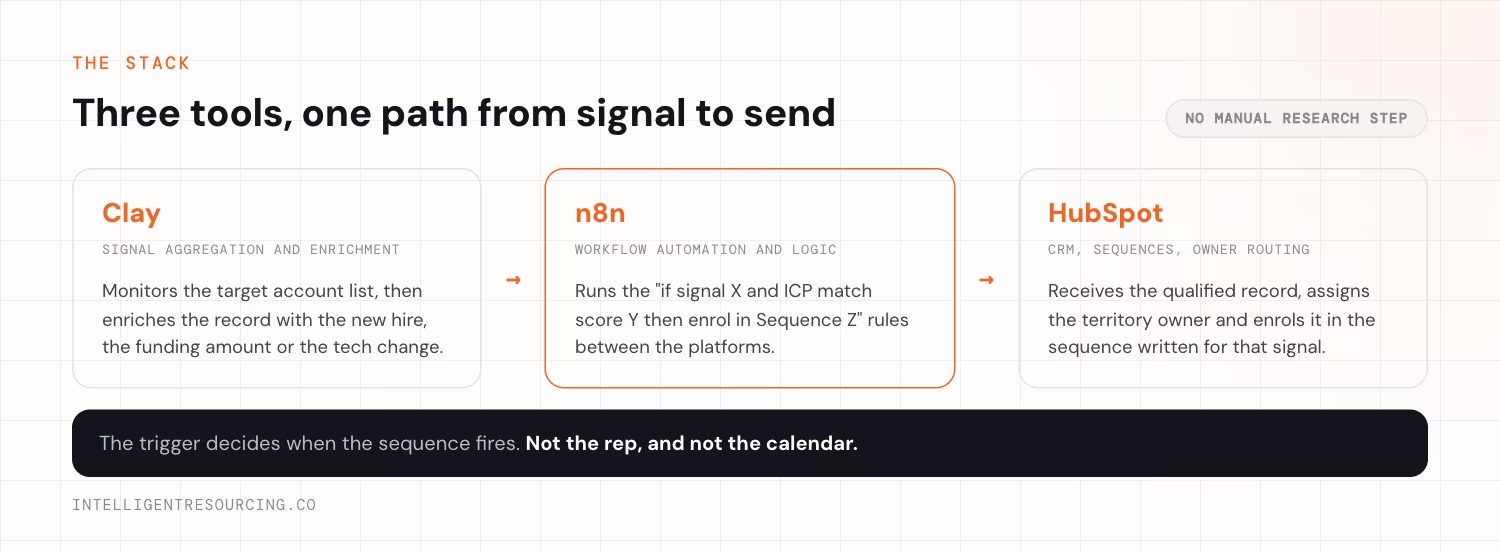
The core infrastructure for signal-led prospecting is Clay for signal aggregation and enrichment, HubSpot for CRM and sequence management, and n8n for workflow automation between platforms. These 3 tools handle monitoring, routing, and outreach execution without a manual research layer at each step.
The stack at a glance:
| Tool | Role in the system | Key function |
|---|---|---|
| Clay | Signal aggregation and prospect enrichment | Pulls signals from LinkedIn, Crunchbase, job boards, BuiltWith; enriches records before they hit the CRM |
| HubSpot | CRM, sequence management, owner routing | Receives enriched records, assigns to territory owner, enrols in the correct signal-specific sequence |
| n8n | Workflow automation and conditional logic | Runs the "if signal X AND ICP match score Y THEN enrol in Sequence Z" rules between platforms |
How the 3 tools connect:
- Clay monitors the target account list for defined trigger events
- When a signal fires, Clay enriches the record with the relevant context (the new hire's name and role, the funding amount, the tech change)
- n8n evaluates whether the account meets the enrolment criteria (ICP score, company size, segment rules)
- HubSpot receives the qualified record, assigns ownership, and enrols it in the pre-written sequence for that signal type
- The sequence is written for the specific signal: a job change sequence leads with the new hire context; a funding sequence leads with the growth initiative framing
What the system does not do automatically:
- Write new sequences: those are built once per signal type and maintained quarterly
- Replace judgement on edge cases: accounts that partially match criteria need a human decision
- Operate without quarterly review: signal definitions and ICP criteria need updating as your market shifts
Signal-based outreach via Clay produced $1M in pipeline and 20% higher positive reply rates for Sendoso's outbound programme alongside a 10x increase in SDR productivity.
Those 3 tools are also the foundation of B2B lead generation automation more broadly, which is why the same stack carries both programmes.
Is Signal-Led Prospecting the Right Fit for Every B2B Team?
Signal-led prospecting works best for B2B companies selling into defined ICP accounts where observable trigger events reliably precede purchase decisions. For high-volume, low-ACV products where buying decisions are opportunistic and not tied to a business change event, the model does not produce the same lift.
3 prerequisites the team must have or build
- A defined ICP. Signal-led prospecting monitors specific accounts for specific events. Without a clear ICP, there is no monitored list and no signal taxonomy to build. The signal only means something relative to your ideal customer profile.
- Signal coverage for the ICP. Some segments produce abundant, trackable signals. Others are opaque.
- Infrastructure to act within 48 to 72 hours. A buying window closes. If the signal fires and the outreach takes 3 weeks to get approved and sent, the window is gone. The faster the team moves from signal to send, the higher the conversion rate.
| High signal coverage | Low signal coverage |
|---|---|
| Series A/B SaaS companies | Bootstrapped SMBs |
| Private equity-backed mid-market | Professional services firms |
| Listed companies with active investor relations | Government entities |
| High-growth tech with active LinkedIn presence | Family businesses and owner-operators |
What to do if the prerequisites are not yet in place
Intelligent Resourcing builds the ICP definition and signal taxonomy before any sequence is written or any tool is configured. The ICP and diagnostic work sits inside the B2B lead generation engagement, not as a separate pre-work phase.
For B2B teams where deal values are high enough to justify the build and where an ICP is clearly defined, signal-led prospecting changes the economics of outbound. Intelligent Resourcing designs, builds, and installs signal-led revenue systems for clients.
Prospecting
Intelligent Resourcing designs and installs signal-led revenue systems for B2B teams across Australia. We build the ICP definition, signal taxonomy, and Clay, HubSpot and n8n stack, then hand ownership over. The system runs after we leave.
FAQs
What is the difference between a buying signal and a trigger event?
A trigger event is the observable thing that happened: a funding round closed, a new VP was hired, a job posting went live for a specific role. A buying signal is the interpretation: this event means the account is now likely in a vendor evaluation window. Every buying signal starts with a trigger event, but not every trigger event is a buying signal for every product. The signal definition depends on what your specific ICP is doing when they buy.
How long does a buying window typically stay open?
It depends on the signal type. Funding events typically create a window of 3 to 6 months from announcement. Job changes create a shorter window: 30 to 90 days from the new hire's start date, before they get absorbed into existing vendor relationships. Tech stack migrations can run longer, sometimes 6 to 12 months if the migration is phased. The Verified Buying Window framework assigns a decay estimate to each signal type so outreach is timed to the window, not just to the event date.
Can signal-led prospecting work for a small sales team?
Yes, and it is often more important for small teams than large ones. A team of 2 to 3 SDRs running cadence-based outreach at volume burns out fast and produces inconsistent results. The same team running signal-led prospecting reaches fewer prospects but reaches the right ones at the right time. Fewer, better-timed touches require less headcount to execute and produce a higher return per hour of sales time invested.
How long does it take to build a signal-led prospecting system?
Building a signal-led prospecting system takes 6 to 8 weeks from kick-off to first sequence firing. The build phase covers ICP definition, signal taxonomy design, Clay configuration for signal aggregation, HubSpot workflow architecture for ownership routing and sequence enrolment, and n8n automation rules for conditional logic. Intelligent Resourcing handles the full build. The team uses the system from day 1 rather than spending 6 to 8 weeks building it before any outreach starts.