

What is an AI content platform, and what types do marketers use?
An AI content platform is software that writes marketing drafts, such as blog posts, emails and ads, from your prompts, files and data. Marketers use 4 main types: general assistants, marketing writing platforms, content tools built into a CRM (customer relationship management) system, and custom workflows that link an AI model to other tools.

Use is now close to universal in business-to-business (B2B) marketing. The Content Marketing Institute's 2026 report surveyed 1,015 B2B marketers in mid-2025. It found 95% say their firms use AI tools. Of those, 89% use them to write or improve copy.
The 4 types differ in where the words end up:
- General assistants such as Claude and ChatGPT. You chat, upload files and copy the result out. They are cheap and flexible.
- Marketing writing platforms such as Jasper. They store your brand voice and source files, so every writer starts from the same rules.
- CRM content tools such as HubSpot Content Hub. The writer sits inside the system that holds your contacts, pages and emails.
- Custom workflows. An automation tool passes CRM data to an AI model and sends the draft on. This is the type behind signal-led marketing automation.
How much does an AI content platform cost as of October 2026?
As of October 2026, an AI content platform costs from about $20 a seat each month to $500 or more. A general assistant is the cheapest. A CRM content tool costs the most, because it comes bundled with web page and email tools. A custom workflow swaps seat fees for model fees and build time.

In October 2026, Anthropic's Claude pricing page listed the Team Standard seat at $25 a month, or $20 a month billed yearly. Teams run from 2 to 150 seats, and Claude does not train on Team content by default.
HubSpot's Content Hub page listed Professional from $500 a month in October 2026, with 3 seats included. That tier is where HubSpot lists "Define your brand voice".
| Platform | Plan | Price listed in October 2026 (before tax) | What sets it apart |
|---|---|---|---|
| Claude | Team Standard | $25 a seat a month, or $20 billed yearly | Shared projects, no training on your content by default |
| Jasper | Pro | $69 a seat a month, or $59 billed yearly | 2 brand voices, 5 knowledge files, 3 audiences |
| HubSpot Content Hub | Professional | From $500 a month, 3 seats included | Brand voice, content remix, AI agents in the CRM |
| Custom workflow | Your own build | Model costs plus build and upkeep time | Content set off by buyer signals |
A custom build is cheap to run but not free to own. At Intelligent Resourcing, our programmatic content engine produces a researched, citation-backed article draft for under 30 cents in model costs. The real cost sits in the build and the upkeep, so count those hours before you compare it with a $25 seat.
Is Jasper better than ChatGPT for on-brand marketing content?
Jasper is better than a general assistant such as ChatGPT when several people write for 1 brand, because it turns your past content into tone and format rules that every writer shares. ChatGPT or Claude is the better buy for a small team that writes its own brief each time, because a seat costs less and does more tasks.
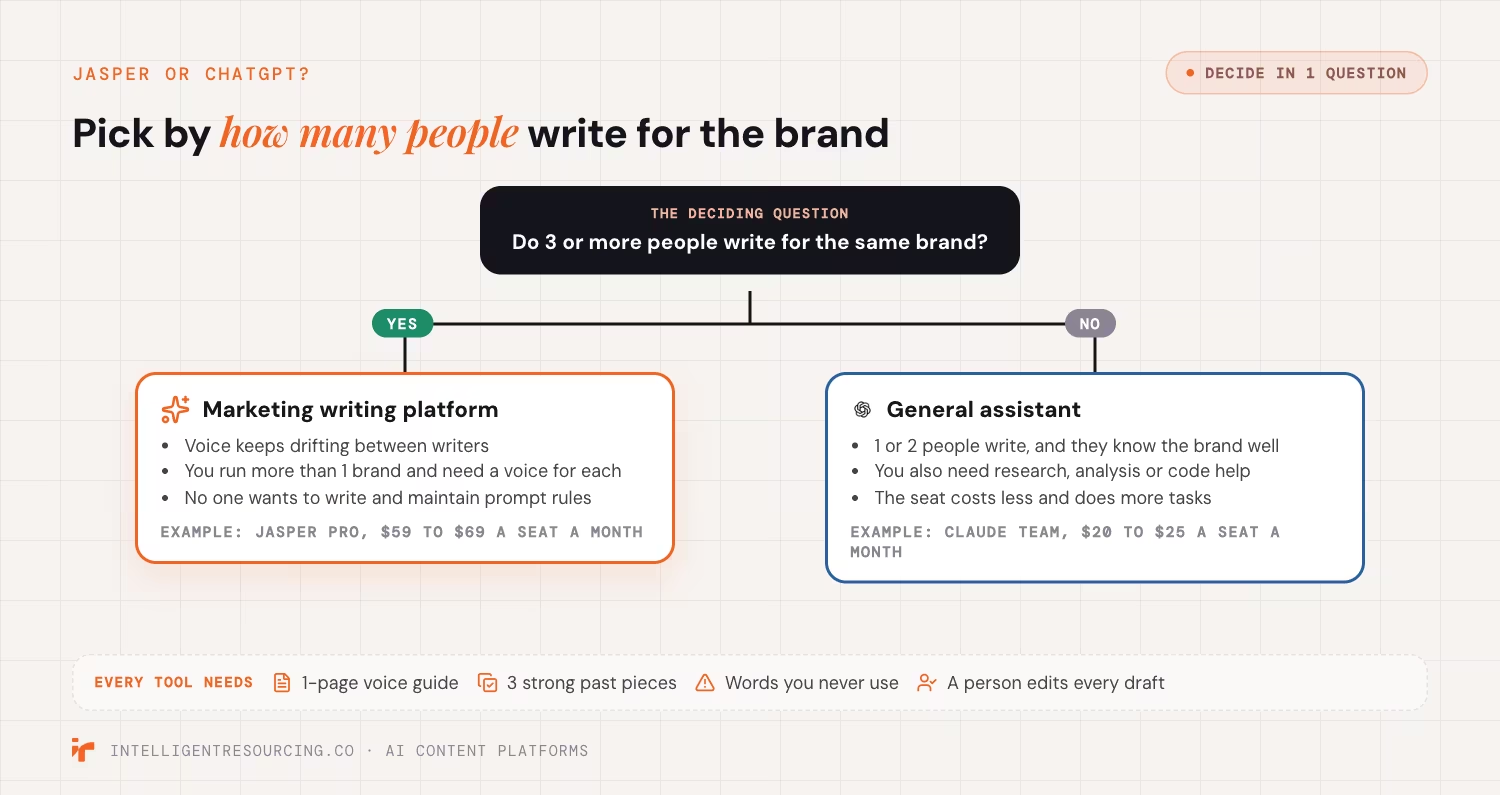
In October 2026, Jasper's pricing page listed Pro at $69 a seat each month, or $59 billed yearly, with a 7-day free trial. Pro includes 2 brand voices, 5 knowledge files and 3 audiences. Jasper says the tool reads the tone of your past content, then sets tone and format rules so drafts sound like you. Style guides and API (application programming interface) access sit on the Business plan, which has no public price.
Choose a marketing writing platform if:
- 3 or more people write for the same brand and voice keeps drifting.
- You run more than 1 brand and need a separate voice for each.
- No one on the team wants to write and maintain prompt rules.
Choose a general assistant if:
- 1 or 2 people write, and they already know the brand well.
- You also need research, analysis or code help from the same seat.
Any tool needs the same basics to stay on-brand:
- Write a 1-page voice guide.
- Give the tool 3 strong past pieces as examples.
- List the words you never use.
- Have a person edit every draft.
Our guide to AI content workflows at scale covers those editing steps in detail.
How does an AI content platform connect to your CRM and buyer signals?
An AI content platform connects to your CRM through a built-in link, an app add-on or an automation tool. The CRM spots a buyer action, such as a second pricing page visit. The workflow then sends that account's details to the AI model. The model drafts a matching email, and a person checks it before it goes out.

The data link is the weak point for most teams. Salesforce's 2026 State of Marketing report surveyed 4,450 marketers. It found the average firm keeps data in 7 different sources, and only 26% of marketers are completely happy with how they connect. Yet 78% say they need more personalised content than they can make now.
Here is how a signal-led content workflow runs, step by step:
- Detect. HubSpot logs a contact's second pricing page visit in 1 week.
- Check fit. The workflow confirms the account matches your ideal customer profile, so you do not write for a poor fit.
- Add context. It pulls the contact's role, industry and past emails from the CRM.
- Draft. The AI model writes a short follow-up email using your voice guide and those facts.
- Review. The account owner reads and edits the draft, then sends it.
A tool list alone does not make this work. The tools in a signal-led stack only connect when someone designs the hand-offs between them.
Who should set up an AI content platform: a marketer or a GTM engineer?
A marketer can set up a general assistant or a marketing writing platform without technical help. A custom workflow tied to CRM signals needs a go-to-market (GTM) engineer, a technical role that builds the links between sales and marketing tools. Either way, someone must own the voice rules, the checks and the fixes when a step breaks.
Ownership also covers privacy, and the Office of the Australian Information Commissioner (OAIC) published 2024 guidance on commercial AI. It tells Australian firms not to put personal information into publicly available AI tools. It also says a person should be responsible for checking the accuracy of personal information an AI tool produces. That means a CRM-linked workflow needs a named owner, not just a login.
When we built our own content system, we set clear rules for who checks what:
- Every article runs through a staged pipeline, brief first then draft, with a full trace of every run.
- No agent grades its own work. Every claim in our audits is re-verified by a second agent whose job is to refute it, and every status table carries the date it was true.
That split matters, because a workflow that checks its own work lets its own mistakes through. If you are weighing the hire, read what a GTM engineer does before you write the job ad.
How do you know if an AI content platform is paying off?
An AI content platform pays off when it saves staff hours and the content still performs. Track 3 numbers: hours per piece before and after, editing time per draft, and pipeline from the content. Time saved alone can fool you, because faster drafts that no one reads do not create demand.
The time savings are real but modest across a whole workforce. The St Louis Fed's AI tracker puts the share of all US work hours saved by generative AI at just over 2% in the third quarter of 2026. Performance gains are harder to win. In the same 2026 Content Marketing Institute report, 87% of marketers using AI for content saw productivity gains, but only 39% saw content performance improve.
| Measure | What to track | Warning sign |
|---|---|---|
| Speed | Hours per piece, before and after | Fewer hours but more edit rounds |
| Quality | Editing time and facts fixed per draft | Editors rewrite most of each draft |
| Voice | Share of drafts that pass the voice guide first time | Each writer's output sounds different |
| Revenue | Meetings and pipeline linked to the content | Output goes up while pipeline stays flat |
Check these numbers each month for the first quarter. If drafts get faster but pipeline stays flat, fix the trigger and the brief before you add more content. If you want content that reacts to buyer signals, talk to us about a build.
GTM Engineering
We build signal-led content workflows that draft from your CRM data, keep your brand voice and put a person on every draft before it goes out.
FAQs
Is Jasper worth the money?
Jasper is worth it when 3 or more people write for 1 brand and voice keeps drifting. Its Pro plan cost $69 a seat each month in October 2026 and includes shared brand voices. A solo marketer gets most of the same drafting from a general assistant seat at $20 to $25 a month.
How can AI be used in content marketing?
Marketers use AI to research topics, write first drafts, repurpose long pieces into posts and emails, and tailor copy to each buyer. The best use ties drafts to a clear brief and a human edit. Without a brief, AI writes bland copy that sounds like everyone else.
How do I create my own AI content?
Start with a short brief: the reader, the goal, the key facts and your voice rules. Give the AI tool 2 or 3 strong past examples. Ask for a first draft, then edit it yourself for facts, voice and claims before it goes out.
Can AI content platforms connect to HubSpot?
Yes. HubSpot Content Hub has AI writing built into the CRM, and other platforms connect through app add-ons or automation tools. The hard part is not the link itself but deciding which buyer actions should set off content and who checks it.
Do AI content platforms replace writers?
No. They speed up drafting, but a person still needs to set the brief, check facts and keep the voice right. The writer's job shifts from first drafts to editing, fact-checking and deciding what is worth writing.