

What should every signal-based workflow recipe include?
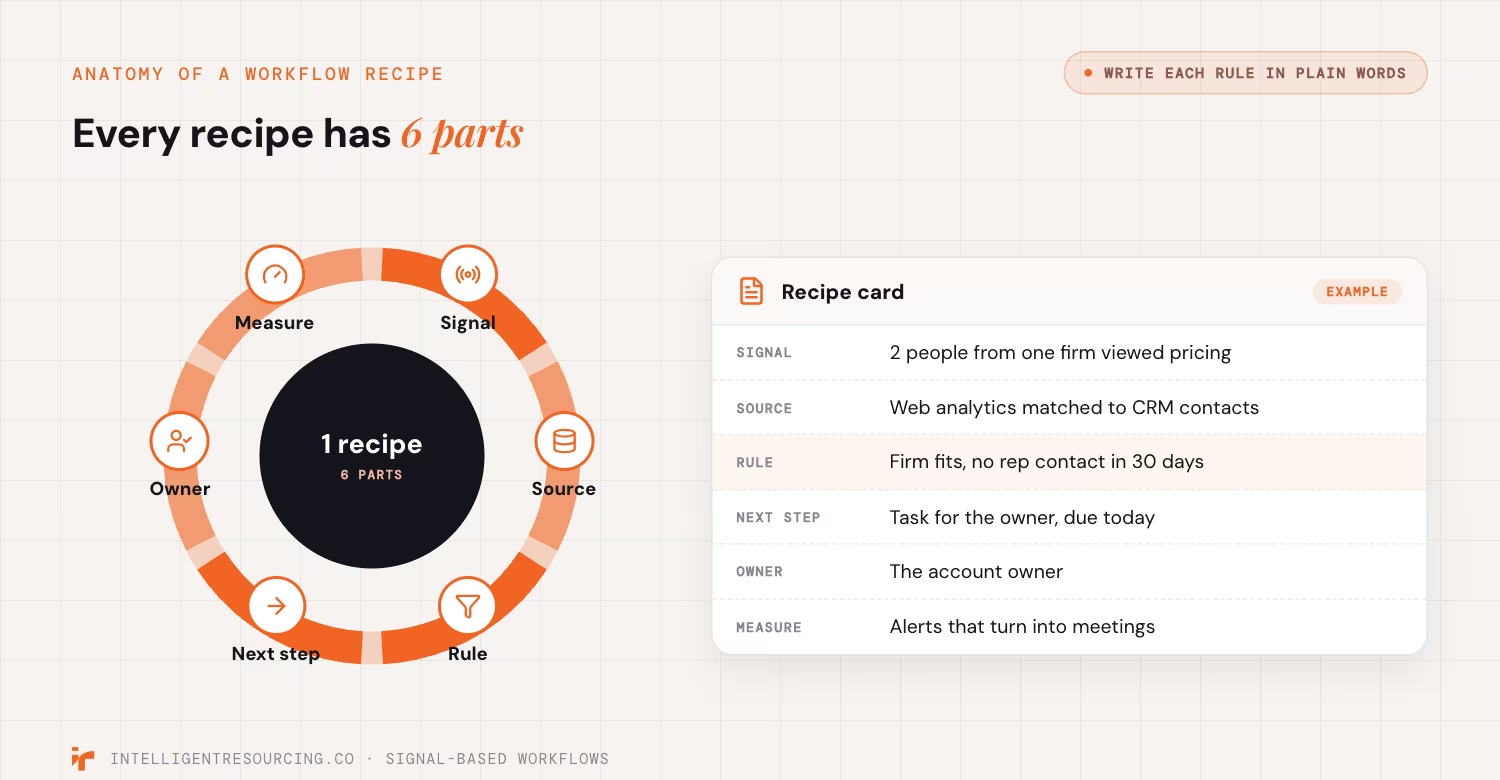
Every recipe needs 6 parts: the signal, the source, the rule, the next step, the owner and the measure. The signal is what happened, and the source is where you saw it. The rule says if it counts, and the next step is what the workflow does. The owner acts, and the measure shows if it works.
This article gives you ready recipes for business-to-business (B2B) teams. Each one runs inside your customer relationship management (CRM) system and the tools around it. If you need the full build first, from finding signals to measuring them, read our 5-step workflow build guide. Then come back and pick your first 2 recipes.
| Part | What it answers | Example |
|---|---|---|
| Signal | What happened? | 2 people from one firm viewed pricing |
| Source | Where did we see it? | Web analytics matched to CRM contacts |
| Rule | Does it count? | Firm fits, no rep contact in 30 days |
| Next step | What runs now? | Task for the owner, due today |
| Owner | Who acts? | The account owner |
| Measure | Is it working? | Alerts that turn into meetings |
Write each rule down in plain words, because reps trust an alert more when they can read why it fired. A written rule also helps with Australian privacy law.
From 10 December 2026, firms must say in their privacy policy when a computer program makes or informs decisions that significantly affect a person. The Office of the Australian Information Commissioner (OAIC) set this out in its September 2026 guidance. So check each recipe against that test, and keep the rule on file.
Which workflows act on your own website and email signals?
Your own site gives the signals closest to a sale. A demo form, a pricing visit from 2 or more people and a click on a product email all show a buyer at work. These need the fastest reply, so build these 3 recipes first and give each one a clear owner.
Recipe 1: Demo request fast lane
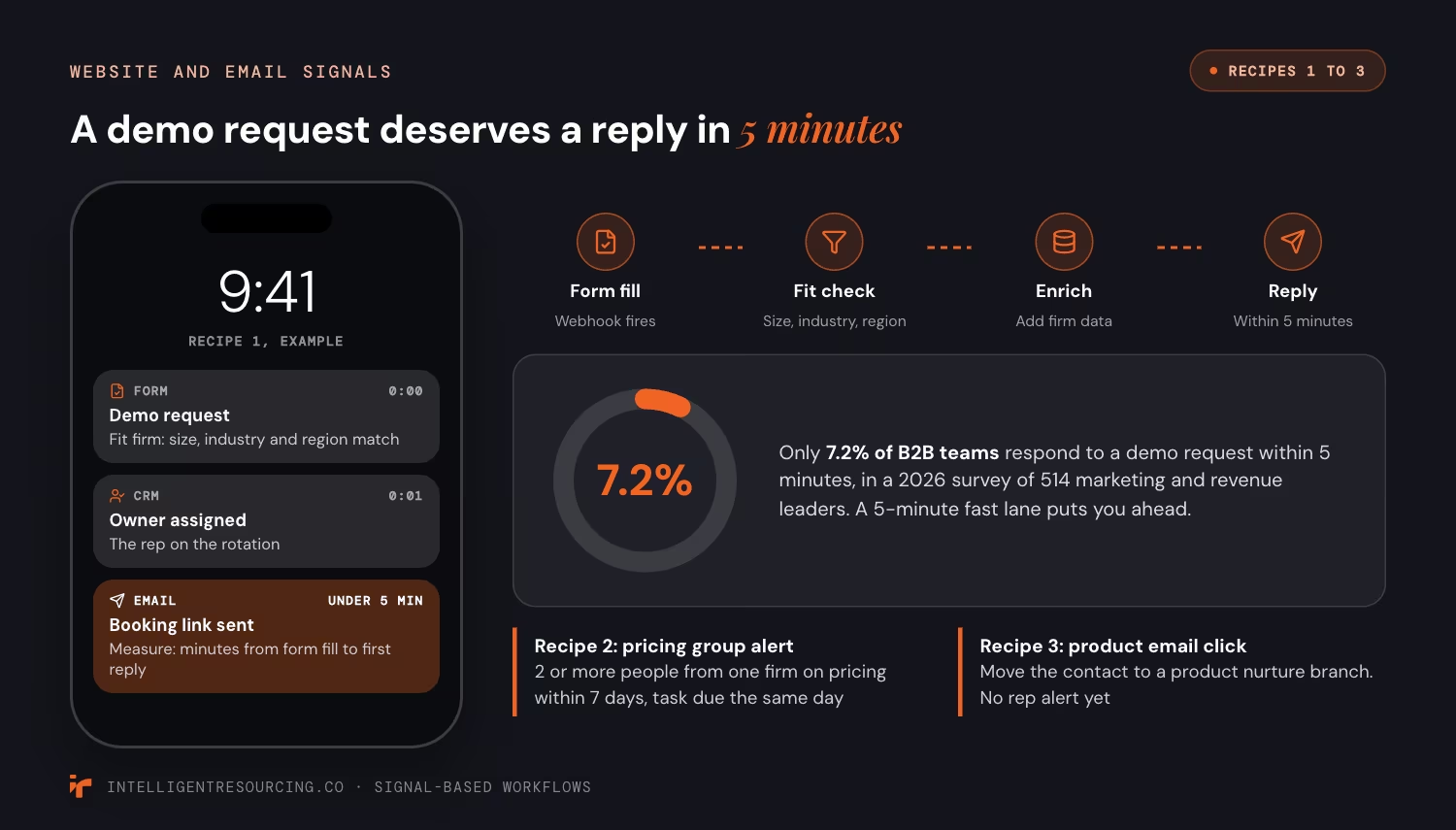
- Signal: a demo or contact form fill.
- Source: your form tool, which sends a webhook (an instant message from one app to another) to the workflow.
- Rule: the firm fits your size, industry and region.
- Next step: enrich the firm (add its size, industry and contact data), assign an owner and send a booking link within 5 minutes.
- Owner: the rep on the rotation.
- Measure: minutes from form fill to first reply.
Speed is where most teams fall short. Qualified's 2026 agentic marketing report surveyed 514 B2B marketing and revenue leaders, and only 7.2% of their teams respond to a demo request within 5 minutes. So a 5-minute fast lane puts you ahead of most teams in that survey.
Recipe 2: Pricing page group alert
- Signal: 2 or more people from one firm view your pricing page within 7 days.
- Source: your web analytics, matched to known contacts in your CRM.
- Rule: the firm fits, and no rep has contacted it in the last 30 days.
- Next step: create a task for the account owner, due the same day.
- Owner: the account owner.
- Measure: alerts that turn into meetings.
Recipe 3: Product email click branch
- Signal: a click on a product or case study link in a nurture email.
- Source: your email tool.
- Rule: the contact works at a fit firm with no open deal.
- Next step: move the contact to a nurture branch on that product. Do not alert a rep yet.
- Owner: marketing.
- Measure: the share of clickers who later visit pricing.
Each of these rules starts with "the firm fits". To decide what fit means for you, use our guide to lead scoring.
Which workflows act on people who change jobs?
People signals tell you when a buyer is new or has moved. A new leader at a target firm is new to the tools in place, and a past champion who joins a new firm already knows you. Recipes 4 and 5 catch both moves, then send a short note about the new role.
Recipe 4: New leader at a target account
- Signal: a new head of sales, marketing or operations at a firm on your list.
- Source: a new hire monitor that checks public profiles.
- Rule: the role matches your buyer, and the start date falls in the last 90 days.
- Next step: enrich the contact, then start a 3-step email series in a tool such as Smartlead that refers to the new role.
- Owner: the rep who owns the account.
- Measure: reply rate on the series.
Some tools now ship this as a built-in step. Clay's November 2024 changelog added new hire signals. The monitor lists people hired at your target firms within the last 3 months.
Recipe 5: Champion moves to a new firm
- Signal: a contact who bought from you, or backed a deal, starts at a new firm.
- Source: a job change monitor on your customer contacts.
- Rule: the new firm fits your market and is not already a customer.
- Next step: create the new firm and contact in the CRM. Then alert the old account owner with a note on what the champion bought.
- Owner: the old account owner.
- Measure: meetings booked with moved champions.
Check each flag before you act. A board seat or a side role listed as a new job will set off a false alert. For more signal types worth a monitor, see our list of B2B buying signals.
Which workflows act on company news?
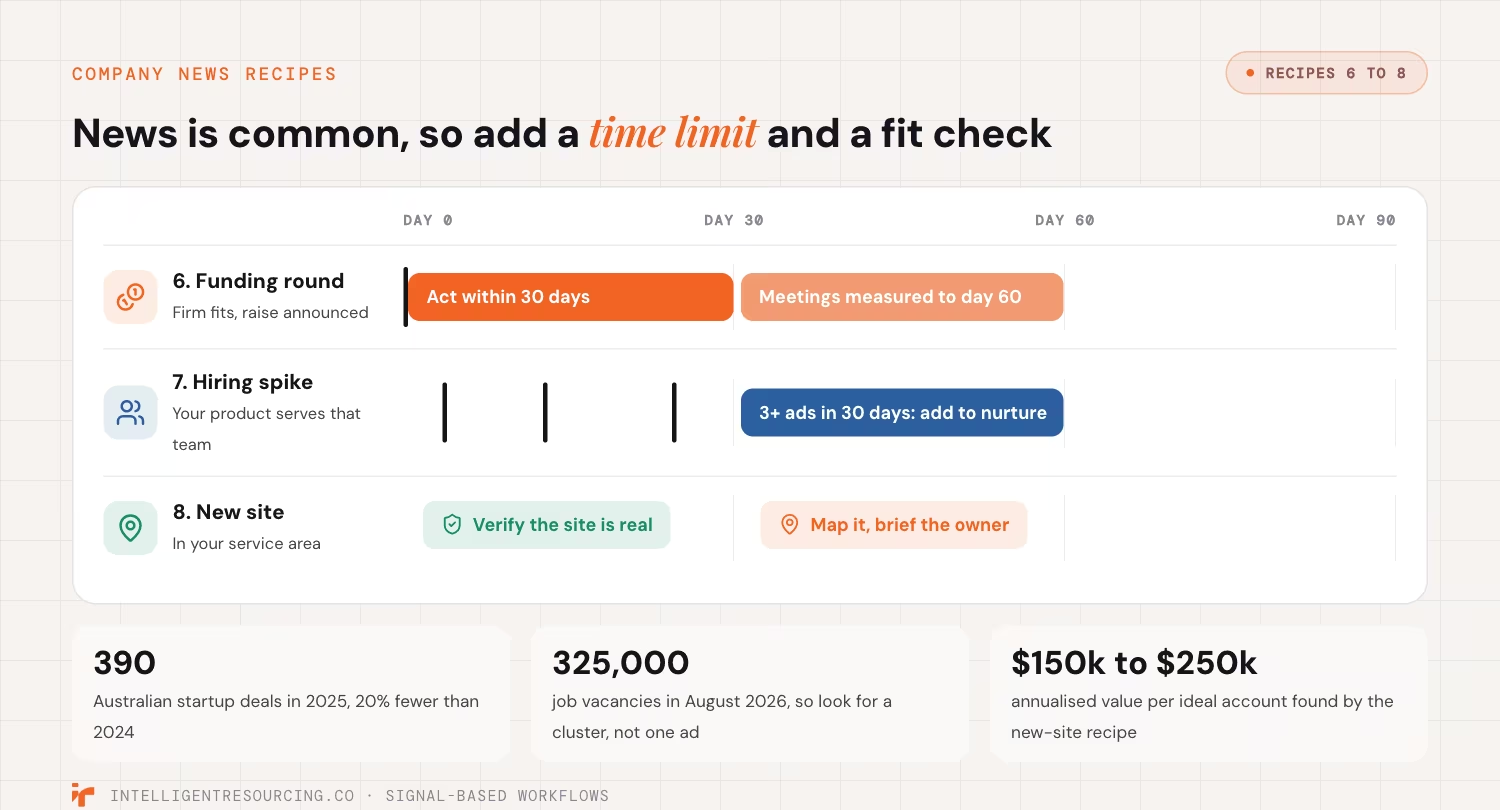
Company news shows a firm is changing: new money, new staff or a new site. Each event is common, so none of them proves intent on its own. Recipes 6 to 8 add a fit check and a time limit, then send the account to the right owner with the news attached.
Recipe 6: Funding round
- Signal: a firm announces a raise.
- Source: news alerts and public funding trackers.
- Rule: the firm fits, and the round was announced in the last 30 days.
- Next step: move the account to your top tier and send the owner a brief with the round size.
- Owner: the account owner.
- Measure: meetings from funded accounts within 60 days.
Funding news is steady enough to plan around. The State of Australian Startup Funding 2025 report counted 390 deals in 2025, worth $5.4 billion. That was 20% fewer deals than in 2024, so each round in your market is worth a fast look.
Recipe 7: Hiring spike
- Signal: 3 or more job ads in one team within 30 days.
- Source: job boards and the firm's careers page.
- Rule: your product serves that team.
- Next step: add the account to an ad audience and a nurture series on that team's problems.
- Owner: marketing.
- Measure: engaged contacts per account after 60 days.
One job ad on its own means little. The Australian Bureau of Statistics (ABS) counted 325,000 job vacancies in August 2026. With that many open roles, look for a cluster in one team, not a single ad.
Recipe 8: New site or facility
- Signal: a firm opens or plans a new site.
- Source: independent public sources and local news.
- Rule: the site is real and sits in your service area.
- Next step: map the site, add it to the account and brief the owner before first contact.
- Owner: the account owner.
- Measure: pipeline value from new-site accounts.
We verify each physical site against geospatial boundary data, and flag anything we cannot confirm. We built this recipe for a national waste-management client. A six-person team had spent about three years prospecting manually without finding these accounts. Each ideal-customer account carries $150,000 to $250,000 in annualised value.
Which workflows keep your data and past deals working?
Bad data breaks every other recipe. A bounced email, a contact who has left and a lost deal that goes quiet all need a rule. Recipes 9 and 10 fix stale contacts each day and bring lost deals back when the buyer returns, so reps spend their time on real people.
Recipe 9: Bounce and departure clean-up
- Signal: a hard bounce or an "I have left" auto-reply.
- Source: your email tool.
- Rule: the contact sits at an account you still target.
- Next step: mark the contact as gone, find who now holds the role and write the new contact back to the CRM.
- Owner: revenue operations.
- Measure: the share of contacts with a valid email.
Contact data goes stale fast. ZeroBounce's 2026 email list decay report found at least 23% of an email list decays within a year. It drew on more than 11 billion addresses checked in 2025.
Our CRM enrichment service runs this clean-up as a standing job.
Recipe 10: Lost deal comes back
- Signal: a closed-lost account (a deal marked lost in your CRM) returns to your pricing page or hires a new leader.
- Source: your web analytics and your CRM.
- Rule: the deal was lost more than 90 days ago, and the loss reason was not "poor fit".
- Next step: alert the old deal owner with the loss reason and the new signal.
- Owner: the old deal owner.
- Measure: lost deals reopened each quarter.
Which recipe should you build first?
Build recipe 1, the demo fast lane, first. Then add recipe 2 and recipe 9, so alerts are fast and the data behind them stays clean. Add 1 public signal recipe next, and run each new recipe for a month before you add the next, because 1 change at a time shows you what works.
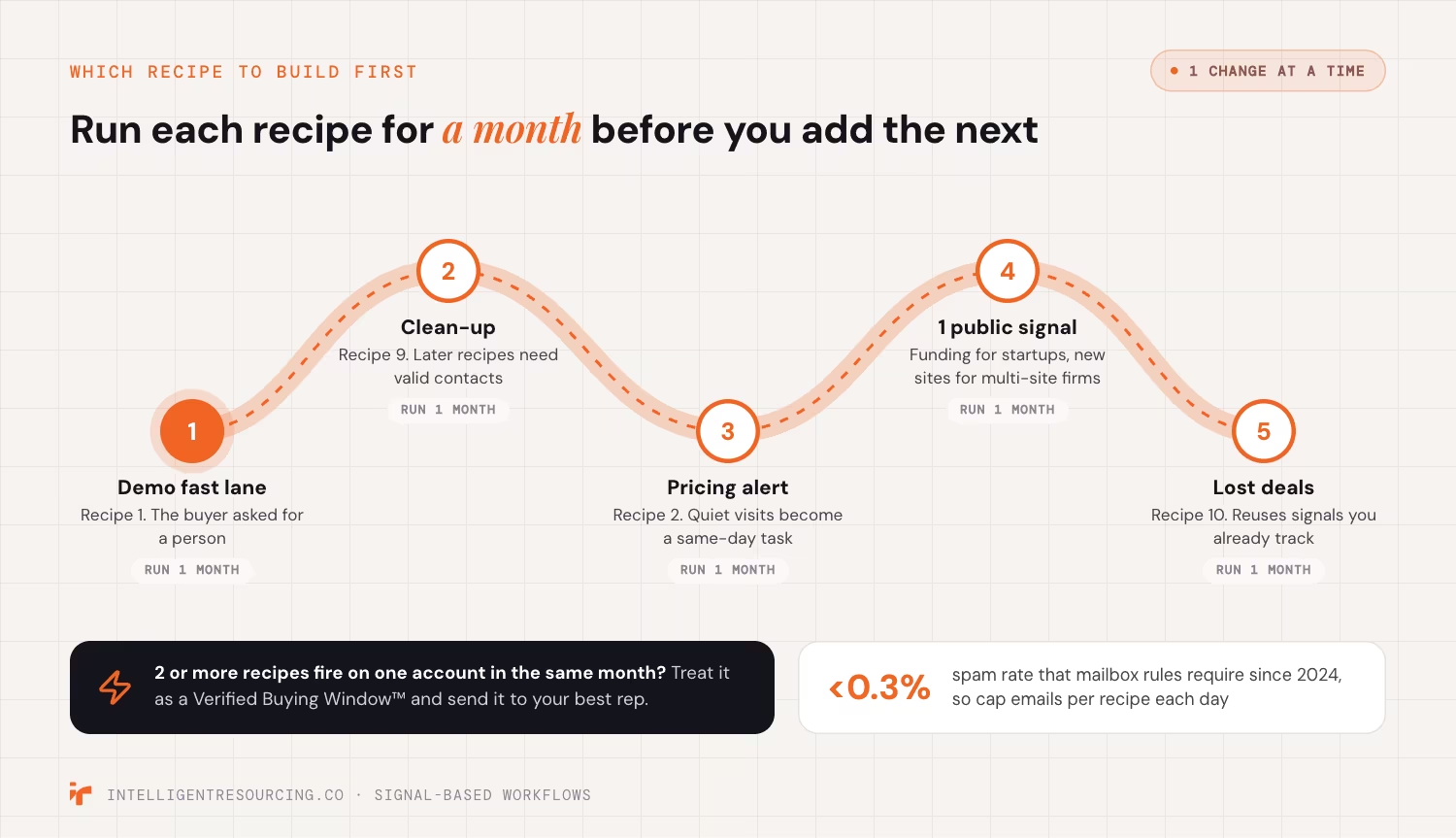
A good build order for most teams:
- Recipe 1, demo fast lane. The buyer has asked for a person, so speed pays off first.
- Recipe 9, clean-up. Every later recipe needs valid contacts, so fix data early.
- Recipe 2, pricing alert. It turns quiet visits into a same-day task.
- 1 public signal recipe. Pick the one that fits your market, such as funding for startups or new sites for firms with many sites.
- Recipe 10, lost deals. It reuses signals you already track.
Any recipe that sends email must meet mailbox rules. Since February 2024, Google's email sender guidelines have required all Gmail senders to keep spam rates below 0.3%. Senders of 5,000 or more emails a day to Gmail must also offer one-click unsubscribe, so cap how many emails each recipe can send per day.
When 2 or more recipes fire on the same account in the same month, treat it as a Verified Buying Window™ and send it to your best rep. If you want help to choose and build your first 3 recipes, book a working session.
Clay Workflows
Our go-to-market engineers build workflows that act on real buying signals, not batch schedules. Book a working session to map your first 3 recipes.
FAQs
What are examples of marketing automation?
Common examples are a welcome email after a sign-up, a nurture series after a download and a task for a rep after a demo request. Signal-based examples go further. They act on a pricing visit, a new leader at a target firm or a funding round. Each one runs a set next step when a rule is met.
What are the top 5 marketing automation tools?
The right 5 depend on the job each tool does. Most B2B teams need a CRM, such as HubSpot or Salesforce, to hold accounts. They add an enrichment tool such as Clay, a workflow tool such as n8n and a sending tool such as Smartlead. Web analytics on your own site make up the fifth part.
What are trigger points in marketing?
Trigger points are the moments that set off a planned next step. A form fill, a pricing visit, a new hire or a bounced email can each be a trigger. A good trigger has a rule, so it fires only for the right accounts.
How does AI fit into signal-based marketing automation?
Artificial intelligence (AI) helps with the reading and writing steps. It can sort news into signal types, sum up an account for a rep and draft a first email. Keep a person in charge of the rules and the send, because a wrong alert costs a rep's time.
How do you start building signal-based workflows?
Start with 1 recipe and 1 owner, such as the demo fast lane. Write its rule in plain words and set the 1 number you will track. Run it for a month, then add the next recipe.
How many signal-based workflows should you run at once?
Run only as many as your team can act on each day. Start with 3 to 5 live recipes, and add more only when the current ones turn alerts into meetings.