

How is signal-based lead scoring different from traditional scoring?
Traditional scoring adds points for clicks, opens and form fills, and it rarely takes them away. Signal-based scoring changes 2 things. It scores the whole firm, not just one person. And it gives the most points to fresh signals that show a firm is close to buying, such as 3 staff on your pricing page in a week.
That is why sales teams in business-to-business (B2B) firms stop trusting the old kind of score. A student who downloads 4 guides can outscore a buyer who asked for a price. A guide read 60 days ago still counts in full. Reps learn that a high score means little, so they stop looking at it.
Signal-based scoring fixes this with live data. As of October 2026, Salesforce's Trailhead guide to behaviour scoring says "score decay is built into this model." It adds that scores "are typically updated every 4 hours." So a score shows what a buyer is doing this week, not last quarter.
A signal-based model looks at 3 kinds of data:
- Fit: company size, industry, region and the role of each contact.
- Intent: pricing page visits, demo requests, replies, and visits from more than 1 person at a firm.
- Timing: a new round of funding, a new sales head or a jump in hiring.
This is the same idea behind signal-based marketing: act on what a buyer does, not on a date in a plan.
How do you score fit and intent separately?
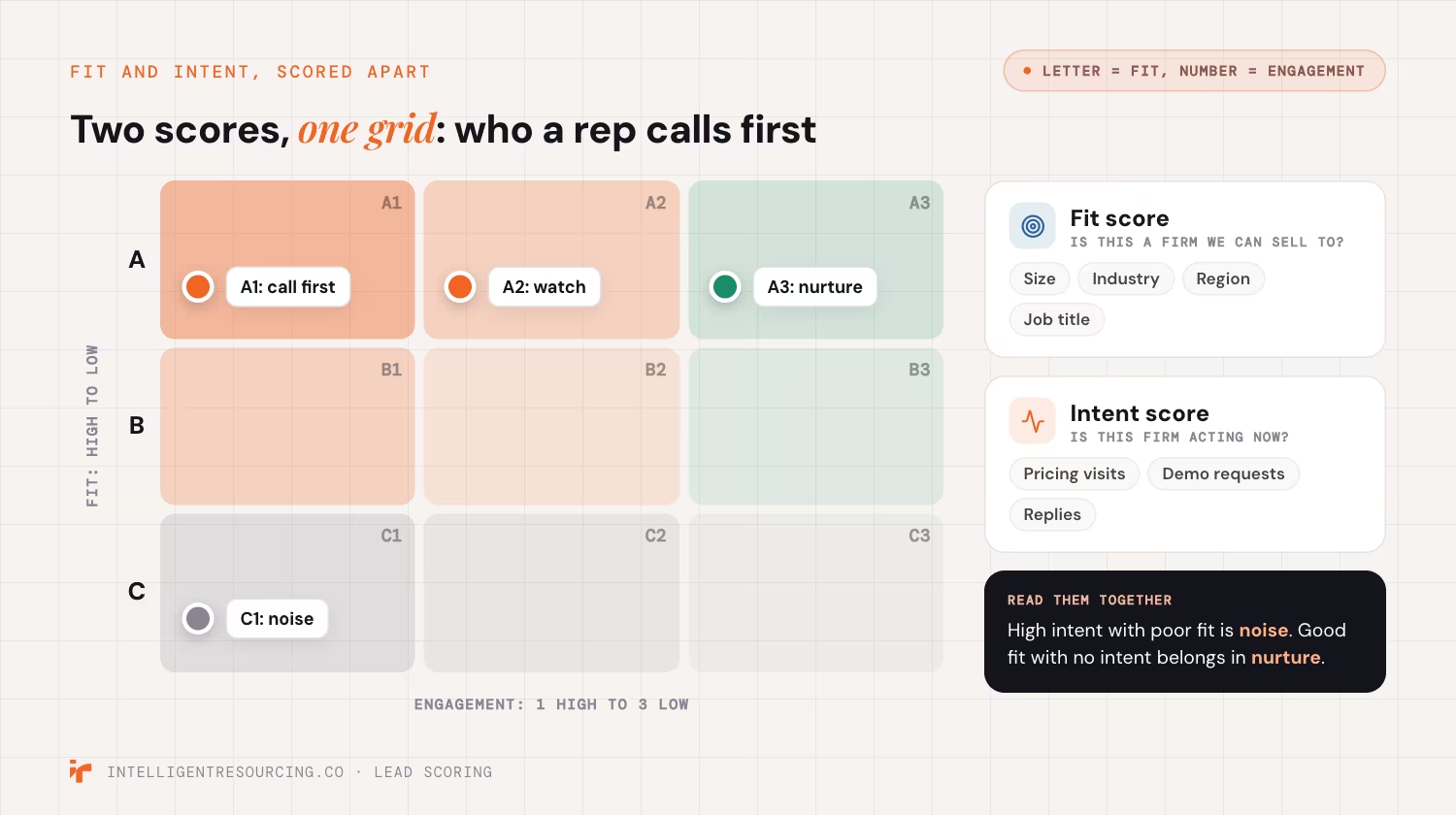
Keep 2 scores, not 1. A fit score asks if the firm is a buyer you want, based on size, industry, region and role. An intent score asks if they are acting now, based on visits, replies and requests. A lead needs both: high intent with poor fit is noise, and good fit with no intent belongs in nurture.
Most customer relationship management (CRM) tools now work this way. As of October 2026, HubSpot's lead scoring tool guide lists 3 score types: engagement, fit and combined.
Its combined score uses a grid from A1 to C3. The letter shows fit, from A (high) to C (low). The number shows engagement, from 1 (high) to 3 (low). So a C1 is a firm with poor fit but lots of activity.
HubSpot has replaced its old single score property with this tool. Its old guide to score properties now sends readers to the new lead scoring tool.
| Score | What it asks | Example data | How often it changes |
|---|---|---|---|
| Fit | Is this a firm we can sell to? | Size, industry, region, job title | Rarely, when the firm changes |
| Intent | Is this firm acting now? | Pricing visits, demo requests, replies | Daily, and it fades with time |
| Combined | Who should a rep call first? | Both scores read together | Each time either score moves |
Score the account as well as the person. Add up the intent points of every contact at one firm. Three people on your site in a week tell you more than one person on it 3 times.
A fit score is only as good as your CRM fields. If size or industry is blank or wrong, the score is wrong too, so fix the data with CRM enrichment before you trust the fit score.
How is a lead score calculated?
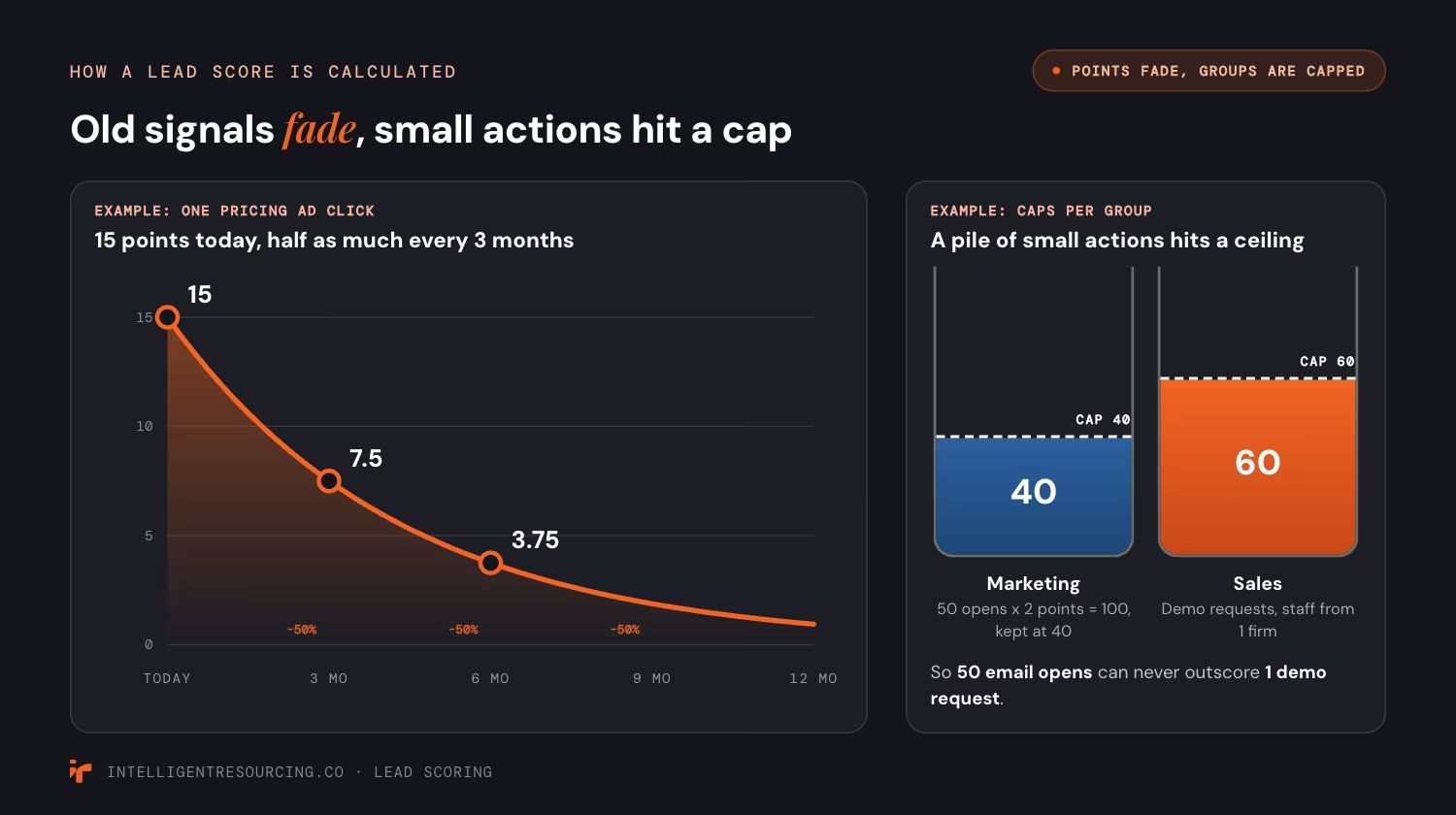
Give each signal points, add them up, and take points away as signals age. Strong signals, such as a demo request, get the most points. Weak ones, such as an email open, get the fewest. Then set a cap on each group of points, so a pile of small actions can never outscore one strong action.
Here is a worked example. As of October 2026, HubSpot's guide to building lead scores walks through a sample firm.
That October 2026 sample gives 15 points for a click on a demo page or pricing ad, and 2 points for an email open. It applies "50% score decay every three months to each rule." It caps the marketing group at 40 points and the sales group at 60, so sales actions carry more weight.
You can build your own sheet in the same way:
| Signal | Points | Group | Fades? |
|---|---|---|---|
| Email open | Low | Marketing | Yes, fast |
| Guide download | Low to mid | Marketing | Yes |
| Pricing page visit | Mid | Marketing | Yes |
| Several staff from 1 firm on the site | High | Sales | Yes |
| Demo or price request | Highest | Sales | Yes, slowly |
| Wrong region or too small | Minus points | Fit | No |
Decay is the step most teams skip. As of October 2026, HubSpot's tool lets you set decay to run every 1, 3, 6 or 12 months. Pick a short gap for weak signals and a longer one for strong ones.
Not every signal earns points. To see which ones show real intent and which are noise, read our guide to B2B buying signals.
What score should trigger a hand-off to sales?
Set the hand-off score with sales, not for them. Pick a level, such as the top band of your score, and agree what a rep must do and by when. Then check it each month: if reps reject most leads that pass, the bar is too low, and if good leads sit below it, the bar is too high.

Use bands, not one exact number. As of October 2026, HubSpot's sample uses 3 bands: High (70 to 100), Medium (40 to 69) and Low (0 to 39). Bands let a team act on a range. A rep does not need to argue over 68 or 72.
Write the hand-off rules down:
- The band: which score sends a lead to a rep, and which sends it to nurture.
- The owner: who gets the lead, by account, territory or turn.
- The reply time: how fast the rep must act, such as the same day.
- The way back: how a rep returns a lead to nurture, with a reason.
Hand off the buying group, not just one contact. In a case Forrester shared in April 2025, Palo Alto Networks moved its lead process to buying groups. Its lead manager said that "during the pilot stage, win rates doubled." Forrester's advice is to pass buying group signals to your reps.
The hand-off is where scoring meets routing. Our guide to signal-based marketing workflows shows how to route each lead to one owner with a set reply time.
How do you test a lead scoring model against closed deals?
Run the model over deals you have already won and lost, without telling it the result. Then compare the scores with what really happened. If high scores did not win more often, or did not bring bigger deals, the weights are wrong. Fix them before the model scores a single new lead.

Researchers use the same test. A 2025 Frontiers journal study built a lead scoring model for a B2B software firm from 16,600 CRM records. The team trained the model on 70% of the records and tested it on the other 30%. They found that "source" and "lead status" did the most to make the prediction more accurate.
Here is how to run the test:
- Pull 12 to 24 months of closed deals, both won and lost.
- Score them as they looked before the deal closed, not as they look now.
- Split the scores into bands and check the win rate and deal size in each band.
- Change one weight at a time and run it again.
This is how we work too. We prove our scoring against reality first: a client's already-decided deals are run through it blind, so the model is validated before it scores a new prospect.
The result can surprise you. Blind-tested on 640 of a client's already-decided deals, our scoring did not predict who would win, but the top-scored accounts were up to 3.6x more likely to be large deals. It was a value filter, not a win predictor.
So the team used it to rank which accounts get time first, not to guess which deals would close.
If you want a second view on your own model, talk to our team about a blind test.
Should you use AI predictive lead scoring or rules?
Use rules first, and add artificial intelligence (AI) when you have the data to feed it. A predictive model learns its own weights from past results, so it needs many closed leads with a clear outcome. A rules model works from day one, and sales can see why a lead scored high. Test both on the same past deals.
Each major CRM sets a minimum amount of data before its model will run. As of October 2026, Salesforce's Einstein Lead Scoring guide asks for at least 1,000 leads created in the last 200 days, with at least 120 of them converted. Below that, it uses a global model built from "anonymous data from many Salesforce customers."
Microsoft's predictive lead scoring guide, updated in August 2025, needs at least 40 qualified and 40 disqualified leads in the time frame you pick. As of October 2026, HubSpot's AI scores need at least 50 contacts: 25 converted and 25 not converted.
| Rules model | Predictive AI model | |
|---|---|---|
| Works from day 1 | Yes | No, it needs past results |
| Sales can see why a lead scored high | Yes | Partly |
| Finds patterns you did not think of | No | Yes |
| Handles a new product or market | Yes, you set the weights | Poorly, there is no history yet |
| Upkeep | A person reviews the weights | The model retrains, but someone still checks it |
A minimum is not the same as enough. In Dynamics, 80 closed leads will build a model, but that model can still learn the wrong lesson. So treat the minimum as the start line, and keep your blind test as the judge.
Buyer Intent
We test your scoring model blind on deals you have already won and lost, so you know what the score really predicts before reps rely on it.
FAQs
What does lead scoring mean?
Lead scoring gives each lead a number that shows how likely it is to buy. Points come from fit, such as company size and role, and from intent, such as pricing visits or a demo request. Sales then works the highest scores first.
Can you give me an example of lead scoring?
Say a firm in your target industry gets 20 fit points. Three of its staff visit your pricing page in one week, which adds 30 intent points. One of them asks for a demo, which adds 40 more. The firm passes your hand-off band, so a rep calls the same day.
How is lead scoring used in a CRM?
The CRM adds or takes away points each time a contact acts or a field changes. The score sits on the contact or company record. Workflows then use the score to route the lead to a rep or send it back to nurture.
What is the best software for lead scoring?
The best tool is usually the one inside the CRM you already use. HubSpot, Salesforce and Microsoft Dynamics all have built-in scoring. Pick the one your team works in every day, since a score that sits in another tool gets ignored.
Should you score leads or accounts?
Score both. Lead scores show what one person does. Account scores add up every contact at a firm, which shows if a whole buying group is active.
How often should you review a lead scoring model?
Review the hand-off band each month with sales. Re-run the blind test on fresh closed deals every quarter. Review sooner if you launch a new product or enter a new market.