

What Determines the Price of B2B Data Enrichment?
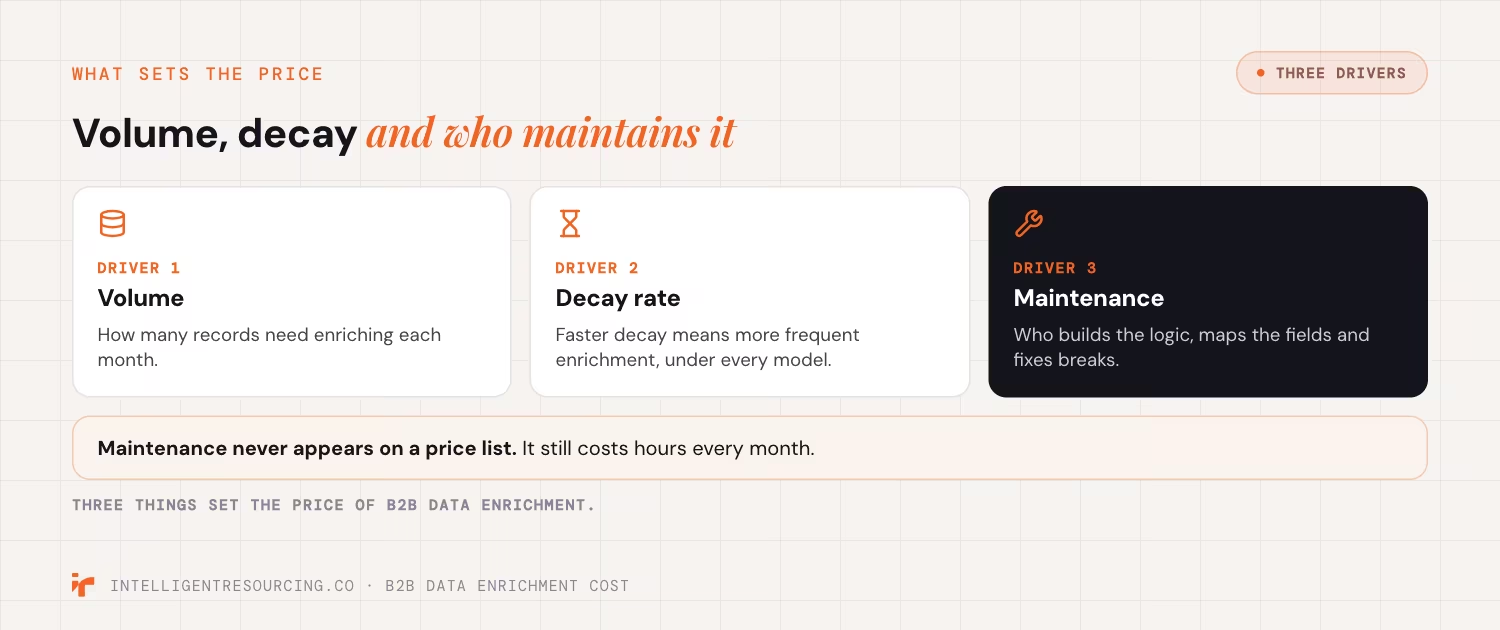
Three things set the price: how many records need enriching, how fast the data goes stale, and who maintains the system.
Decay estimates vary with what counts as a change. Apollo's decay analysis cites published estimates that put contact data decay at 22.5% to 70.3% a year.
Data vendor Cleanlist's 2026 benchmark report puts decay at about 67% a year when records are re-verified continuously, against a classic benchmark of 30%.
- Volume. A team enriching a few hundred records a month pays almost nothing on a credit plan. A team enriching thousands every month is different. Here, a bundled retainer can cost less than stacking credit top-ups.
- Decay rate. Faster decay means more frequent enrichment, which raises the bill under every pricing model.
- Maintenance. Someone has to set up the enrichment logic, match the fields to the CRM, and fix things when a data provider changes. This labour never appears on a price list.
How Much Do Credit-Based Enrichment Tools Cost?
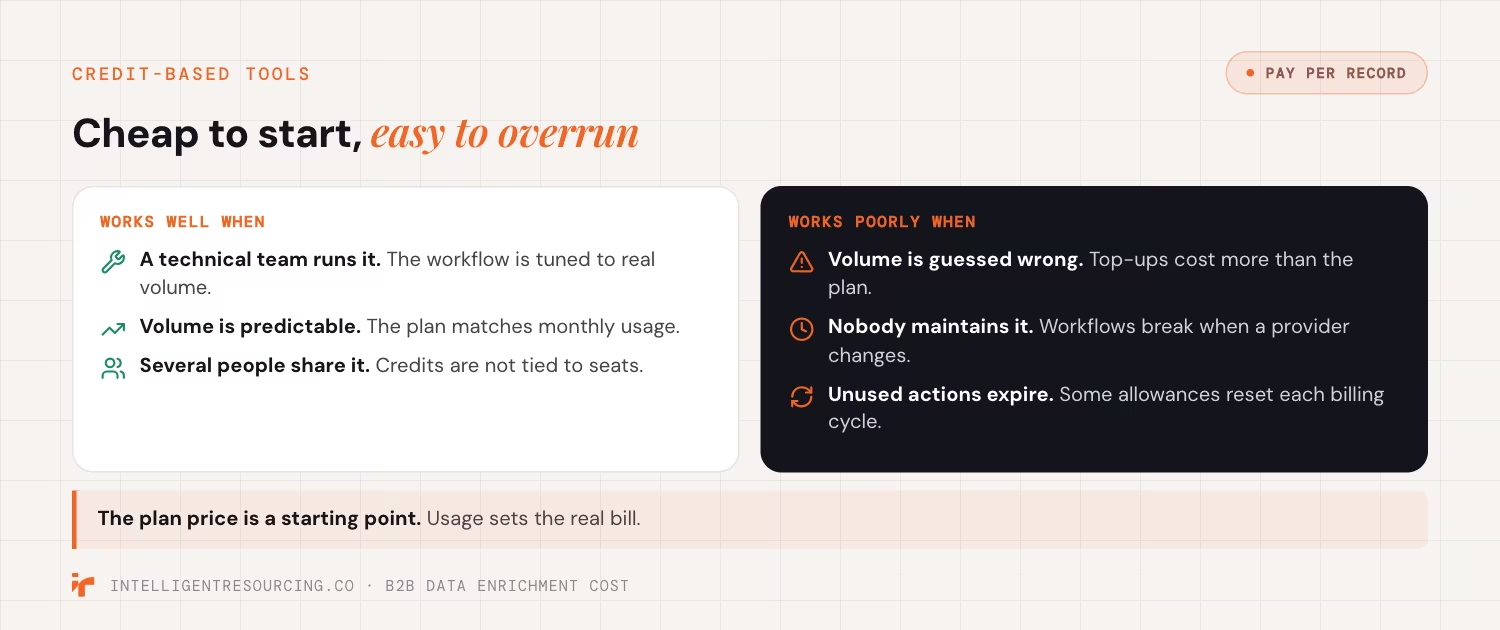
Credit-based tools charge per record, not per seat. The plan price is only a starting point, since usage sets the real bill. Clay's pricing page, checked 30 October 2026, lists these plans, shown here in Australian dollars:
| Clay plan | Annual billing (per month) | Month to month | What the page lists |
|---|---|---|---|
| Free | AUD 0 | AUD 0 | 100 Data Credits and 500 Actions a month |
| Launch | from about AUD 235 | from about AUD 265 | Data Credits and Actions step up by tier |
| Growth | from about AUD 635 | from about AUD 705 | Higher tiers, plus CRM sync and signals |
Clay's page says you can top up Data Credits at a 30% premium or move to a higher tier. Actions reset each billing cycle and do not roll over. Teams with unpredictable volume often pay more than the headline price suggests.
- Works well when: a technical team can tune a workflow to its exact volume.
- Works poorly when: a team guesses wrong on volume or lacks time to maintain the workflow. Clay's own credit model is covered in Clay vs ZoomInfo pricing.
How Much Do Per-Seat Enrichment Subscriptions Cost?
Per-seat tools charge a flat fee per user, with credits bundled in. The price multiplies with every hire, unlike a credit plan shared across a team. Apollo and Lusha list these prices on their own pricing pages, checked 1 November 2026. Check the live page before you buy.
| Tool | Plan | Annual billing (per month) | Month to month |
|---|---|---|---|
| Apollo | Basic | about AUD 70 a user | about AUD 90 a user |
| Apollo | Professional | about AUD 110 a user | about AUD 140 a user |
| Apollo | Organization (3-user minimum) | about AUD 170 a user | Annual billing only |
| Lusha | Pro (2 seats included) | about AUD 75 | about AUD 100 |
Apollo's figures come from Apollo's pricing page.
Lusha's come from Lusha's pricing page.
Per-seat pricing is predictable for a team of one or two. Add a third or fourth person, and the bill grows just as fast.
What Does In-House Enrichment Really Cost?
In-house enrichment has no subscription line. That makes it look free, until the labour cost shows up elsewhere. For a full analyst comparison, see the build-versus-buy guide.

- The hidden labour cost. A rep who manually updates 50 records a week spends hours on work a tool could do in minutes. That time never shows up on a software invoice.
- The hidden data cost. Cold-email vendor Instantly models US median private-sector tenure of 3.5 years as 15% to 20% of professionals changing roles each year. It is a vendor model, not a measured rate. Without a system to catch this, outreach lands on records that are already wrong.
- When it still makes sense. Only at small volume, where labour stays under an hour or two a week.
When Does a Managed Enrichment Retainer Cost Less Than Tools?
A managed retainer costs less than stacking tools once volume is steady and nobody wants to manage credits every month. Waterfall enrichment sends a record through several providers until one finds a match. Clay's waterfall guide shows a waterfall reaching 80% coverage where a single provider reaches 40%. That is a vendor illustration, not an independent result.

Intelligent Resourcing publishes its GTM Engineering price on its pricing page as AUD 3,500 to 8,400 plus GST a month, with tool licences, data and enrichment credits and artificial intelligence (AI) token costs included. There is no separate credit bill. The trade-off is a higher entry price than a single Clay plan. At very low, occasional volume, the retainer stops making sense.
Which Model Fits Your Enrichment Volume?
The right choice depends on volume, predictability and who can maintain it. A chief financial officer (CFO) modelling spend can use Databar's CFO guide. It splits cost into data, operations and the cost of not enriching, and notes that on its own outcome-based billing, only the waterfall provider that returns data is charged.
| Your situation | Best-fit model |
|---|---|
| Low, predictable volume, technical capacity in-house | Credit-based tool, matched to actual monthly usage |
| Low volume, no spare technical capacity | Per-seat tool, accepting the price climbs with every hire |
| Steady, CRM-wide volume, no appetite for credit management | Managed retainer that bundles enrichment into one number |
| Occasional, very small volume | Manual enrichment, watched closely for the labour hours it costs |
What Should You Do Next?
For what GTM engineering costs an Australian business, see GTM engineering cost for a small business.
Every month enrichment lags, outreach lands on stale records. Audit your CRM data
Lead Generation
See how CRM enrichment keeps contact and company records accurate inside your own CRM, with credits and tools included in one monthly fee.
FAQs
Is data enrichment free?
Not for serious use. Clay's free plan lists 100 Data Credits a month, and Lusha's lists 40 credits a month. That is enough for testing, not for ongoing use.
What's the difference between per-seat and credit-based enrichment pricing?
Per-seat pricing charges a flat fee for each user, with credits bundled in. Credit-based pricing charges per record enriched, no matter how many people use the account. Per-seat pricing suits small teams. Credit-based pricing suits teams with a known, steady volume.
How much does CRM data enrichment cost for a small Australian B2B team?
A small team on a self-serve tool typically pays about AUD 235 to 705 a month for Clay's paid plans, or about AUD 70 to 170 a user a month for Apollo on annual billing. Those are converted from US-dollar listings, so check the live price. A managed retainer starts at AUD 3,500 plus GST a month.
When does a credit plan beat a managed retainer?
When volume is low and steady and someone in the team can build and maintain the workflow. A credit plan from about AUD 235 a month then costs far less than a retainer with a AUD 3,500 floor. The retainer wins once volume is high and nobody wants to manage credits.
Do unused enrichment credits roll over?
It depends on the vendor. Lusha's page says unused credits on monthly plans roll over up to twice the plan limit, and annual plans reset at the end of the cycle. Clay's page says Actions do not roll over and lists limited credit rollover on paid plans. Ask each vendor before you buy.