
Why Is LinkedIn Outbound Hitting a Ceiling for B2B Teams in 2026?
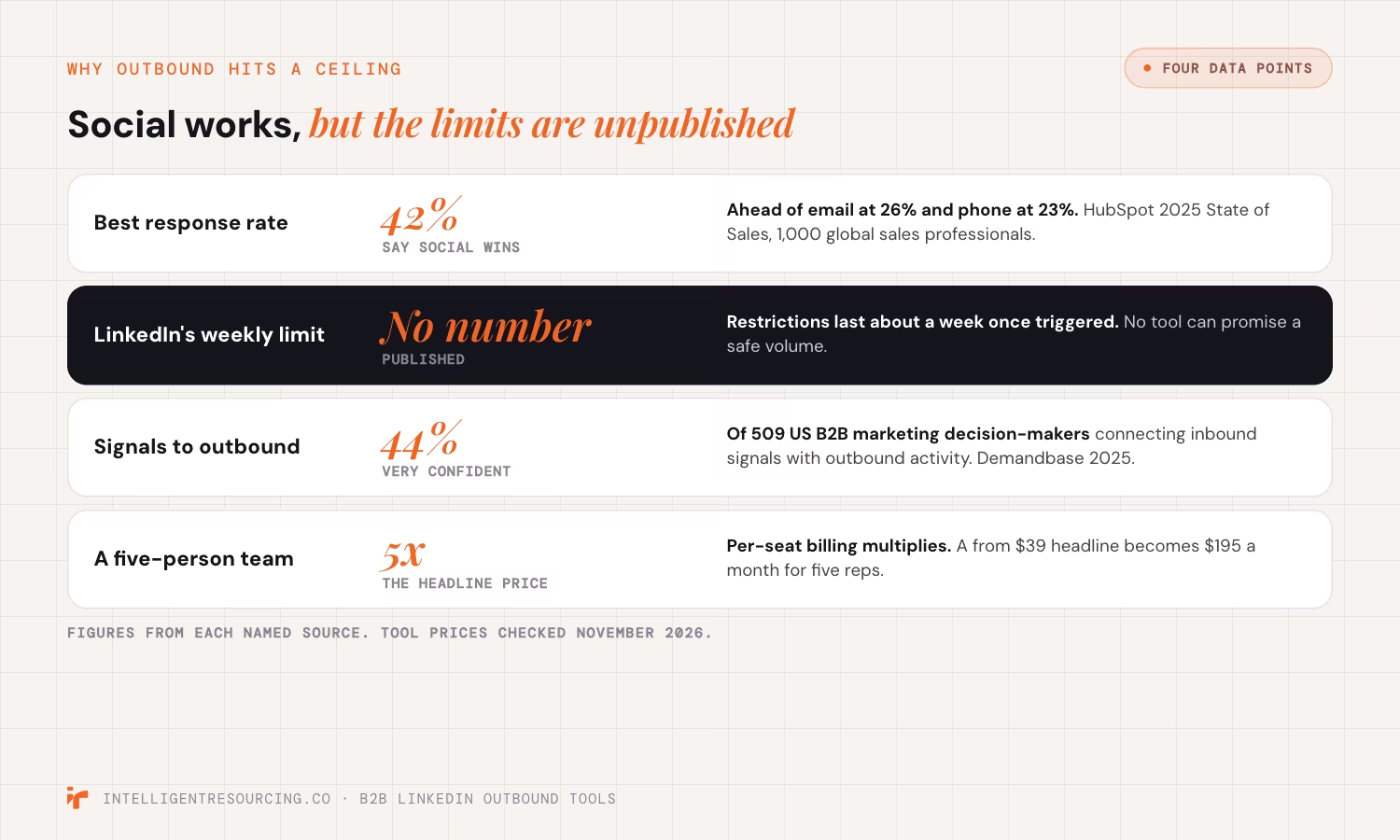
LinkedIn outbound has hit a hard structural limit, and the honest case for these tools sits right alongside it:
- Sales teams rate social highest for cold outreach. HubSpot's 2025 State of Sales Report surveyed 1,000 global sales professionals. 42% say social media delivers the highest cold outreach response rate, ahead of email at 26% and phone at 23%.
- LinkedIn won't say where the ceiling actually is. Hublead's reading of LinkedIn's help pages shows Basic and Premium accounts both face invitation restrictions, typically lasting about a week once triggered, with no published number. Every tool's "safe daily volume" is a guess, not a guarantee any vendor can give.
- These platforms genuinely remove real grind. They cut the manual work of sending connection requests one profile at a time. Several now log that activity straight into a CRM, with no Zapier step needed. That beats a rep copying names from a spreadsheet.
- But faster sending never fixes who gets sent to. A tool with unlimited senders aimed at the wrong accounts just gets more accounts restricted, faster. Intelligent Resourcing's signal detection layer flags accounts showing buying signals, so outreach starts inside a live buying window instead of running on volume and hope.
What Should You Evaluate in a LinkedIn Outbound Tool for B2B Pipeline?
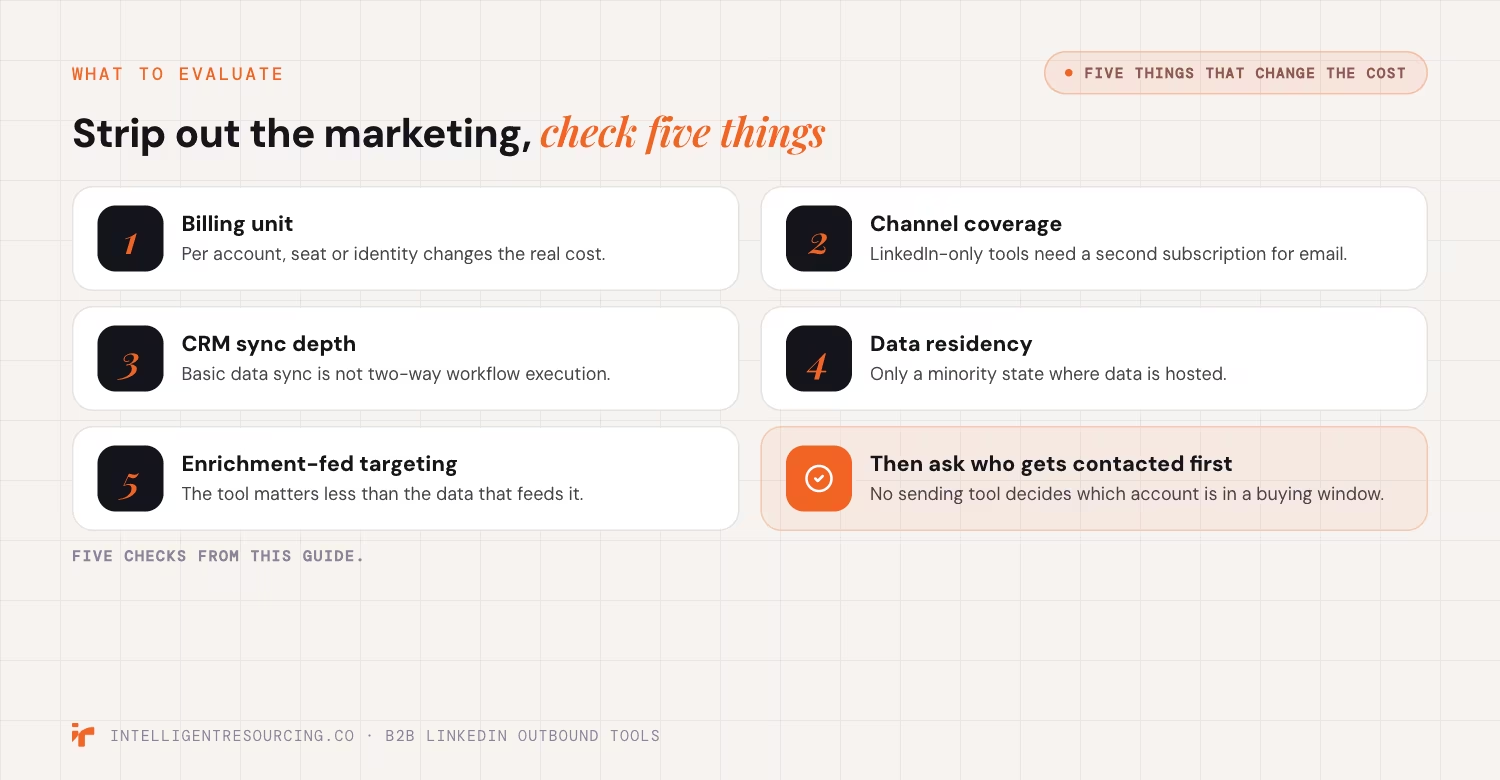
Five things separate these platforms, once you strip out the marketing language. They are ranked by how often each one changes the real cost of ownership. For the fuller picture, see our breakdown of signal-based marketing tools.
- Billing unit. Per account, per seat, or per identity changes the real cost once a second person joins. A "from $39" headline becomes $195 a month for five reps.
- Channel coverage. HeyReach sends on LinkedIn only and needs a connected email tool, paid separately. Multichannel tools, including Overloop, Dripify, Lemlist, La Growth Machine and SalesRobot, bundle it. Some gate it behind a higher tier.
- CRM sync depth. Basic data sync and two-way workflow execution are not the same feature. Vendors rarely separate them on the pricing page.
- Data residency. Only a minority of this category states where data is hosted. EU-based teams under General Data Protection Regulation (GDPR) procurement review should ask directly, not assume.
- Enrichment-fed targeting. Demandbase's 2025 State of B2B Marketing report surveyed 509 US B2B marketing decision-makers. Only 44% feel very confident connecting inbound signals with outbound sales activity. The tool matters less than the data that feeds it.
Which Tools Actually Drive B2B Pipeline on LinkedIn?
1. HeyReach
Flat per-sender pricing built for agencies running many accounts at once
HeyReach bills per connected LinkedIn account, not per user seat, per its own plans and pricing guide. Growth costs $79 a month per sender under 10 senders, dropping to $59 at 10 or more. The agency runs $999 a month for 25 senders or $1,399 for 50. Unlimited is a flat $2,999 a month with no per-seat charges.
Best for: agencies or in-house teams running outreach across many separate LinkedIn accounts who want one flat price per sender.
Limitation: HeyReach sends on LinkedIn only. Email sequences run through a connected tool such as Instantly or Smartlead, which you pay for separately.
Switcher proof: Lux Sales Consulting says it scaled from managing 15 to 20 LinkedIn accounts to 40 to 60, with a substantial rise in booked appointments. A per-sender model rewards teams with many accounts and punishes a solo operator paying full price for one.
2. Expandi
One all-inclusive plan, billed per LinkedIn account
Expandi sells one Business plan at $99 a month per seat, or $79 billed annually, per a 2026 pricing and features review. Every core feature is included, plus a 7-day free trial. Image, graphics interchange format (GIF) and video personalisation cost extra, through separate Hyperise and SendSpark subscriptions.
Best for: teams that want LinkedIn and email combined in one cloud platform, without comparing feature-gated tiers first.
Limitation: the per-seat cost goes up with every account added.
Switcher proof: SaleScout says it switched from a white-label tool with hidden costs and poor support, and booked 6 new demos plus $250,000 in pipeline within 3 weeks. Simplicity has a price: one plan means no cheaper entry point for a single-account user.
3. Overloop
EU-hosted multichannel outreach with AI-written sequences
Overloop's own pricing breakdown sets Starter at $69 a month per user, with 250 monthly credits and one connected email account. Growth runs $99 a month, with 500 credits and three connected accounts. It is EU-based, with GDPR-aware data handling in its data processing agreement (DPA), and draws on a 450-million-contact database.
Best for: EU-based or GDPR-reviewed teams who need LinkedIn and email in one sequence.
Limitation: Overloop's own review states CRM integration scope varies by provider, and HubSpot replies do not sync back into HubSpot. It is an execution layer, not a CRM replacement.
Switcher proof: Lemons reports a 55% response rate on its campaigns, and says one rep generated $150,000 in revenue within six weeks. EU hosting is rare in this category; most competitors here don't state a data region.
4. Dripify
Cloud-based campaign builder now covering LinkedIn and email in one sequence
Dripify's Pro plan runs $79 a month per user, or $59 billed annually, per a pricing review. Advanced runs $99 a month, or $79 billed annually. Dripify now runs LinkedIn and email in the same sequence on every paid plan, with native HubSpot integration and API access.
Best for: founder-led sales or small teams wanting a visual, low-cost entry point into LinkedIn and email automation.
Limitation: team controls and multi-rep visibility are Advanced-plan only. AI personalisation covers one icebreaker variable; the rest of the message is a template.
Switcher proof: Zycus says LinkedIn went from 1% reply rates to 33% of all meetings booked, across 40 users in 1.5 years. The lowest price here still assumes a small team; the jump to Advanced is where team features get paid for.
5. Lemlist
Native two-way CRM sync, gated above the entry tier
Lemlist's Email plan runs $69 a month, or $55 billed annually. Its Multichannel plan, adding LinkedIn, WhatsApp and calling, runs $109 a month, or $87 billed annually, per Lemlist's pricing page. A side-by-side review confirms native sync with HubSpot, Salesforce, Pipedrive, Zoho CRM, Close.io, ActiveCampaign, HighLevel and Streak.
Best for: teams already standardised on HubSpot or Salesforce who want sync without routing through Zapier.
Limitation: that same review found full two-way workflow, launching campaigns straight from the CRM, needs the Enterprise tier, a 5-seat minimum. Smaller teams only get basic data sync.
Switcher proof: Mindee says it doubled reply rates after switching to Lemlist, and cut sales stack costs by up to 70%. The CRM integration headline is accurate but incomplete without the tier that unlocks it.
6. Waalaxy
Cloud-based LinkedIn automation at a low entry price for solo founders
Waalaxy's tiers run from €19 a month per user to €69 for its Business plan, per a 2026 platform review. The Business plan adds email sending. SalesRobot's review of Waalaxy says the platform runs fully in the cloud and routes accounts through a shared virtual private network (VPN) internet protocol (IP) address used by up to five users. Waalaxy's own pricing page does not state this.
Best for: early-stage founders validating whether LinkedIn works as a channel before committing to a premium platform.
Limitation: the full email channel sits behind the top tier. A shared IP, if confirmed, is a weaker safety model than the dedicated IP several competitors here state.
Switcher proof: Agatha says its LinkedIn engine, built from scratch, generated about 200 qualified opportunities in two years, at a 10 to 30% conversion rate. A low floor price for testing the channel, though the useful features and the safer setup both live higher up the ladder.
7. Skylead
Conditional, behaviour-based sequences for long sales cycles
Skylead's own pricing page lists All-in-one at $100 a seat a month, with an Agency tier at $999 a month for 25 seats or $1,999 for unlimited seats on a first-year promotion. It covers LinkedIn and email in one sequence, with branching based on how a prospect responds, rather than a fixed schedule.
Best for: B2B teams with long sales cycles who need a sequence that adapts to a prospect's behaviour.
Limitation: that same pricing page lists AI data enrichment and the AI sales development representative (SDR) as paid add-ons on top of the base seat price. The B2B contact database itself is included, but the features that use it to prioritise leads cost extra.
Switcher proof: Minut says it now books about 6 qualified meetings a month at a 33% average reply rate with Skylead. Conditional branching is a real capability gap most entry-tier tools don't match; targeting who gets that logic first is still on you.
8. SalesRobot
Published daily quotas and AI-written messages from enrichment data
SalesRobot's tiers run Basic at $39 a month, Advanced at $59, and Professional at $79 per account on annual billing, per a 2026 pricing comparison. Each tier publishes a daily quota: 20 actions a day on Basic, rising to 75 on Advanced and Professional. Email steps are included on every plan, and a separate Email Automation add-on costs $15 per email account a month. A bulk email product starts from $43 a month on annual billing.
Best for: SDR teams who want AI-written personalisation and a daily quota tied to each plan, not an opaque "safe volume."
Limitation: the included email allowance is basic; real email volume alongside LinkedIn needs the bulk add-on.
Switcher proof: IncentAdvisors reports a 42% reply rate and a 35% connection-acceptance rate building a national referral network. Tying a daily quota to each plan makes budgeting easy.
9. La Growth Machine
Multichannel sequencing with enrichment built in, not bolted on
La Growth Machine prices from €60 a month per identity on Basic, €120 on Pro and €180 on Ultimate, per its own pricing page. Annual billing cuts those to €50, €100 and €150. It combines LinkedIn and email steps, with waterfall enrichment on every plan and CRM sync included on Ultimate.
Best for: scaling teams who want enrichment and multichannel deliverability handled in one platform.
Limitation: the cheapest plan caps at 3 identities, and CRM sync is an add-on until Ultimate.
Switcher proof: Zeotap reports a 50% cold outreach response rate and a six-figure pipeline, while returning about 90% of prospecting time to the sales team. Enrichment bundled with sequencing is a differentiator; budget for the higher tiers.
How Do These Tools Compare on Price and Capability?
| Tool | Best for | Multi-account | CRM sync | Starting price | Data residency |
|---|---|---|---|---|---|
| HeyReach | Agencies running many LinkedIn accounts | Unlimited, per sender | Native integrations + API/webhook | $59-79/mo per sender | Not stated |
| Expandi | One all-inclusive LinkedIn + email plan | Per seat, no bundling | Native + webhook | $79-99/mo per seat | Not stated |
| Overloop | EU/GDPR-reviewed teams | No, per user, email-account based | Native, scope varies by provider | $69/mo per user | EU (Amazon Web Services Ireland) for EU customers |
| Dripify | Founder-led, small teams | Advanced-tier team features | Native HubSpot + API | $59-79/mo per user | Not stated |
| Lemlist | Teams already on HubSpot/Salesforce | Yes, per user | Native, full workflow at Enterprise | $55-69/mo per user | Not stated |
| Waalaxy | Solo founders testing the channel | No, one LinkedIn account per user | Business tier only | €19-69/mo per user | Not stated |
| Skylead | Long B2B sales cycles | Agency tier, 25 to unlimited seats | Native | $100/mo per seat | Not stated |
| SalesRobot | SDR teams, published daily quotas | Per account | Via API | $39/mo per account | Not stated |
| La Growth Machine | Scaling teams, enrichment bundled | Yes | Native (top tier) | €60-180/mo per identity | Not stated |
Steelman: for a single operator testing the channel, Waalaxy at €19 a month is cheaper and simpler than a managed signal-based engagement. It needs no onboarding. For that narrow case, it is the honest pick.
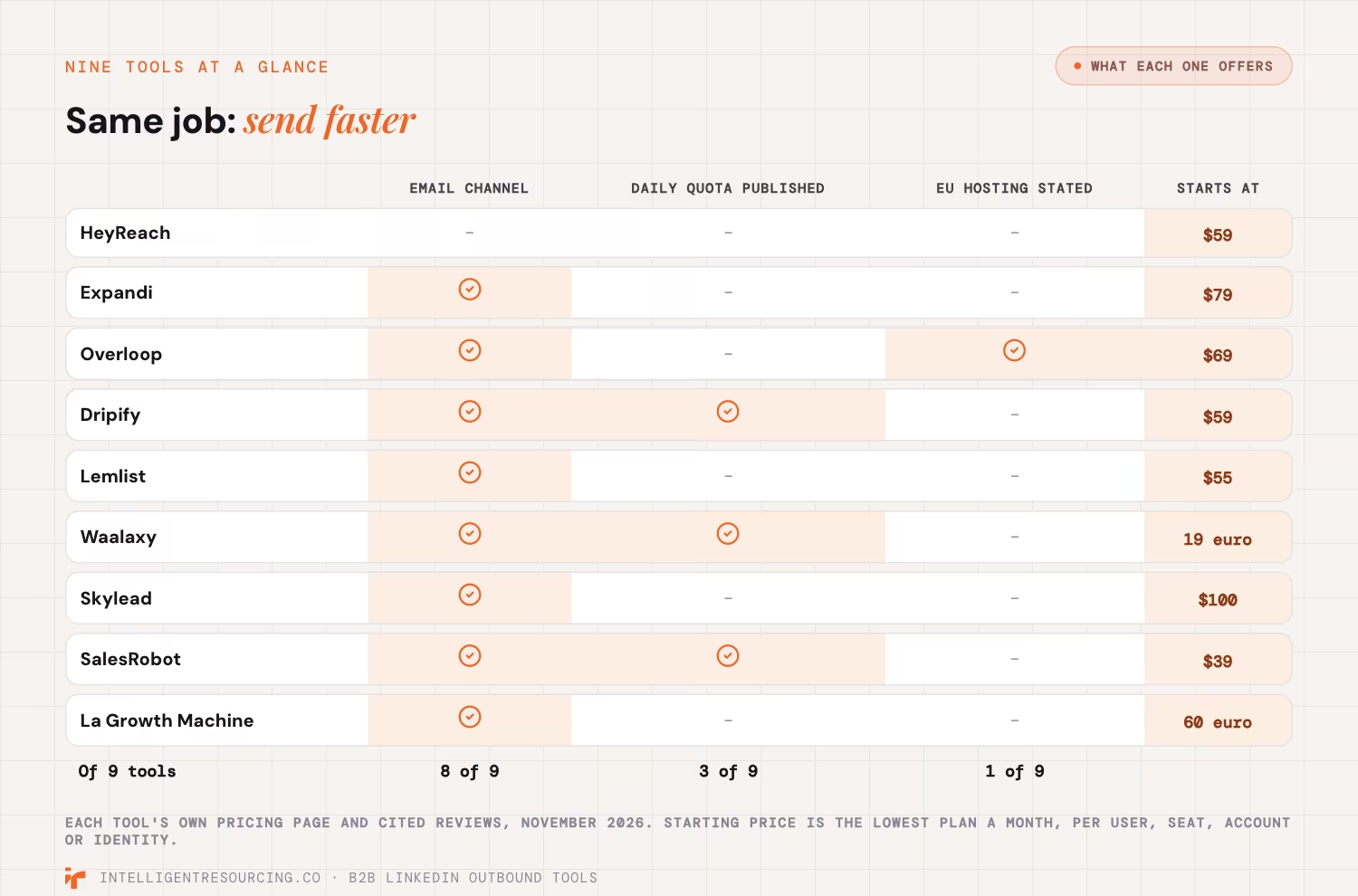
None of the nine rows above is "wrong." They all compete on the same thing: how fast and how cheaply one account can send more LinkedIn messages. Intelligent Resourcing works differently. It starts from which accounts are worth touching at all, using signals instead of list volume.
Stop paying per seat for raw volume. See what signal-based targeting finds before the first message goes out. Explore signal-based lead generation.
Which Tool Fits Your Team's Stage and Motion?
A solo founder or first SDR hire
Waalaxy or Dripify's entry tiers fit this best: one account, one operator, low monthly cost, no team features to pay for and not use.
A small agency running client accounts
HeyReach's per-sender model and Expandi's all-inclusive plan both suit running several LinkedIn identities from one place. The cost: per-seat pricing goes up with every new client account.
A RevOps-led team standardised on HubSpot or Salesforce
Lemlist's native integrations go furthest here, built on the same enrichment and CRM routing principle signal-based systems use. One caveat: the deeper sync sits behind its Enterprise tier, not the entry plan.
A team under EU data-residency or GDPR procurement review
Overloop states EU hosting for EU customers. La Growth Machine is a French company with a published data processing agreement, but its pricing page does not state a hosting region.
You have already chosen Intelligent Resourcing
If the real gap is targeting, not throughput, the next step is a conversation about signal detection. Not another seat on a sending tool.
If your team already has the motion, the gap is likely in targeting, not tooling. See how signal-based listening works.
What Changes When You Move From Automation to Signal Detection?
Every tool compared above answers the same question, just faster: how many LinkedIn touches can one account safely send. None of them answers a different, earlier question: which accounts are worth touching this week, not three months from now when the buying window has closed.
That is the actual shift a signal-based system makes. Outreach starts from a detected change and reaches the account while that change is still live. The kind of signal that triggers it:
- A new senior hire in a relevant function
- A funding round or other financial event
- A tool switch or vendor change
- A relevant job posting going live
The tools above make the sending faster. They don't make the targeting better, because targeting was never the problem they were built to solve. For a build that automates the sequence, see Clay LinkedIn workflow for outbound prospecting at scale.
Final Verdict: Which LinkedIn Outbound Tool Should You Pick?
- HeyReach: an agency running many accounts, on flat per-sender pricing.
- Expandi: a team that wants one plan with everything included.
- Overloop or La Growth Machine: EU hosting (Overloop) or enrichment (La Growth Machine) bundled in, not bolted on.
- Dripify or Waalaxy: a solo operator testing the channel cheaply.
- Lemlist: a team already deep in HubSpot or Salesforce.
- Skylead: long, behaviour-driven sales cycles.
- SalesRobot: SDR teams that want a published, predictable daily quota.
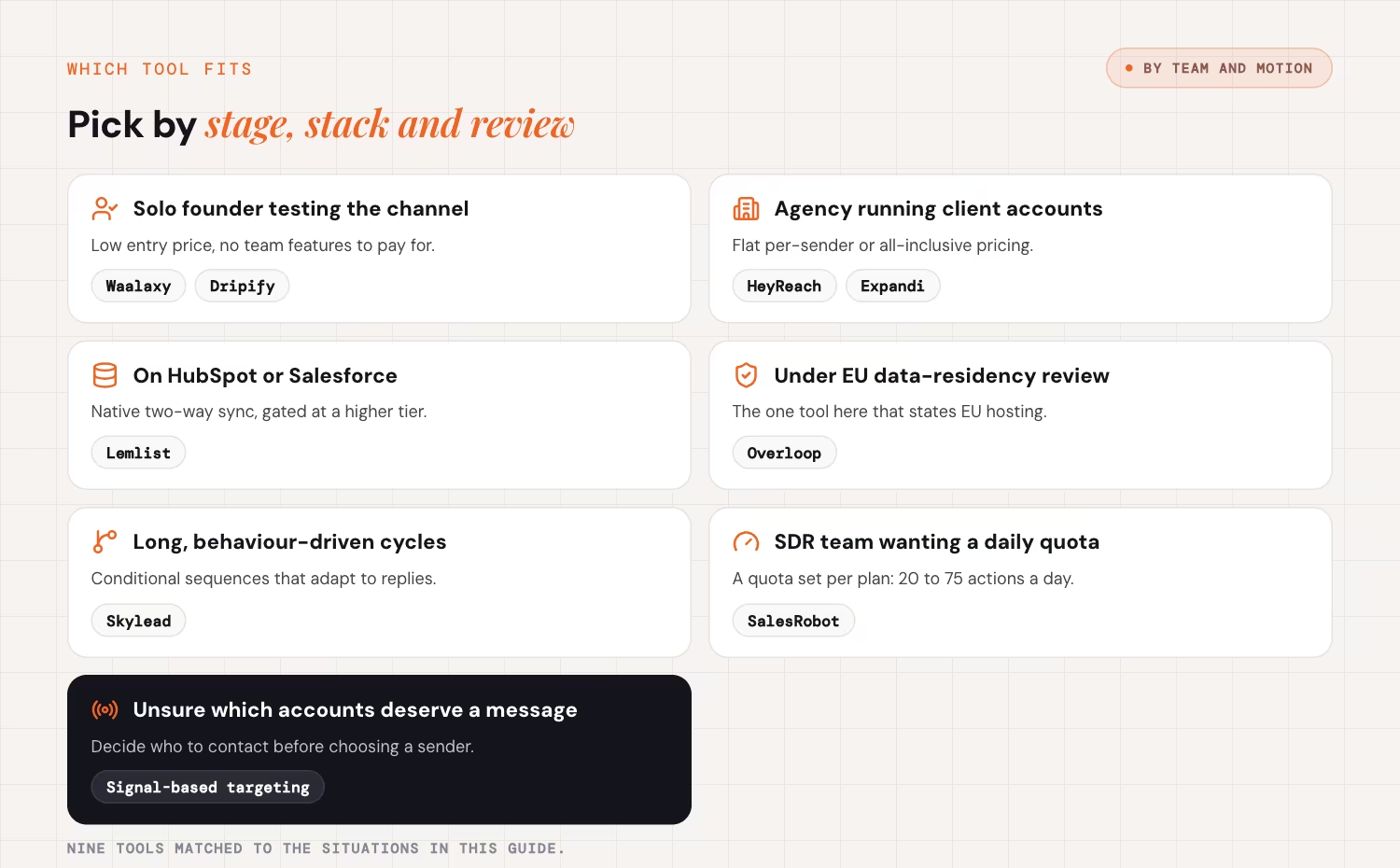
Intelligent Resourcing fits differently: teams whose real constraint is deciding who to contact, not how fast to contact them.
Every day without signal detection is outreach sent on a guess, not a read. See the results first in the Kynection case study, then book a scoping call.
Next in this series: a closer look at how signal-based targeting changes the mechanics of a LinkedIn outbound sequence, once the tool question is settled.
Comparisons
If your gap is deciding who to contact, not how fast to contact them, see how signal-based targeting works before the first message goes out.
FAQs
Can LinkedIn automation tools get your account restricted?
Yes. Hublead's reading of LinkedIn's help pages shows invitation restrictions apply to both Basic and Premium accounts, usually lasting about a week once triggered. No automation tool can guarantee protection, since LinkedIn never publishes the exact threshold.
Do LinkedIn outbound tools replace a CRM?
No. Even tools with the deepest native CRM integrations, such as Lemlist, sync activity into an existing CRM rather than replacing it. The CRM stays the system of record; the outbound tool is the sending layer on top.
What's the real cost difference between a per-seat tool and a managed service?
A per-seat or per-account tool's price multiplies by headcount or accounts connected. A "from $39" headline can turn into several hundred dollars a month for a small team. Intelligent Resourcing prices managed signal-based work by scope, not seats: Signal Starter runs AUD 3,500 to 5,500 a month plus GST, with tool licences and data credits included.
How many LinkedIn accounts can one person safely run?
LinkedIn does not publish an official number. Every tool here treats "safe volume" as an estimate, not a guarantee. SalesRobot publishes a daily quota for each plan, as do Dripify and Waalaxy in their own documentation. Most others leave the figure to trial and error.
Is signal-based outbound a replacement for LinkedIn automation or an addition to it?
It changes what decides who gets contacted, not how the message gets sent. A team can run signal-based targeting to find accounts in an active buying window, then use any of the tools above to run the sequence itself. The two layers solve different problems.