

Why Is Digital8 Still the Right Choice for Some Projects?
Digital8 remains a strong choice when website development and marketing implementation genuinely belong in the same scope. Its developers, designers and digital marketers work across the same digital environment, reducing coordination risk when SEO, GEO, UX and technical changes all need to reach production together.
Digital8 publicly positions website development, app development, UX and digital marketing as connected capabilities, with developers in-house who can fix website issues alongside marketing work. That becomes commercially useful when a recommendation depends on changes to templates, CMS functionality or the technical experience itself.
Digital8 also understands the shift. Its July 2026 material covers GEO, AEO, AI citations, direct-answer formatting, schema and entity authority.
So the case for an alternative is not that Digital8 lacks awareness of GEO or AEO. It is a question of project shape. Stay with Digital8 when website implementation is the harder problem: during a replatform, a redesign or a technically complex transformation. A measurement specialist can identify that a template needs restructuring, but someone still has to implement it. If that pathway is weak, buying deeper measurement first produces a more accurate backlog that nobody is ready to deploy.
What Changes When Your Website Is Already Stable?
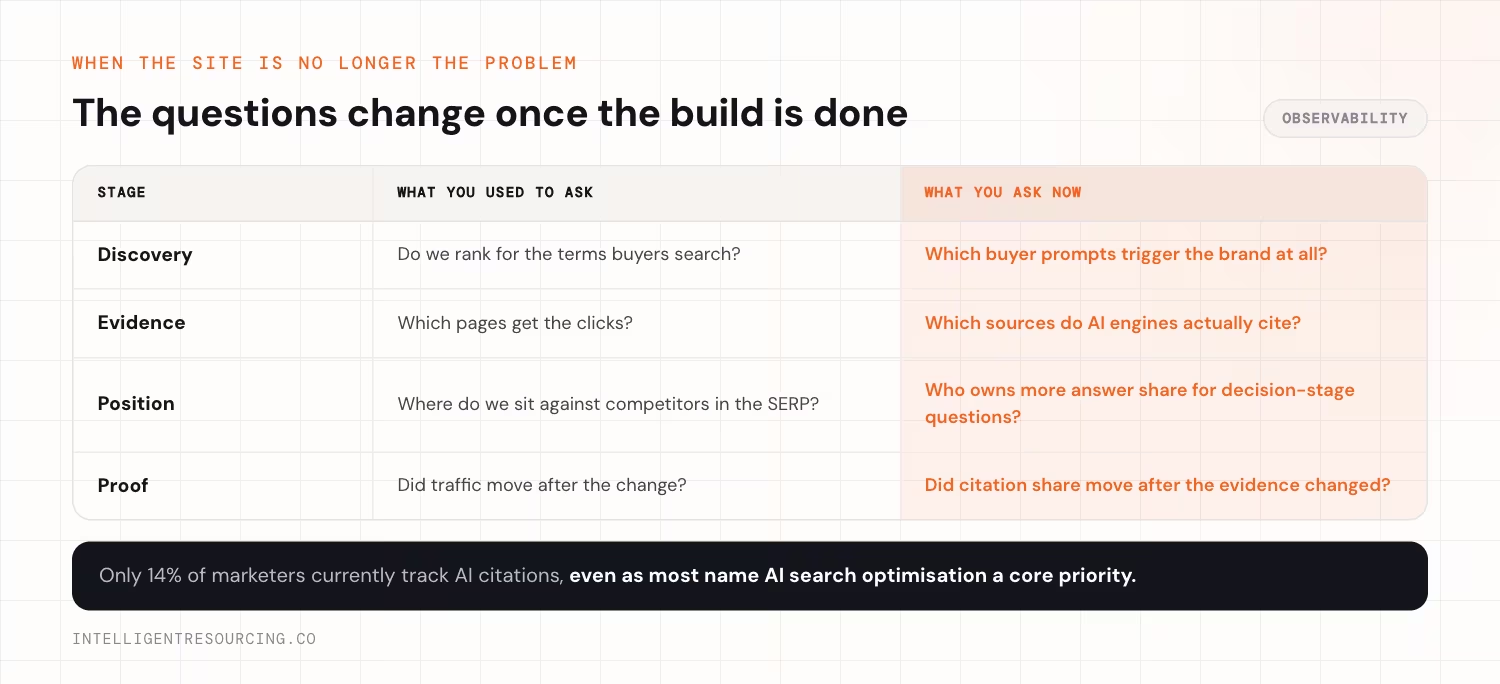
Once a website is crawlable, technically sound and capable of supporting content and schema changes, build capability stops being the differentiator. The next problem is observability: identifying which buyer prompts trigger the brand, where competitors are being recommended, which sources earn citations and whether visibility improves after each optimisation cycle.
A stable website may already have an internal development team, a working CMS and good technical SEO. Paying for another provider mainly because it can also rebuild the site adds breadth without solving the bottleneck.
The new questions are different:
- Which sources are AI engines actually citing, and is the brand one of them?
- Did the brand appear when a buyer asked for a shortlist?
- Was the company merely mentioned, or was its own website cited?
- Which competitor owns more answer share for decision-stage questions?
- Did visibility change after a new comparison page or evidence asset went live?
Most teams cannot answer those yet. GoodFirms' 2026 survey of marketers found only 14% currently track AI citations, even though most name AI search optimisation as a core priority.
Across the public Digital8 service and AI-search pages reviewed for this article as of 30 August 2026, there is no named standalone per-engine citation tracker, fixed prompt-monitoring methodology or published AI Share of Voice reporting system. That does not mean Digital8 cannot measure AI performance. It means a buyer prioritising measurement depth should ask specifically what is measured, how often, across which engines and against which baseline.
For a side-by-side breakdown of where each option fits, see Digital8 vs Intelligent Resourcing compared in full.
What Is the AI Visibility Measurement Ladder?

AI-search measurement has five useful levels: presence, prompt coverage, citation evidence, competitive Share of Voice and an optimisation loop. A provider that reaches only the first level can tell you whether a brand appeared. A mature programme uses the deeper levels to explain where visibility came from, what changed and what should happen next.
| Measurement level | What it answers | Weak measurement | Strong measurement |
|---|---|---|---|
| 1. Presence | Did the brand appear? | Occasional manual screenshots | Repeatable mention monitoring |
| 2. Prompt coverage | Which buyer questions trigger the brand? | Ad hoc branded searches | Fixed or governed commercial prompt sets |
| 3. Citation evidence | Which sources does AI actually use? | Brand mentioned somewhere | Citation rate, cited URLs and source analysis |
| 4. Competitive share | Who owns the category answers? | Brand-only reporting | Share of Voice against a defined competitor set |
| 5. Optimisation loop | What should change next? | Dashboard reporting | Measurement, diagnosis, execution, re-test |
A tracker that identifies a citation gap without changing the page causing that gap is monitoring. A programme that diagnoses the gap, changes the evidence and measures the next result is optimisation.
Per-engine reporting is what makes level three usable. Qwairy's research across 118,000 AI-generated answers found ChatGPT cites 8 sources per answer while Perplexity cites 22. Each engine draws from a different pool, so a blended visibility score hides which engine is carrying the result.
Two practitioners, one principle
Ronan Leonard puts the distinction plainly in Intelligent Resourcing's Kynection GEO study: "AI share of voice is not the same as website traffic, organic ranking or market share."
StudioHawk's Lawrence Hitches reaches the measurement problem from another direction after analysing AI referral activity across 600 plus businesses: "Our data shows AI assistants reward seven different formats."
Both point to the same principle: AI search creates its own observable behaviour, which ranking and traffic data cannot fully describe.
The 5 Alternatives, Ordered by Programme Breadth
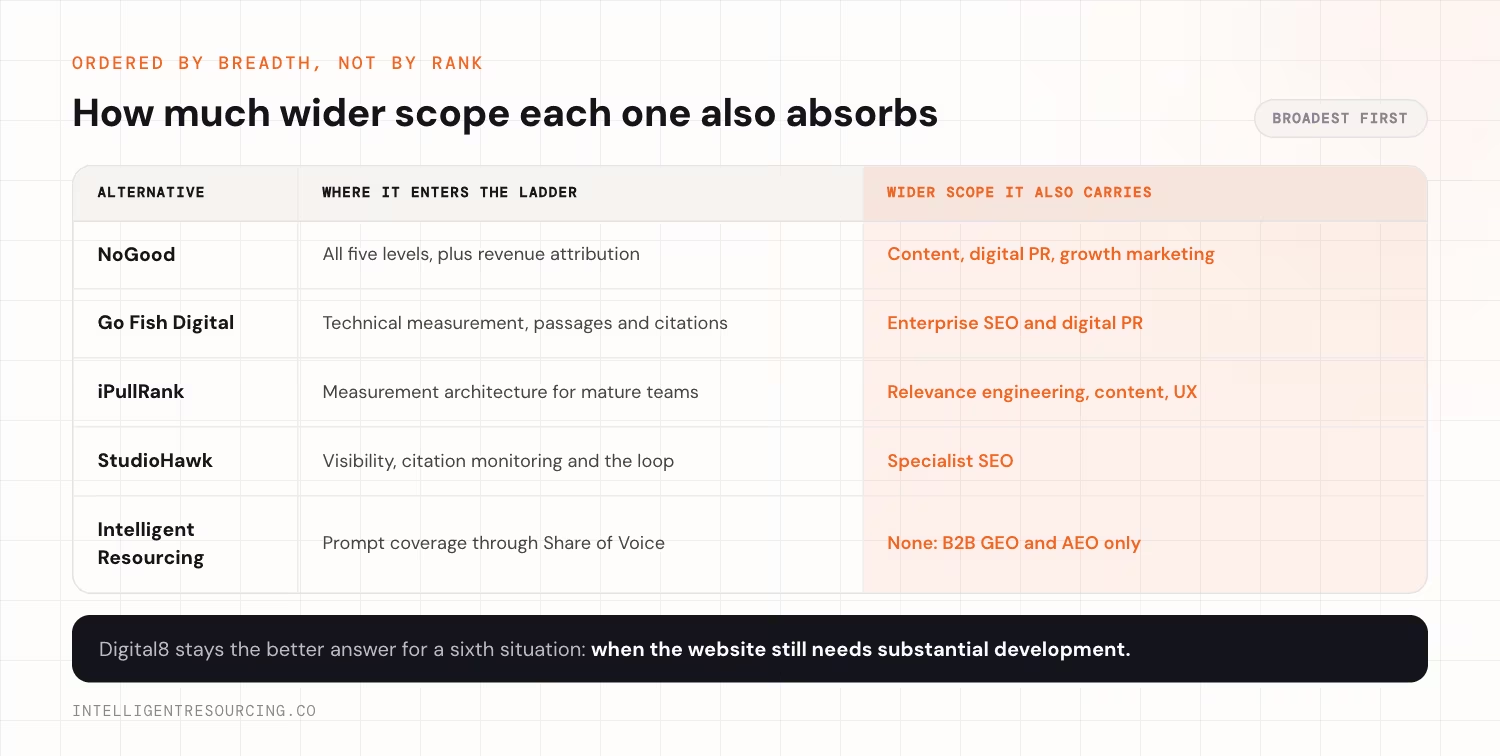
The useful comparison is not the longest service menu. It is where each provider enters the ladder, and what happens after measurement finds a problem.
1. NoGood, when AEO measurement must connect with wider growth
NoGood suits businesses that want AI-search measurement embedded inside a broader growth programme. Its public AEO methodology tracks brand mentions, citation rate, Share of Voice, sentiment, recommendation position, AI referral traffic and revenue outcomes, while also covering content, technical AEO, digital PR and authority building. It describes AEO as a dedicated practice rather than a renamed SEO service, with delivery spanning prompt research, ongoing monitoring, schema, earned media and citation building.
The trade-off is breadth. A company looking for a scoped Australian B2B GEO engagement will find the model broader than required. A company wanting AEO, digital PR, SEO and growth thinking inside one connected strategy sees that breadth as the advantage.
Ladder fit: broad coverage across all five levels, with extra emphasis on downstream revenue attribution.
2. Go Fish Digital, when enterprise GEO needs technical analysis and tooling
Go Fish Digital suits larger organisations needing technical GEO, passage-level optimisation, AI visibility analysis and digital PR inside an integrated search programme. Its GEO offer includes semantic content audits, page and passage-level optimisation, technical discovery and digital PR to strengthen citations, supported by proprietary tools for AI Overview analysis and content similarity scoring.
The limitation for an Australian buyer is operating fit. Go Fish is a broader full-funnel agency with substantial enterprise capability. A tightly scoped local B2B GEO engagement does not need that breadth.
Ladder fit: strong technical measurement and optimisation, particularly around visibility, passages and citations.
3. iPullRank, when AI search requires enterprise relevance engineering
iPullRank suits enterprise teams that want deep technical thinking about how AI systems retrieve and recommend information. Its relevance engineering model integrates AI, information retrieval, content strategy, digital PR and user experience.
That technical depth is also the buying constraint. A smaller organisation seeking straightforward managed content execution does not need an enterprise relevance engineering engagement. Teams managing large content estates or sophisticated in-house search functions do.
Ladder fit: strongest for technically mature teams needing rigorous measurement architecture alongside enterprise search strategy.
4. StudioHawk, when SEO and AI search should stay in one workflow
StudioHawk suits buyers where the website is stable, traditional SEO still matters, and AI-search measurement should be added without creating a second organic-search team. Its AI SEO service includes prompt and intent research, entity and topic clusters, authority signals and technical foundations, and it argues GEO should sit on top of SEO fundamentals rather than detached from them.
The trade-off is the operating philosophy. Keeping GEO inside specialist SEO suits organisations that want one organic workflow. It is less differentiated when the buyer wants AI Share of Voice to operate as a separate management metric.
Ladder fit: strong across visibility, citation monitoring and the optimisation loop, anchored to specialist SEO.
5. Intelligent Resourcing, when measurement must drive B2B GEO execution
Intelligent Resourcing is the narrowest option here, and the fit for B2B teams whose website is stable but whose AI visibility is unmeasured. Its GEO service runs an operating loop of audit, map, build and monitor, combining prompt mapping, structured answer content, cross-engine citation tracking and competitive Share of Voice, then using the findings to identify which content or evidence gap to close next.
That matters when the brief is not "make us more AI friendly" but "prove whether our relative visibility moved." A wider view of how Australian agencies handle citation tracking sets out how uncommon that loop still is.
Its limitation is clear. Intelligent Resourcing is not a website transformation agency. If the site needs substantial UX redesign, application development or replatforming, Digital8's broader implementation model is the better fit.
Ladder fit: strongest from prompt coverage through competitive Share of Voice and managed optimisation.
What Should You Measure Before Replacing Digital8?
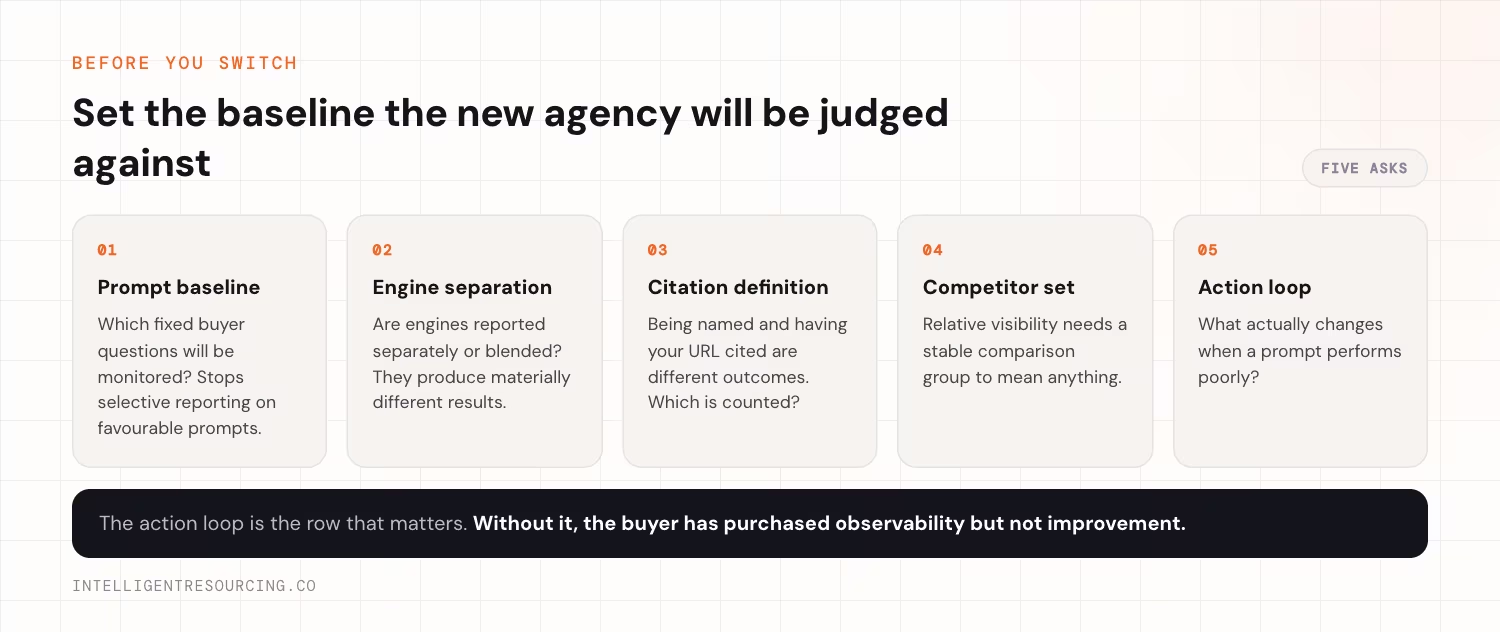
Establish the measurement baseline the new engagement will be judged against. Without a fixed prompt set, engine list, competitor group, citation definition and measurement date, a buyer can receive more sophisticated reporting without being able to prove that AI visibility improved.
| Requirement | Question to ask | Why it matters |
|---|---|---|
| Prompt baseline | Which fixed buyer questions will you monitor? | Prevents selective reporting using favourable prompts |
| Engine separation | Are engines reported separately, or blended? | Different engines produce materially different results |
| Citation definition | Do you distinguish being named from having our URL cited? | Brand awareness and source authority are different outcomes |
| Competitor set | Which businesses form the Share of Voice benchmark? | Relative visibility needs a stable comparison group |
| Measurement cadence | How often are prompts re-run? | AI outputs and source selection change over time |
| Action loop | What changes when a prompt performs poorly? | Converts monitoring into optimisation |
The most important row is the action loop. A provider should be able to explain the causal chain: prompt gap, diagnosis, content or authority change, implementation, re-test, measured movement. Without that loop, the buyer has purchased observability but not improvement.
Comparisons
When implementation is the constraint, build-and-market coordination matters. When observability is the constraint, pick the provider whose measurement model matches your team. Book a call and we will establish your baseline first.
FAQs
Is Digital8 an AEO or GEO agency?
Digital8 publicly covers GEO, AEO and AI-search optimisation and explains tactics such as answer-first formatting, schema, topical authority and citation-worthy content. Its wider business remains a multidisciplinary digital agency spanning website development, UX and digital marketing rather than a dedicated AI-search measurement provider.
What is the best Digital8 alternative for B2B AI-search measurement?
Intelligent Resourcing is the closest fit on this shortlist for B2B teams specifically seeking managed GEO combined with prompt monitoring, citations and competitive AI Share of Voice. Its published Kynection case study documents the prompt set, measurement date and tracked result rather than relying on an undated citation screenshot.
What should an AI-search agency actually measure?
At minimum, measurement should distinguish brand presence, prompt coverage, citations and competitor visibility. More mature programmes add Share of Voice, engine-level reporting, cited-source analysis and downstream business outcomes before feeding the results back into another optimisation cycle.
Is AI Share of Voice the same as Google ranking?
No. AI Share of Voice measures relative brand visibility across a defined set of generated answers and competitors. Google ranking measures the position of webpages in traditional search results. The 2 can influence one another because AI systems use web retrieval, but they are not interchangeable.
Should I replace Digital8 if my website still needs development?
Not necessarily. Digital8's integrated development and marketing model is an advantage when website, UX, technical SEO and AI-search changes touch the same codebase. A specialist alternative becomes more compelling when development capacity already exists and dedicated measurement is the missing layer.
Which alternative is best if I want AEO plus broader marketing?
NoGood is the clearest match on this shortlist. Its AEO model connects AI visibility monitoring with content, digital PR, technical optimisation and broader growth measurement, including AI-referral conversions and attributed revenue.