

Why Does B2B Contact Data Decay So Fast?
HubSpot's January 2026 research found that B2B contact data decays at 2.1% per month, or 22.5% per year. Job changes, company acquisitions, and email domain migrations all drive this decay. A contact list built 12 months ago has lost roughly 1 in 5 accurate records, even without any enrichment failures along the way.
Job Changes and Role Transitions
The average B2B buyer changes roles every 2-3 years. When a contact moves companies, their work email becomes invalid on day one. Titles change, reporting structures shift, and the budget holder mapped last quarter may no longer be the relevant decision-maker this quarter.
Domain Migrations and Acquisitions
Company acquisitions and rebrands break email formats at scale. A business acquired by a larger parent often transitions its entire email domain within 6-12 months. Every contact under the old domain becomes unreachable during and after the migration.
CRM Inactivity and Compounding Error
Contact records that sit dormant in a CRM degrade without anyone noticing. A record untouched for 18 months is likely 40-68% inaccurate by the time someone attempts outreach. MIT Sloan Management Review found that bad data costs 15-25% of revenue for most companies, because corrupted records compound errors across every pipeline stage.
Decay is continuous. Re-enriching a list once per year is not sufficient. GTM teams need a re-verification system that runs in parallel with outreach, not a one-time cleanup before each campaign. Intelligent Resourcing's CRM enrichment services run that re-verification on a continuous cycle, so records stay current between campaigns rather than being rebuilt before each one.
What Is a Contact Enrichment Waterfall and How Does It Work?
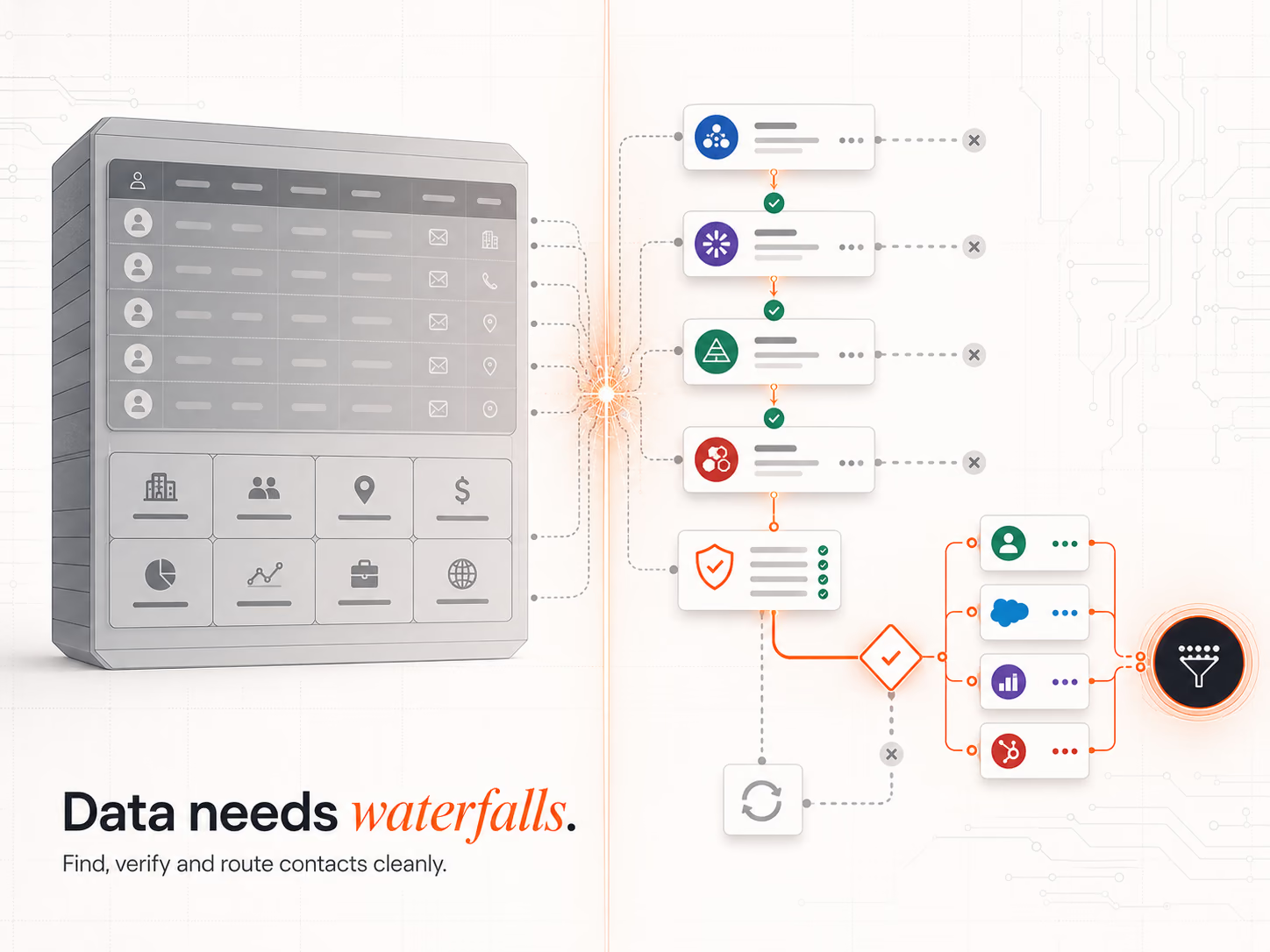
A contact enrichment waterfall queries multiple data providers in a fixed sequence. Each provider attempts to return a verified email, phone number, or LinkedIn profile for a given record. If provider 1 returns a null result, provider 2 runs next. The process continues until a verified result is returned or the waterfall exhausts all sources.
Cleanlist.ai's January 2026 benchmark tested 10,000 contacts and found that a waterfall returned verified data on 96.4% of records versus 68.2% for a single-source approach. The 28.2 percentage point gap is not marginal. On a 1,000-contact ICP list, that is 282 additional reachable prospects the single-vendor approach misses entirely.
Why Single Sources Miss Contacts
Each data provider builds its database using different methods: some scrape public sources, some aggregate opt-in data, some licence records from third-party publishers. No single provider has complete coverage across all industries, geographies, and company sizes. A provider with strong US enterprise technology coverage may have poor data for Australian SMEs or European manufacturing contacts.
The waterfall fills these gaps by routing each failed enrichment attempt to the next provider in the stack. Providers with the highest ICP coverage go first, cheaper providers run early to conserve credits, and niche sources for specific geographies or verticals catch the remaining gaps at the end.
The Coverage Compounding Effect
Coverage gaps multiply across large ICP lists. A 5,000-account list at 68% single-source coverage leaves 1,600 contacts unreachable. Across a quarter of outbound campaigns, those missed contacts never appear in pipeline metrics, because the outreach never went out. The gap is invisible until you run the waterfall comparison.
How Does Clay Automate Multi-Source Contact Enrichment?
Clay connects to over 100 data providers and automates the waterfall sequence without manual API management. Each contact record moves through the configured provider stack automatically. Clay stops when a verified result is returned, therefore minimising credit spend on records already resolved.
Keith Jones, OpenAI's GTM Systems Lead, reported: "With Clay, we more than doubled our enrichment coverage from low 40% to high 80%." OpenAI's GTM team achieved this by replacing a manual single-source workflow with an automated Clay waterfall.
How Clay's Waterfall Logic Works
Clay processes each row in a table as a job. A waterfall formula checks the result of the previous enrichment attempt: if the result is empty or invalid, the next provider in the sequence runs. This logic executes automatically across thousands of records simultaneously, without manual triage between tools.
What previously required a Clay operator days of spreadsheet reconciliation now runs in hours. The Clay waterfall eliminates the manual step between provider outputs and the CRM entirely.
Clay's Credit System and Cost Optimisation
Clay uses a credit-based pricing model. Each enrichment action consumes credits at a rate determined by the provider queried. High-coverage providers like LinkedIn and Apollo cost more credits per lookup than smaller providers. Intelligent Resourcing sequences waterfalls to exhaust cheaper providers first, therefore preserving credits for the expensive providers that catch what cheaper sources miss.
Teams building Clay waterfalls without this optimisation logic often exhaust credits mid-campaign because the sequence was not designed with cost-to-coverage ratio in mind.
Which Data Sources Does a Clay Waterfall Query?
Clay waterfalls query sources based on ICP requirements, not a fixed universal stack. Common providers include LinkedIn data via Clay's native integration, Apollo, ZoomInfo, Clearbit, Hunter.io, and People Data Labs (PDL). The sequence varies by geography, company size, and vertical.
For Australian B2B contacts, LinkedIn and PDL consistently return higher coverage than US-focused providers. For US enterprise technology contacts, Apollo and ZoomInfo provide deeper data. Intelligent Resourcing analyses the client's ICP before configuring the waterfall sequence, therefore avoiding the common mistake of applying a US-optimised default stack to non-US markets.
Intent Signals and Contact Selection
Finding a contact is step one. Finding the right contact at the right time is the full job. Intelligent Resourcing integrates buying signal monitoring with contact enrichment so that waterfall enrichment runs on accounts showing active intent, not the entire addressable market simultaneously. IR runs a system that books qualified meetings, triggering enrichment and outreach only when buying signals appear, such as new executive hires or funding rounds, therefore concentrating contact data spend on accounts inside an active buying cycle.
Contact Fields in a Standard Waterfall
A standard Clay waterfall for B2B outreach enriches 8 core fields: verified work email, direct dial or mobile, LinkedIn profile URL, current job title, company name, company domain, company size, and industry vertical. These fields cover the minimum data required for personalised outbound at scale. Additional fields such as technology stack, funding stage, and headcount growth rate require separate enrichment tables connected to the main waterfall output.
How Does Intelligent Resourcing Build Clay Enrichment for GTM Teams?
Intelligent Resourcing builds the Clay waterfall architecture, connects it to the client's CRM, and manages the ongoing enrichment workflow. GTM teams receive verified contacts without needing an in-house Clay operator or data engineering resource. The Demand Gen Report 2025 found that more than 60% of B2B marketing and sales teams say poor data quality directly disrupts their lead handoffs.
Intelligent Resourcing runs the build across 4 phases.
Phase 1: ICP and Data Audit
Intelligent Resourcing maps the client's ideal customer profile, identifies which data fields outreach requires, and audits the existing CRM for decay rate and coverage gaps. This audit produces a provider shortlist ranked by ICP coverage rate, the sequence order that determines cost-per-verified-contact before a single credit is spent.
Phase 2: Waterfall Architecture and Credit Plan
Intelligent Resourcing builds the Clay table structure, configures the waterfall formula logic, and sequences providers to match the ICP's geographic and vertical profile. A credit spend estimate per 1,000 contacts is produced and reviewed before the build begins, so GTM teams know the cost model before committing an enrichment budget.
Phase 3: CRM Integration
It connects the enriched Clay output to HubSpot, Salesforce, or the client's existing CRM using native integrations or n8n automation workflows. Contacts enter the CRM with enrichment timestamps so it is clear which records have been re-verified and when they were last checked.
Phase 4: Ongoing Management
Clay waterfalls require ongoing maintenance as providers update their data quality, pricing, and API structures. It monitors credit burn rates, updates provider sequences as conditions change, and adjusts waterfall logic when ICP definitions evolve. Without ongoing management, provider deprecations and pricing changes silently degrade coverage rates within 90 days of the initial build.
For teams that also need AI answer visibility alongside their contact data infrastructure, Intelligent Resourcing integrates both programmes into a single revenue operations engagement.
What Does a Clay Enrichment Build Cost?
A Clay enrichment build with Intelligent Resourcing has 3 cost components: the Clay seat subscription, the build and configuration fee, and an ongoing management retainer. Teams that build the waterfall internally carry the Clay subscription plus internal engineering time, without pre-built provider sequences or credit optimisation logic already tested against their ICP.
What the ROI Looks Like
At 500 outbound contacts per quarter, a 28-point coverage improvement from 68% to 96% produces 140 additional reachable prospects per quarter. At a 5% meeting conversion rate, that is 7 incremental meetings. At a standard B2B deal size, the Clay build pays back within the first quarter.
Each failed handoff is a pipeline opportunity that entered the system and did not convert, not because the prospect was unqualified, but because the contact data was wrong. Fixing the data layer fixes the pipeline.
Comparing Clay to Manual List Building
Manual list building via a single vendor and a VA produces roughly the same 68% coverage rate as a single-vendor enrichment approach, at higher labour cost and slower cycle time. The waterfall approach is faster, cheaper per verified contact at scale, and removes the manual reconciliation step between provider outputs and the CRM. Intelligent Resourcing's lead gen and outbound service includes the Clay enrichment build as part of the GTM infrastructure engagement. Contact data and signal-led outreach run as a single connected system, not separate tools with separate management.
Prospecting
Single-vendor data leaves a third of your list unreachable. The Revenue Operations Studio at Intelligent Resourcing builds and manages the Clay enrichment waterfall, connects it to your CRM, and keeps coverage high as data decays, so your team owns verified contact data, not a stale list.
FAQs
What is contact data enrichment?
Contact data enrichment adds missing or updated fields to an existing contact record. For B2B records, enrichment typically adds verified work email, direct dial, LinkedIn profile, current job title, and company firmographics. Enrichment runs against live provider databases to return current information, not data from when the record was first created.
What is the difference between single-source and waterfall enrichment?
A single-source approach queries one data provider and returns whatever that provider has. A waterfall approach queries multiple providers in sequence, stopping when a verified result is returned. Waterfall approaches produce higher coverage because each provider has different data, and the gaps in one provider are filled by the next in the sequence.
How often should a B2B contact database be re-enriched?
B2B contact data decays at roughly 22.5% per year. High-velocity ICP lists, where contacts change roles frequently, may require re-enrichment every 90 days. Static lists targeting stable enterprise accounts can run on a 6-month re-enrichment cycle. The right cadence depends on how fast contacts in your specific ICP change roles and companies.
Does Clay work with HubSpot and Salesforce?
Yes. Clay connects natively to HubSpot and Salesforce. Enriched records export directly into your CRM via Clay's built-in integrations or via n8n automation workflows. Intelligent Resourcing uses both integration methods depending on the client's CRM data structure and workflow requirements.
Can Clay enrich contacts for non-US markets?
Yes. Clay accesses global data providers including LinkedIn, People Data Labs, and several APAC-specific sources. Coverage quality varies by region. Australian B2B contacts typically return higher coverage via LinkedIn and PDL than via US-centric providers. Intelligent Resourcing sequences waterfalls based on the client's ICP geography to maximise hit rate for the specific market being targeted.
What is a Revenue Operations Studio?
A Revenue Operations Studio builds, integrates, and manages the systems that generate and convert pipeline. This includes contact enrichment, buying signal monitoring, CRM automation, and outbound sequencing. Unlike a traditional agency, a Revenue Operations Studio installs infrastructure the client owns permanently. It does not stop when the engagement ends.