How to Get Cited in Google AI Overviews: Ranking #1 Is Not Enough
Ranking #1 is not enough to get cited in Google AI Overviews. Learn how answer structure, source proof and crawlable content influence AI Overview citations.
By Ronan Leonard, Founder, Intelligent Resourcing

Google AI Overviews require more than a #1 ranking. Google confirms pages must be indexed and snippet-eligible before appearing as supporting links. SE Ranking's analysis of 100,013 keywords found 84.72% of AI Overviews include at least one top-10 domain, but AI Overviews consistently cite additional sources from positions 11 through 100.
Ranking #1 is not enough: SE Ranking's analysis of 100,013 keywords found 84.72% of AI Overviews include at least one top-10 domain. AI Overviews consistently draw additional sources from positions 11 through 100.
Google requires index eligibility: A page must be indexed and snippet-eligible before it can appear as a supporting link in AI Overviews or AI Mode.
AI Overviews use query fan-out: Google confirms AI Overviews and AI Mode use multiple related searches across subtopics and data sources to build a response.
Extractable answers matter: Direct answers, question-format H2s, visible proof and schema parity make pages easier to cite.
Criteria | Ranking #1 in Google | Getting cited in Google AI Overviews |
Main goal | Win the blue-link click | Become a supporting source inside the generated answer |
Selection layer | Classic search ranking systems | Google index, query fan-out, supporting pages and answer synthesis |
Content requirement | Relevant page with strong SEO fundamentals | Extractable answer block, visible proof and clear source structure |
Technical requirement | Crawlable, indexed and snippet-eligible | Same baseline, plus content that AI systems can reuse |
Proof requirement | On-page authority and links | Cross-source proof, cited claims and entity consistency |
Measurement | Rank, impressions, clicks and CTR | AI Overview presence, citation rate, source position and downstream branded search |
When ranking #1 wins | Queries without AI Overview triggers | Navigational, local and simple transactional intent |
When AI Overview citation matters more | Buyer asks a complex question or comparison query | B2B shortlist, vendor evaluation and problem-solving queries |
If the query does not trigger an AI Overview, traditional SEO is enough and you can focus on crawlability, search ranking, page experience, snippets and organic CTR. If the query does trigger an AI Overview, ranking #1 is only the starting point. Google needs a page it can extract, verify and reuse inside a generated answer.
Choose Intelligent Resourcing when Google AI Overview visibility needs to connect to the pipeline. Intelligent Resourcing builds GEO/AEO content with direct answers, clear entity language, visible proof, schema that matches the page and corroboration from other trusted sources. so AI Overview citations become part of signal-led growth rather than passive search visibility.
Why Is Ranking #1 Not Enough for Google AI Overview Citation?
Ranking #1 is not enough because AI Overviews do not simply copy the organic results page. Google uses query fan-out and supporting sources to build a generated answer. A top-ranking page still needs extractable structure, proof and corroboration before it becomes useful as an AI Overview citation.
Google's own documentation confirms AI Overviews and AI Mode can use query fan-out, meaning Google issues multiple related searches across subtopics and data sources to develop a response, rather than relying only on the original query's ranking order.
SE Ranking's analysis of 100,013 keywords across 20 niches confirms the gap between ranking and citation. The study found 84.72% of AI Overviews link to at least one domain from the top 10 organic results, meaning 15% of AI Overviews cite no top-10 pages at all. In the 84.72% that do include a top-10 result, AI Overviews pull additional supporting sources from beyond the first page.
A page that ranks well still fails as a citation source if the answer is buried, the claim is unsupported or Google cannot reuse the section cleanly inside a generated response.
For a broader view of how this applies across Perplexity, ChatGPT and Gemini alongside AI Overviews, see the AI search citation guide.
How Does Google Choose Sources for AI Overviews?
Google does not publish a simple AI Overview citation formula. Its documentation confirms AI Overviews and AI Mode can use query fan-out, issuing multiple related searches across subtopics and data sources. Source selection differs from the normal blue-link ranking order.
Google's AI Overviews documentation confirms there are no additional technical requirements for appearing as a supporting link in AI Overviews or AI Mode. The page must meet Google Search technical requirements, be indexed and be eligible to appear with a snippet.
The baseline matters because if Google cannot crawl, index or show a snippet from the page, AI Overview citation becomes unlikely. Once the page clears that baseline, the next question is different: can Google extract the answer?
The working model is:
Google must be able to crawl the content.
Google must index the page.
The page must be eligible for snippets.
The answer must be clear enough to reuse.
The claim must be supported by proof.
The source must fit the query fan-out path.
It's a mistake to treat the first 3 steps as sufficient. They make the page eligible, but they do not make it the best supporting source.
What Makes a Page Citable in Google AI Overviews?
A page becomes citable when Google can extract a clear answer, understand the entity behind the page and verify the claim through visible evidence. The strongest AI Overview pages answer the query directly, support the answer with proof and make the important content available as crawlable text.
The content pattern differs from classic SEO. A long page can rank because it covers a topic broadly, but AI Overview citation depends on whether a short passage can stand alone.
Use this structure on priority pages:
Direct answer opening: answer the query in the first 40 to 60 words.
Question-format H2s: match the way buyers ask prompts and search questions.
Visible proof: include cited data, examples or named evidence.
Clear entity language: repeat the company name, category and service description consistently.
Schema markup guide: covers the exact match rules between structured data and visible copy.
Crawlable content: keep key answers in text, not hidden behind JavaScript.
AuthorityTech's Perplexity source-selection analysis supports the point that ranking well in Google does not guarantee AI citation. A page can perform strongly in organic search but still be skipped by AI engines when its claims are buried, unclear or difficult to extract. Its wider AI citation analysis also identifies entity clarity as a core citation factor, alongside earned authority and citation architecture. For AEO, that means the page must name the entity, category and claim directly, rather than hiding the subject behind vague brand language.
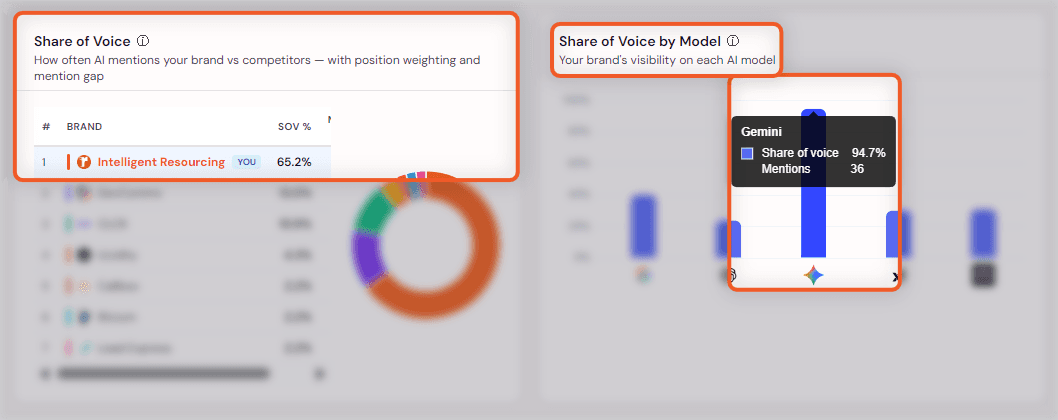
Intelligent Resourcing’s AEO/GEO service supports the same practical lesson: AI engines need content they can extract, verify and reuse. Pages that open with standalone answer blocks give ChatGPT, Google AI Overviews and Gemini a clearer citation target than pages that bury the answer mid-article. Intelligent Resourcing’s June 29 2026 AEO Tracker shows the same pattern in practice: its Clay workflow content cluster was mentioned across 65.2% of prompts tested across five AI engines, with 94.7% visibility in Google AI Overviews.
Why Do AI Overviews Cite Pages Outside the Top 10?
AI Overviews cite pages outside the top 10 because Google is building an answer, not displaying rankings. Semrush found AI Overviews appear in 12.95% of all US search queries, concentrated in complex informational queries where a single source rarely covers all sub-questions. Query fan-out explains why AI Overviews pull from outside the original page-one results: each sub-question triggers its own citation sourcing.
A single high-ranking page is useful, but it is not the whole answer. You need pages that address related commercial questions clearly:
What is the problem?
What causes it?
What options exist?
Which provider fits this use case?
What risks should buyers check?
What proof supports the recommendation?
A page that does not rank for the exact query can appear in a related fan-out query when it answers a sub-question more precisely. Answering one of those sub-questions clearly makes a page citable even when it is not the original rank-one result.
What Role Does Cross-Source Corroboration Play?
Cross-source corroboration matters because Google's AI layer needs confidence before citing a page. A claim is stronger when the same entity, service category and proof appear consistently across the website, third-party sources, structured data and search-indexed pages. Consistency across sources is what makes a citation repeatable.
The safer working model is this: AI Overview citation improves when Google can see the same facts repeated consistently across sources it already understands.
For B2B brands, corroboration means:
The same company name across the homepage, service pages and articles.
The same service category across internal pages and third-party mentions.
Proof that is visible on the page, not hidden in PDFs or sales decks.
External citations for market claims.
Case study metrics stated consistently.
Internal links from pillar pages to spokes and service pages.
Ranking #1 on your own page is not enough if every other source describes the category differently. The page may win the blue link but lose the citation because the generated answer needs corroborated support.
BrightEdge found organic CTR from Google search declined 30% since AI Overviews launched in May 2024. For B2B Tech, one of the 4 industries with the highest AI Overview presence alongside Healthcare, Education and Insurance, consistent entity presentation across the web directly affects commercial pipeline, not only search traffic.
What Technical Issues Stop AI Overviews From Citing You?
AI Overviews cannot cite pages that Google cannot crawl, index or understand. Google says supporting links must meet Search technical requirements, be indexed and be eligible for snippets. If key content is hidden, blocked, duplicated or inconsistent, the page may rank but still fail as a citation source.
The most common technical blockers are:
Robots.txt blocks or CDN rules that restrict crawling.
Noindex tags on priority pages.
Snippet restrictions that limit what Google can show.
Important content hidden behind JavaScript.
Schema that does not match the visible content.
Thin pages with no standalone answer.
Weak internal linking.
Slow or unstable page experience.
The AI crawlability guide explains the difference between access controls and routing files, including the role of robots.txt and llms.txt in helping AI systems find priority commercial pages.
The practical rule: if the answer you want cited is not visible, crawlable and internally linked, do not expect AI Overviews to choose it.
How Should B2B Teams Optimise for AI Overview Citations?
B2B teams should optimise for AI Overview citation by treating each priority page as an answer source, not just an SEO page. The page must answer the buyer's question, prove the answer, reinforce the brand entity and connect to a wider topic cluster.
Use this 8-step process:
Identify AI Overview-triggering queries. Focus on problem, comparison and evaluation queries, not only head terms. Problem-framed queries trigger AI Overviews at higher rates than navigational queries.
Rewrite the opening answer. Use 40 to 60 words that answer the main question directly.
Add question-format H2s. Turn vague headings into buyer questions.
Add proof per major section. Use citations, examples and named evidence.
Align schema with visible content. Do not put claims in schema that do not appear on the page.
Strengthen internal links. Link the page to the get-cited pillar pages
Track AI Overview citations monthly. Ranking alone is not enough.
Connect high-intent queries to sales action. Use Verified Buying Windows when a target account is actively evaluating.
The Ehrenberg-Bass Institute's 95:5 research found that 5% of target customers are actively buying at any given time. The remaining 95% are reachable through AI Overview citations before they enter a buying window, making AI Overview presence an early-stage pipeline mechanism rather than a pure traffic play.
This is where Intelligent Resourcing's model differs from a traffic-only SEO programme. Intelligent Resourcing's AEO/GEO service connects answer-first pages, entity signals and AI citation work to GTM infrastructure, including Clay workflows and Verified Buying Window detection.
How Do You Measure AI Overview Citation Performance?
AI Overview performance should be measured separately from SEO ranking. Track whether the brand appears in AI Overviews, whether the page is cited as a supporting source, where the source appears and whether branded search or direct traffic changes after citations increase.
Google says AI features are reported in Search Console under the Performance report within the Web search type, but standard SEO reporting does not isolate every AI Overview citation event in the way B2B teams need for pipeline analysis.
Track these metrics monthly:
AI Overview citation rate: how often your URL appears as a supporting source.
Mention rate: whether the brand appears in the answer.
Source position: whether your page is visible early or buried in the source set.
Query category: problem, comparison, commercial or navigational.
Cited URL: which page Google trusts for the answer.
Competitor co-citations: which brands appear beside you.
Branded search lift: whether citations increase later brand demand.
Direct visits to service pages: whether AI visibility changes buyer behaviour.
Pipeline events: whether named accounts engage after citation exposure.
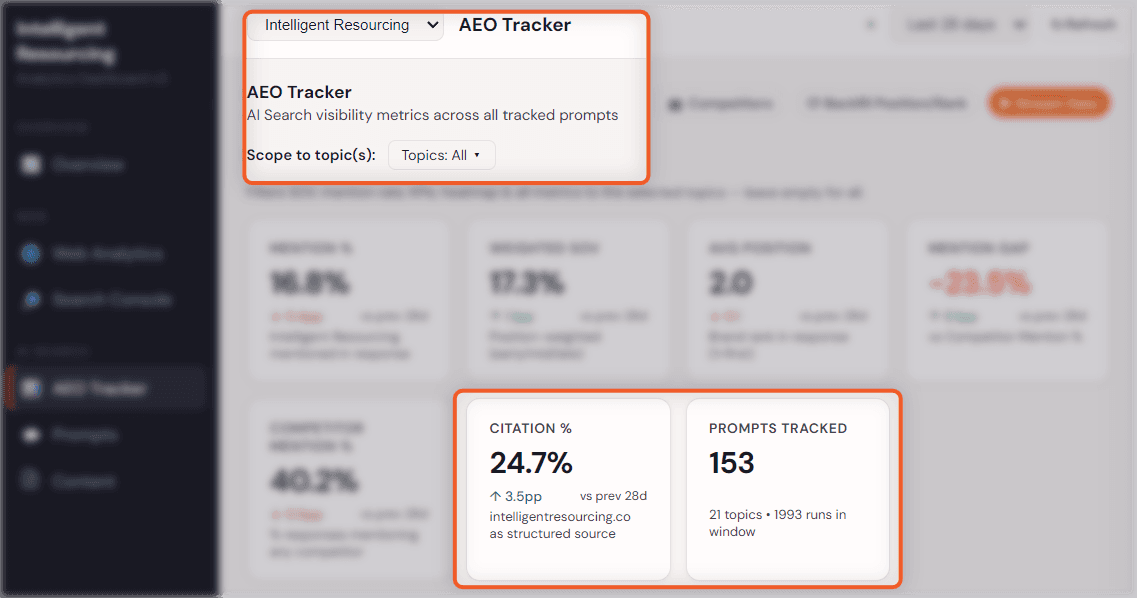
Intelligent Resourcing's AEO Tracker gives an example of this measurement model. The AI visibility guide explains how to set up equivalent tracking for your domain. Across 159 tracked prompts and 1993 AI engine runs, the Intelligent Resourcing domain is cited as a structured source in 24.7% of runs and is cited across all 5 tracked AI engines, including AI Overview.
FAQs
How Do I Get Cited in Google AI Overviews?
Get the page indexed, make it snippet-eligible and structure it as a clear answer source. Use direct-answer openings, question-format H2s, visible proof, consistent entity language and crawlable text. Google says supporting links must be indexed and eligible to show a snippet.
Does Ranking #1 Guarantee an AI Overview Citation?
No. Ranking helps but does not guarantee citation. AI Overviews use query fan-out to pull supporting sources from beyond the first page of results, meaning any page that answers a sub-question clearly can be cited regardless of its ranking position.
Does Google Require Special Schema for AI Overviews?
No. Google says there are no additional technical requirements for AI Overviews or AI Mode beyond the normal Search requirements. Schema that mirrors the visible page text improves extract quality, but Google has not specified schema as a separate requirement.
Why Do AI Overviews Cite Lower-Ranking Pages?
AI Overviews build generated answers from supporting sources. A lower-ranking page can be cited when it answers a sub-question clearly, has visible proof or offers a more extractable passage than a higher-ranking page.
What Should B2B Teams Track?
Track AI Overview citations, brand mentions, cited URLs, source position, competitor co-citations and downstream signals such as branded search, direct traffic and target-account engagement. For pipeline teams, citation only matters commercially when it connects to buyer timing.