

Why Choose a Local Lead Generation Agency in Australia?
Australian B2B teams choose local lead generation when their buyers need context that generic outreach misses. A local team knows Australian business language, regions, working hours and how industries buy. That matters most in professional services, enterprise software, industrial supply and other complex sales.
Better Alignment With Australian Buyers
A firm that sells to Australian construction businesses must tell contractors, developers, subcontractors and procurement leads apart. A generic list lumps them together, though each buys differently.
Complex sales also involve several people. Demandbase's State of the B2B Buyer research found that 72% of B2B purchases involve multi-stakeholder complex buying groups.
Local experience helps refine the ideal customer profile (ICP), pick the right accounts and write fitting messages. Location alone proves nothing, though. An offshore specialist with deep Australian experience can know these buyers better than a local generalist.
Closer Collaboration With Sales
Outsourced lead generation needs steady feedback from the team that gets the meetings. If account executives reject meetings because buyers lack budget, authority or interest, the targeting must change.
Australian-based teams face fewer scheduling barriers to those talks. That makes it easier to review call notes, update qualification rules and react to pipeline changes.
Greater Visibility Into Delivery
Know who runs outreach, which systems they use and how they qualify leads. Local agencies can make supervision easier, but visibility rests on contracts, process and reporting.
The best evidence is whether the provider can show how an account moved from identification to qualification and handover. The location of the sales development representative (SDR) matters far less.
Is Offshore Lead Generation Cheaper Than an Australian Agency?
Yes, offshore SDR staff cost less per hour than a managed Australian team costs per month. The two prices cover different things, so compare them with care. Staff rates buy hours. Managed retainers buy a run team, list building, reporting and a handover process.

Published Australian Pricing Examples
| Delivery model | Example provider | Published starting price |
|---|---|---|
| Offshore SDR staffing | Offshore 24/7 | AUD 12 to 17 an hour for SDRs running full outbound sequences. |
| Local managed SDR service | Nousu Collective | AUD 7,000 a month plus AUD 1,000 setup. |
Offshore 24/7 lists SDRs running full outbound sequences at AUD 12 to 17 an hour, with lower rates for appointment setters and higher rates for senior SDRs. Its pricing is all-inclusive, covering pay, human resources (HR), payroll, equipment and an account manager, with no lock-in contract.
Nousu Collective's Sydney team starts from AUD 7,000 a month plus a setup fee of AUD 1,000. That covers calling, email and LinkedIn follow-up, list building, qualification, meeting booking and weekly reporting. It runs on a 3-month initial term, then rolling monthly, with a performance guarantee from month two.
These are the providers' own prices, checked in October 2026, and they are no market average. Confirm goods and services tax (GST), terms and inclusions in writing.
At 160 billed hours, an SDR at AUD 12 to 17 an hour costs AUD 1,920 to 2,720 a month in staffing charges. Oversight time, tools and data come on top unless the provider includes them.
The gap looks large, and the comparison stays incomplete until you test both models against accepted deals.
Why Does Cost per Qualified Meeting Matter?
Take 2 hypothetical monthly campaigns:
| Metric | Offshore campaign | Local campaign |
|---|---|---|
| Total campaign cost | AUD 3,000 | AUD 7,000 |
| Meetings booked | 12 | 12 |
| Meetings accepted as qualified | 3 | 9 |
| Cost per qualified meeting | AUD 1,000 | AUD 778 |
Illustrative calculation only, and no measured agency performance.
Here the local campaign costs more up front and less per qualified meeting. The reverse also holds: a well-run offshore programme beats a poorly run local one. Calculate cost per qualified meeting, and ideally cost per sales deal, from your own results.
What Are the Hidden Costs of Offshore Lead Generation?
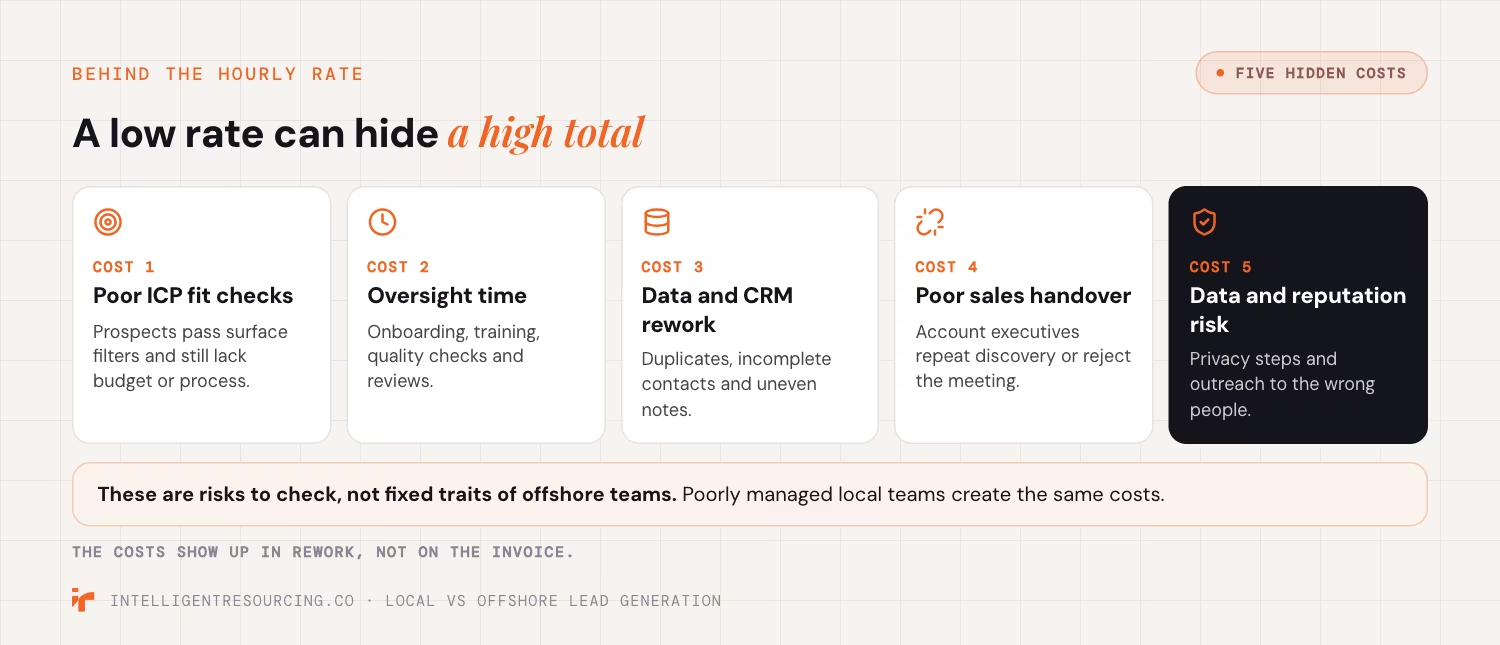
Hidden costs appear when a low staffing rate comes with extra management, rework or wasted sales time. These are risks to check and no fixed traits of offshore teams. Poorly managed local teams create the same costs.
1. Poor ICP Fit Checks
Prospects can match surface filters such as industry or company size and still be a poor fit. A business with 20 employees can meet the size rule and lack the budget, systems or buying process the solution needs.
Weak vetting gives meetings that look productive in a report and create little sales value.
2. Internal Oversight Time
An offshore SDR needs onboarding, supervision, training, quality checks and regular reviews. Ramp time alone averages about 3 months for a new in-house SDR, according to The Bridge Group's 2025 SDR report, whose sample is mostly North American.
Those hours cost money even when no invoice shows them.
3. Data and CRM Rework
Incomplete contacts, duplicate accounts and uneven notes create work for sales operations. Systems that do not connect add to it. Salesforce's 2026 State of Sales research found that 51% of sales leaders using artificial intelligence (AI) say disconnected systems slow their AI work.
You also need to budget for prospecting tools, enrichment and data checks.
4. Poor Sales Handover
A booked meeting is not always a sales-ready opportunity. If SDRs do not record the buyer's problem, the people involved, the timing and the next steps, account executives repeat discovery or reject the meeting.
5. Data Handling and Reputation Risk
Offshore access to contact data adds a privacy step, covered in the privacy section below. Outreach to the wrong people also damages your brand. Both risks apply to local and offshore providers. The difference is whether you can check how the provider manages them.
A Warning From Volume-First Lead Generation
In one Intelligent Resourcing-reported example, 80 to 90% of leads delivered by a previous volume-outreach vendor fell outside the ideal customer profile.
The vendor's location is unspecified, so the example does not show that offshore delivery caused the problem. It shows why you must set qualification standards before a campaign starts and measure fit, not volume.
The core question for any provider is whether it can explain why a given account should be contacted and what evidence supports the timing.
Should I Use an Offshore SDR Team for Australian Prospects?
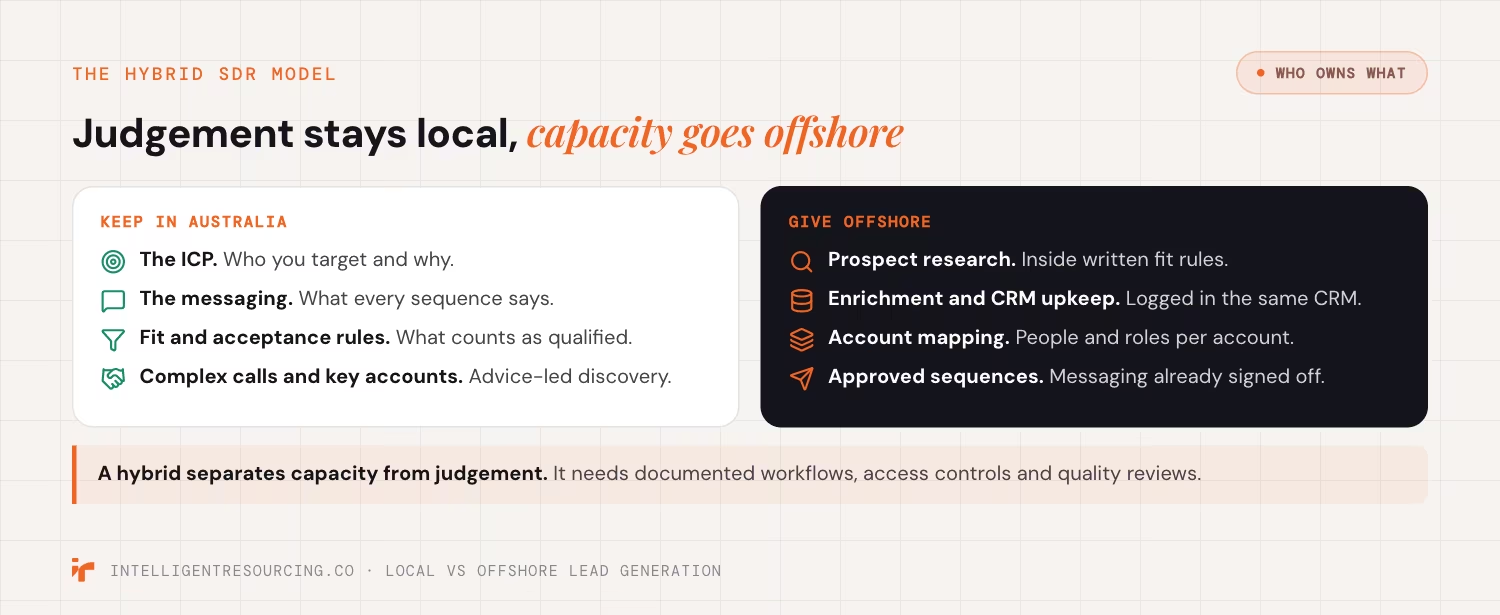
An offshore SDR team fits when the work is well defined and you keep control of targeting, quality and commercial decisions. It suits prospect research, data enrichment, CRM upkeep, account mapping and approved outreach sequences. Complex discovery calls, key accounts and fit decisions often gain from locally experienced staff.
The Case for a Hybrid SDR Model
A hybrid model separates capacity from judgement. The Australian team owns the ICP, the messaging, the fit rules and the acceptance rules. Offshore staff work inside those rules and log results in the same CRM.
This cuts staffing cost and keeps accountability clear. It works best with documented workflows, data access controls and regular quality reviews.
What Should You Measure?
Track the share of leads that match the ICP, meetings attended, meetings accepted by sales, deals created and pipeline progress.
Intelligent Resourcing describes the next step as a shift from volume-based targeting to Signal Orchestration. The system finds buying signals, applies fit rules and starts outreach when the signals point to a Verified Buying Window, with no static list to work through. That is the core of signal-led lead generation, and it sits within the wider idea of signal-based selling.
What Do Privacy Rules Mean for Offshore Outreach?
Sharing contact data with an overseas provider triggers a privacy duty for covered Australian organisations. Under Australian Privacy Principle 8, an organisation covered by the principles must generally take reasonable steps before it discloses personal information to an overseas recipient.
The Office of the Australian Information Commissioner's cross-border disclosure guidance says that giving personal information to an overseas contractor is generally a disclosure, though some arrangements are treated differently depending on control and circumstances.
Check data handling, access rights and contract terms before you open CRM access to offshore staff. Neither location guarantees compliance, so confirm your duties with a qualified adviser.
How Do You Choose Between Local and Offshore Lead Generation?
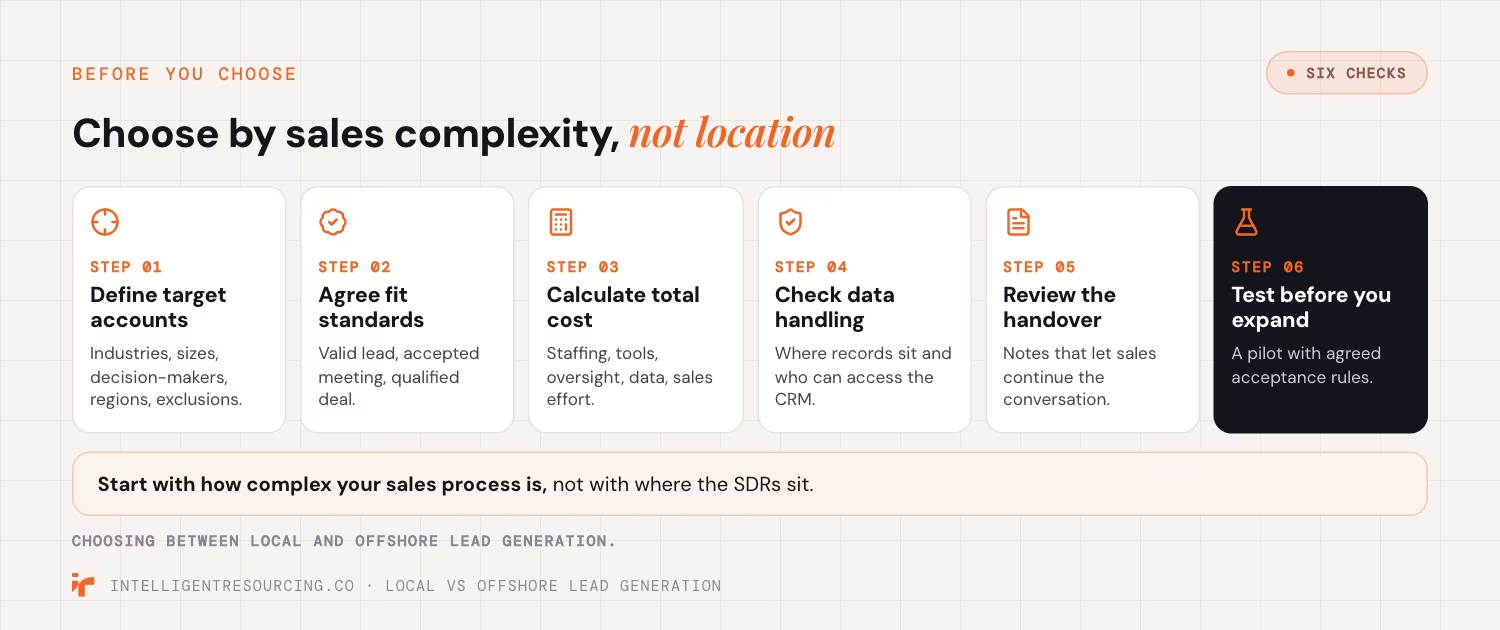
Start with how complex your sales process is, and set aside any assumption about where SDRs should sit. Work through this checklist:
- Define your target accounts: Write down industries, company sizes, decision-makers, regions and exclusions.
- Agree fit standards: Say what counts as a valid lead, an accepted meeting and a qualified deal.
- Calculate total delivery cost: Include staffing, tools, oversight, data and internal sales effort.
- Check data handling: Confirm where records sit, who can access the CRM and what the contract says.
- Review the handover: Require notes that let sales continue the conversation.
- Test before you expand: Run a pilot with agreed acceptance rules and review the results.
A scorecard for weighing providers sits in choosing a lead generation agency, and a shortlist of Australian options sits in B2B lead generation companies in Australia.
Lead Generation
Define a qualified deal, agree who owns targeting and acceptance, and hold every proposal to that definition. Then compare local and offshore options on accepted meetings and total cost. Intelligent Resourcing builds and manages signal-led go-to-market (GTM) systems inside a client's own CRM. If your gap is targeting and timing, start with GTM engineering.
FAQs
Why choose a local lead generation agency in Australia?
Local agencies bring market familiarity, shared working hours and easier sales collaboration, which helps complex B2B sales. Proven skill and vetting results matter more than location. A managed Sydney team costs more per month, and Offshore 24/7 staff cost less per hour.
Is offshore lead generation cheaper than an Australian agency?
Offshore SDR staff have lower hourly rates, from AUD 12 an hour at Offshore 24/7. A managed Sydney team such as Nousu Collective starts at AUD 7,000 a month. Total cost depends on oversight, tools, qualified meetings and sales effort, so compare cost per accepted deal.
Should I use an offshore SDR team for Australian prospects?
Yes, when the team follows written fit rules and you keep strong oversight. Offshore staff suit research, enrichment, CRM upkeep and approved sequences. Keep strategy, acceptance decisions and complex calls with Australian staff, and review data handling before you share contact records.
What are the hidden costs of offshore lead generation?
Costs include onboarding, quality checks, data cleaning, oversight time, rejected meetings and privacy steps. They differ by provider and appear in rework, not on the invoice. Measure them against accepted deals and pipeline progress.
Is local lead generation always better?
No. Local agencies also produce poor-fit leads, and offshore teams can deliver strong results with training and management. The right model depends on sales complexity, your oversight capacity and verified performance. Many B2B teams use a hybrid model.