


What Is the Best Marketing Strategy for Law Firms?

The best strategy for a law firm is to be easy to find, quick to reply and early to act. Most firms rely on referrals and a website. Signal-based growth adds a third part: contacting a business when a public record shows a new need, before it picks a lawyer.
In the 2022 small law survey, small Australian firms named referrals (84%) and word of mouth (82%) as their top sources of new clients. Smokeball, which sells legal software, ran that survey, so treat it as a guide, not a benchmark. Our guide on why referrals alone stop growing a law firm explains where that approach hits a ceiling.
Signal-based growth has three parts:
- Find the signal: A dated public fact, such as a new company registration.
- Match it to a practice area: One signal points to one kind of legal need.
- Reach out with one useful fact: Not a pitch, a reason to talk now.
Signal-based growth works by matching a dated business event to a relevant practice area, then checking whether the account is worth pursuing. The broader signal-based lead generation model uses the same logic across business-to-business (B2B) markets, but law firms need a tighter layer of practice-area fit, professional conduct and contact compliance.
How Do You Generate Leads for a Law Firm?
A law firm can generate leads by watching public records for dated business signals, matching each signal to a relevant practice area and checking whether the account is worth pursuing. A small firm can do this manually each week. A larger firm can use a system to screen sources, filter for fit and surface the accounts that need review.
At scale, the process works like a signal-based prospecting system: monitor news and public registers, remove signals that do not match the target practice area, check accounts against the firm's customer relationship management (CRM) or client list, then prioritise the ones worth investigating.
Official registers can provide useful signals. The Australian Securities and Investments Commission (ASIC), for example, publishes weekly insolvency statistics two weeks in arrears, including companies entering external administration for the first time. For a firm advising directors or creditors, that creates a timely reason to check whether the company fits its practice.
A signal does not prove that a business needs legal help, and it does not create permission to contact someone. The firm still needs to verify the account, confirm the relevance of the signal and use a lawful contact route before outreach.
What Are the Best Marketing Ideas for Law Firms?
The best ideas tie one public signal to one practice area. A new company needs commercial advice, a trade mark filing points to intellectual property (IP) work and a change of director points to governance. The firm chooses the signals that fit the work it wants more of.
This map shows common signals, where they appear and the work they point to:
| Signal | Where it appears | Practice area | First message angle |
|---|---|---|---|
| New company registered | ASIC company register | Commercial, employment contracts | Set-up and first contracts |
| New trade mark application | IP Australia register | IP and brand protection | Next steps and renewal dates |
| Change of director | ASIC register | Corporate governance | Director duties and records |
| Funding or acquisition news | News | Corporate, mergers and acquisitions | Deal and integration issues |
| Hiring plan or restructure news | News, job ads | Employment | Contracts and policies |
| Company enters external administration | ASIC notices | Insolvency and creditor advice | Handle with care |
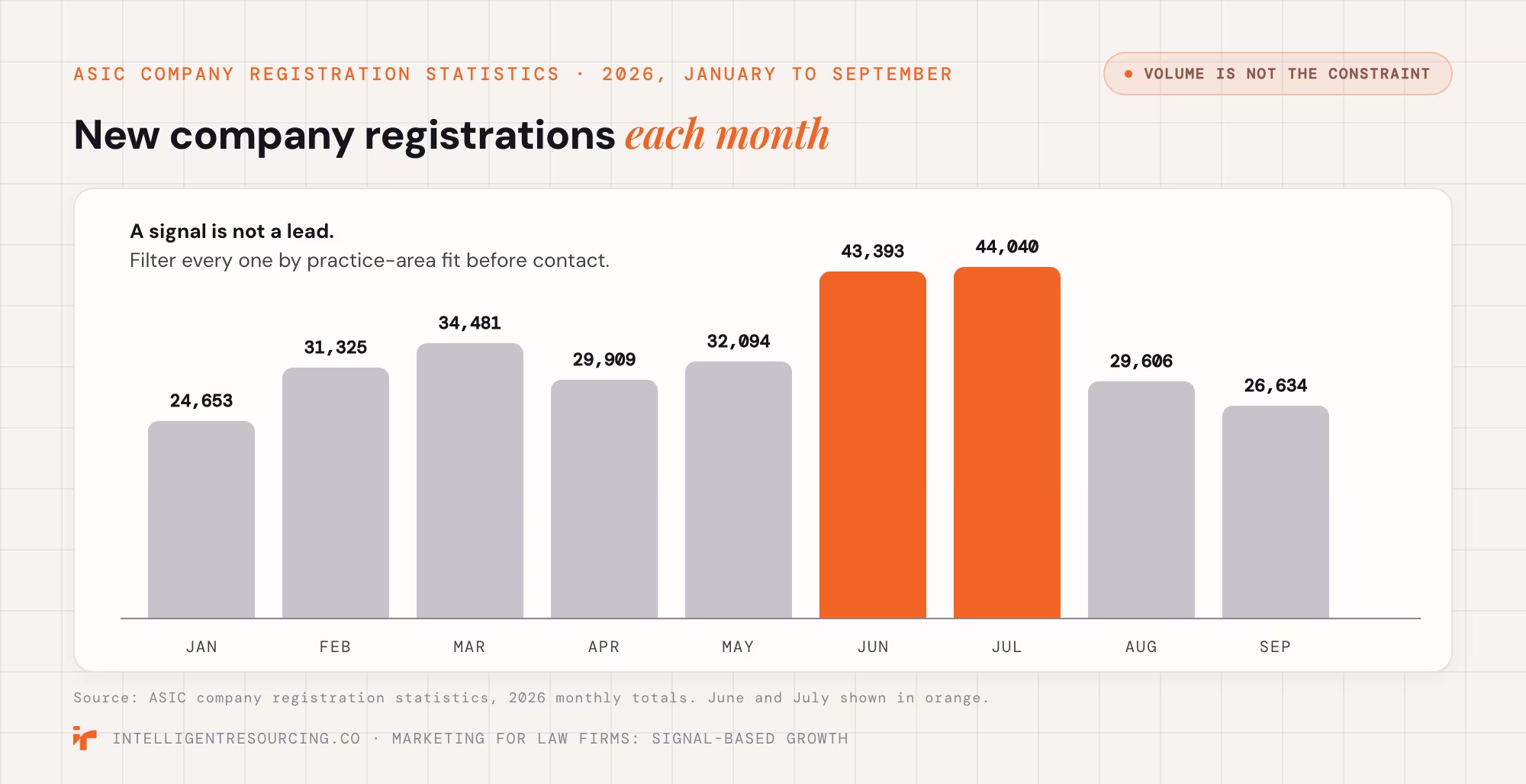
The volume is large. ASIC's company registration statistics show between 24,653 and 44,040 new company registrations a month from January to September 2026.
IP Australia's 2026 report on trade marks says a record 97,345 trade mark applications were filed in 2025. It says filings signal new product launches, business formation and brand repositioning. A firm must filter that volume by its own fit.
What Are Lead Generation Companies for Law Firms?

Lead generation companies sell enquiries or run outreach for a law firm. Some sell shared leads that go to several firms. Others run outbound campaigns or build a signal system the firm owns. The model matters more than the brand, so ask who owns the list and who makes the contact.
Compare any provider on five points:
- Who owns the list? A list the firm owns keeps its value. A seller's list does not.
- Is the lead shared? A lead sent to several firms is a race.
- How is a qualified meeting defined? Ask for it in writing.
- Who contacts the prospect? The firm's name should be on the message.
- Who checks the rules? Rule 36.1 of the conduct rules makes the solicitor or principal responsible for marketing done in connection with the practice, so the firm cannot hand that duty to a provider.
Compare cost by the same measure for every source: cost per qualified meeting. An outbound meeting comes earlier in the buyer's thinking than an inbound enquiry, so compare them with that in mind. For firms using automated monitoring, agentic signal listening can help surface relevant business events before a person reviews whether the account and timing are a genuine fit.
Which Marketing Agencies Are Best for Law Firms in Australia?
The best agency is the one that fits the job: brand, website, search, paid ads or outreach. No agency is best for every law firm. Ask each one for a named law-firm client, a result with a date and a published price. Then match the agency to the gap you have now.
Agencies for law firms fall into a few groups:
- Brand and website studios. Good for a new look and a clear site.
- Search and artificial intelligence (AI) visibility agencies. Good for being found when clients search or ask AI tools.
- Paid ads specialists. Good for firms that want enquiries from ads.
- Outreach and signal partners. Good for firms that want to contact businesses at the right time.
How Do You Write a Law Firm Marketing Plan?
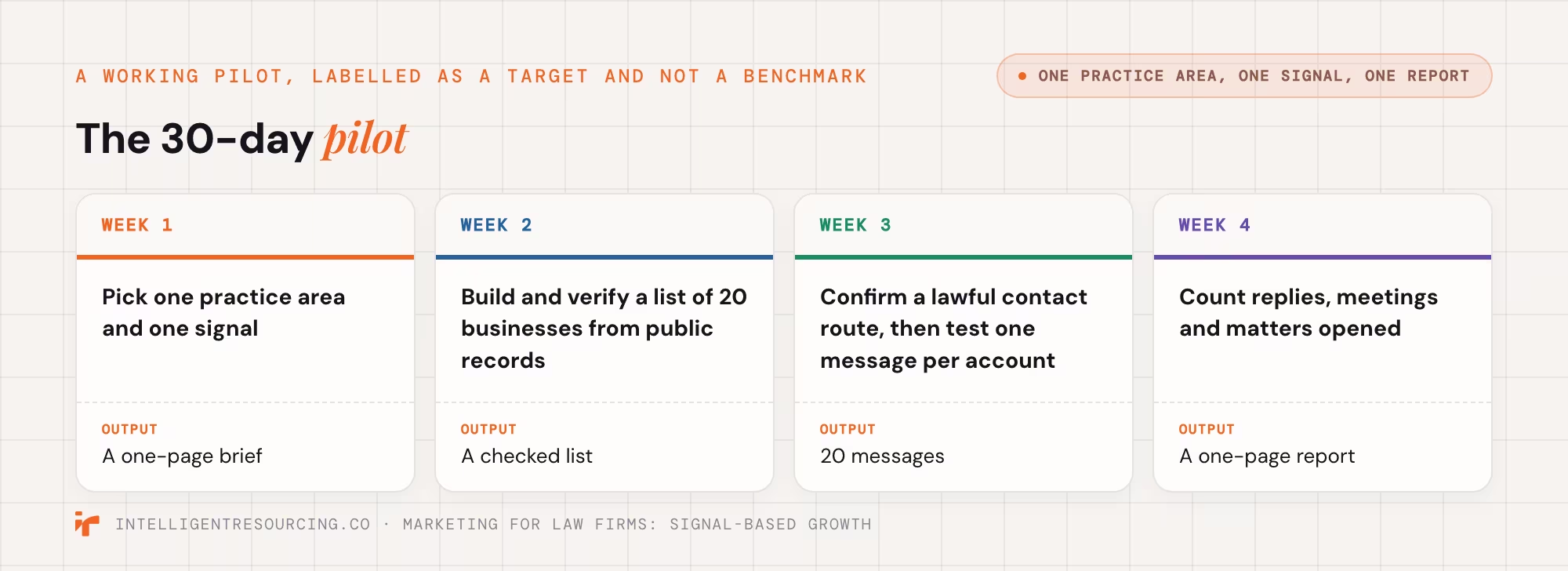
Write the plan as a 30-day pilot: one practice area, one signal and one report. Pick the work you want more of, identify a signal that may indicate a relevant need, check the rules, test a small list and review the results before spending more.
A working pilot, labelled as a target and not a benchmark:
| Week | Step | Output |
|---|---|---|
| 1 | Pick one practice area and one signal | A one-page brief |
| 2 | Build and verify a list of 20 businesses from public records | A checked list |
| 3 | Confirm a lawful contact route, then test one message per account | 20 messages |
| 4 | Count replies, meetings and matters opened | A one-page report |
Check the rules before week 3. The conduct rules of your regulator apply to every message, and the Spam Act applies to commercial email and text messages.
The fact sheet on unsubscribe rules from the Australian Communications and Media Authority (ACMA) sets out the basics for commercial messaging, including consent and a working unsubscribe option. This page does not give legal advice, so have the process checked before outreach begins.
Keep the pilot small so the result is easy to judge. If the signal produces qualified conversations, add a second practice area rather than expanding everything at once.
Want to see what a signal-based growth system could look like for your firm? Book a call with Intelligent Resourcing.
Lead Generation
To see what a signal-based growth system could look like for your firm, book a call with Intelligent Resourcing.
FAQs
How do law firms generate leads?
They watch public records for dated signals, such as a new company or a change of director. They match each signal to a practice area and contact the business while the need is fresh. Many also rely on referrals and a website.
What is signal-based growth for a law firm?
It is contacting a business when a public record shows a new need for legal help. The firm picks signals that match its practice areas, checks the rules and sends one useful message. It adds a timed channel to referrals and search.
Are lead generation companies worth it for law firms?
It depends on the model. Shared leads go to several firms, while a signal system the firm owns keeps its value. Ask who owns the list, how a qualified meeting is defined and who checks the rules.
What is the best marketing for a small law firm?
Reply to every enquiry fast, write one clear page for each practice area and run a 30-day pilot on one signal. Track where each new client comes from. Add channels only when the numbers hold.
Do law firms need a marketing agency?
Not always. A firm that is full and has a clear niche can wait. A firm that needs new clients can use an agency matched to the job, and should ask for a named law-firm client and a dated result.