

Why Do Law Firms Struggle to Get New Clients From Marketing?
Most law firms do not have a marketing problem. They have a single-channel problem.
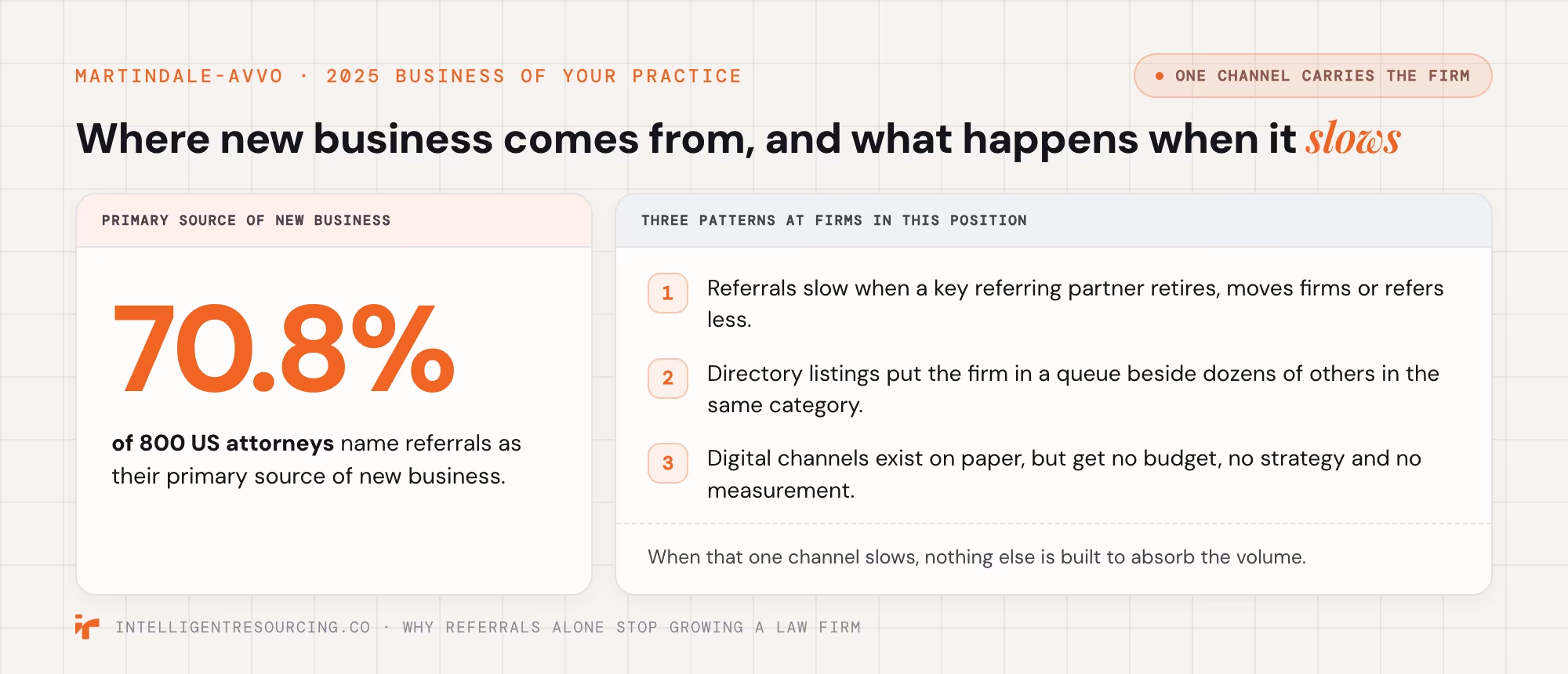
Martindale-Avvo, a legal directory, surveyed 800 attorneys in the United States (US) for its 2025 Business of Your Practice report. It found that 70.8% of attorneys name referrals as their primary source of new business. When that one channel slows, nothing else is built to absorb the volume.
Three patterns show up at firms in this position:
- Referrals slow when a key referring partner retires, moves firms or refers less.
- Directory listings put the firm in a queue beside dozens of others in the same category.
- Digital channels exist on paper, but get no budget, no strategy and no measurement.
None of this is a lack of effort. It happens when a firm builds growth on one channel, then never runs the other channels it calls "marketing."
Why Does Referral-Only Growth Stop Scaling?
Referral growth is capped by one number: the size of the partners' combined networks. Thomson Reuters found that Australian large firms grew profit per lawyer by 27.4% since the 2022 financial year, while midsize firms managed 3.1%, in its 2026 market update.
| Firm segment | Profit-per-lawyer growth since the 2022 financial year |
|---|---|
| Large firms | 27.4% |
| Big 8 firms | 7.1% |
| Midsize firms | 3.1% |
Source: Thomson Reuters, 2026 Australian Legal Market Midyear Update.
The report does not say why the gap opened. It describes large firms as pursuing expansion and demand capture, and midsize firms as taking a more measured course. A referral network offers one possible reason a firm lags, because it does not expand just because the firm wants to grow faster:
- A referrer's contact list does not grow on its own.
- A referrer's willingness to make an introduction does not speed up either.
- Hiring more lawyers adds capacity to deliver work, not capacity to find it.
Why Do Law Firm Websites Get Traffic but Not Enquiries?
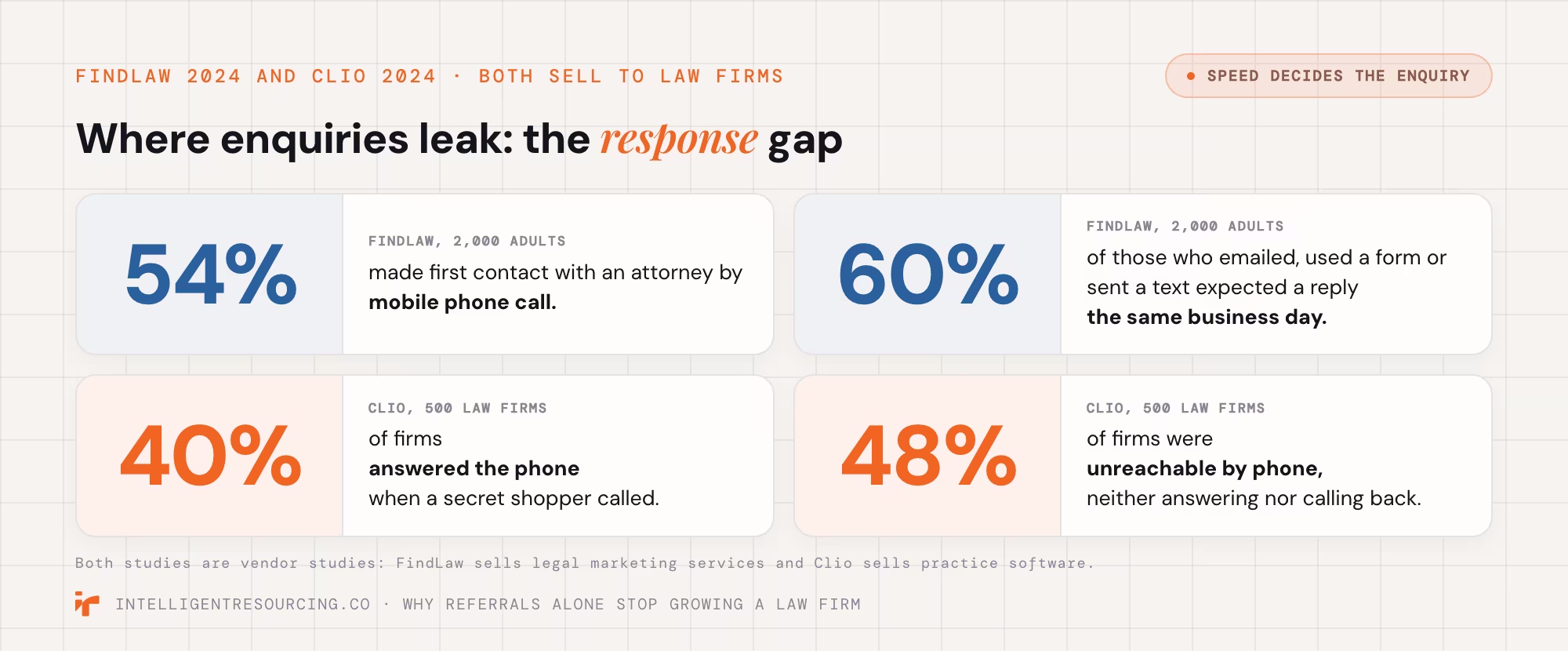
A website can generate visits and still produce no new clients, because visits were never the bottleneck. Response is. FindLaw's 2024 US Consumer Legal Needs Survey of 2,000 adults found 54% made first contact by mobile phone call. Of those who emailed, used a form or sent a text, 60% expected a reply within the same business day.
FindLaw sells legal marketing services, so read the figures as a vendor study.
This is a structural gap, not an effort gap:
- A firm can publish strong content and rank well, and still answer every enquiry a day late.
- Nobody owns the response step, so calls fall through unnoticed.
- Traffic measures interest only, not whether that interest is converted.
Our law firm website checklist lists the fixes a site needs before traffic turns into clients, from faster replies to the credentials a prospective client checks first.
What Happens When a Referral Checks You Out Online First?
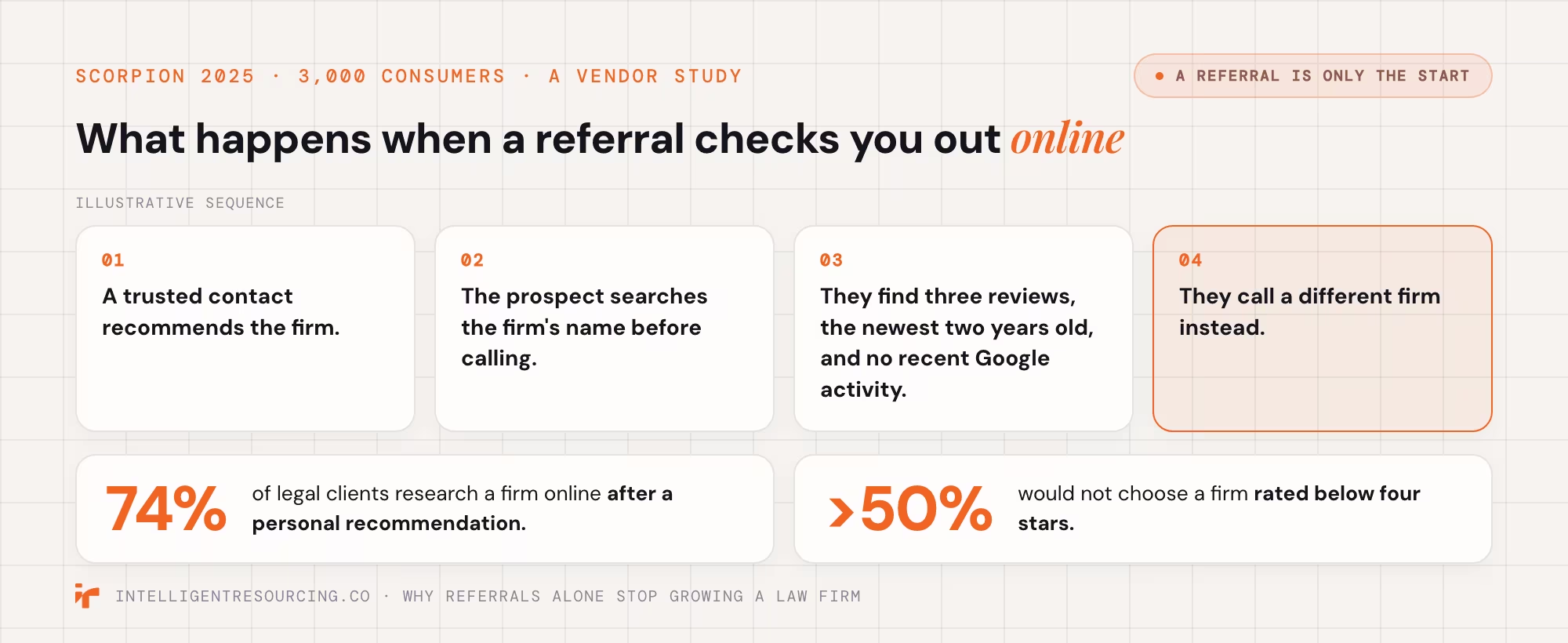
A referral no longer guarantees a client. Scorpion's 2025 survey of 3,000 consumers found that 74% of legal clients research a firm online after a personal recommendation, Localogy reported. More than half would not choose a firm rated below four stars. Scorpion sells marketing to law firms, so read the figures as a vendor study.
Thin, outdated or inconsistent reviews can cost a firm a client its own network already sent. Picture the sequence many referred consumers follow:
- A trusted contact recommends the firm.
- The prospect searches the firm's name before calling.
- They find three reviews, the newest two years old, and no recent Google activity.
- They call a different firm instead.
The referral gets the firm considered. What the firm has published online decides whether it stays on the list. Artificial intelligence (AI) assistants such as ChatGPT and Perplexity now stand in for Google. Our post on law firms missing from AI answers covers the same gap there.
What Replaces Referral-Only Growth for a Law Firm?
Referrals stay the first place business clients look. In the 2025 Greentarget and Zeughauser Group survey, 92% of in-house counsel and 86% of C-suite executives named trusted recommendations their top way to find counsel. Attorney Journals reported the findings, and the article's author runs a legal marketing firm.
The same survey shows what clients check next. Bios are reviewed by 67% of in-house counsel and 74% of business leaders, and firm blog posts by 62% and 57%. A growth model built only on referrals and directories leaves those pages as the firm's only chance to persuade a stranger. It also reaches no one outside the network.
How Does Signal-Based Growth Work for a Law Firm?
Signal-based growth watches for public signs of a legal need instead of waiting for a referral. For a firm that serves businesses, the signals sit in public events that raise legal need.
The Association of Corporate Counsel ran a 2026 Australia survey. It found 33% of organisations faced a regulatory investigation or enforcement action in the past year. And 49% of chief legal officers named regulatory compliance their top priority.
Watching for those signals in practice means tracking events such as:
- A regulatory change in a practice area the firm serves.
- A funding round or acquisition at a company that triggers a legal need.
- A hiring spike in a specialism the firm is built around.
Agentic signal listening runs that monitoring continuously, so no single partner has to catch every event alone. Go-to-market (GTM) engineering then turns each signal into a fast, well-timed first message. A generic enquiry form that sits unanswered overnight does not.
This is not a replacement for referrals. It is a second channel that keeps producing new volume in the weeks a referral does not land.
Which Fixes Come First for a Law Firm's Enquiries?
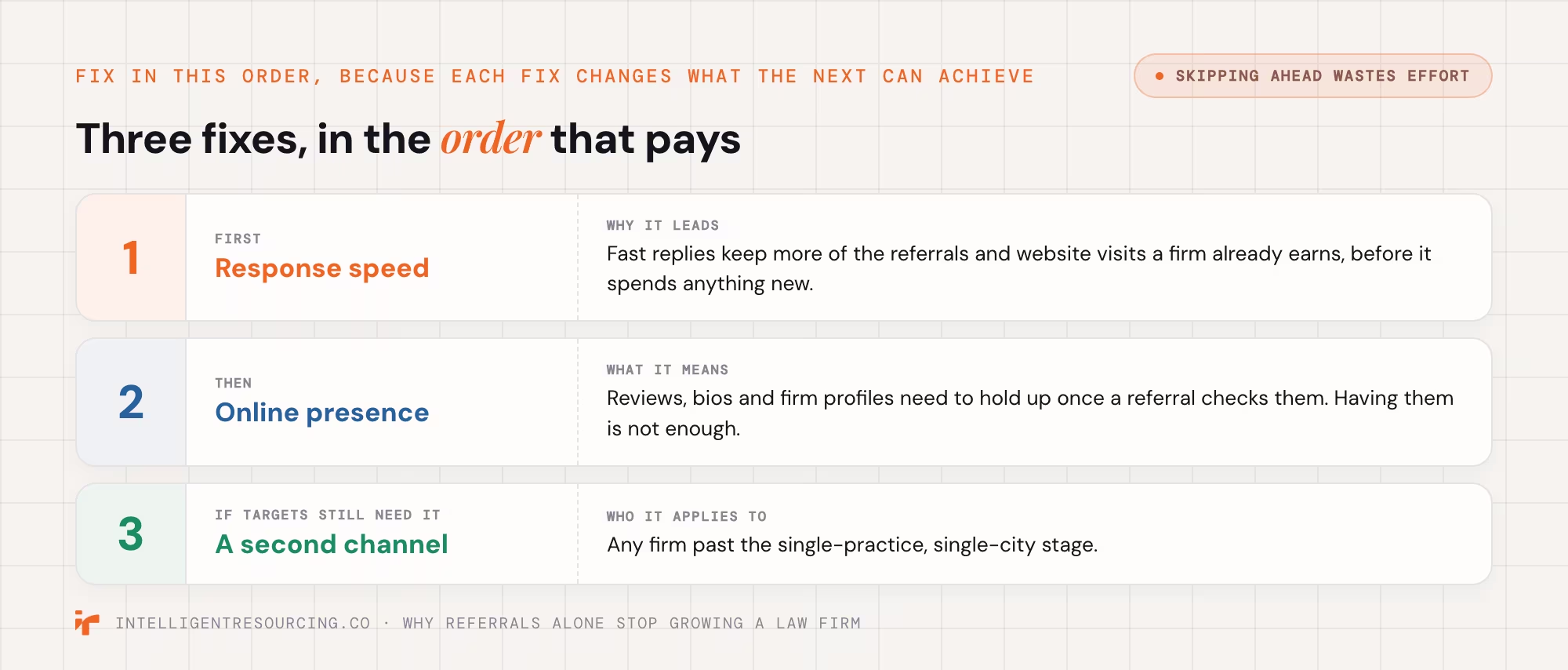
A law firm should fix three things in this order: response speed, online presence, then a second channel if growth targets still require one. Skipping ahead wastes effort, because each fix changes what the next can achieve.
- Response speed. In its 2024 Legal Trends Report, Clio sent a secret shopper to 500 law firms. Only 40% answered the phone, and 48% were unreachable by phone. Clio sells practice software, so read the figures as a vendor study.
- Online presence. Reviews, bios and firm profiles need to hold up once a referral checks them. Having them is not enough.
- A second channel. Once response and presence are fixed, a firm may still need a channel beyond referrals to reach a growth target. This applies to any firm past the single-practice, single-city stage.
Fast replies keep more of the referrals and website visits a firm already earns, before it spends anything new. That is why response speed comes first. For the content side of law firm growth, see our AI visibility guide for law firms.
How Can a Law Firm See Its Own Buying Signals?
Is your firm visible once a referral goes looking? See which businesses show signs of needing a firm like yours, before they ask a colleague for a name. Audit your buying signals
Lead Generation
To see which businesses show signs of needing a firm like yours, book a strategy session with Intelligent Resourcing.
FAQs
Why do law firms struggle to get new clients from marketing?
Most firms rely on one channel, referrals, for the majority of new business. Martindale-Avvo's 2025 report found 70.8% of US attorneys name referrals their primary source. When that channel slows, no other channel is built or measured well enough to absorb the gap.
Is referral-only growth sustainable for a law firm?
It depends on the firm. A single-practice, single-city firm at capacity, where clients choose by location and category, can run on referrals indefinitely. A firm that competes on reputation, specialism or cross-sell needs a second channel. Referral volume is capped by the partners' networks.
Why does a law firm website get visitors but few enquiries?
Traffic is rarely the problem. Response is. FindLaw's 2024 survey found 60% of people who emailed, used a form or sent a text expected a same-day reply. A slow or missed response loses the enquiry, however much traffic the site generates.
What should a law firm do instead of relying on referrals alone?
Fix response speed first, since it protects clients the firm already attracts. Then add a second channel that detects businesses with a likely legal need, instead of waiting for a referral or directory listing to produce one.
Does a referral network still matter once signal-based growth is in place?
Yes. Referrals remain the largest single source of new clients for most firms. Signal-based growth does not replace that network. It is a second channel that keeps producing new volume in the weeks the network does not.