


1. Is Your Client Data Clean Enough to Act On?
Client and prospect records go stale quietly. The Australian Bureau of Statistics found that 1.0 million people changed jobs in the year to February 2026, a job mobility rate of 7.2%. Every move can leave a wrong name, title or email in a firm's customer relationship management (CRM) system.
Run this check every quarter:
- Bounces removed: delete bounced emails, do not just flag them.
- Roles confirmed: check that the finance contact at each business still holds that role.
- Duplicates merged: one business should not appear twice with two histories.
- Last contact dated: every active record shows when someone last spoke to it.
Firms that would rather not do this by hand can use automated CRM enrichment to keep records current between checks.
2. Is Your Client Profile Narrow Enough to Watch?
A narrow ideal customer profile (ICP) is easier to watch than a long list. A useful profile for an accounting firm names three things:
- Size: a headcount or revenue band, not "growing small business".
- Industry: sectors where the firm already has proof, not every sector it could serve.
- Trigger: the event that makes a business worth calling now.
Rules give firms clear triggers. Under the Corporations Act, a proprietary company is "large" when it meets at least two of three tests: $50 million consolidated revenue, $25 million consolidated gross assets or 100 employees. Large proprietary companies must prepare and lodge a financial report and a director's report each year, and the accounts must be audited unless the Australian Securities and Investments Commission (ASIC) grants relief. A business nearing those tests is a clear audit and reporting prospect.
3. Which Public Signals Should You Watch?

Pick two or three signals that fit the profile. Watching every signal for every prospect wastes more time than it saves.
| Signal | Where to look | What it suggests |
|---|---|---|
| New company or entity | ASIC registers | A new structure that needs set-up and reporting |
| Headcount near 100 | LinkedIn, job ads | Payroll growth and a possible audit trigger |
| Finance leader change | LinkedIn, press releases | A new person reviewing advisers |
| Second site or acquisition | Local press, council notices | Multi-entity reporting and tax work |
ASIC lets anyone search its company registers for registration details. Our guide to signal-based versus demographic targeting explains why timing beats a size filter alone.
4. Do You Track Every Lead Source the Same Way?
Most partners can name their best referral source from memory, but few can prove it. Hinge, a professional services marketing firm, studied 133 accounting and financial services firms in 2026. Referrals remained a top lead source, but high-growth firms relied on them 34% less, focusing instead on proactive direct outreach and social media. A firm can only shift that mix if it can see where each lead came from.
Fix this with one field:
- One source field: use it for referrals, website forms, events and outbound replies alike.
- Named referrers: record the lawyer, bookkeeper or client who sent each lead, not just "referral".
- Quarterly review: compare sources against signed engagements, not enquiries.
- Drop dead sources: stop paying for a source that never signs a client.
This check sits inside a wider lead generation strategy checklist, which covers the rest of the pipeline.
5. How Fast Does a New Lead Get a Reply?
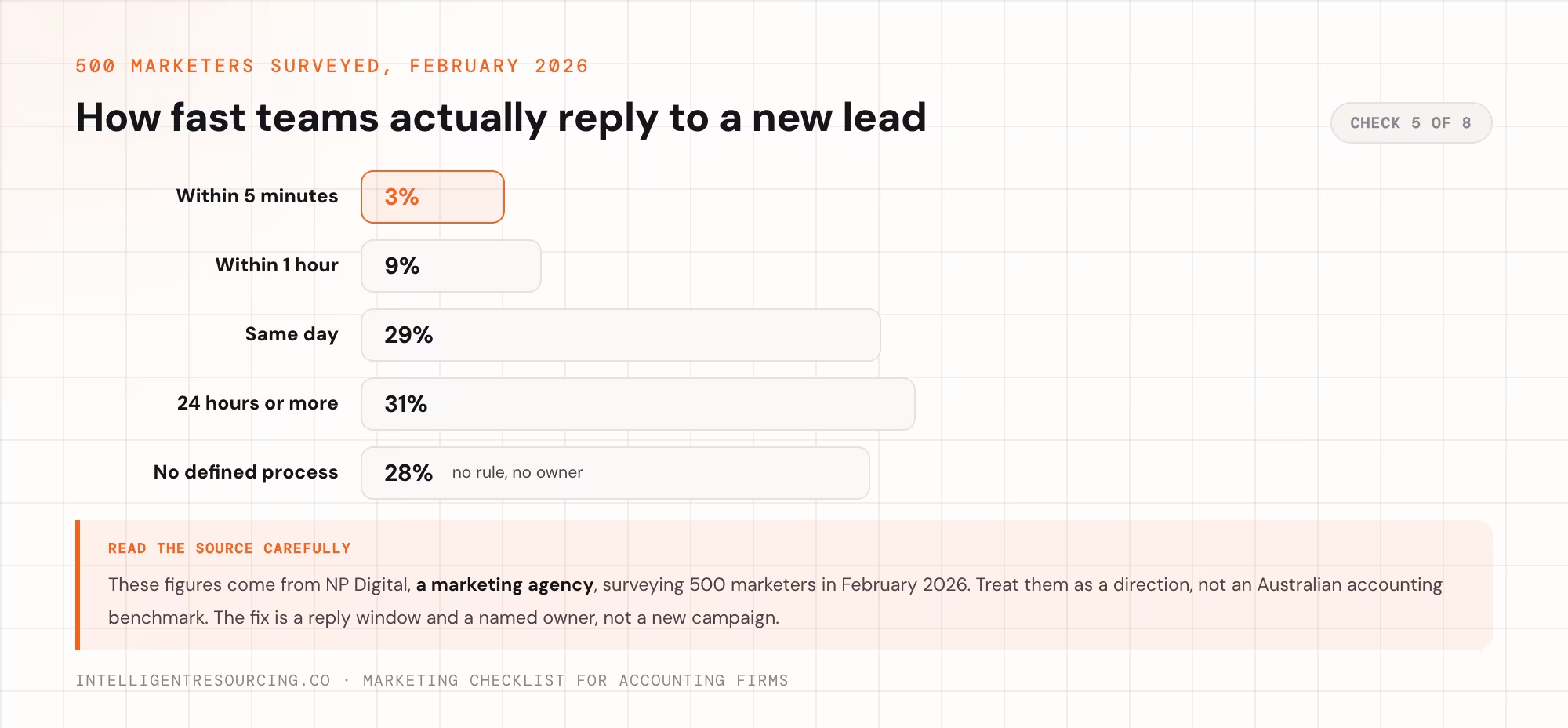
Leads go cold between the first message and the first call. In a February 2026 survey of 500 marketers by NP Digital, a marketing agency, only 3% replied to new leads within five minutes. Another 31% took 24 hours or more, and 28% had no defined process at all.
Set one rule and one owner:
- A reply window: set it in hours, and make same day the minimum.
- A named owner: every lead goes to a person, never a shared inbox.
- A monthly measure: track the real gap, not the target.
- A process fix first: treat a missed window as a process problem before a staffing one.
6. Will Signals Still Reach Someone at Tax Time?

Accounting firms have predictable peaks. Under the Australian Taxation Office's lodgment program, 31 October 2026 is the final date to add new clients so their 2026 tax return is covered. Returns for entities that did not have to lodge earlier are then due on 15 May 2027. In those weeks, a buying signal can sit unread while partners lodge, and a prospect who enquires in October needs signing before the 31st.
Before you start watching signals, name:
- An owner per signal type: a person, not a team.
- A backup for peak weeks: someone outside the lodgment rush.
- A deadline per signal: hours or days, matched to how fast the need fades.
Signal monitoring only pays off when someone owns each alert on the day it arrives.
7. Can You Show Which Channel Brought Each Client?
Attribution decides where next year's budget goes. Google's Analytics help explains that an attribution model determines how credit is assigned to touchpoints along a user's path, rather than giving it all to the last click. For a firm, the path often mixes a referral, a website visit and a phone call.
Keep it simple:
- Pick one model: use the same model all year, so results compare.
- Join web and CRM data: match web enquiries to records that became clients.
- Count fee, not leads: report annual fee from each channel, not enquiry volume.
8. Do Your Outbound Emails Follow the Rules and Get Tracked?
Outbound email needs the same records as any other channel, plus legal care. The Australian Communications and Media Authority (ACMA) says a sender must first have consent, include their contact details in the message, and give the recipient a way to say stop.
Check that every outbound email:
- Has a consent basis: express, or inferred from an existing relationship.
- Names the firm: with accurate contact details.
- Offers an unsubscribe: and the firm acts on it.
- Logs to the CRM: with the same source field as referrals.
For the full build order of a signal-led system, see how to build signal-led prospecting.
How Do You Put the Checklist to Work?
Work through the checks in order, one per fortnight, and do not add spend until checks 1 to 5 hold. A firm that fixes data, profile and follow-up first gets more from every campaign after that.
Intelligent Resourcing builds signal routing and CRM upkeep for firms that want checks 1, 3 and 6 run for them.
Lead Generation
To plan the order for your practice and see what signal routing would look like in your current CRM, book a GTM strategy session with Intelligent Resourcing.
FAQs
How often should an accounting firm clean its CRM?
Every quarter at minimum. With about 7% of employed Australians changing jobs in a year, an annual clean leaves many records wrong for months. Check finance contacts first, because they decide who the firm advises.
What does a narrow client profile look like for an accounting firm?
It names a size band, an industry and a trigger. An example is a manufacturer with 80 to 100 staff and growing revenue, close to two of the size tests that make a proprietary company "large" and bring an audit.
Should referrals sit in the same CRM as outbound leads?
Yes. One source field, filled in the same way for every lead, shows which referrers and channels lead to signed work. Name the referrer, not just "referral".
What should a firm do with leads that arrive during tax time?
Name a backup owner who is not lodging returns that week. Leads that wait until after 31 October or 15 May are often lost to firms that replied sooner.
Does a small practice need signal monitoring at all?
Not always. A practice under five partners whose referrals already fill capacity can track leads in a spreadsheet. Add signal monitoring when new work outgrows one person's memory, or when a new service line needs buyers the partner network does not reach.