

What Should a Law Firm's Generative Engine Optimisation (GEO) Checklist Cover?
A GEO checklist for a law firm website runs 4 tests: crawler access, practice area pages, lawyer profiles and client prompts. Each test has a pass mark, shown in the tables below. A fifth list names popular fixes a firm can skip to save budget.
Australians asked LawConnect, a legal artificial intelligence (AI) platform, more than 120,000 legal questions in its first year, Lawyers Weekly reported in January 2026. Almost 22,000 asked for a lawyer's quote.
The most-asked areas were:
- Family law
- Criminal law
- Property law
- Employment law
LawConnect sells legal AI services, so these are one platform's numbers.
Each question lands on a specific page:
| Client question | Page that has to answer it | Checklist part |
|---|---|---|
| "Who handles parenting disputes in Parramatta?" | Practice area page | Practice area pages |
| "Is this solicitor an accredited specialist?" | Lawyer profile | Lawyer profiles |
| Any of the above | Every page AI tries to read | Crawler access |
To find out why a firm goes unnamed, start with why law firms go missing.
Is Your Firm's Firewall Blocking AI Search Crawlers?
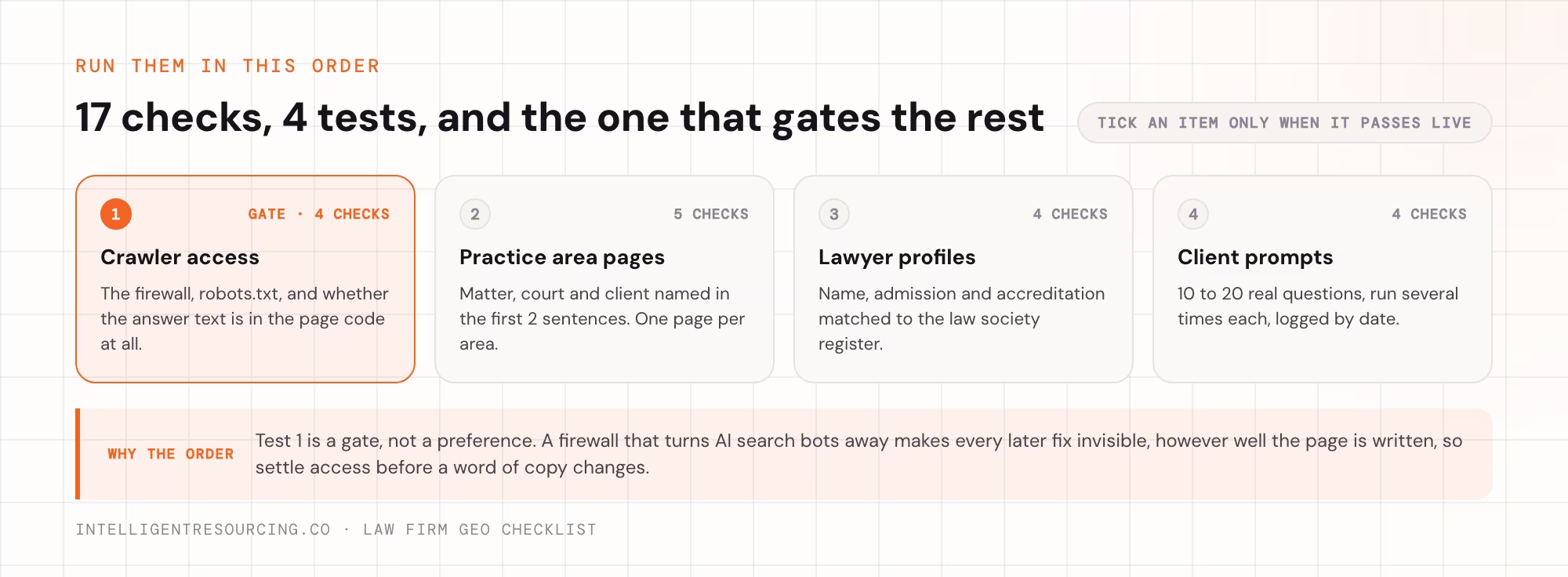
A firewall is the security layer in front of a website. It can block AI search bots even when the firm's robots.txt file lets them in. Access comes first because every later fix depends on it.
On 1 July 2025, Cloudflare became the first major internet infrastructure company to block AI scraping by default, Nieman Lab reported. Every domain registered with Cloudflare from that date is asked upfront whether it wants AI crawlers on the site. An older firm site is not covered by that default, which is exactly why the setting has to be checked rather than assumed.
Ask the firm's web host 3 questions:
- Which AI bot rules are switched on?
- Are AI search bots treated differently from AI training bots?
- Who last changed the settings, and when?
OpenAI and Anthropic each run one bot for search and one for training. A firm can block the training bot and keep the search bot. Cloudflare's same announcement added crawler identification tools that let a site tell those purposes apart.
Access is the first layer of how generative engine optimisation works, so fix it before touching content.
| Check | How to test it | Pass when |
|---|---|---|
| Firewall and bot rules | Ask the host, or open the Cloudflare dashboard | AI search bots are allowed |
| robots.txt | Open yourfirm.com.au/robots.txt | No rule stops search bots reading practice or profile pages |
| Text visible in the page code | Right-click a practice page and choose View Page Source | The answer text is in the code |
| Nothing hides the answer | Load a practice page in a private window | No pop-up or intake form covers the opening lines |
Does Each Practice Area Page Answer the Client's First Question?
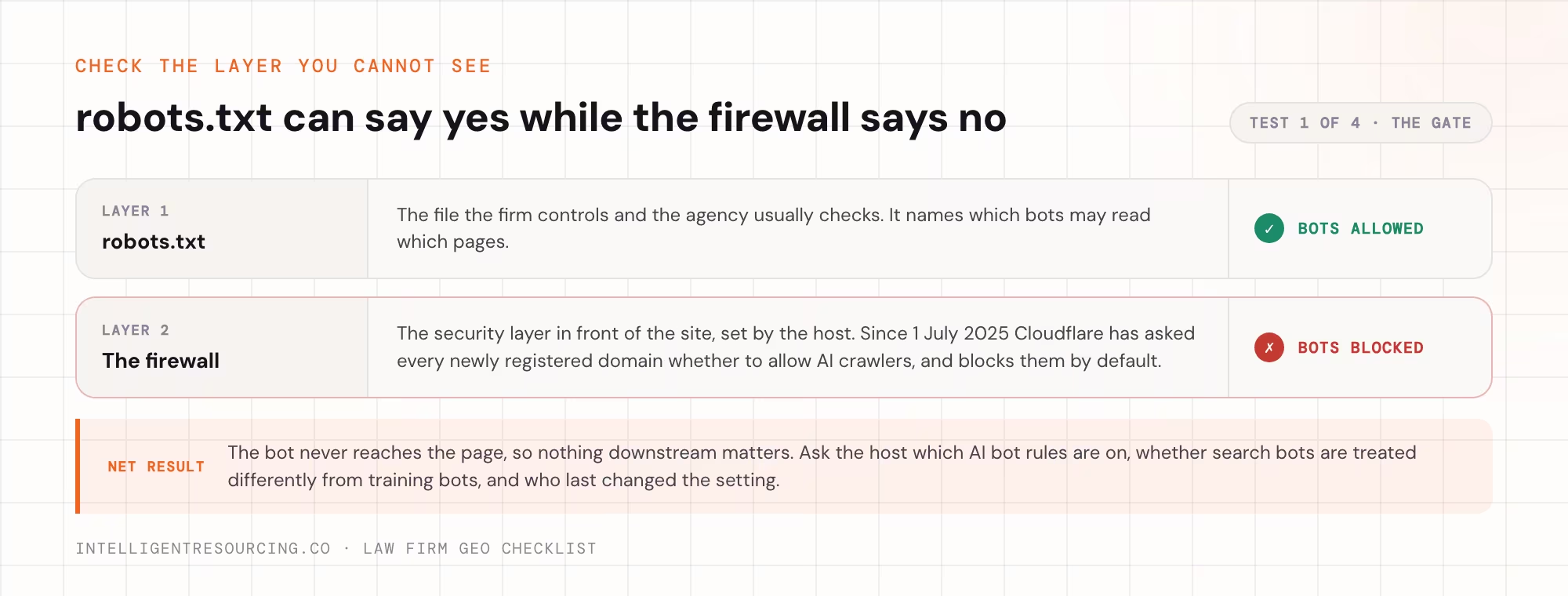
A practice area page passes when its first 2 sentences name the matter, the state or court, and who the firm acts for. Lead with the answer rather than with the firm.
Research on how language models read long inputs supports that placement. Liu and colleagues, in "Lost in the Middle", published in Transactions of the Association for Computational Linguistics in 2023, found models used information best when it sat at the start or the end of a long input, and worst when it sat in the middle. That study measured a model reading a long document, not an engine choosing which page to cite, so treat it as a reason to put the answer up front rather than as a rule about citations.
Write sub-headings as the questions clients type. The LawConnect figures above show people asking in plain language, not in keywords.
The difference on a family law page:
| Part of the page | Hard to cite | Easy to cite |
|---|---|---|
| Opening line | "Our experienced team gives tailored advice on family matters" | "We act for parents in parenting disputes in the Federal Circuit and Family Court of Australia" |
| Sub-heading | "Property Settlements" | "How is property split after separation in New South Wales?" |
Run these checks on every practice page.
| Check | How to test it | Pass when |
|---|---|---|
| First 2 sentences | Read only the opening lines | The matter, the state or court, and the client are all named |
| Sub-headings | List the page's headings | Each is a question a client would ask |
| 1 page per practice area | Compare the page list with the areas the firm offers | Every area the firm offers has its own page |
| Fees and first steps | Search the page for how fees work | Fees and the first meeting are explained |
| Offices and areas served | Compare the page with the firm's Google Business Profile | Same suburbs, addresses and phone numbers |
GEO for professional services firms applies the same test to other advisory firms.
Can an AI Engine Verify Who Your Lawyers Are?
AI can check a lawyer when the profile matches the public record: full name, admission year, state and any accreditation. Rule 36.2 of the Australian Solicitors' Conduct Rules bars a solicitor from conveying a false, misleading or deceptive impression of specialist expertise, and from advertising with the words "accredited specialist" or a derivative of them, post-nominals included, unless accredited by the relevant professional body. These rules bind solicitors in the states and territories that apply them, so confirm which conduct rules cover your firm. A profile must be accurate as well as easy to find.
Queensland Law Society guidance notes the Legal Services Commission's view that the bare word "specialist" is likely a derivative of "accredited specialist" under the rule. The safe reading is that the word belongs to accredited solicitors, not to anyone with a preferred area of practice.
The Law Society Journal's guidance on solicitor marketing adds 3 points to check on every profile:
- The public may read "specialist" as implying expertise rather than a preferred area of practice.
- Do not advertise a qualification until you hold it, even when the only thing outstanding is an administrative formality.
- Principals should review and approve any website publication, and any change to it, before it goes live.
| Profile wording | Result |
|---|---|
| "An accredited specialist firm" | Fails: accreditation is held by individual solicitors |
| "Jane Lee, Accredited Specialist in Family Law" | Passes: names the person and area, which AI can check against the register |
| Check | How to test it | Pass when |
|---|---|---|
| Name matches the register | Compare each profile with the state law society's listing | Same spelling and initials |
| Admission and jurisdiction | Read the first lines of each profile | Admission year and state are stated |
| Specialist wording | Search the site for "specialist" and "specialise" | Used only for accredited solicitors, with the area named |
| Bylines on legal guides | Open 3 recent articles | Each names a lawyer and points to that lawyer's profile |
For the step-by-step matching process, see how regulated firms publish credentials.
Which Popular GEO Fixes Can a Law Firm Skip?
A law firm can skip mass page production and schema-only projects, because neither gets a firm quoted by AI on its own.
Mass page production
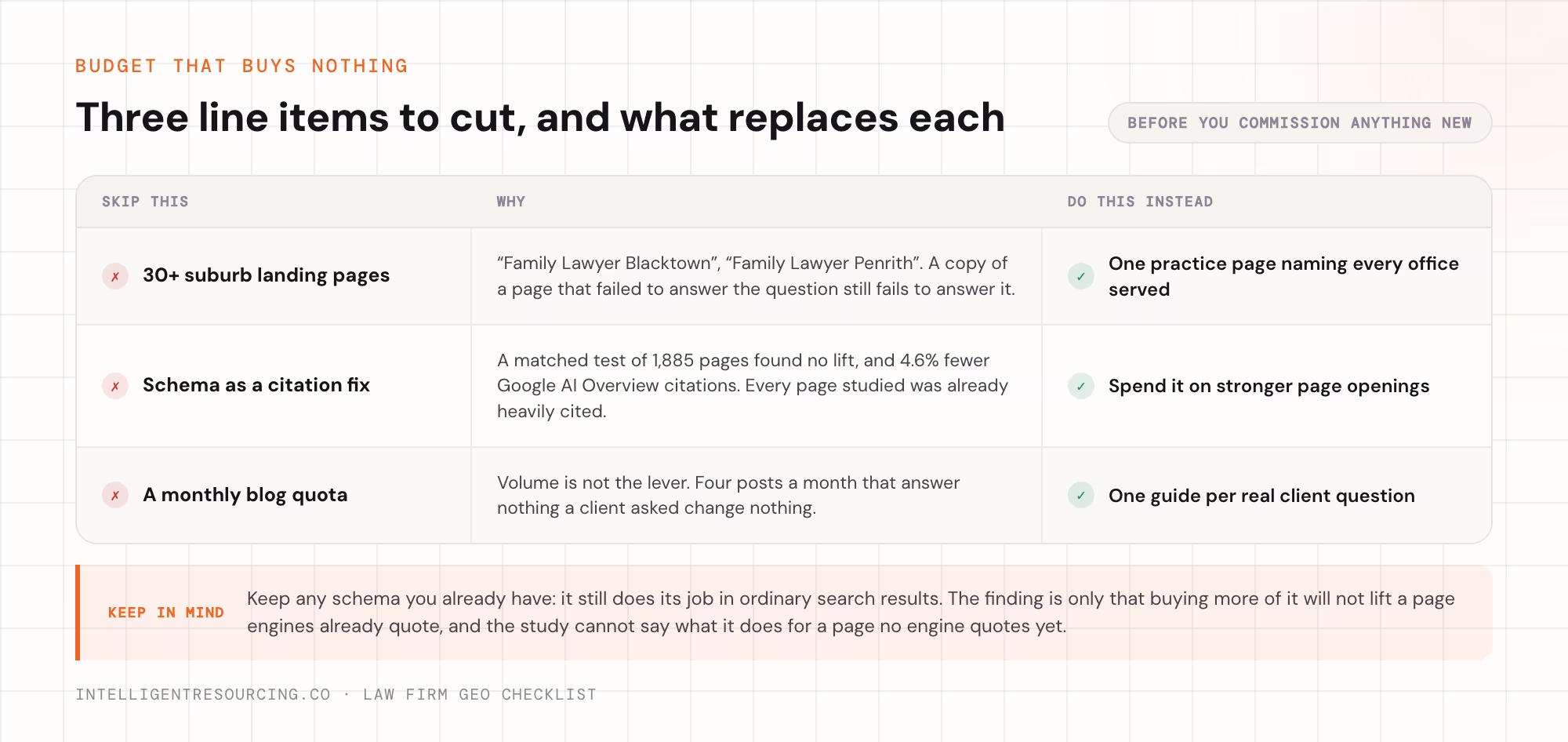
The law firm version is 40 suburban pages with one word swapped: "Family Lawyer Blacktown", "Family Lawyer Penrith". One practice page that lists every office does the same job. A copy of a page that failed to answer the question is still a page that fails to answer the question.
Cutting length is no fix either: a page that skips the question fails at any length.
Schema as a citation fix
Schema markup is hidden code that labels a page for search engines. Ahrefs ran a matched test of 1,885 pages that added this code between August 2025 and March 2026, comparing each against 3 control pages from other domains with similar prior citation levels.
Those pages were not quoted more by AI. In Google AI Overviews they were quoted 4.6% less than the controls, while the differences in ChatGPT and Google AI Mode were too small to separate from zero.
One limit matters for a firm that is currently invisible. Every page in the study already had 100 or more AI Overview citations before any schema was added, so the test shows schema does not lift a page engines already quote. It does not show what schema does for a page no engine quotes yet. Keep existing schema for normal search results, but do not buy it as a way out of invisibility.
| Line item | Why to skip it | Do this instead |
|---|---|---|
| 30+ suburb landing pages | Copies add pages, not answers | 1 practice page naming every office served |
| Schema as a citation fix | A matched test found no lift on pages already quoted | Spend the money on stronger page openings |
| A monthly blog quota | Volume is not the lever | 1 guide per real client question |
Content built for precision over volume is the alternative to a page quota.
Which Client Prompts Should a Law Firm Test Each Month?
A law firm should test 10 to 20 prompts that match real client questions, split by practice area and location. Each prompt needs several runs.
SparkToro, working with tracking firm Gumshoe.ai, had 600 volunteers run 12 prompts 2,961 times across ChatGPT, Claude and Google AI Overviews. It put the odds of getting the same list of brands twice at under 1 in 100, and the odds of the same list in the same order at about 1 in 1,000. One run proves little.
The same study concluded that how often a brand appears, measured across many prompts run repeatedly, is a reasonable metric, while a claimed ranking position inside an AI answer is not. So record whether the firm shows up and ignore its position.
| Check | How to test it | Pass when |
|---|---|---|
| Prompt list | Write prompts in the words clients use | Each practice area has 2 or more prompts, with and without a suburb |
| Repeat runs | Run each prompt 5 times in ChatGPT, Perplexity and Google AI Mode | You know how often the firm appeared for each prompt |
| What got cited instead | Note the source each answer cites | Each directory, competitor or government page is logged |
| Dated log | Date every run | Prompts are re-run monthly and after each fix |
Whoever is cited instead shows which check to revisit:
| Cited instead of the firm | Check to revisit |
|---|---|
| A legal directory | Your directory profiles and lawyer listings |
| A competitor's practice page | Your own practice page openings |
| No firm at all | Room for a well-built page to answer it |
Content Creation
Intelligent Resourcing tests access, practice pages, lawyer profiles and client prompts on your existing pages, and names the fixes to skip before anything new is written.
FAQs
Does a law firm need new content to appear in AI answers?
Not at first. A firm with a page for each practice area should fix crawler access, page openings and lawyer profiles first. New pages copy the old faults. New content comes first only for an offered practice area with no page.
Can a solicitor call themselves a specialist on a page written for AI search?
Only if they hold the accreditation. Rule 36.2 of the Australian Solicitors' Conduct Rules limits "accredited specialist", and the post-nominals that go with it, to solicitors accredited by the relevant professional body. Queensland Law Society guidance notes the Legal Services Commission's view that the bare word "specialist" is likely caught by the same rule, so treat it as reserved.
Should a law firm block AI crawlers to protect client information?
Client information should never sit on public pages, so blocking crawlers protects nothing there. OpenAI and Anthropic each run one bot for search and one for training. A firm can block the training bots and let the search bots read its practice pages and profiles.
Does schema markup help a law firm get cited by ChatGPT?
Not on pages engines already quote. In an Ahrefs study, 1,885 pages added schema and were compared with matched controls. They were not quoted more in ChatGPT or Google AI Mode, and were quoted 4.6% less in Google AI Overviews. Every page studied was already heavily cited, so the test says nothing about a page no engine quotes yet. Keep any schema you have for search results, but do not buy it as an AI fix.
How often should a law firm re-run its AI prompt tests?
Once a month, and again after each fix goes live. The same prompt gives different answers each run. Date every entry and compare how often the firm appears month to month.