

What Searchmaxxed Actually Sells
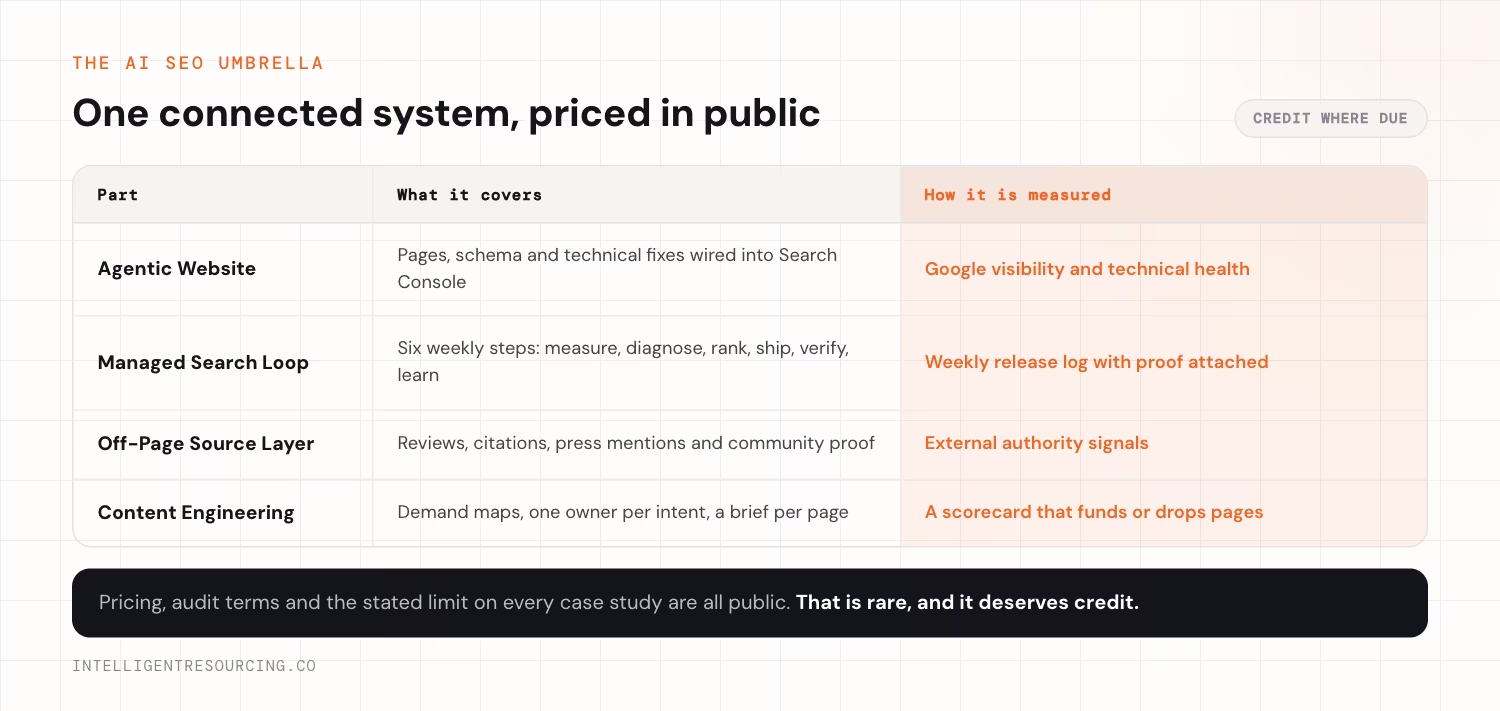
Searchmaxxed positions AI SEO as the umbrella term, covering Google rankings and AI-generated recommendations in one system. It runs on three connected parts: an Agentic Website (pages, schema and technical fixes wired into Search Console and analytics), a Managed Search Loop (six steps run weekly: measure, diagnose, rank, ship, verify, learn), and an Off-Page Source Layer (reviews, citations, press mentions and community proof). Content engineering is the piece closest to GEO: demand maps, one owner per search intent, a brief for every page, and a scorecard that funds or drops pages on results.
An AI SEO audit sits ahead of all three: a fixed-fee, six-business-day check covering Google and AI-engine visibility, technical health and a ranked fix list, with the fee returned in full if the client signs within 14 days. The company behind it is a named Australian entity with a named founder, and it states plainly that it does not claim offices, rankings or client proof it cannot back up.
That last claim needs one qualification a buyer should know about. Searchmaxxed also ranks itself first across a network of "best agency" comparison sites that carry disclosure text identifying Searchmaxxed as their owner. We set that out in full in our roundup of Impressive Digital alternatives. The published pricing is genuinely transparent. The #1 rankings are self-published, and should be read as marketing rather than third-party validation.
Page volume is worth weighing carefully as a headline number. An AI engine picks the passage that best answers a question. It does not count how many pages a site has published. A high release count measures output, not citation.
What Its Published Evidence Actually Shows
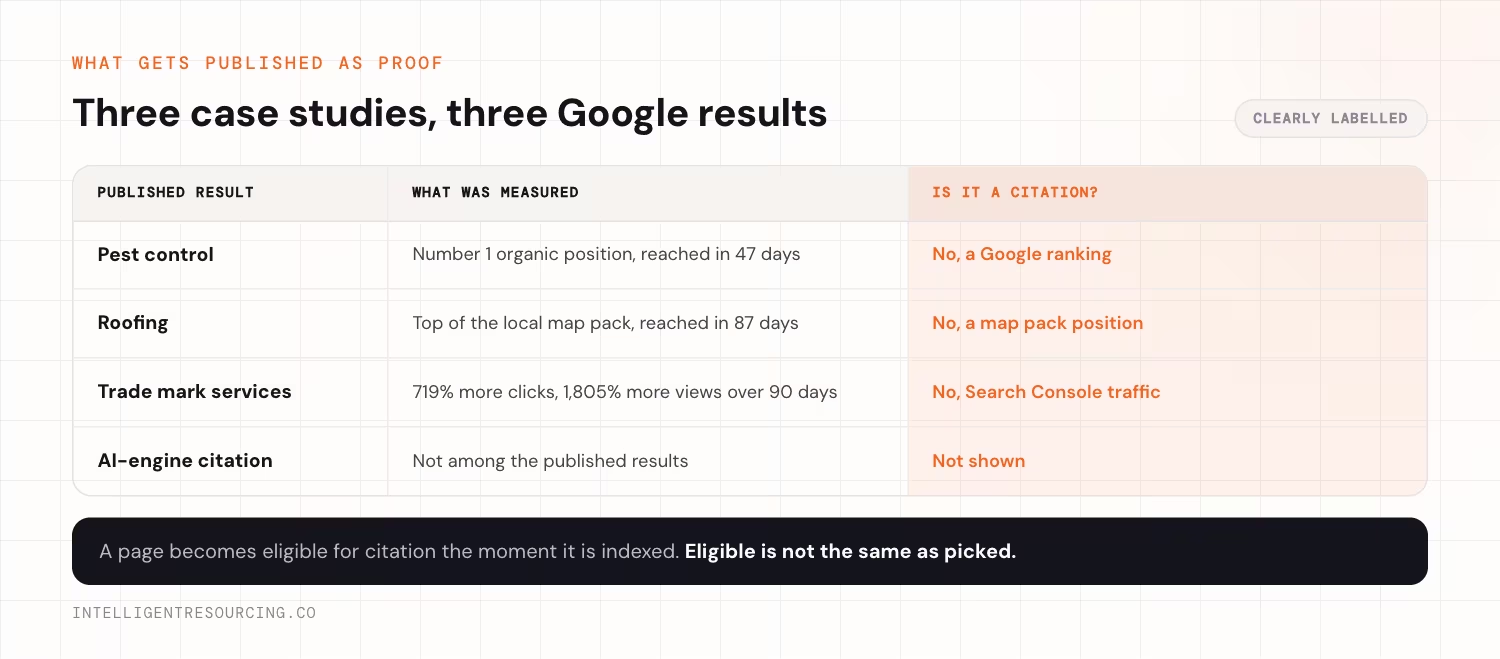
Searchmaxxed's case studies page states the industry, the checked result, the timeframe, the evidence type and the limit for every result it publishes. That is a genuinely higher bar than most agencies clear, and it is the reason a buyer can assess the evidence at all.
Look at what the 3 published results measure:
- A pest-control page reached number 1 organic in 47 days.
- A roofing company reached the top of the local map pack in 87 days.
- An Australian trade mark services site saw 719% more clicks and 1,805% more views over a matched 90-day window.
All 3 are Google wins. None shows a citation or mention inside an AI engine. Both timed results, 47 days and 87 days, are ranking wins rather than citation wins, which matters for how a buyer reads any speed claim in this field. A page becomes eligible for citation the moment it is indexed. Eligible is not the same as picked.
What Intelligent Resourcing Publishes Instead
Intelligent Resourcing runs generative engine optimisation as a dedicated service rather than a broad AI SEO umbrella. It is built around one question: which engines name and cite a brand, and when. The tracker covers ChatGPT, Gemini, Google's AI Overview and Copilot, dates every result to its tracking period, and reports a named-against-cited split rather than a general visibility score.
The published Kynection engagement is the worked example: 393 buyer prompts across 8,891 AI runs, producing 22.88% AI Share of Voice and first position in its category as of August 2026, against a next competitor at 6.31%.
That is a different kind of claim from a ranking result. It is the logic behind citation velocity: a single win proves a page can be found once. A dated series proves whether it stays found.
Both providers track four engines, and three of them are the same. Searchmaxxed's stated AI answer tracking covers ChatGPT, Gemini, Perplexity and AI Overviews, with Claude listed among the systems on its pricing pages. Intelligent Resourcing tracks Copilot where Searchmaxxed tracks Perplexity. One engine apart is not the thing to choose on.
Why the Evidence Type Matters More Than the Engine Mix
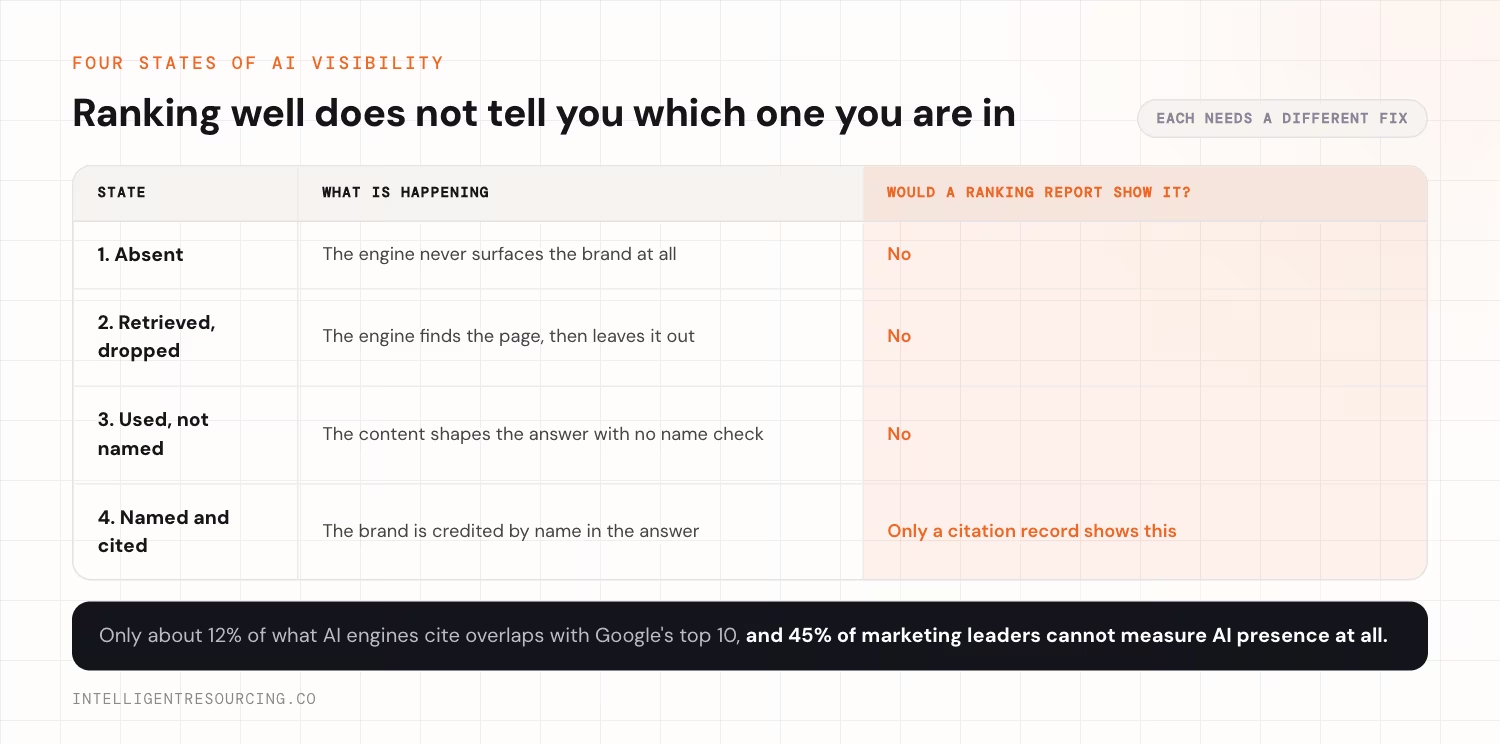
AI visibility breaks into at least 4 states:
- Absent from an engine's answers entirely.
- Retrieved by the engine, then dropped from the final answer.
- Used in the answer without a name check.
- Properly cited by name.
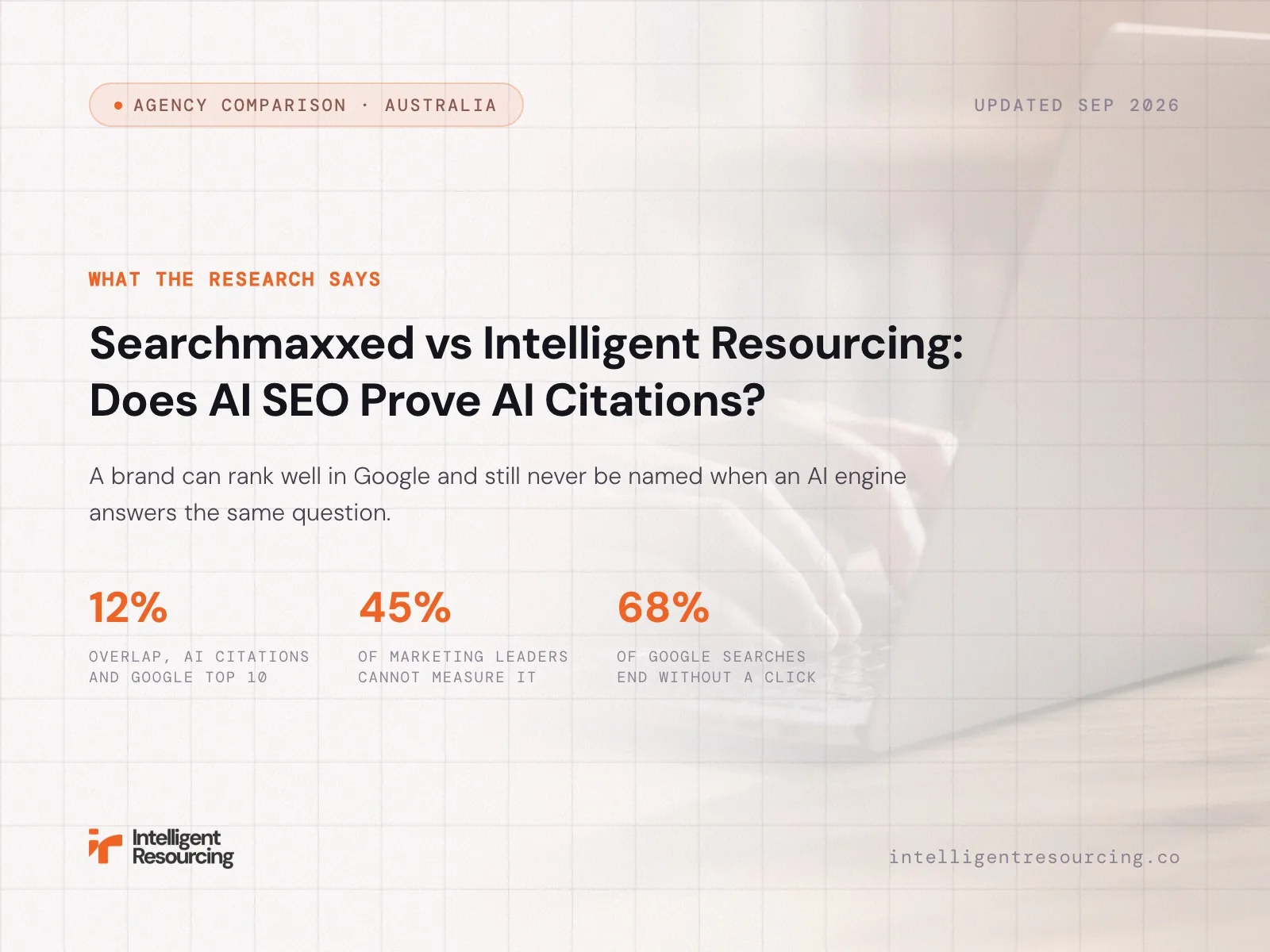
A brand can rank well in Google and still sit in any of the first three. Ahrefs' Brand Radar research, covering 15,000 prompts, found only about 12% overlap between what AI engines cite and what ranks in Google's top 10. SparkToro's analysis puts 68% of Google searches as ending without a click at all, so the ranking itself is describing a shrinking slice of what buyers see.
Most teams cannot see the gap, let alone close it. Semrush's 2026 AI Visibility Index, built on 126 million AI search prompts, found 45% of marketing leaders cannot measure their brand's presence in AI answers at all.
The fix is structural as much as analytical. The original GEO research paper found structured, source-grounded content earns measurably more consistent citations from generative engines than unstructured writing on the same topic. Knowing whether that effect landed still requires measuring it per engine.
Which Model Fits Your Business?
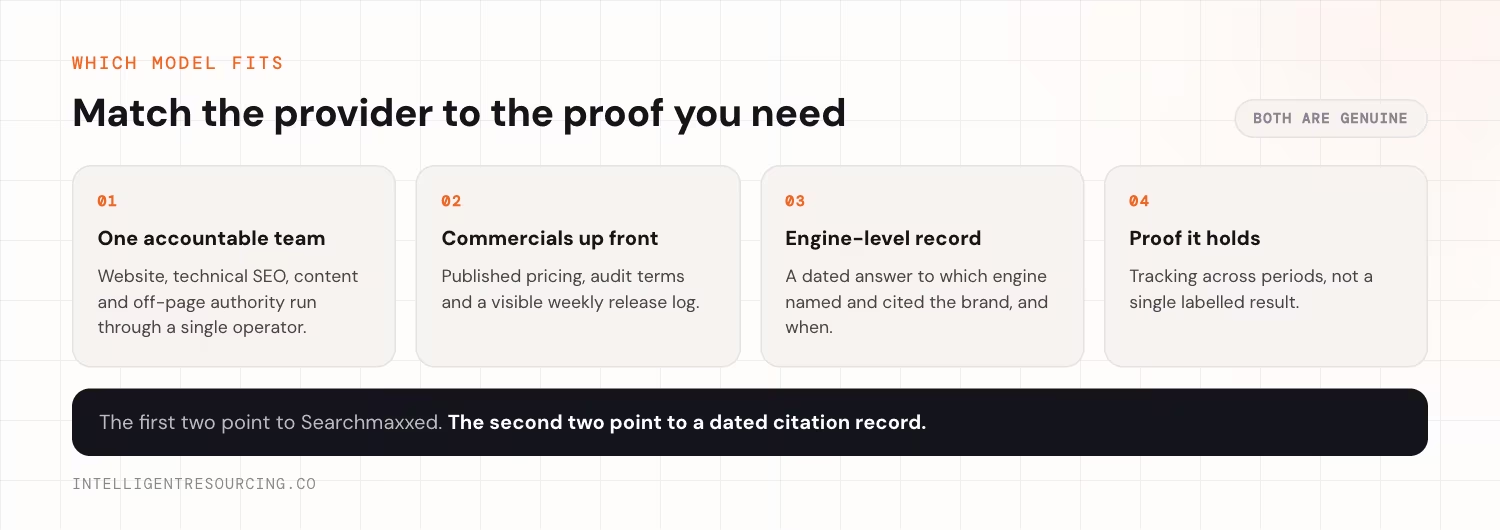
| Buyer need | Better fit |
|---|---|
| One team running the whole website, SEO and content | Searchmaxxed |
| Published pricing and a visible weekly release log | Searchmaxxed |
| A dated, engine-by-engine record of naming and citation | Intelligent Resourcing |
| Proof that visibility holds across tracking periods | Intelligent Resourcing |
A business that wants one open operator handling its technical base, content and off-page authority gets a well-documented system from Searchmaxxed, with commercials stated up front.
A business that needs to know, with dated proof, whether AI engines are naming and citing the brand is asking a question the published Google case studies do not answer. For a wider view of how this field gets judged, see the roundup of Google AI Overviews agencies.
Comparisons
A ranking result proves a page can win in Google. It does not prove the brand gets named when an AI engine answers the same question. Get in touch to see how the tracking reads against your own accounts.
FAQs
Does Searchmaxxed track AI-engine citations?
Its own pages state AI answer tracking across ChatGPT, Gemini, Perplexity and AI Overviews as part of its packages, with Claude listed among the systems on its pricing pages. Its published case studies do not yet include a result that shows a citation inside any of those engines.
Are Searchmaxxed's case studies checked and verified?
More openly than most. Each one states the evidence type and a clear limit. But all 3 published results measure Google organic rank, map pack position, or Search Console clicks and views, not AI-engine citation results.
How does Intelligent Resourcing's GEO service differ from Searchmaxxed's AI SEO?
Searchmaxxed's AI SEO is a broad system covering technical SEO, content and authority work, with AI tracking as one stated part. Intelligent Resourcing's GEO service is a dedicated citation tracker, reporting a named-against-cited split by engine and by date.
Which AI engines does each service track?
Searchmaxxed's AI answer tracking names ChatGPT, Gemini, Perplexity and AI Overviews. Intelligent Resourcing tracks ChatGPT, Gemini, Google's AI Overview and Copilot. Three of the four are the same, and Copilot stands where Perplexity does.
Should I treat Searchmaxxed's number 1 rankings as independent proof?
No. Those rankings appear on comparison sites that disclose Searchmaxxed as their owner, which makes them self-published marketing rather than third-party validation. Its published pricing and case study limits are a separate matter, and genuinely transparent.
Is Searchmaxxed a good fit for a business that only wants AI-citation proof?
It can fold AI tracking into a broader SEO and content plan. But its published evidence still centres on Google wins, so a buyer whose only requirement is dated citation proof should ask to see that evidence before committing.