
What Are Common Questions About Lead Generation in Australia?
Australian B2B buyers ask about cost, pricing models, agency selection, privacy law, timing and measurement, usually in that order. They also ask these questions one at a time, and increasingly in an artificial intelligence (AI) chatbot. G2's 2026 AI Search Insight Report, a March 2026 survey of 1,076 B2B decision makers, found 51% of B2B software buyers start their research with an AI chatbot more often than Google.
This page answers all 20 questions in 4 groups:
- Cost and pricing: what lead generation costs, which pricing models exist, average cost per lead, pay-per-lead against a retainer, and in-house against outsourced.
- Choosing an agency: how to choose, what to ask before signing, agency against GTM Engineering studio, and what counts as a qualified lead.
- Compliance: Australian privacy law, small business coverage, Spam Act against Privacy Act, and consent for marketing emails.
- Results and measurement: time to results, lead volume, common challenges, buying committees, lead generation against demand generation, and return on investment (ROI).
Each answer opens with the short version. Where a full guide exists, the answer links to it.
Cost and Pricing Questions
How Much Does B2B Lead Generation Cost in Australia?
In Intelligent Resourcing's 2026 pricing review, B2B lead generation in Australia typically cost $2,500 to $19,000 or more per month. The figure depends on whether a business is paying for outreach activity or for a system that produces qualified pipeline. On its own, the price tells a buyer less than the model behind it.
| What's on offer | Typical monthly cost |
|---|---|
| Basic outreach, little targeting | $2,500 to $5,000 |
| A mid-tier programme with follow-up built in | $6,000 to $10,000 |
| A programme built for a harder audience or a bigger deal | $11,000 to $19,000+ |
| Pay-per-appointment, Australian market | $400 to $900 per meeting, commonly quoted (few providers publish a price) |
A low number usually buys volume, not qualification. A higher one, paid for the right reasons, buys signal capture, qualification gates and a clean customer relationship management (CRM) handoff.
3 things move the price up or down:
- Ideal customer profile (ICP) difficulty. A niche, regulated audience costs more to research than a broad commercial one.
- Deliverability management. Someone has to own inbox and domain health, or messages stop landing.
- CRM compatibility. Clean handoff rules cost less than paying twice, once for the lead and again for cleanup.

B2B Lead Generation Agency Pricing breaks the full range down by tier, including what each tier should and should not include.
Which Pricing Models Do Lead Generation Agencies Use?
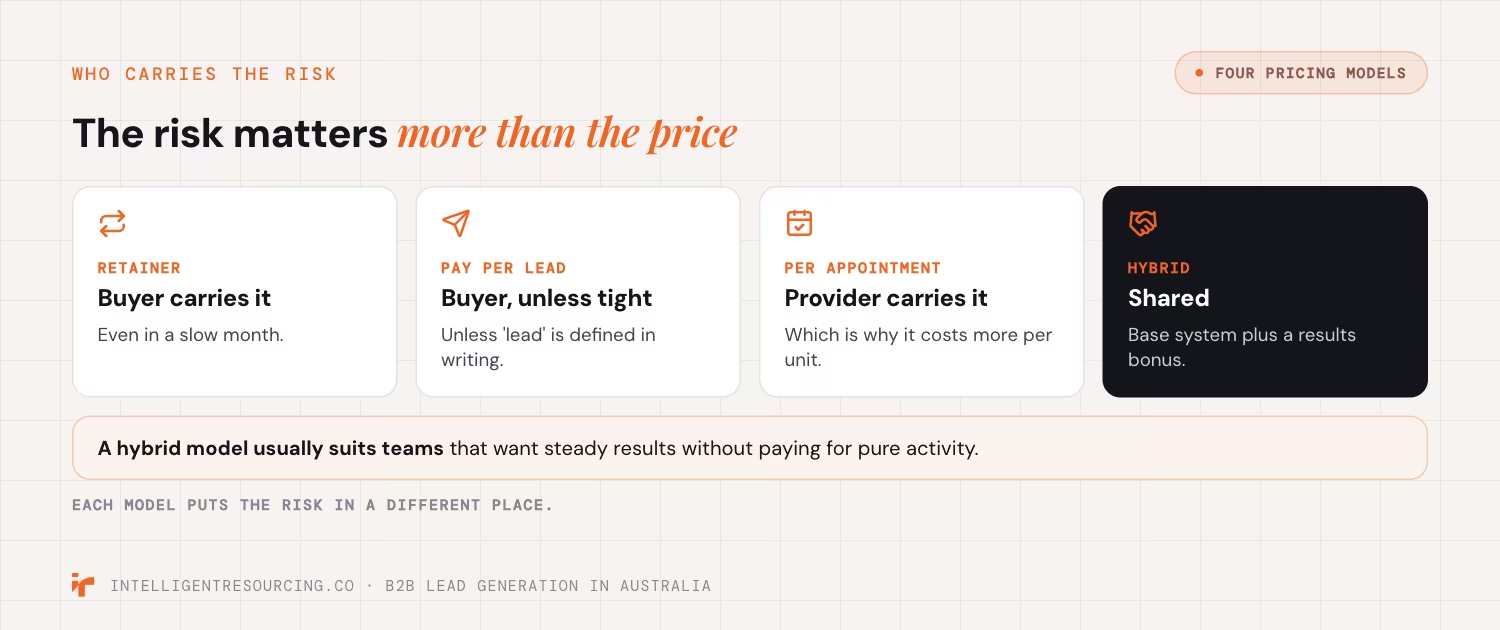
4 pricing models cover most B2B lead generation in Australia: monthly retainer, pay-per-lead, pay-per-appointment, and a hybrid of a base fee plus a performance bonus. Each one puts the risk in a different place, and that matters more than the headline price.
| Model | What you're paying for | Who carries the risk |
|---|---|---|
| Monthly retainer | Ongoing capacity and optimisation | Buyer, even in a slow month |
| Pay-per-lead | Each contact meeting agreed criteria | Buyer, unless "lead" is defined tightly |
| Pay-per-appointment | A booked, qualified meeting | Provider, which is why it costs more per unit |
| Hybrid (retainer + performance) | A base system plus a results bonus | Shared between both parties |
A hybrid model usually works best for teams that want steady results without paying for pure activity.
What Is the Average Cost per Lead in Australia?
Channel-level cost per lead in Australia runs from $5 on an owned email list to $165 for paid LinkedIn, according to CM Beyer's Australian Marketing Benchmarks 2026 report, which draws on client engagements, public platform data and its own research from Q4 2025 to Q1 2026. A single average hides that spread, and cost per lead says nothing about whether the lead was qualified.
A cheap lead that never becomes a meeting costs more than an expensive one that does. B2B Cost Per Lead in Australia converts any of these figures into cost per qualified opportunity, the number that matters.
Is Pay-per-Lead Cheaper Than a Retainer?
Pay-per-lead looks cheaper up front, but it often costs more in practice because it rewards delivery over conversion. The provider is paid when a contact arrives, so a loose definition of "lead" shifts the cost of every bad-fit contact onto the buyer's sales team.
It can work when 3 conditions hold: "lead" is defined in writing, each lead is checked against that definition, and rejected leads are replaced. Without those 3 conditions, a retainer with weekly reporting usually gives a buyer more control.
Should a Company Build Lead Generation In-House or Outsource It?
A company should build in-house when it already has RevOps capacity, a stable ICP and the budget to hire and manage people. It should outsource when it needs a working system faster than a hire can ramp, or when it lacks the tools and data skills to run one.
The comparison point is the cost of a hire. Median on-target earnings for a sales development representative (SDR) sit at $80,000, before overhead, tools or management, according to The Bridge Group's 2025 SDR research, a study of 351 B2B companies, 78% of them North America-based. Convert the figure before comparing it with Australian pay.
Choosing a Lead Generation Agency
How Do I Choose a Lead Generation Agency in Australia?
Choosing a lead generation agency in Australia means checking its signal capability, how deep its CRM integration goes, and whether it can prove outcomes, not just activity. Trust has become the decisive variable in B2B buying, according to LinkedIn and Ipsos's The Trust Advantage, a survey of over 900 B2B buyers across 7 markets.
Our full agency scorecard covers 4 areas: signals and data, systems and integration, operating model, and risk and compliance. The short version is a walk-away list.
3 missing items should end a conversation on the spot:
- No written definition of "qualified," so a buyer cannot check a lead against anything.
- No rejection policy for bad-fit leads or meetings, so the buyer alone pays for every miss.
- No answer for what happens when the approach works correctly and the account still is not ready to buy.
What Questions Should a Buyer Ask an Agency Before Signing?
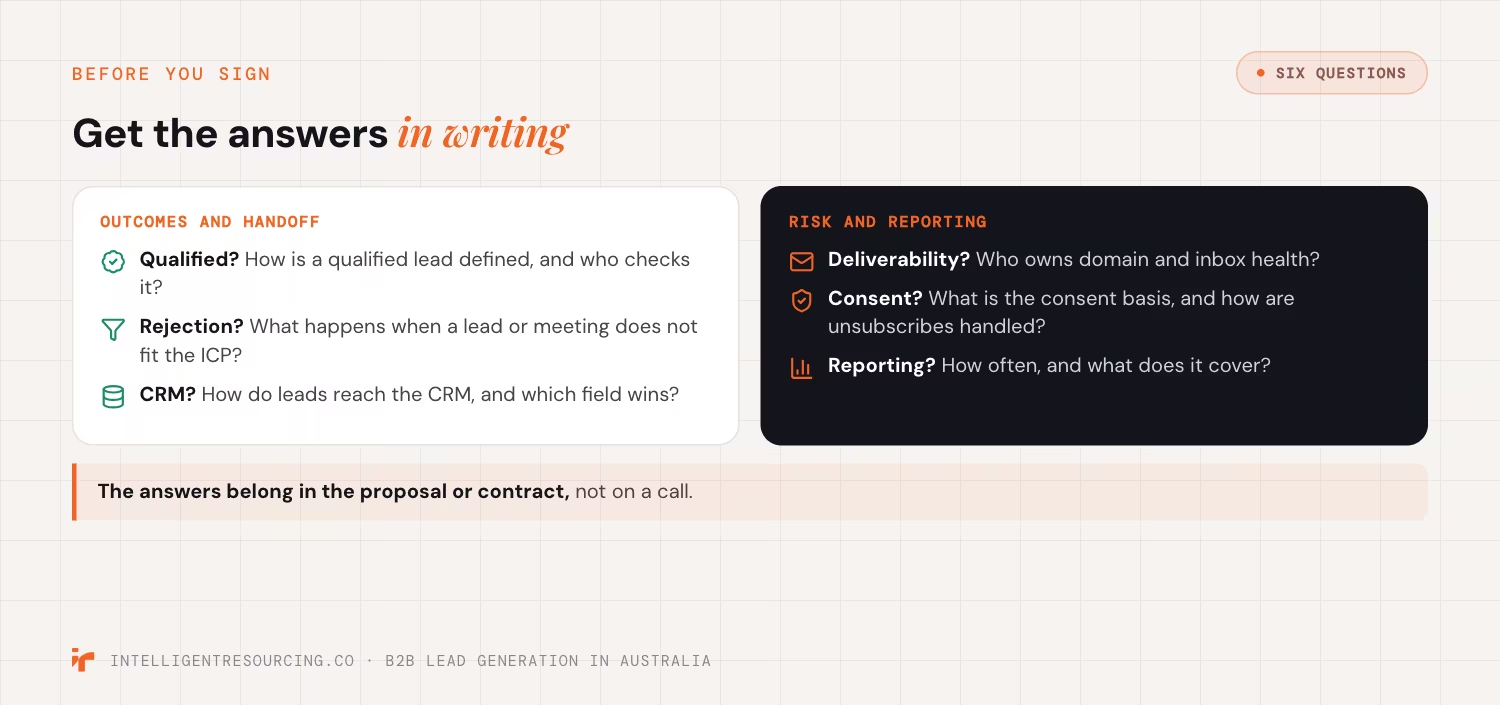
A buyer should ask 6 questions before signing a lead generation agreement, and each one tests a different risk. The answers should be in writing, in the proposal or the contract, not given on a call.
- How do you define a qualified lead, and who checks it? This tests whether outcomes can be verified.
- What happens when a lead or meeting does not fit the ICP? This tests the rejection and replacement policy.
- Who owns deliverability? Domain and inbox health decide whether messages land.
- How do leads reach our CRM, and which field wins when records conflict? This tests handoff and data ownership.
- What is the consent basis for each contact, and how are unsubscribes handled? This tests Spam Act and Privacy Act compliance.
- How often will we see a report, and what does it cover? Weekly reporting on sourced pipeline is the standard to ask for.
What Is the Difference Between a Lead Generation Agency and a GTM Engineering Studio?
A traditional lead generation agency sells outreach activity, while a GTM Engineering studio builds and runs the system that produces qualified pipeline. The agency typically delivers lists, sequences and activity reports. The studio builds signal capture, qualification gates, CRM integration and weekly optimisation.
The practical difference shows in reporting. An agency reports emails sent and meetings booked. A studio reports qualified conversations, CRM-ready handoffs and cost per closed-won deal. That is the split behind the GTM Engineering approach Intelligent Resourcing uses, so read this comparison as the view of a studio that sells the second model.
What Counts as a "Qualified" Lead?
A qualified lead is a contact or account that meets criteria both sides agreed in writing before work started. A usable definition has 4 parts: the account fits the ICP, the contact holds a relevant role, there is a timing or buying signal, and the contact details are verified.
The definition matters because it is also the basis for rejection. If a lead fails any of the 4 parts, the buyer should be able to reject it and have it replaced. Intelligent Resourcing replaces leads that do not fit the agreed ICP, and a buyer should ask any provider for the same terms in writing.
Compliance: Spam Act and Privacy Act
What Do Australian Privacy Laws Mean for Lead Generation?
2 separate laws apply to Australian B2B lead generation. The Spam Act 2003 governs commercial messages, like email and short message service (SMS). The Privacy Act 1988 governs the personal information behind those messages, like names and contact details. Most teams only check 1 of the 2.
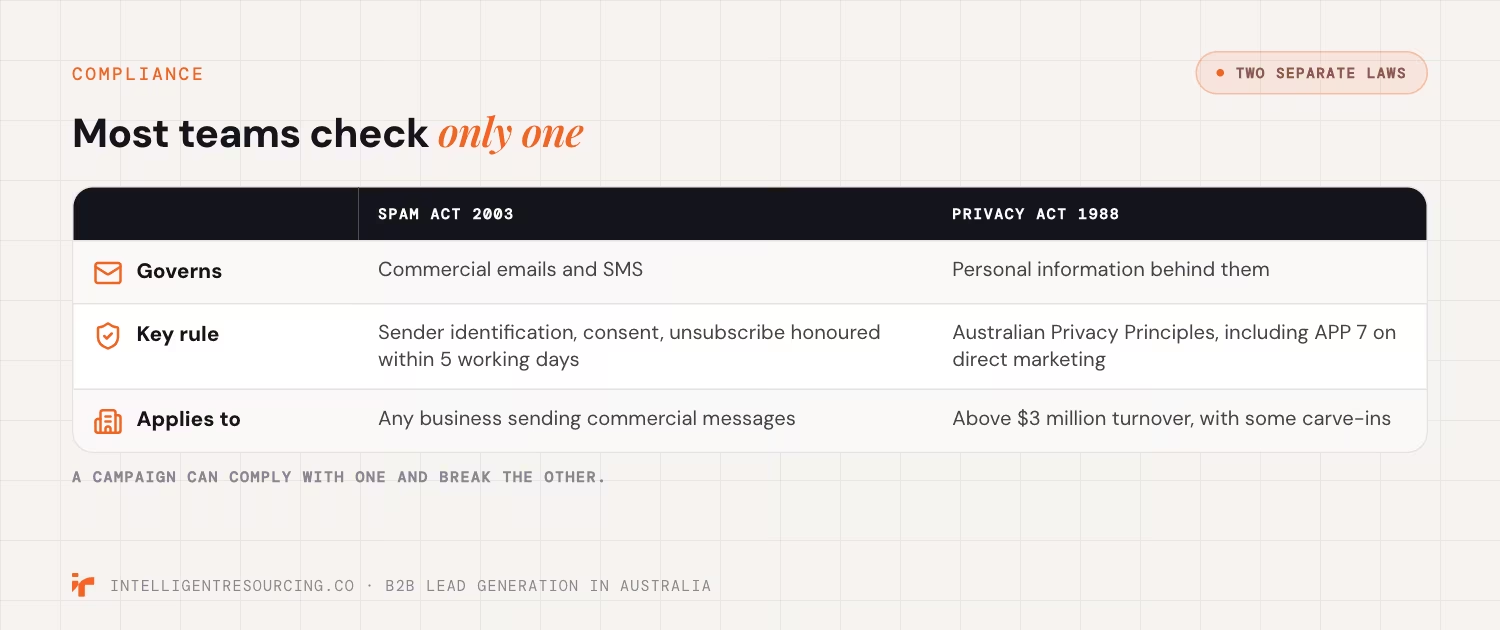
| Spam Act 2003 | Privacy Act 1988 | |
|---|---|---|
| Covers | Commercial emails and SMS | Personal information handling |
| Key rule | Sender identification, consent, unsubscribe honoured within 5 working days | Australian Privacy Principles (APPs), including APP 7 on direct marketing |
| Applies to | Any business sending commercial messages, even when an agency sends them on its behalf (Australian Communications and Media Authority (ACMA), Avoid sending spam) | Businesses above $3 million annual turnover, with some sectors carved back in regardless of size (Office of the Australian Information Commissioner (OAIC), Direct marketing guidance) |
A few details trip teams up:
- Consent can be inferred where the person has knowingly and directly given their address and would reasonably expect marketing from the business, but inferred consent does not stretch to unrelated offers.
- Unsubscribe requests must be honoured within 5 working days, and unsubscribing cannot require extra personal information or a login.
- A business cannot keep messaging someone who has opted out, regardless of which list they came from.
Does Australian Privacy Law Apply to a Small Business?
The Privacy Act generally applies only to businesses with annual turnover above $3 million, so many small businesses fall outside it. Some small businesses are covered regardless of size, including private health service providers and businesses that trade in personal information.
That second exception matters for lead generation. A small business that buys or sells contact lists may be treated as trading in personal information, and the turnover threshold would not protect it. The Spam Act applies to every business that sends commercial messages, whatever its size. Check the OAIC's direct marketing guidance before relying on the small business exemption.
What Is the Difference Between the Spam Act and the Privacy Act?
The Spam Act governs how a commercial message is sent and how a recipient withdraws from it. The Privacy Act governs how the personal information behind that message is collected, used and stored. A campaign can comply with one and break the other.
A compliant email can still draw on a contact list that was collected unlawfully. A well-governed list can still be emailed without consent or an unsubscribe link. Both checks need to pass before a sequence fires, which is why consent basis and data source should be recorded per contact.
Is Consent Required Before Sending Marketing Emails in Australia?
Consent is required before sending a commercial electronic message in Australia, under the Spam Act 2003. The consent can be express, such as a form tick, or inferred where the person has knowingly and directly given their address and would reasonably expect marketing from the business.
Inferred consent has limits: ACMA notes it is less reliable than express consent, and the sender must be able to prove it. The message must identify the sender and carry a working unsubscribe option that is honoured within 5 working days. Record the consent basis for every contact, so a buyer or regulator can see why each message was sent. Confirm the detail against the ACMA guidance.
Results, Timing and Measurement
How Long Does It Take to See Results From B2B Lead Generation?
In Intelligent Resourcing's signal-led onboardings, the first qualified meetings typically land between days 31 and 60. Days 1 to 30 build the system: ICP, signal thresholds and CRM integration. Days 61 to 90 validate whether the numbers work for the sales motion.
A list-led agency can book meetings in the first two weeks, which suits a fast, low-value sale. It also tends to book meetings with the wrong accounts when the sale is complex. No public benchmark gives a median time to first qualified meeting, so ask any agency for its own figures by client. What to Expect in the First 90 Days sets out the three phases.
How Many Leads Should a B2B Company Expect Each Month?
No honest universal number exists, because lead volume depends on the size of the ICP, the deal value and how many buying signals the market produces. A narrow, high-value audience produces fewer leads than a broad one, and that is usually the right trade.
Ask for qualified meetings, not leads. As an illustration, not a forecast, a $5,000 monthly budget spent at the Australian pay-per-appointment range of $400 to $900 per meeting would buy roughly 6 to 12 meetings if that range holds. A retainer is not priced per meeting, so treat that as a sense of scale only.
What Challenges Do Australian B2B Teams Face in Lead Generation?
Slow follow-up and poor qualification cause much of the pipeline loss B2B teams report. A March 2024 RevenueHero test, in which the author submitted demo requests to 1,000 B2B SaaS companies, found 63.5% sent no reply. Among the 36.5% that did, the average first response took 1 day, 5 hours and 17 minutes, with automated replies counted. A fast, well-timed response beats a larger volume of leads.
3 recurring problems sit behind most lead generation complaints:
- Static targeting. An ICP gets defined once and never updated while the market moves.
- Channel silos. Email, LinkedIn and web activity run apart, so timing signals never add up to one picture.
- Activity reporting. Emails sent and meetings booked get reported as success, while pipeline quality quietly drops.
Adding volume does not fix any of these. Tightening the qualification gate and acting on signals the same day they appear does. A signal-based lead generation approach is built around that from the start, not bolted on later.
How Do Buying Committees Change B2B Lead Generation?
Buying committees mean a lead generation programme has to reach several people at one account, not one contact. A May 2026 Belkins study of 1,871 ideal customer profile submissions found the average target buying committee ranges from 4.6 titles for companies under 200 employees to 6.0 for enterprises over 1,000, with 5.6 for mid-market. The figures show the titles buyers plan to target, not closed deals.
That changes 3 things. Targeting works at account level, with several roles mapped per account. Messaging differs by role, because a technical evaluator and a budget holder need different proof. Qualification looks at account readiness, not only one contact's reply.
What Is the Difference Between Lead Generation and Demand Generation?
Lead generation captures named contacts or accounts that may be ready to buy, while demand generation builds awareness and preference across a market so buyers come to the business later. Lead generation is targeted and measured in contacts and meetings. Demand generation is broader and measured in reach, brand search and pipeline over time.
The two work together. Demand generation widens the pool of buyers who recognise the brand, and lead generation turns the buyers who show intent into conversations. A business with strong demand and no lead generation misses ready buyers. A business with lead generation and no demand works a thin audience. For the inbound side, see inbound B2B lead generation.
How Is Lead Generation ROI Measured?
Lead generation ROI is best measured as cost per closed-won conversation, not cost per lead. The formula is program fee plus tool costs plus internal time cost, divided by the closed-won opportunities the programme influenced.
Cost per lead rewards volume, so it can look healthy while pipeline quality drops. Cost per closed-won conversation needs the provider to track which leads become deals, which is why CRM-tracked outcomes matter. If a provider cannot show that link, spend is at risk. How to measure B2B lead generation ROI covers the metrics worth tracking.
Fix the system, not the spend. Our GTM Engineering approach routes verified buying signals into your CRM instead of adding more unqualified volume. See how GTM Engineering works.
Lead Generation
Our GTM Engineering approach routes verified buying signals into your CRM instead of adding more unqualified volume.
FAQs
What are common questions about lead generation in Australia?
Cost, pricing models, agency selection, compliance with the Spam Act and Privacy Act, timing and measurement come up most often, and all 20 are answered above.
How much does B2B lead generation cost in Australia?
In Intelligent Resourcing's 2026 pricing review, monthly retainers typically ran $2,500 to $19,000 or more, and pay-per-appointment offers are commonly quoted at about $400 to $900 per meeting, depending on scope and qualification depth.
How do I choose a lead generation agency in Australia?
Check signal capability, CRM integration depth, a written definition of "qualified," and a rejection policy for bad-fit leads before signing anything.
Does Australian privacy law affect lead generation?
The Privacy Act and Australian Privacy Principles apply once turnover passes $3 million, or earlier for some sectors, and the Spam Act applies to commercial messages regardless of business size.
What's the difference between the Spam Act and the Privacy Act for lead generation?
The Spam Act governs how a commercial message is sent and withdrawn from. The Privacy Act governs how the personal information behind that message is collected, used and stored.