
What Is a Go-To-Market Strategy?
A go-to-market strategy is the commercial plan a business uses to win customers and grow revenue. It names who you serve, which problems you solve, how you differ from the alternatives, how buyers find you and how a purchase turns into revenue. A general marketing plan covers less. GTM covers the whole path from first contact to a kept customer, including positioning, pricing, sales roles, onboarding and the systems that link them.
Why Do Separate Team Plans Fail?
Many B2B teams plan around separate targets. Marketing makes leads, sales books meetings, customer success handles retention and revenue operations keeps the CRM. Each team can hit its target while pipeline quality stays weak. The cause is disconnected work.
Buyers also deal with many people and touchpoints. Demandbase's 2025 State of the B2B Buyer report found that 72% of B2B purchases involve multi-stakeholder complex buying groups. Your website, outreach, content and calls must tell 1 story.
So treat GTM as a connected revenue system, such as signal-led lead generation, that adapts as buyer needs and market signals change.
How Do I Build a Go-To-Market Strategy for a B2B Company?
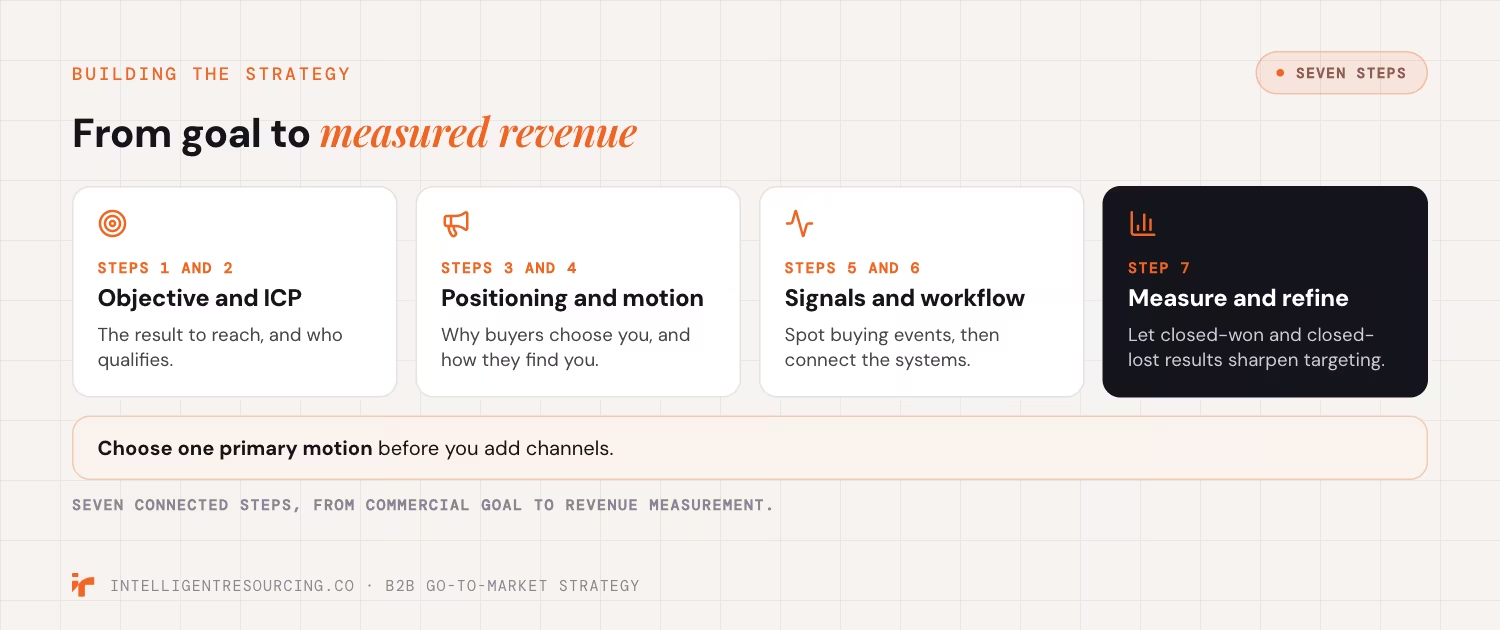
Build it in 7 connected steps, from the commercial goal to revenue measurement.
Step 1: Define Your Commercial Objective
Start with the result the strategy must reach. A newly funded software company often needs steady sales in 1 customer segment. An established services firm often needs a new vertical or more revenue from existing accounts. Set the target, the timeframe and the limits before you pick any activity.
Step 2: Identify Your Ideal Customer Profile
Study your best customers for shared traits: industry, size, region, technology needs, buying complexity, contract value and retention. Also note customers who cost too much to win, are hard to support or rarely renew. Your ideal customer profile (ICP) should say who qualifies and who does not.
Step 3: Develop Positioning and Messaging
Define the problem, the alternatives and the business result you deliver. Avoid positioning built only on features. A workflow tool that calls itself "AI-powered business automation" says little. A stronger position names the bottleneck it fixes and why its approach beats existing software or manual work.
B2B positioning specialist April Dunford describes positioning as defining how your product is the best in the world at delivering value that a well-defined set of customers care a lot about. Strong positioning feeds sales calls, website copy and campaign messages.
Step 4: Choose Your Primary Acquisition Motion
Pick the channels and sales approach that match how buyers research and buy. A complex enterprise service needs direct sales, referrals and an account-based approach. A software product with a low-friction trial can add product-led acquisition beside marketing. Choose 1 primary motion before you add channels.
Step 5: Identify Buying Signals
Buying signals are events or behaviours that show an organisation is nearing a purchase decision. Examples include funding news, hiring, expansion plans, technology moves and engagement with high-intent content. A signal is no proof of intent, so check it against the account's fit, timing and context.
Step 6: Build the Revenue Workflow
Connect targeting, data enrichment, CRM updates, lead qualification and sales handovers. Define who receives an account, why it qualifies and what happens after a reply. The process should run without 1 salesperson's private spreadsheet. Disconnected systems slow this step: Salesforce's 2026 State of Sales research found that 51% of sales leaders using artificial intelligence (AI) say disconnected systems slow their AI work.
Step 7: Measure, Learn and Refine
Review accepted opportunities, pipeline created, conversion rates, customer acquisition cost and deal progress. Use closed-won and closed-lost results to improve targeting and signal scoring. The strategy gets stronger when real customer behaviour changes the next decision.
What Should a B2B GTM Strategy Include?
| GTM component | Question it answers | Output |
|---|---|---|
| Market and ICP | Who should we target? | Ranked segments and exclusions. |
| Positioning | Why should buyers choose us? | Value statement and messages. |
| Offer and pricing | What do we sell, and at what value? | Packages and a commercial model. |
| Acquisition | How will buyers find us? | Channels and sales motion. |
| Fit checks | When is an account worth pursuing? | Fit, intent and timing rules. |
| Revenue operations | How does work move between teams? | CRM, routing and handover rules. |
| Measurement | What proves it works? | Pipeline and revenue dashboard. |
These parts work together. Pricing decides which customers can pay, which shapes the ICP, which sets the channels, messages and qualification rules. A strategy becomes hard to scale when each decision is made alone.
Which Metrics Matter?
Measure at 3 levels. Activity metrics track outreach, content output and campaign engagement. Pipeline metrics track accepted meetings, qualified opportunities, conversion rates and cycle progress. Revenue metrics track customer acquisition cost, contract value, retention and revenue growth.
More meetings look good, and they prove nothing if few become qualified opportunities.
How Do I Choose Target Segments?
Rank segments by customer fit, commercial value and evidence of demand. A huge market is not always the best first target. A narrow industry with a clear problem and an established buying process often gives a more repeatable route to revenue.
Imagine an Australian software company that serves logistics firms:
| Segment | Product fit | Sales complexity | Starting approach |
|---|---|---|---|
| Small operators | Moderate | Low | Self-service or marketing-led. |
| Mid-sized fleets | Strong | Moderate | Sales-assisted. |
| Enterprise networks | Strong | High | Account-based sales. |
Illustrative example and no real client data.
The team picks mid-sized fleets if their problems match the product, setup is manageable and past customers renew. That choice then shapes messages, content, outreach and sales capacity.
Position against alternatives and not only rivals. A buyer's alternative can be another provider, an internal team, existing software or doing nothing. "We improve efficiency" says less than a clear statement of the workflow, cost or risk you remove.
Why Do B2B GTM Strategies Fail?
Strategies fail when targeting, delivery and measurement come apart. Warning signs include more outreach with no growth in qualified pipeline, different customer definitions across teams and CRM records that cannot show where deals began. Scaling weak work makes it worse: if you do not know which accounts qualify, more automation repeats the same targeting errors faster.
Fix the earliest confirmed failure first. If the ICP is unclear, refine targeting before you change channels. If qualified accounts are found and never contacted, check enrichment and routing.
If meetings rise and opportunities do not, review fit rules and handovers. If opportunities appear and revenue stalls, look at sales execution, pricing, product fit and retention.
What Does a Signal-Led GTM Framework Look Like in Practice?
A signal-led framework links account selection to action in 5 stages.

| Stage | What happens | Purpose |
|---|---|---|
| 1. Target | Match companies to the ICP | Exclude poor-fit accounts. |
| 2. Detect | Find relevant buying signals | Spot likely timing. |
| 3. Qualify | Check fit, context and contacts | Rank credible opportunities. |
| 4. Activate | Route accounts into sales or marketing action | Coordinate engagement. |
| 5. Learn | Record outcomes in the CRM | Improve later targeting. |
Intelligent Resourcing applies this through its Signal Engine, which screens about 50,000 Australian news items a day and distils them to about 50 usable signals.
It tracks about 115,000 Australian companies and surfaces roughly 50 net-new accounts a month, each checked against the client CRM. These are operational figures from Intelligent Resourcing's own system, and they are no audited conversion rate.
From Buying Signal to Sales Action
Take an industrial software supplier that targets Australian logistics operators. A fleet expansion announcement is detected. The team checks the account against the ICP and its CRM record, then tests whether the expansion creates a problem the software solves.
If fit and timing hold up, a salesperson receives the account with context and a next step. If the account fits and timing is unclear, it joins a nurture programme and gets no immediate sales push. Intelligent Resourcing calls the point where validated signals show buying activity is under way a Verified Buying Window.
Speed matters once a signal fires. In RevenueHero's demo request test of 1,000 B2B websites, 365 sites replied at all, with an average wait of 1 day, 5 hours and 17 minutes. Automated replies were counted, so the figure points to slow response, not poor replies. Automation should help teams decide better and never only send more messages.
Using Australian Market Signals
Use Australian evidence to pick accounts: expansion, local hiring, government procurement, industry investment and technology changes. Check whether each event is a real opening for your product. A company that sells to national enterprises needs coordinated account-based selling. A specialist provider can build demand through industry associations, referrals and regional campaigns.
Intelligent Resourcing wrote this guide and sells this work. It builds and manages signal-led GTM systems that integrate with a client's existing CRM. If your gap is targeting and timing, start with GTM engineering.
What Are the Five Go-To-Market Strategies?
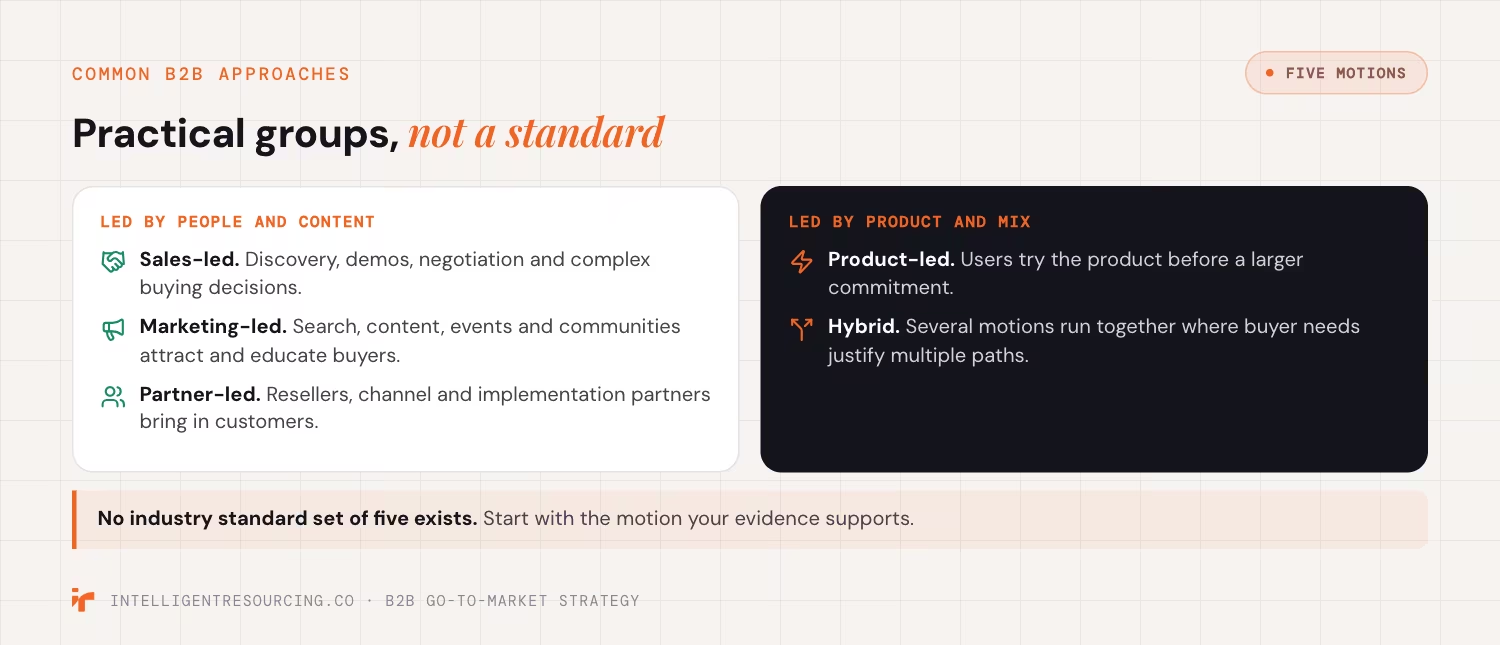
No standard set of 5 exists. As at 29 October 2026, we found none in the sources reviewed. A useful B2B split is sales-led, marketing-led, product-led, partner-led and hybrid.
- Sales-led GTM: Salespeople run discovery, demos, negotiation and complex buying decisions.
- Marketing-led GTM: Search, content, events, communities and campaigns attract and educate buyers.
- Product-led GTM: Users try the product before a larger commitment.
- Partner-led GTM: Resellers, channel partners and implementation partners bring in customers.
- Hybrid GTM: Several motions run together where buyer needs justify multiple paths.
ICONIQ's 2026 State of Go-to-Market report, a survey of 150+ B2B software GTM leaders, calls hybrid the default and says the most successful organisations blend enterprise sales with bottom-up entry points. It also found that high-growth companies source 60 to 80% of pipeline from sales and channel, against 15 to 20% from marketing.
That supports hybrid motions, and it does not mean every firm should launch several channels at once. Start with the motion your evidence supports, then add complexity where the economics justify it. Firms with growth-equity backing can see why systems come before headcount in the growth-stage GTM playbook.
How Should a Funded Company Approach GTM After Raising?
A funded B2B company should treat go-to-market as a staged process: confirm the ICP and revenue target, set up signal detection and qualification, then test whether the process scales. A funding round gives capital to test a strategy. It does not prove that more salespeople or more campaigns will produce lasting revenue.
In the first 90 days, confirm the ICP, positioning and baseline. Then build the workflows for signals, enrichment and routing. Then run campaigns and review cost per qualified meeting and opportunity progress. The plan in three 30-day blocks sits in first 90 days after Series A.
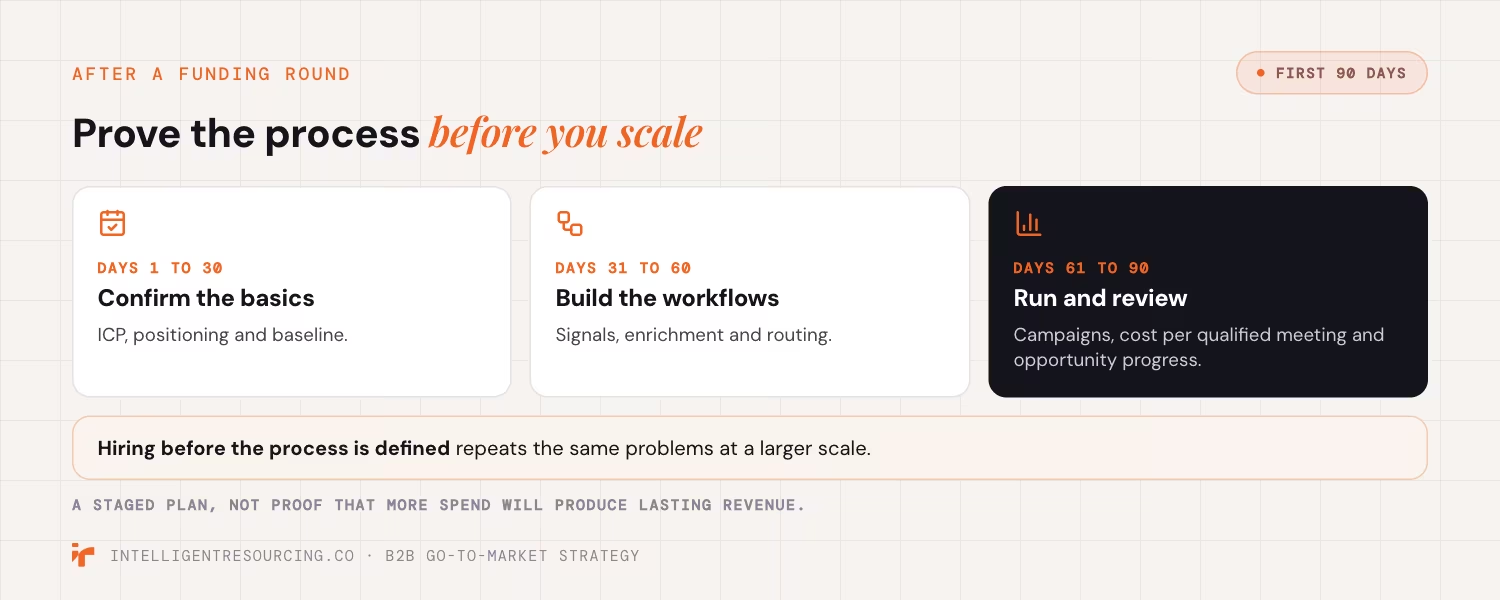
Hiring before the process is defined repeats the same problems at a larger scale. Ramp time averages 3.0 months for a new in-house sales development rep, according to The Bridge Group's 2025 SDR report, where 78% of respondents are based in North America. If you already run a repeatable motion and lack capacity for qualified demand, hiring is the right call. For demand programmes built around funded firms, see demand generation for funded B2B companies.
Lead Generation
If your gap is targeting and timing, signal-led go-to-market engineering ties account selection to action inside your existing CRM.
FAQs
What is a go-to-market strategy?
A go-to-market strategy is the plan a business uses to reach customers, show its value, win new business and grow revenue. It combines segmentation, positioning, pricing, acquisition channels, sales execution and measurement.
What are the five go-to-market strategies?
Common B2B approaches are sales-led, marketing-led, product-led, partner-led and hybrid. These are practical groups and no industry standard. ICONIQ's 2026 survey calls hybrid the default, so match your choice to how buyers research and purchase.
What is an example of a GTM strategy?
An Australian software company targets mid-sized logistics firms, watches for expansion signals, uses sales-assisted outreach and tracks qualified opportunities. It adds segments once conversion rates and acquisition cost support growth.
How do I build a go-to-market strategy for a B2B company?
Set commercial goals and define your ICP. Develop positioning, pick 1 primary motion, identify buying signals and build the workflows that link marketing and sales. Measure opportunities, revenue and retention, then refine.
How should a funded company approach go-to-market after raising?
Validate the target market and operating metrics before you scale. Build a repeatable process for finding, qualifying and engaging accounts, then use real pipeline results to decide where more spend or hiring is justified.