

What should I expect in the first 90 days with a lead generation agency?
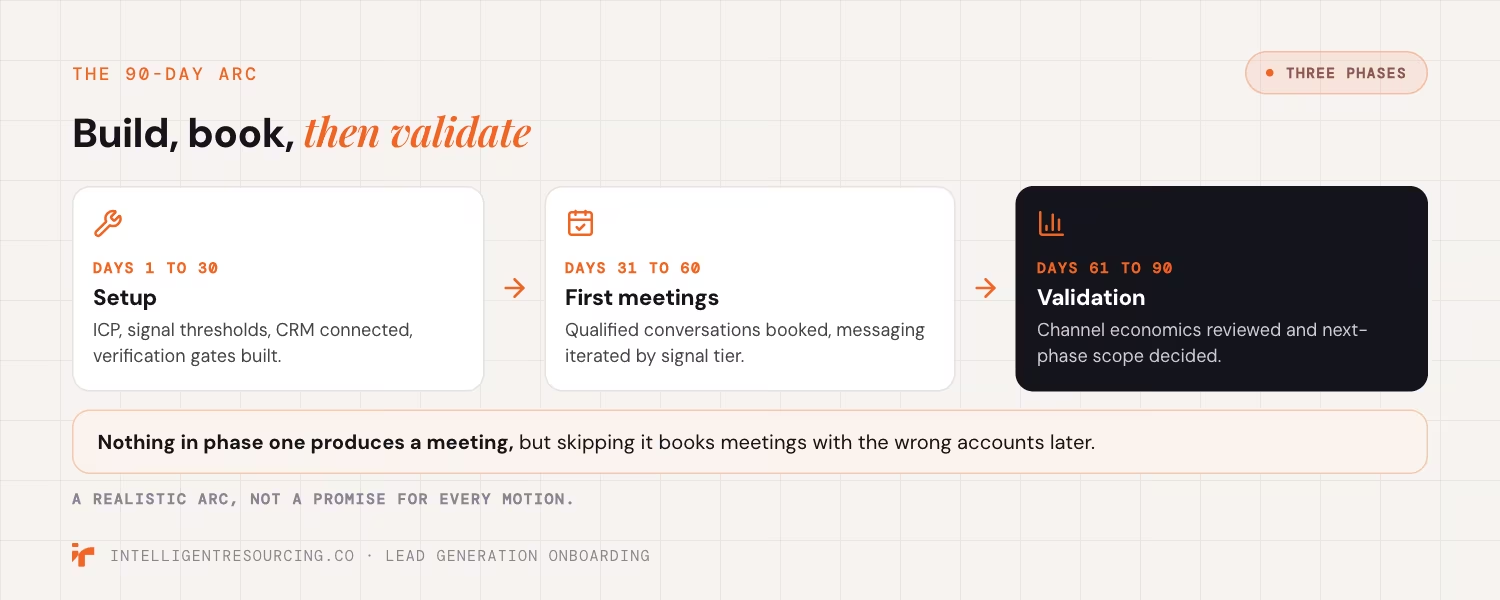
The first 90 days are split into three phases. Setup runs days 1 to 30, first qualified meetings run days 31 to 60, and validation runs days 61 to 90. Each phase has a different job. Expecting phase one to look like phase two is the most common frustration on both sides.
What a realistic 90-day arc looks like
| Phase | Days | What's happening |
|---|---|---|
| Setup | 1 to 30 | Ideal customer profile (ICP) and exclusions locked, signal thresholds defined, CRM connected to enrichment, routing and sequencing, verification gates built |
| First meetings | 31 to 60 | Qualified conversations booked, messaging iterated by signal tier, deliverability and reply quality monitored |
| Validation | 61 to 90 | Channel economics reviewed, cost per qualified meeting checked against the sourced pipeline it produced, next-phase scope decided |
Nothing in phase one produces a meeting, but skipping it books meetings with the wrong accounts later.
OnRamp's 2026 State of Onboarding report surveyed 161 onboarding and customer success leaders and found 57% say onboarding friction directly affects revenue realization.
Haven't chosen an agency yet? See choosing a lead generation agency.
How long before a lead generation agency delivers meetings?
In Intelligent Resourcing's signal-led onboardings, the first qualified meetings typically land between days 31 and 60, not in the first two weeks. LinkedIn and Bain's 2026 buyability research shows B2B deals are decided by a committee of target and hidden buyers, not one person replying to an email.
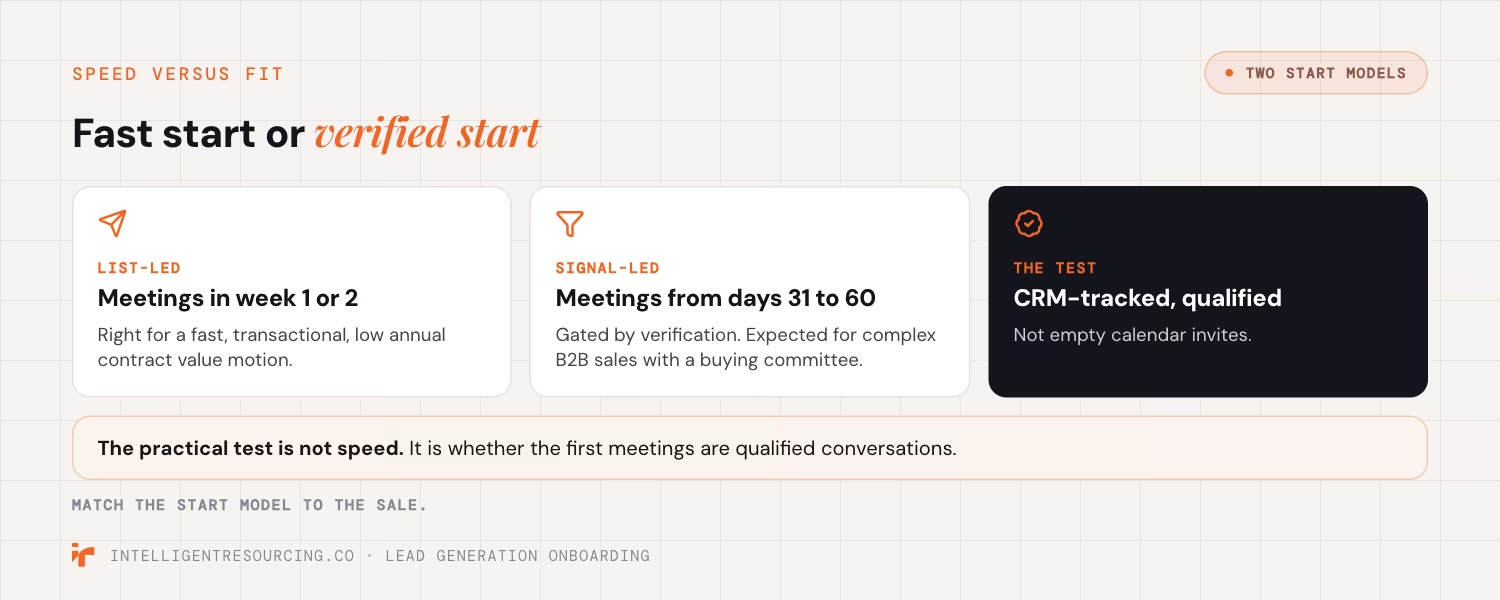
| Timing | What it usually means |
|---|---|
| Meetings booked in week 1 or 2 | Likely list-led, not signal-verified. Right for a fast, transactional, low annual contract value (ACV) motion |
| Meetings booked days 31 to 60 | Signal-led, gated by verification. Expected for complex B2B sales with a buying committee |
No public benchmark gives a median days-to-first-qualified-meeting for B2B outbound agencies, so ask any agency to show its own time-to-first-meeting by client, not an industry average.
The practical test is not speed. It is whether the first meetings are CRM-tracked qualified conversations, not empty calendar invites.
Not sure where your own motion fits on this timeline?
Book a 90-day signal audit before you sign →
What does lead generation agency onboarding look like?
A signal-led agency does infrastructure work first, outreach second. That means locking the ideal customer profile, defining what counts as a buying signal, and connecting the CRM so every later step works from accurate data. A generic agency skips straight to sequence templates.
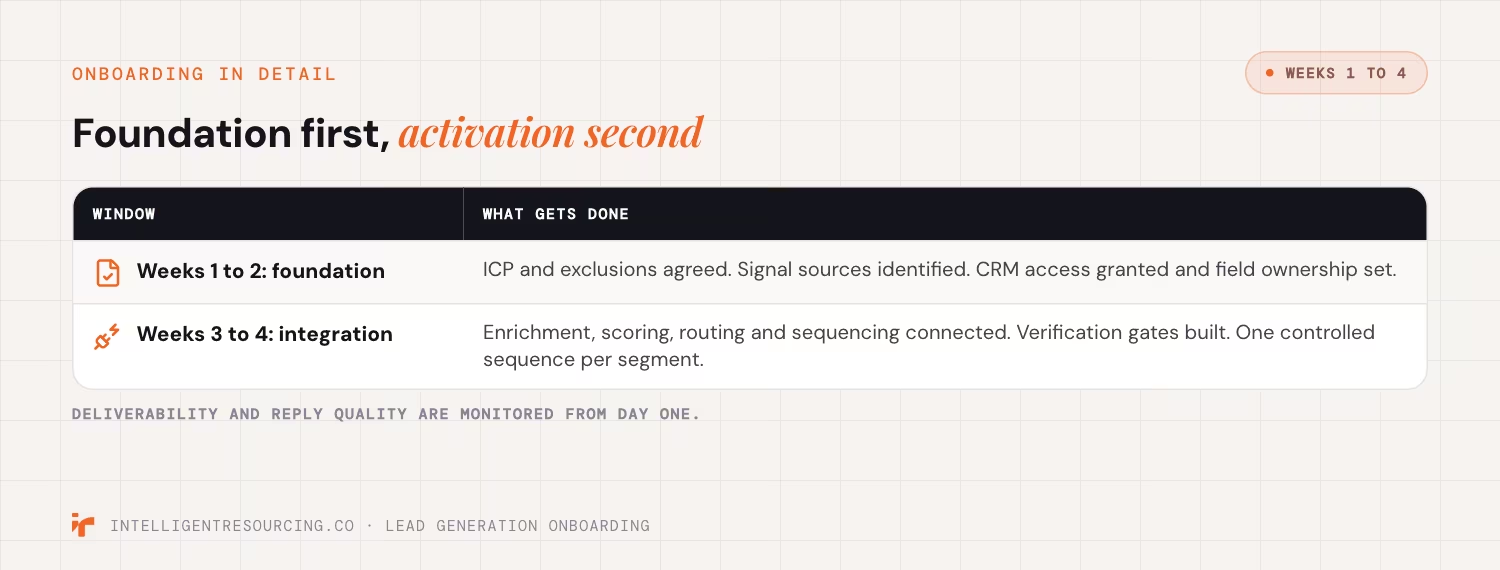
Week 1 to 2: foundation
- ICP fields and exclusions documented and agreed with the client
- Signal sources identified: behavioural, contextual, technographic and engagement, relevant to the vertical
- CRM access granted and field ownership rules set, so both sides know what field wins when data conflicts
Week 3 to 4: integration and first activation
- Enrichment, scoring, routing and sequencing connected end to end
- Verification gates built, so outreach only fires once a signal clears its threshold
- One controlled sequence activated per segment, with deliverability and reply quality monitored from day one
Salesforce's sales statistics page lists an average of 8 tools per seller, and 42% of reps feel overwhelmed by too many tools, which is why connecting them in a controlled sequence matters.
Agentic Signal Listening covers how these thresholds get set. The workflow behind the connection is set out in a B2B lead generation workflow.
The most common problem is a client expecting week 1 to look like week 5. It will not, and an agency that forces the resemblance is skipping verification, not moving faster.
What is on a lead generation agency onboarding checklist?
A working onboarding checklist covers three things before it covers outreach: access, data accuracy and definitions. Agencies and clients that skip the data accuracy step discover the problem in month two. Bad records have gone through the sequences by then.
Validity's 2025 CRM Data Management report, which surveyed 602 CRM users and administrators, found 76% say less than half of their organisation's CRM data is accurate and complete. It also found 37% say their organisation loses revenue as a direct result of poor data quality. A good checklist catches that early.
CRM Enrichment explains how to fix the accuracy problem before onboarding starts.
- Access: CRM, enrichment tool and sequencing platform access granted with correct permission levels
- Data baseline: current CRM accuracy audited before new enrichment runs against it
- ICP definition: written and signed off by both sides, including explicit exclusions
- Signal thresholds: defined, with agreement on what triggers outreach and what does not
- Field ownership: documented, so it is clear which system wins when two records disagree
- Suppression rules: unsubscribes, prior contact history and compliance exclusions loaded before the first sequence fires
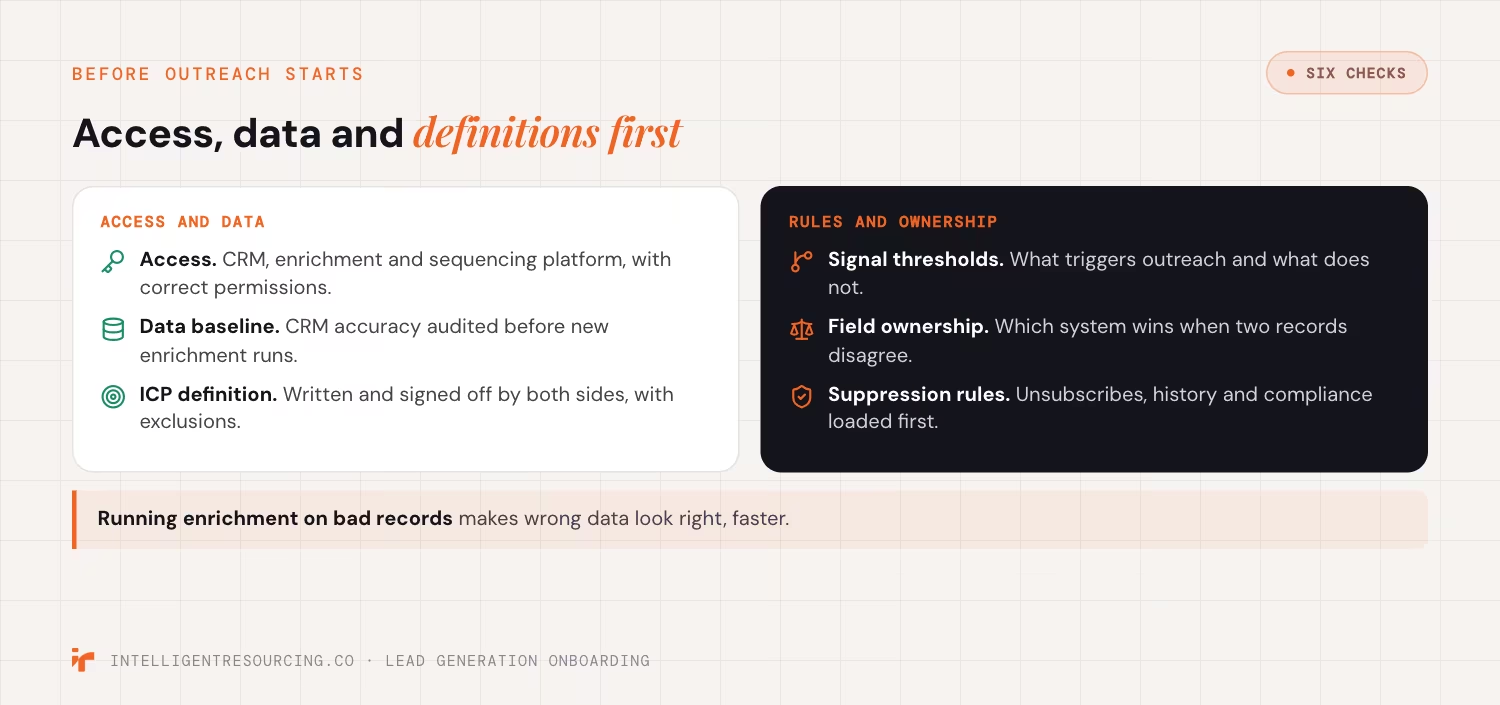
A checklist missing the data baseline step is incomplete. Running enrichment on bad records makes wrong data look right, faster.
See how a 30-day signal-led build compares to a generic launch →
What do reporting and communication look like in the first months?
Reporting in the first 90 days should happen weekly and track sourced pipeline, not activity counts. Belkins' 2026 B2B pipeline survey of 164 B2B professionals found most teams do not track pipeline well: only 30% track all 12 core pipeline metrics, and 10% track none.
What a weekly cadence covers
A weekly review should surface three things. A stalling motion should be visible by week three, not discovered in the month-two report:
- Signals captured that week
- Meetings qualified and booked
- Any account that has gone quiet
Agreeing this cadence in writing before signing stops the most common early complaint: a client who feels they have heard nothing since the kickoff call.
What to ask before signing
- How often will we see a report, and what does it cover at each cadence?
- Who owns the weekly review on your side, and who owns it on mine?
- What does the agency do differently if signals conflict or a segment underperforms?
See how to measure lead generation ROI for the metrics worth tracking once reporting starts.
What legal and compliance steps come up during onboarding?
An Australian B2B lead generation motion has to build consent and suppression handling into the system before outreach starts. It should not be added afterwards. The Spam Act 2003 (Cth) requires consent before sending marketing emails, texts or similar messages, and the Australian Communications and Media Authority enforces it.
What should be in place before the first sequence fires
- A documented consent basis for every contact entering a sequence, inferred or express
- An unsubscribe and suppression process that updates the CRM immediately, not on a weekly batch
- Data provenance tracked per contact, so source and last-verified date are visible
What to ask an agency about compliance
A good agency should explain its suppression rules and consent basis clearly and quickly. An agency that treats this as an afterthought during onboarding is a real risk, not a small gap to fix later.
The first 90 days end with a decision point, not a verdict on the relationship. By day 90, you should have enough CRM-tracked data on qualified meetings and sourced pipeline. That data should tell you whether the numbers work for your motion. You should also know enough about how the agency communicates to tell whether month four will differ from month one.
If pricing was never pinned down in your contract, the lead generation pricing guide covers what each delivery model costs.
Lead Generation
A 90-day signal plan shows what setup, first meetings and validation should look like for your sales motion before you sign.
FAQs
What should I expect in the first 90 days with a lead generation agency?
Expect three phases. Setup and signal configuration run days 1 to 30, first qualified meetings days 31 to 60, and pipeline validation days 61 to 90. Progress in phase one looks like infrastructure, not meetings. Expecting it to look like phase two is the most common frustration.
How long before a lead generation agency delivers meetings?
In signal-led onboardings like Intelligent Resourcing's, the first qualified meetings typically land between days 31 and 60. A faster start, in week one or two, means a list-led approach rather than verified signals. That approach fits a transactional motion better than a complex B2B sale.
What does lead generation agency onboarding look like?
Onboarding starts with ICP definition, signal sourcing and CRM access in weeks 1 to 2. It then integrates enrichment, scoring, routing and sequencing in weeks 3 to 4, with one controlled activation per segment before full outreach begins.
What is on a lead generation agency onboarding checklist?
A working checklist covers system access, a CRM data accuracy baseline, and a signed-off ICP definition with exclusions. It also covers signal thresholds, field ownership rules and suppression logic, all agreed before the first sequence fires.
What should I ask about reporting before signing with a lead generation agency?
Ask how often reports arrive, what each cadence covers, and who owns the weekly review on both sides. Also ask what the agency changes when signals conflict or a segment underperforms. A weekly reporting cadence tied to sourced pipeline is the standard to ask for.