

Why Don't SaaS Product Pages Get Cited in AI Search?
Most SaaS content strategies were built for a buyer who scrolled 10 blue links. That buyer now asks an AI assistant a direct question and reads 1 synthesised answer instead. The content type that wins that answer is not the one most SaaS teams have spent years producing.
Product content, meaning specs, comparisons and "best of" lists, accounts for 46% to 70% of all AI citations, and climbs past 70% for decision-stage queries. That comes from an XFunnel study of 768,000 citations run over 12 weeks across ChatGPT, Google AI Overviews and Perplexity, reported by Search Engine Journal in April 2025. Educational blog content, the format most SaaS budgets still favour, earns 3% to 6%.
This checklist covers the 2 page types that carry the most weight in that shift: the product page and the comparison page. Get these right first, because everything else in a content plan matters less until they are.
Buyers increasingly open an AI assistant before a search engine. They ask things like "what's the best customer relationship management (CRM) tool for a 20-person sales team" and act on the tools the answer names. A product or comparison page that cannot supply the specifics behind that answer does not get to compete for the mention.
What Is the Citation Ownership Gap and Why Does It Matter?
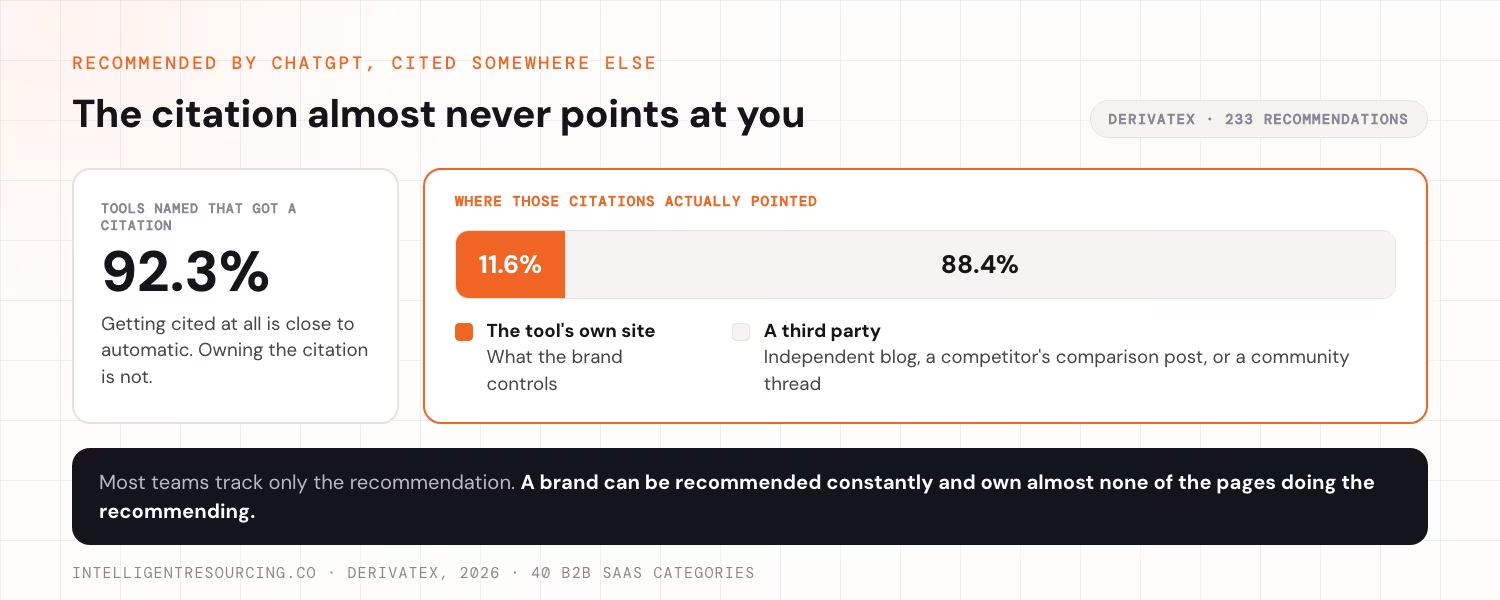
Getting recommended by an AI engine and getting cited by it are 2 separate events. Most SaaS teams only track the first one. A brand can be named as a strong option in an AI answer while the clickable source beside it points to a page the brand does not own.
A 2026 DerivateX study tested 40 business-to-business (B2B) SaaS categories, covering 233 recommendations across 219 distinct tools, with ChatGPT running web search. It found ChatGPT attached a citation to 92.3% of the tools it named. Citation itself is close to automatic. Ownership is not: only 11.6% of those citations pointed to the recommended tool's own site. The other 88.4% credited a third party, whether an independent blog, a competitor's comparison post or a community thread.
That is the gap worth measuring. A brand can be recommended constantly and still own almost none of the pages doing the recommending.
What Does a Citable SaaS Product Page Need?
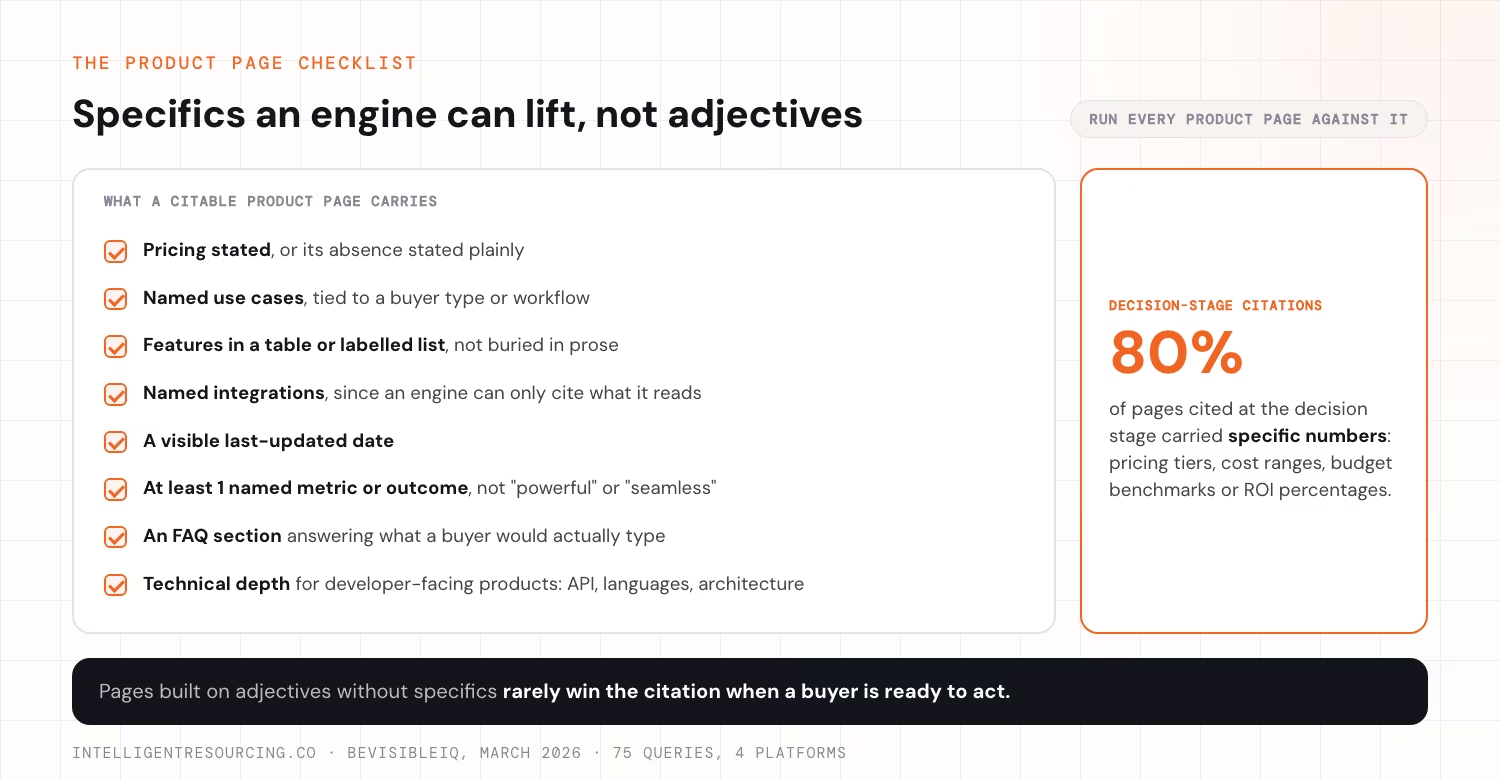
A citable SaaS product page answers a buyer's question with specifics an AI engine can lift directly. BeVisibleIQ classified citations from 75 B2B SaaS buyer queries across Perplexity, Gemini, Claude and ChatGPT in March 2026, and found 80% of pages cited at the decision stage contained specific numbers: pricing tiers, implementation cost ranges, budget benchmarks or return on investment (ROI) percentages. Pages built on adjectives without specifics rarely win the citation when a buyer is ready to act.
Run your pages against this list:
- Pricing is stated on the page, or its absence is stated plainly, not hidden behind a "contact us" form with no detail at all
- Named use cases appear, tied to a specific buyer type or workflow, not a generic "for teams of all sizes" claim
- Core features are listed in a structured format, such as a table or a labelled list, rather than buried in prose
- Named integrations are listed explicitly, since an AI engine can only cite a connection it can read
- A last-updated or last-reviewed date is visible somewhere on the page
- At least 1 specific, named metric or outcome appears, not just an adjective like "powerful" or "seamless"
- The page includes a frequently asked questions (FAQ) section addressing what a buyer would actually type into an AI assistant
- Technical depth is present for developer-facing products: application programming interface (API) details, supported languages or architecture notes
That last point is not a minor detail. In the DerivateX data, own-site citations were highest in customer onboarding, single sign-on, procurement and data infrastructure, which are categories where vendors publish substantive technical content on their own domains. In 25 broader categories, including CRM, email marketing and project management, there were no own-site citations at all. Third-party listicles owned the citation completely.
What Does a Citable SaaS Comparison Page Need?
A citable SaaS comparison page reads like a fair, current reference document, not a sales pitch with a table attached. This is the single most valuable page most SaaS teams can publish, because it can win the citation for several brand recommendations in 1 AI answer, not just your own.
The DerivateX study measured what the cited pages actually had in common, and the four attributes are not equally strong. List structure was universal. The rest were common but not required:
| Attribute of a cited page | Share of cited pages | How to read it |
|---|---|---|
| List or numbered structure | 100% | Treat as non-negotiable, since every cited page had it |
| Current year in the title | 78% | Strong signal, and the cheapest of the four to fix |
| Comparison table | 68% | Common, and the format buyers scan first |
| FAQ section | 56% | Useful, but the weakest of the four on its own |
Beyond format, the editorial checks matter just as much:
- Competitors are named and assessed honestly, including at least 1 point where a competitor genuinely wins
- Pricing is compared directly where it is publicly available, or the comparison states clearly where it is not
- The page is scoped to 1 clear category or buyer question, not a broad, unfocused "best software" claim
- The page is refreshed on a fixed schedule. AirOps reports that pages going more than three months without an update are over 3 times more likely to lose visibility than recently refreshed ones, and that more than 70% of pages cited by AI had been updated within the past 12 months
Does Schema Markup Help AI Engines Cite Your Pages?
Schema does not create a citation on its own. It reduces ambiguity by making product details, categories, relationships and review data easier for machines to interpret. That is why schema markup for AI citation works best as a grounding layer for information that is already accurate and visible on the page.
Apply the same checks to both product and comparison pages:
- SoftwareApplication or Product schema is present, with pricing and category fields completed accurately.
- Organization schema is present, with sameAs links connecting your website, review profiles and social accounts.
- FAQPage schema matches the visible FAQ content exactly, with no outdated or conflicting answers.
- AggregateRating schema, where used, reflects real and current review data.
- BreadcrumbList schema is present so category context is machine-readable, not only visible in the navigation.
Never mark up a rating, review count or pricing figure that is not current. Schema should describe what is already true on the page. If the structured data conflicts with the visible content, it creates another signal an AI engine has to reconcile.
Why Don't G2 and Capterra Help With ChatGPT Citations?
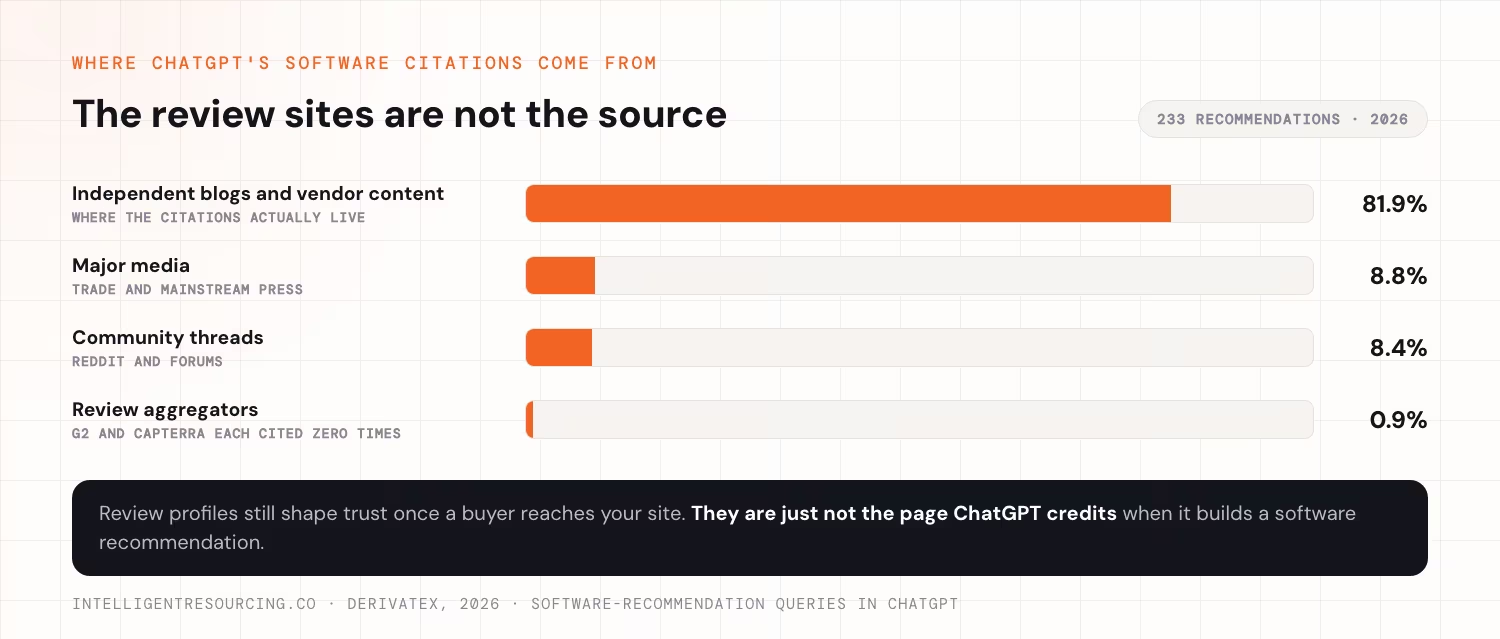
A large share of SaaS generative engine optimisation (GEO) advice tells teams to prioritise G2 and Capterra profiles above almost everything else. For the specific job of winning a ChatGPT citation on a software-recommendation query, the evidence does not support that priority.
Review aggregators, including G2, Capterra and TrustRadius combined, accounted for 0.9% of citations across those 233 software recommendations. G2 and Capterra each received zero. Independent and niche blogs, plus vendor-published content, accounted for 81.9% of the same citations, with major media at 8.8% and community threads at 8.4%.
This does not mean review profiles are worthless. They still shape buyer trust and conversion once a prospect reaches your site. It means they are not the pages ChatGPT pulls from when it builds and cites a software recommendation. A team that treats review-site presence as its entire GEO strategy is optimising for the wrong surface.
One caveat on scope: this is a finding about software-recommendation queries in ChatGPT, not a general law of AI search. Broader studies of brand visibility across other industries do find review platforms and community sources earning citations. The point is to match the tactic to the query your buyers actually ask.
Which Page Patterns Prevent AI Citations?
AI models consistently favour neutral, factual content over brand marketing. A Semrush analysis across five industries put it bluntly: Microsoft's corporate blog generates fewer AI citations than Reddit threads about Microsoft products. Promotional-first copy rarely makes the source list.
Run your existing pages against these patterns. Any single item is a gap. 2 or more together is a page very unlikely to be cited at all.
- The page describes benefits in adjectives ("powerful", "seamless", "best-in-class") with no specific, checkable fact behind any of them
- Pricing is entirely absent, with no indication of tier structure or even a starting range
- The comparison page treats every competitor as strictly worse, with no honest concession anywhere
- The page has no visible date and no way to tell if the information is current
- Feature claims are not represented in structured data anywhere on the page
- The page targets a broad, unfocused claim ("best software for business") instead of 1 clear category or use case
- Integrations, use cases or technical details are described in prose only, with no list or table an engine can parse cleanly
How Do You Audit Your SaaS Pages This Week?
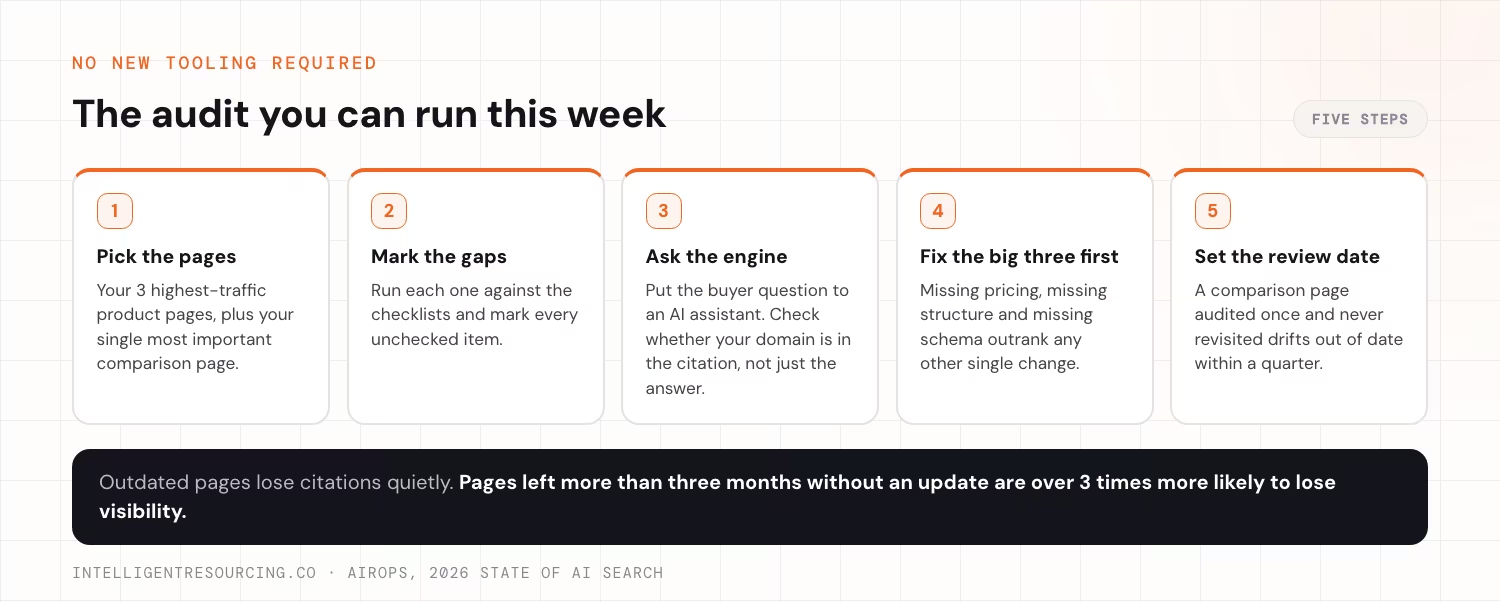
This audit does not require new tooling or a lengthy process. Outdated pages quietly lose citations before most teams notice, which makes a regular review more than a hygiene task. The checklists above give a concrete pass or fail frame for each page type, so the gaps are visible immediately.
- Pick your 3 highest-traffic product pages and your single most important comparison page.
- Run each one against the checklists above and mark every unchecked item.
- Ask an AI assistant the buyer question each page is meant to answer, and note whether your domain appears in the citation, not just in the answer.
- Fix the highest-impact gaps first. Missing pricing, missing structure and missing schema tend to matter more than any other single change.
- Set a recurring review date, since a comparison page audited once and never revisited drifts out of date within a quarter.
How Do Product and Comparison Pages Work Together in AI Search?
Product and comparison pages solve different AI search problems. A product page proves what the tool does. A comparison page proves why one option differs from another. SaaS brands need both, because AI engines use each page for a different type of answer.
The buying behaviour behind that is already measurable. A Responsive survey of more than 350 B2B buyers worldwide, reported by Digital Commerce 360 in October 2025, found the shift most pronounced in technology and software, where 80% of buyers said they use AI tools as much as or more than search engines for vendor discovery. In the same research, 56% of technology buyers named chatbots as a leading source for finding vendors.
- Product pages should make features, use cases, integrations and outcomes easy to verify.
- Comparison pages should make differences, trade-offs and suitability clear enough to cite.
Treating both as the same content job weakens AI visibility, because one proves the product and the other proves the comparison. Our generative engine optimisation work applies that distinction page by page across SaaS sites.
Where Do You Get Help Executing This Checklist?
Bring in outside support when the problem is no longer knowing what to fix, but applying the checklist consistently across every product and comparison page.
That capacity gap is common. In the Content Marketing Institute's B2B Content Marketing Trends for 2025 research, a survey of 980 B2B marketers run in mid-2024, 45% said they lack a scalable model for content creation and only 35% said they have one. A product library with multiple comparison pages can quickly exceed what an in-house team can maintain.
Choosing among B2B content automation agencies should therefore come down to whether they can scale the work without losing page-level accuracy, structure or review.
Once proposals are in hand, the next test is evidence. Knowing how to evaluate an AEO agency's past results helps separate reproducible performance from claims that only look convincing in a pitch.
Content Creation
See where your product and comparison pages actually stand, and which of them an AI engine can already cite.
FAQs
What is a GEO checklist for SaaS product pages?
A GEO checklist for SaaS product pages is a set of concrete criteria: stated pricing, named use cases, structured feature lists, and schema markup. These make a page easier for an AI engine to retrieve and cite accurately when a buyer asks about that category of software.
Why don't G2 and Capterra help with ChatGPT citations?
For software-recommendation queries specifically, review aggregators including G2 and Capterra accounted for 0.9% of citations in a 2026 study of 233 recommendations. G2 and Capterra each received zero. They still influence buyer trust once someone reaches your site, but they are rarely the page ChatGPT credits as the source.
What should a SaaS comparison page include to be cited by AI?
Every cited page in the DerivateX study used list structure, so treat that as non-negotiable. Most also carried the current year in the title, at 78%, a comparison table, at 68%, and an FAQ section, at 56%. Beyond format, the page should treat competitors honestly, including at least 1 point where a competitor genuinely wins.
Is being recommended by AI the same as being cited by AI?
No. A recommendation is the model naming a brand in its answer. A citation is the clickable source the model attaches, and that source captures the discovery and the click. In the DerivateX study, ChatGPT cited 92.3% of the tools it named, but only 11.6% of those citations pointed to the tool's own site.
How often should a SaaS comparison page be updated?
At least quarterly. Competitor pricing, features and positioning change often, and outdated comparisons lose credibility quickly. AirOps reports that pages going more than three months without an update are over 3 times more likely to lose visibility than recently refreshed ones.