
How Much Should an MSP Spend on Marketing?
A managed service provider (MSP) should set its marketing budget from the number of profitable clients it needs to win. Start with target contract value, gross margin and sales capacity, then work back to the new clients and qualified meetings required. A budget built this way has a clear purpose and a spending limit.
A provider selling managed IT support to local accounting firms needs a different plan from one selling security services to national businesses. The first needs strong local visibility and a focused sales process. The second needs wider account research, content and support for longer buying cycles.
Answer 3 questions first:
- How many clients are needed? Set a new contract target.
- What profit will they generate? Calculate monthly recurring gross profit.
- How much acquisition cost fits? Set the payback period the business accepts.
Fund the work that produces suitable opportunities, and skip channels an agency offers by default.
How Much Does Outsourced Marketing Cost for an MSP?
Outsourced MSP marketing costs depend on the supplier, the scope and the contract terms. It covers very different work: content only, ongoing campaign management or outbound meetings. Ask for an itemised quote before comparing fees, because a low retainer can hide large extra costs.
A narrow service works when an MSP already has strategy, sales and reporting covered. Wider agency support suits a business that needs help across several functions.
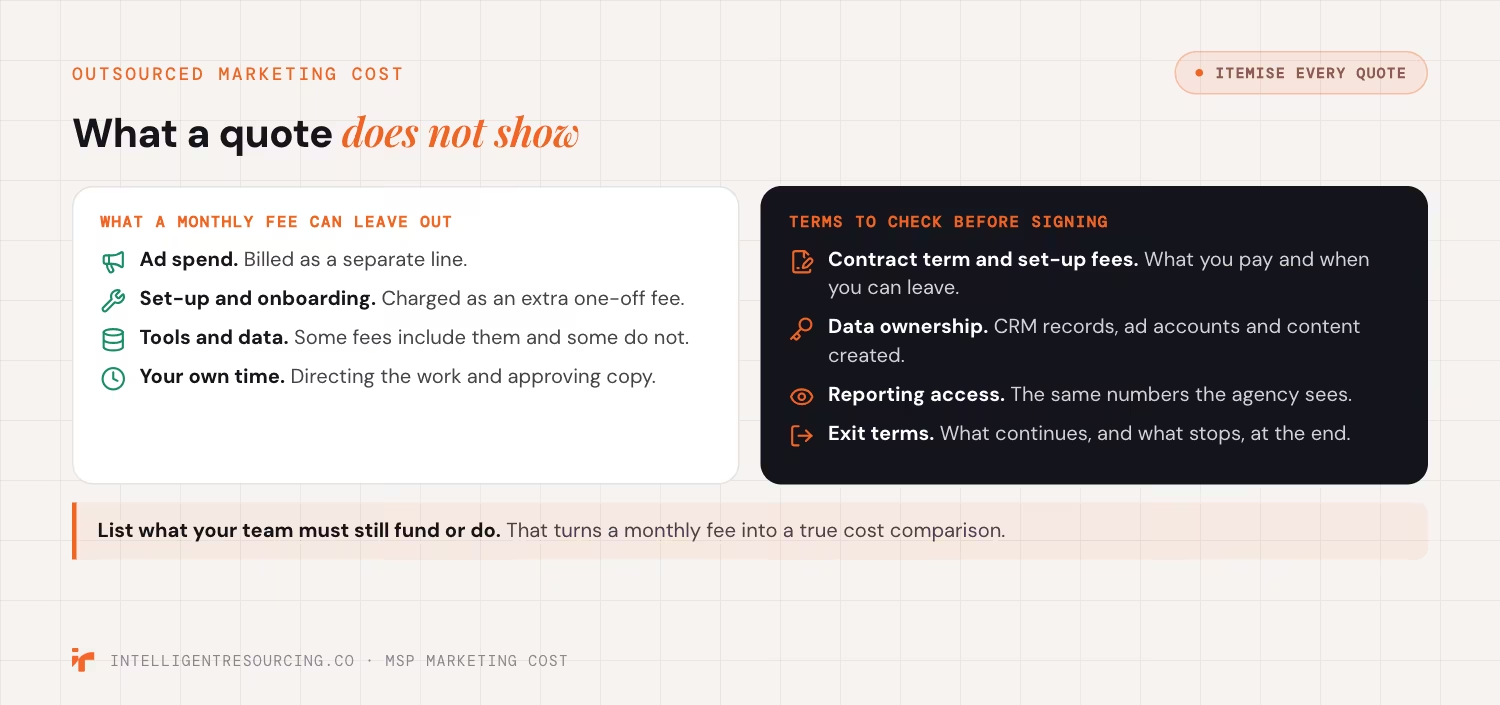
What a fee can leave out:
- Ad spend. Billed as a separate line.
- Set-up and onboarding. Charged as an extra one-off fee.
- Tools and data. Some fees include them and some do not.
- Your own time. Directing the work and approving copy.
Before comparing quotes, list the tasks your team must still fund or perform. That turns a monthly fee into a true cost comparison.
Is an In-House MSP Marketer Cheaper Than a Marketing Agency?
An in-house marketer gives an MSP direct control and close product knowledge, and hiring adds fixed costs. An agency adds outside skills without permanent staff. The better choice depends on the work needed each month, the skills required and the management time available.
Robert Half's 2026 Australian marketing salary guide gives national base salaries at the 25th percentile, median and 75th percentile. They exclude bonuses, benefits and superannuation. The Australian Taxation Office's (ATO) key superannuation rates put the super guarantee at 12%.
| Role | Median base | With 12% super | Per month | 25th to 75th percentile, loaded |
|---|---|---|---|---|
| Marketing coordinator | Australian dollars (AUD) 75,000 | AUD 84,000 | AUD 7,000 | AUD 78,400 to AUD 89,600 |
| Digital marketing specialist | AUD 100,000 | AUD 112,000 | AUD 9,333 | AUD 100,800 to AUD 123,200 |
| Marketing manager | AUD 140,000 | AUD 156,800 | AUD 13,067 | AUD 123,200 to AUD 168,000 |
The table is before payroll tax and workers' compensation where they apply, leave loading, recruitment, software and equipment. An agency fee buys a defined service and no dedicated employee, so check whether strategy, content, data and reporting are included.
The decision turns on whether the MSP needs a full-time employee or a specific set of skills. Also decide who owns sales follow-up, since neither option removes that work.
Which Outsourced MSP Lead Generation Pricing Model Is Best?
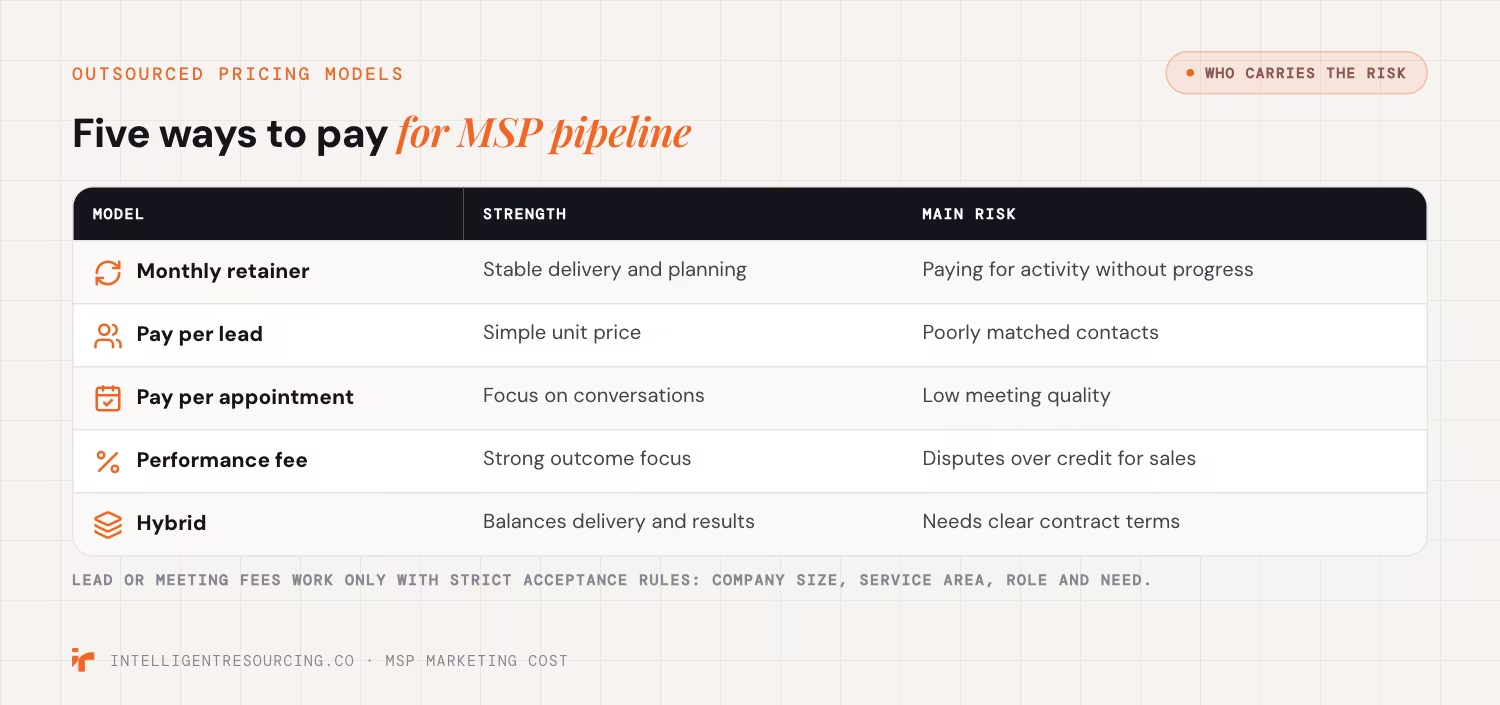
The best pricing model links payment to useful work and gives both sides clear duties. Monthly retainers support regular delivery. Pay-per-lead contracts put a price on contacts. Appointment fees focus on meetings. Hybrid contracts combine ongoing work with agreed results.
| Model | Strength | Main risk |
|---|---|---|
| Monthly retainer | Stable delivery and planning | Paying for activity without progress |
| Pay per lead | Simple unit price | Poorly matched contacts |
| Pay per appointment | Focus on conversations | Low meeting quality |
| Performance fee | Strong outcome focus | Disputes over credit for sales |
| Hybrid | Balances delivery and results | Needs clear contract terms |
Use a retainer when the supplier owns ongoing work, lead or meeting fees only with strict acceptance rules, and a hybrid when the supplier controls enough of the process to be held to agreed targets.
Retainer, appointment and hybrid contracts each shift risk differently, which is the logic behind lead generation pricing models. For an MSP, the contract must also define company size, service area, decision-maker role and buying need. Otherwise a meeting has a price and no clear business value.
What Is a Good Cost Per Lead for Managed IT Services?
A good MSP cost per lead produces qualified sales conversations at a price the business can recover. As at 15 October 2026, we found no independent Australian MSP average that applies across contract sizes and markets. A cheap enquiry is no bargain if the prospect sits outside your service area or has no managed IT requirement.
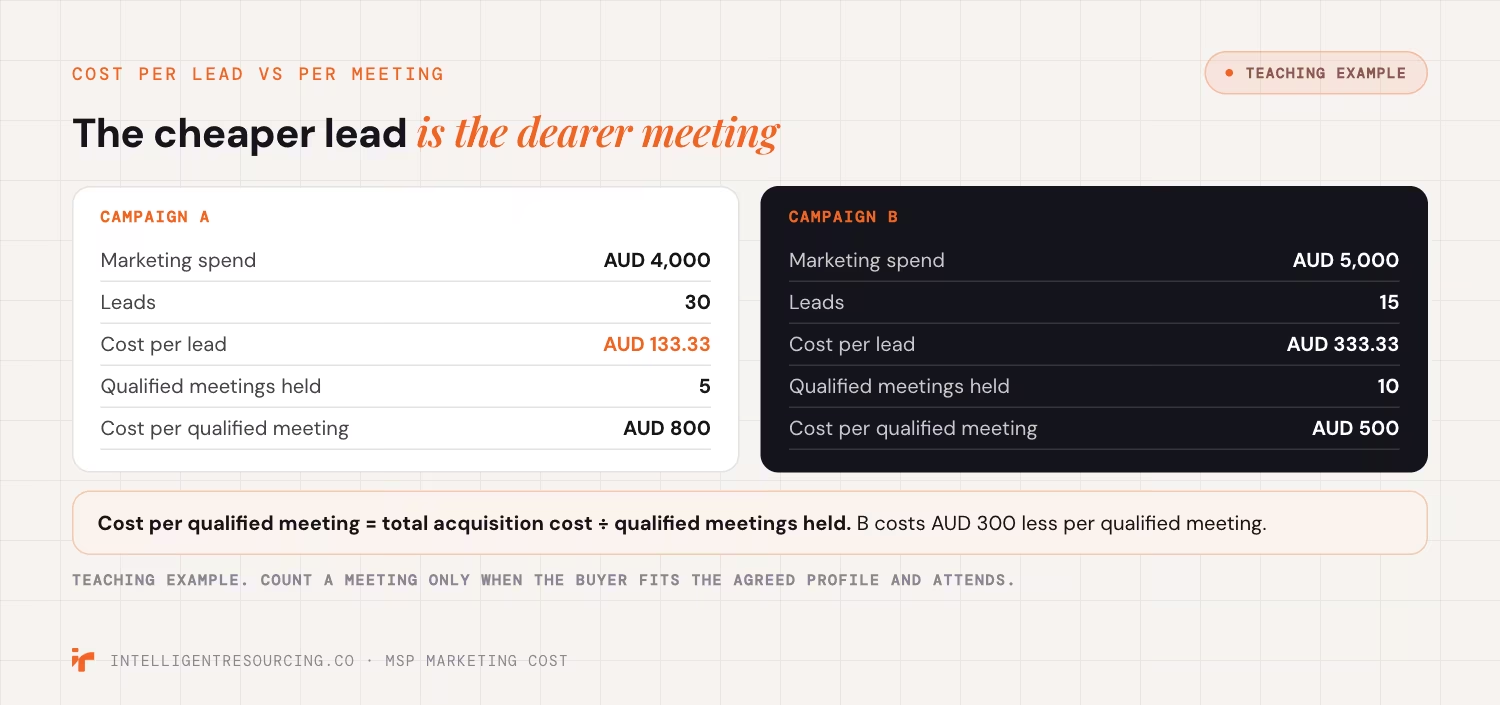
Consider this teaching example:
| Metric | Campaign A | Campaign B |
|---|---|---|
| Marketing spend | AUD 4,000 | AUD 5,000 |
| Leads | 30 | 15 |
| Cost per lead | AUD 133.33 | AUD 333.33 |
| Qualified meetings held | 5 | 10 |
| Cost per qualified meeting | AUD 800 | AUD 500 |
Campaign A wins on lead cost, and Campaign B wins on qualified meeting cost. That matters because sales teams spend time on leads that do not fit. A lead should meet basic rules before it reaches sales: company size, location, decision-making role, service needs and current supplier arrangements.
Broader context for what a lead costs sits in Australian business-to-business (B2B) lead costs, though an MSP's own qualification rule matters more.
How Do You Calculate Cost Per Qualified Meeting for an MSP?
Cost per qualified meeting measures how much an MSP spends to secure 1 suitable sales conversation. It improves on cost per lead because it counts only prospects who meet the agreed profile and attend. Compare approaches over the same period with the same cost rules.
The calculation is:
Cost per qualified meeting = Total acquisition cost ÷ Qualified meetings held
For a fair comparison, count agency fees, paid media, tools and relevant internal time. Include a meeting only when the buyer fits the agreed profile and attends.
Then compare approaches by subtracting one result from the other. In the teaching example above, the difference is AUD 300 per qualified meeting in Campaign B's favour. That does not mean Campaign B will win more clients, because the MSP still needs to track proposals and signed contracts. The difference is an early test and no final return on investment (ROI) figure.
How Do You Compare Outsourcing With a Fully Loaded Sales Hire?
A fully loaded sales hire costs the salary plus super, recruitment, tools and management time. Compare it with outsourcing only after matching the work each option delivers, because an employee also handles follow-up and relationships while an outside provider needs a clear handover into the MSP's sales team.
Obtain local salary quotes for the real role, then add:
- Salary and compulsory super. The core employment cost.
- Recruitment and onboarding. The cost of filling and preparing the role.
- Sales tools and data. Customer relationship management (CRM) access, research and outreach systems.
- Management and training time. Internal support needed to produce results.
The Bridge Group's 2025 sales development representative (SDR) research, covering 351 B2B companies, put average SDR ramp at 3.0 months, so a new sales hire adds meetings only after about a quarter. Include those months in the comparison.
What Is the Average Customer Acquisition Cost for an MSP?
Customer acquisition cost (CAC) is the total cost of winning 1 new customer. No single average gives every MSP a useful target, because contracts differ in size, margin and term. The correct measure includes all sales and marketing work needed to acquire customers, then checks that cost against recurring gross profit.
Use this formula:
CAC = Total sales and marketing acquisition cost ÷ New customers acquired
Keep spending and customer counts within a matching reporting period or cohort. For long sales cycles, link costs to the opportunities they produced.
Then calculate gross profit from a new contract. A managed services agreement with high monthly revenue still has delivery costs: licence fees, technical support and infrastructure reduce the profit available to recover acquisition spend. Compare acquisition cost with recurring gross profit, and revenue alone tells you little.
How Long Does MSP Marketing Take to Show ROI?
MSP marketing ROI depends on the sales cycle, the channel and the profit from new contracts. Early campaign activity is no proof of return, and a signed customer does not mean the investment has paid back at once. The MSP needs to track new profit until it covers acquisition costs.
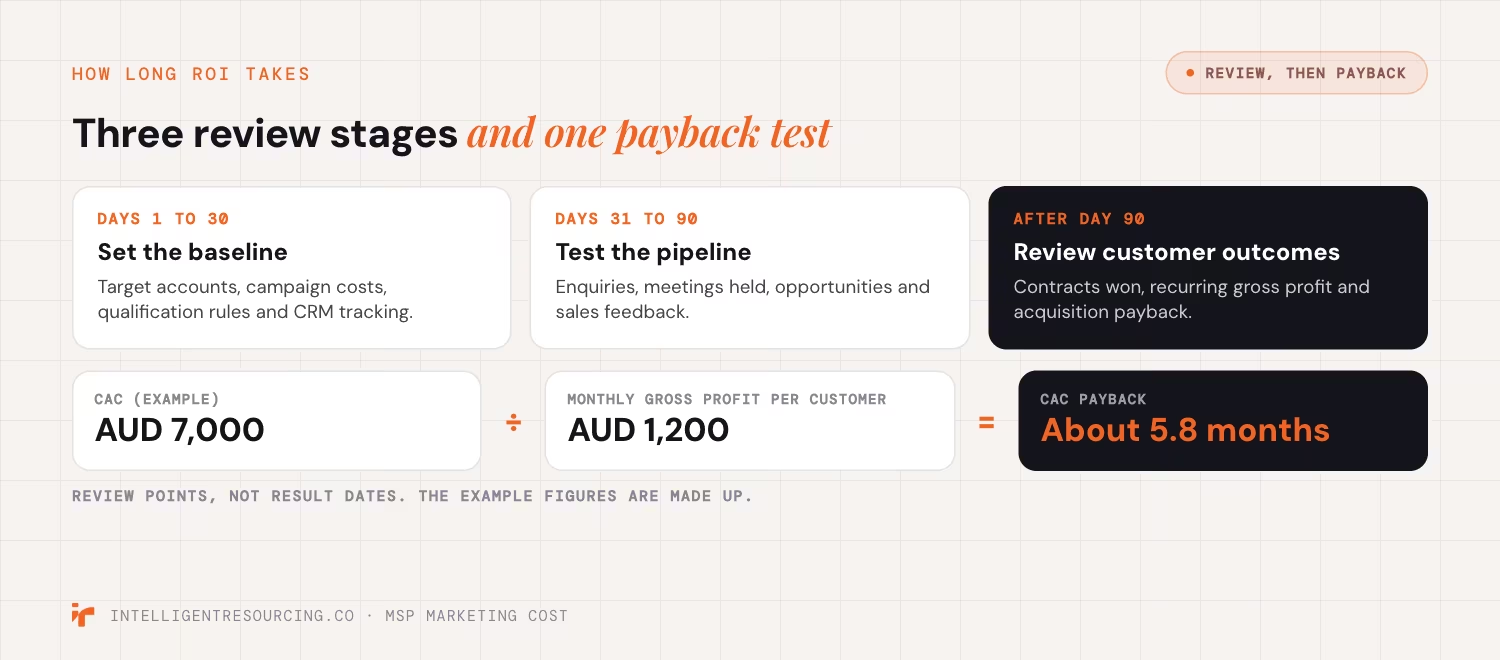
Review a new programme in 3 stages:
- Days 1 to 30: set the baseline. Confirm target accounts, campaign costs, qualification rules and CRM tracking.
- Days 31 to 90: test the pipeline. Review enquiries, meetings held, opportunities and sales feedback.
- After day 90: review customer outcomes. Track contracts won, recurring gross profit and acquisition payback, for the length of the actual sales cycle.
These stages are review points and promise no result dates. Calculate payback with:
CAC payback in months = CAC ÷ Monthly gross profit per new customer
For example, a made-up CAC of AUD 7,000 and monthly gross profit of AUD 1,200 gives about 5.8 months. A short payback releases cash for growth, and a long one ties up funds and raises the risk of overspending.
How Much Should a Startup MSP Budget for Marketing?
A startup MSP should fund a small, focused test before committing to several marketing channels. New providers often lack enough sales data to set a reliable revenue percentage or acquisition target. Begin with 1 market, 1 main service and a clear definition of a qualified buyer.
A new MSP serving professional services firms can start by testing 1 local audience. The founder can review existing contacts, refine the service message and build a simple follow-up process. Paid work should support a clear goal and must not replace the plan.
Set a spending limit the business can afford without putting service delivery at risk. A low start is normal: ConnectWise's 2026 MSP Marketing Report found 51% of MSPs, almost all in the United States, spend under United States dollars (USD) 10,000 a year on marketing. Review meetings held and sales feedback before extending the programme, and use early results to improve targeting, because a small sample cannot show a stable acquisition cost.
How Should an MSP Measure Marketing Spend Performance?
An MSP should review marketing performance from first contact through to new contract profit. Website traffic and lead counts explain activity, and they prove nothing about growth. A useful report shows costs, qualified meetings, sales progress and customer payback in one place.
Use this monthly checklist:
- ☐ Count the full monthly cost, including staff time and tools.
- ☐ Check qualified meetings held, and ignore bookings that did not happen.
- ☐ Track sales opportunities created from accepted meetings.
- ☐ Record signed recurring contracts against their source.
- ☐ Measure customer acquisition cost using matched costs and wins.
- ☐ Calculate gross-profit payback for new customers.
- ☐ Review rejected leads and reasons to improve targeting.
Matching costs to wins by period is the core of measuring B2B lead generation ROI. Clean data matters here: Salesforce's 2026 State of Sales research found that 51% of sales leaders using artificial intelligence (AI) said disconnected systems were slowing their AI work.
The marketing owner keeps campaign records in the CRM, and sales records meeting outcomes and deal progress. If lead costs fall while customer costs rise, check qualification first. If qualified meetings rise while sales stay flat, review the sales process before buying more traffic.
What Should You Ask Before Hiring an MSP Marketing Agency?
Ask an MSP marketing agency to explain the full cost, the exact scope and the evidence of sales value before signing. The proposal should show what the supplier delivers, what your team still owns and how progress is measured. Clear acceptance rules prevent disputes over lead quality and meeting numbers.
Ask the provider to show how it identifies suitable MSP buyers and turns interest into sales conversations. Then check these terms:
- Contract term and set-up fees. What you pay and when you can leave.
- Data ownership. Who owns the CRM records, advertising accounts and content created during the contract.
- Reporting access. Whether you see the same numbers the agency sees.
- Exit terms. What continues, and what stops, when the contract ends.
A low fee is good value when it solves a defined problem. A high fee needs clear proof of the added work and value.
What Is the Best Way to Set Your MSP Marketing Budget?
Start with customer profit, choose the work needed to win new contracts and compare providers on full cost. Use cost per qualified meeting to judge early efficiency, the fully loaded method to test hiring and CAC payback to decide when more spending makes sense.
An MSP with weak demand needs a clear route to new sales conversations and has little use for a longer list of marketing tasks. If qualified conversations are the gap, signal-led lead generation ties buyer signals and CRM workflows to the sales team's next action.
Intelligent Resourcing wrote this guide and sells this work. Its go-to-market (GTM) engineering is priced from AUD 3,500 to AUD 8,400 plus goods and services tax (GST) a month, with an optional fixed AUD 1,500 plus GST strategy session for scoping the work first. It builds and manages the system inside the client's own CRM, and its pricing page describes this as infrastructure the client owns, with workflow documentation included. Still ask any supplier for a written offboarding map that shows what stays and what stops.
Lead Generation
See how signal-led outbound built inside your own CRM turns buyer signals into the sales team's next action.
FAQs
Can an MSP market effectively with AUD 1,000 a month?
Yes, for a narrow plan with founder involvement. Focus on 1 audience, a clear service offer and a small number of actions. It does not fund every marketing service, so track meetings and new opportunities before adding channels or raising the budget.
Should an MSP invest in SEO or paid advertising first?
Start with the channel that matches how your target buyers search and the time you have to win work. Paid search gives tighter control over spend, and SEO builds visibility through useful service pages. Judge both by qualified opportunities and customer profit, and treat traffic as a supporting figure.
Does outsourced MSP marketing include advertising costs?
Not by default. Some suppliers include campaign management and charge media spend separately, and others sell a fixed service package. Ask for an itemised proposal covering set-up, monthly fees, tools, advertising and your internal duties, then compare the total cost for the full contract term.
Is a lower cost per lead always better?
No. A lower cost per lead helps only when lead quality stays strong, because poorly matched enquiries take sales time and reduce conversion. Cost per qualified meeting gives a stronger early comparison, and customer acquisition cost and gross-profit payback then show the commercial result.
How often should an MSP review its marketing budget?
Review campaign activity and qualification each month, and check sales outcomes as deals move through the pipeline. Use quarterly reviews to adjust spending based on cost per qualified meeting, acquisition cost and payback. Avoid scaling a channel from clicks or enquiry volume alone.