


What Should a Law Firm Lead Generation Checklist Include?
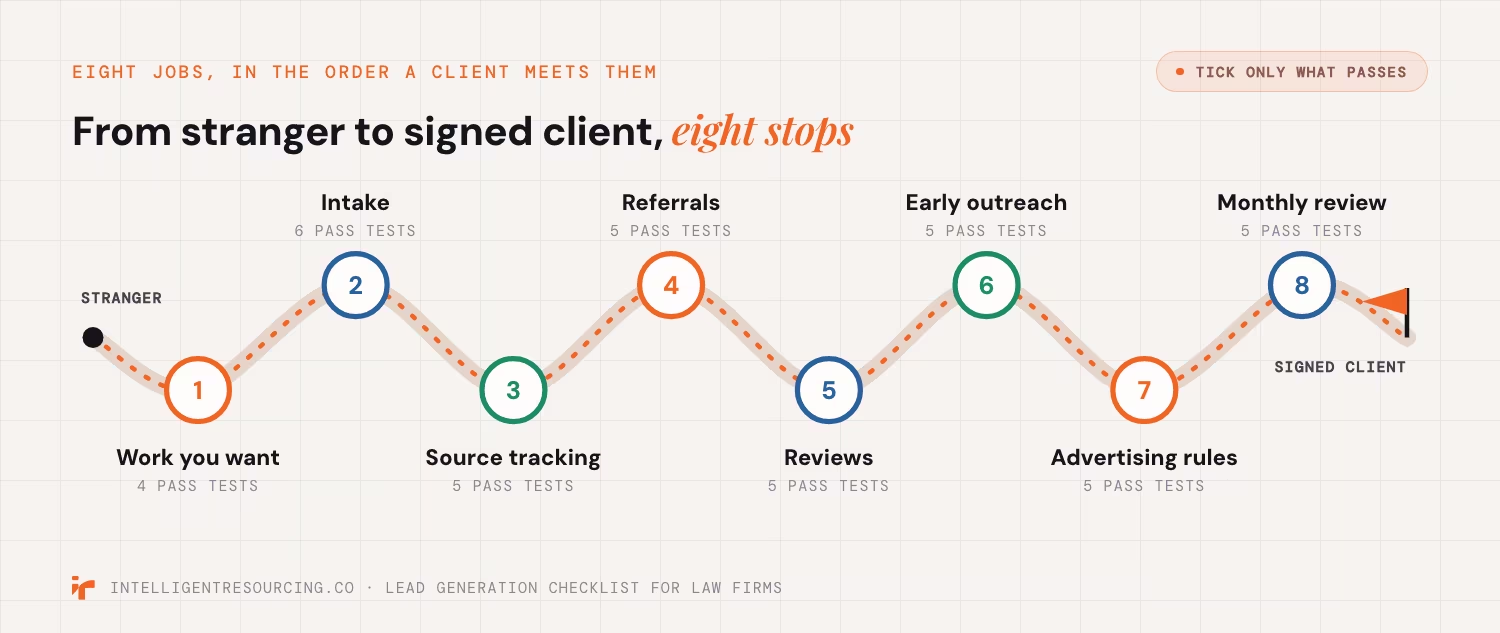
A good checklist covers the whole path from a stranger to a signed client: the work you want, the first reply, source tracking, referrals, reviews, early outreach and the rules. Each item has a pass test so you can tick it honestly.
How to use it:
- Tick an item only when its pass test is true. "Mostly" is a no.
- Count the ticks in each section. The lowest section is your first fix.
- Review monthly. One section a month is enough.
Enquiries that arrive through search results and artificial intelligence (AI) assistants depend on search engine optimisation and AI visibility for law firms, which this checklist leaves out. Firms that also take on business clients can reuse the pass-test method in a business-to-business lead generation checklist.
How Do You Decide What Work You Want More Of?
Pick 1 or 2 practice areas and write down the client you want in each. Leads are only useful if they match the work you want. A firm that takes every enquiry fills its calendar with matters it cannot price well. A written client profile is the first filter for everything else.
- ☐ 1 or 2 target practice areas are named. Pass when: the partners agree on them in writing.
- ☐ The ideal client is described in 1 paragraph. Pass when: a new staff member can use it to qualify an enquiry.
- ☐ The average fee for a good matter is known. Pass when: you can state it from the last 10 matters.
- ☐ Matters you do not want are listed. Pass when: intake staff know what to decline or refer on.
What Does a Good Law Firm Client Intake Process Look Like?
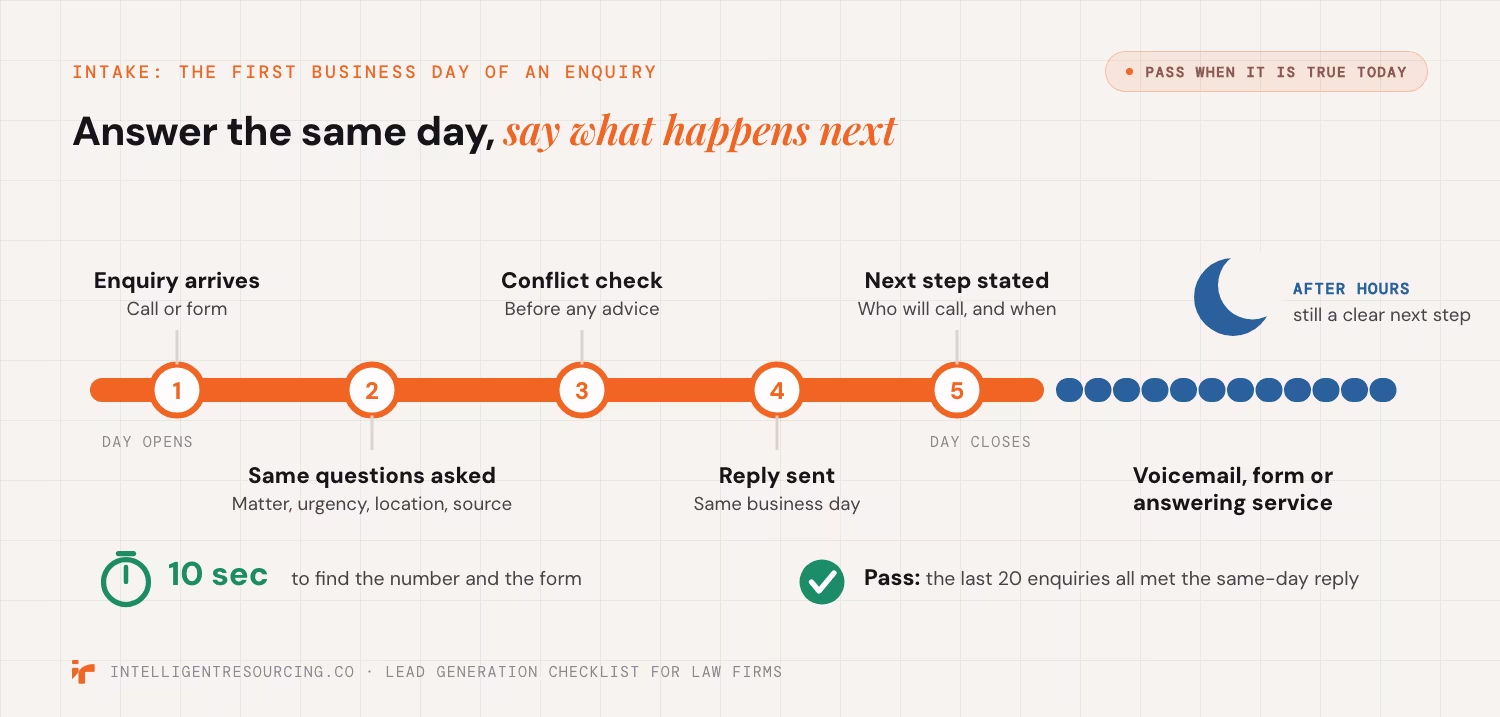
A good intake process answers every enquiry the same day, asks the same few questions every time and records the answers in 1 place. Speed and consistency decide whether an enquiry becomes a client. Fix intake before you add a new channel, because a slow reply wastes every channel above it.
- ☐ 1 phone number and 1 enquiry form are easy to find. Pass when: a stranger finds both in under 10 seconds on a phone.
- ☐ Every call and form gets a reply the same business day. Pass when: the last 20 enquiries all met it.
- ☐ After-hours enquiries are handled. Pass when: a voicemail, form or answering service gives a clear next step.
- ☐ Intake asks the same questions every time. Pass when: matter type, urgency, location and source are recorded.
- ☐ A conflict check happens before any advice. Pass when: it is a fixed step in the process.
- ☐ The next step is stated to the enquirer. Pass when: they know who will call and when.
These are working standards and no legal advice. Confirm the conflict-check and engagement steps against your firm's own procedures.
How Do You Track Where Law Firm Leads Come From?
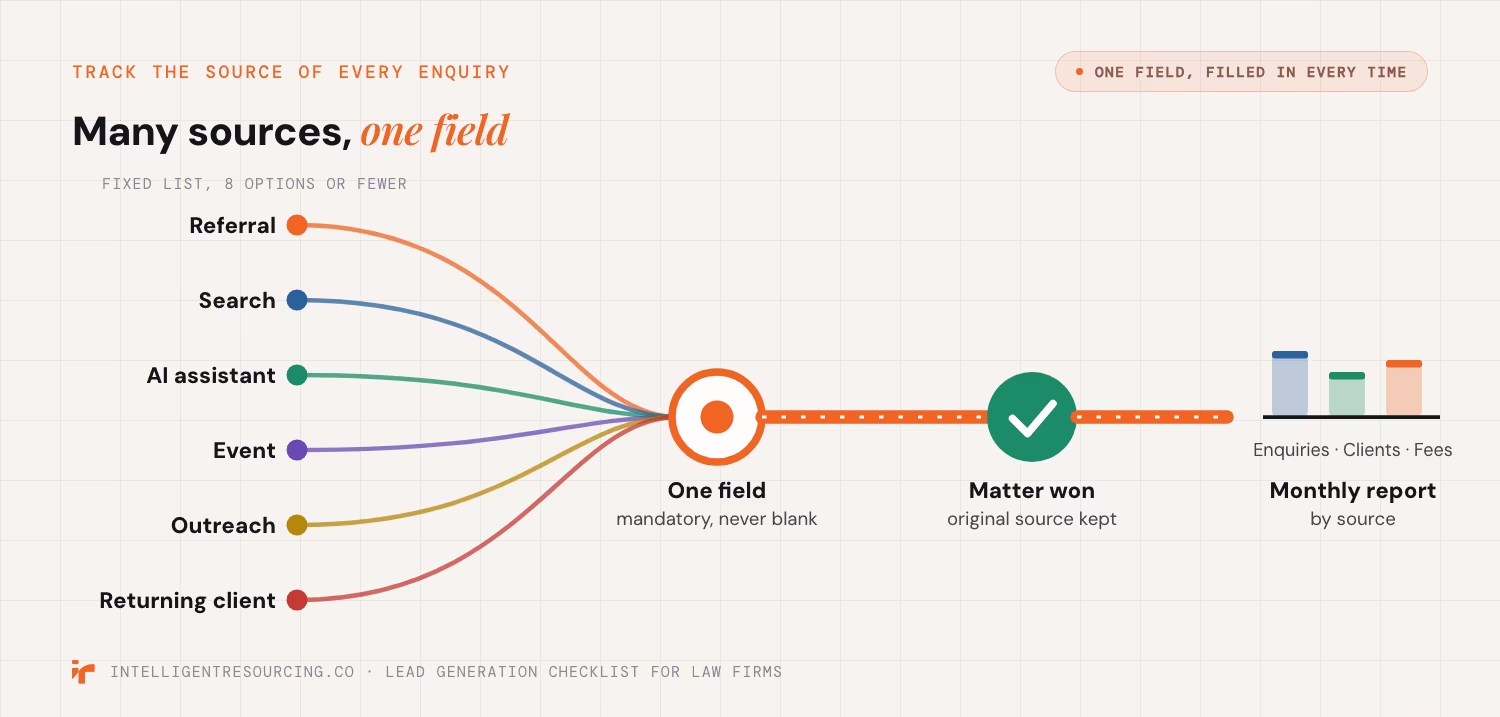
Record the source of every enquiry in a single mandatory field. Without a source, you cannot compare channels or spend with confidence. The tool matters less than the habit: a spreadsheet works for a small firm, and a law firm customer relationship management (CRM) system helps once volume grows.
- ☐ Every enquiry has a source recorded. Pass when: the source field is never blank in the last 20 enquiries.
- ☐ Sources use a fixed list. Pass when: the list has 8 or fewer options, such as referral, search, AI assistant, event, outreach and returning client.
- ☐ Enquiry forms ask "How did you hear about us?" Pass when: the answer is saved, and the form does more than email it.
- ☐ Source is updated when the matter is won. Pass when: closed matters show the original source.
- ☐ A monthly report shows enquiries, clients and fees by source. Pass when: someone reads it each month.
Do Law Firm Referral Programs Work?
Referrals work when someone manages them. A firm should know who sends work, thank them and keep in touch on a schedule. Referrals suit many firms well, though they depend on a few people. A referral list with owners and dates turns hope into a channel.
- ☐ The top 10 referrers are listed. Pass when: you can name them and the matters they sent last year.
- ☐ Each referrer has an owner. Pass when: 1 partner is responsible for each relationship.
- ☐ Referrers are thanked after each matter. Pass when: the thank-you is a set step and a favour is no part of it.
- ☐ Each referrer gets a check-in every quarter. Pass when: dates are in a calendar.
- ☐ Referral fees are checked against the rules. Pass when: no arrangement is made before checking.
The Queensland Law Society publishes guidance on paying referral fees under rule 12.4.4 and on receiving them under rule 12.4.3. A paid referral service is a different channel from a personal network, so review its terms and your obligations before you join one.
Can Lawyers Ask for Google Reviews?
Yes, but the rules for both Google and the profession apply. Google's guidance says reviews must reflect a genuine experience, and offering incentives for reviews is not allowed. Add rule 36 and client confidentiality, and the process needs a few safeguards. Ask every client, whatever the outcome.
Google's tips to get more reviews page says offering free or discounted goods or services in exchange for reviews is not allowed. It also says reviews must reflect a genuine experience.
- ☐ A review request is a set step at the end of a matter. Pass when: it goes out within a week of closing.
- ☐ The request offers nothing in return. Pass when: no discount, gift or favour is linked to a review.
- ☐ Every client is asked. Pass when: the process does not filter by outcome.
- ☐ Replies to reviews reveal no client details. Pass when: a reply never confirms that someone was a client.
- ☐ Reviews are not edited or copied elsewhere without checking rule 36. Pass when: a partner approves any reuse.
The Queensland Law Society publishes guidance on social media and law practice websites that covers client testimonials and confidentiality, so firms can check it before posting review replies.
How Do You Find New Clients Before They Search?
Watch for public events that show a business has a new need for a lawyer, and contact it while the need is fresh. This suits firms that serve businesses, such as commercial, employment and intellectual property (IP) work. It is a poor fit for work where a person is in distress. Start with 1 signal and a short list.
Watching for a public trigger such as a new company or a change of director is the core of signal-based lead generation, applied here to 1 practice area.
- ☐ 1 signal is chosen for 1 practice area. Pass when: it is written down, such as a new company or a change of director.
- ☐ A list of 20 businesses is built from public records. Pass when: each has a date and a source.
- ☐ Each business is checked against your client list. Pass when: no current client is contacted by mistake.
- ☐ The message gives 1 useful fact and 1 question. Pass when: it runs to 4 lines or fewer.
- ☐ Each business has a stated reason for contact. Pass when: the reason cites a dated public fact.
What Rules Apply to Law Firm Lead Generation?
Rule 36 of the Australian Solicitors' Conduct Rules applies to all marketing, and the Australian Consumer Law applies as well. Marketing must not be false, misleading, deceptive or offensive, and only accredited specialists can use that title. Practitioners are personally responsible for meeting rule 36.
The Law Society Journal, from the Law Society of New South Wales, reminds practitioners that they are personally responsible under rule 36, in a market full of marketing vendors. It adds that investigations of unqualified legal practice often arise from inadvertent website misrepresentations.
The Queensland Law Society sets out the text of rule 36, including the "accredited specialist" limit. It also notes that the Australian Consumer Law bans misleading or deceptive conduct and false representations about services.
- ☐ Every page, ad and message has been read against rule 36. Pass when: a partner signs off each new claim.
- ☐ No lawyer is called a specialist without accreditation. Pass when: titles on the site match the register.
- ☐ No outcome is promised. Pass when: results are described with context and accuracy.
- ☐ Vendor copy is checked by a partner before it goes live. Pass when: the contract says so.
- ☐ Your own regulator's guidance has been read. Pass when: the link is saved in the marketing folder.
Rules differ by state and area of law. This list is no legal advice, so ask your regulator or a lawyer to check your process.
How Often Should a Law Firm Review Its Lead Generation?
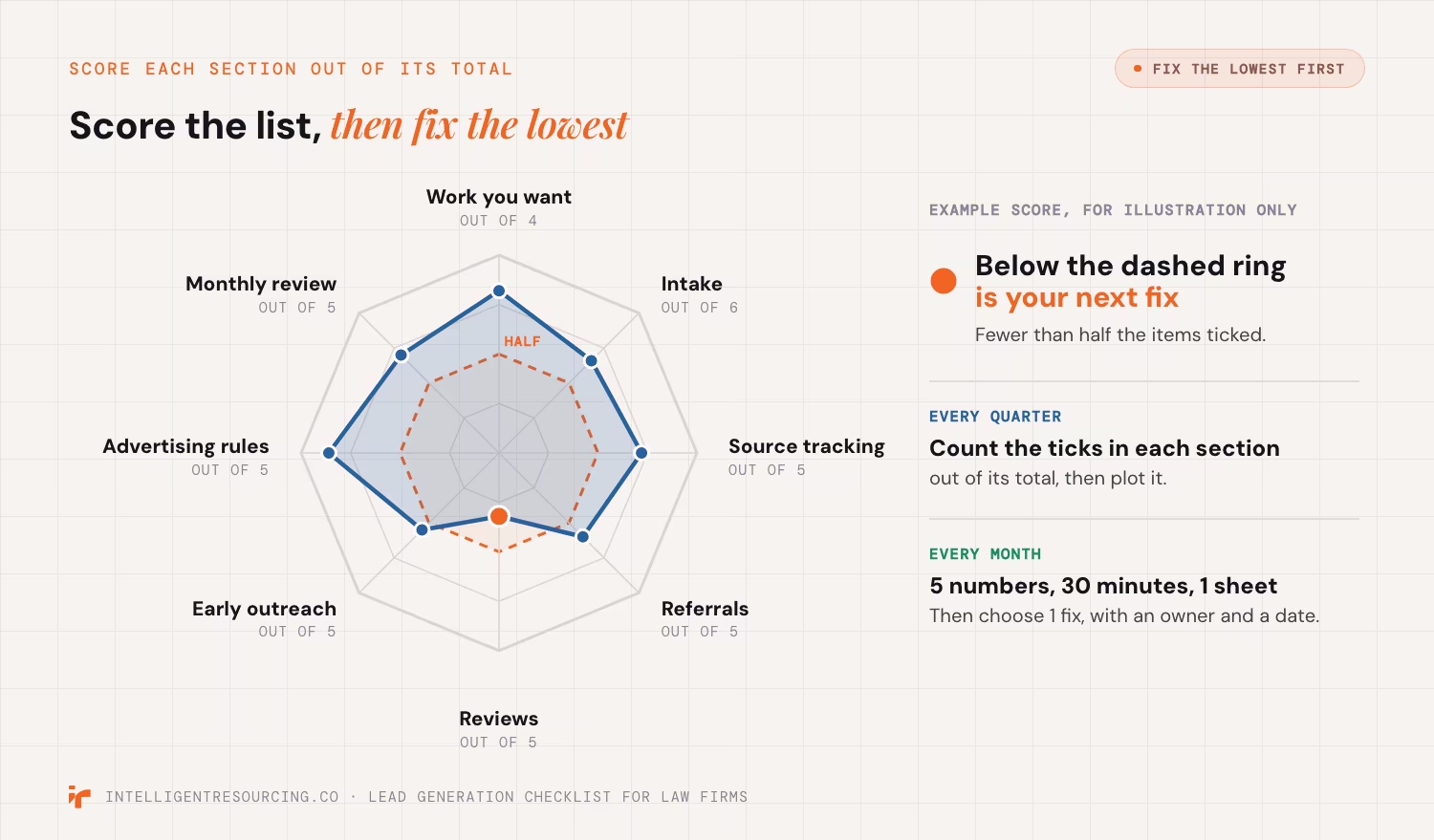
Review it monthly with 5 numbers, and score the checklist every quarter. A short monthly review catches a slow intake or a dry channel before it costs a quarter. Keep the meeting to 30 minutes and the page to 1 sheet.
- ☐ Enquiries this month are counted by source. Pass when: the numbers match the CRM.
- ☐ Reply time is checked. Pass when: the slowest reply is known.
- ☐ Enquiries that became clients are counted. Pass when: the conversion rate is written down.
- ☐ Fees from new clients are recorded by source. Pass when: the best source is clear.
- ☐ 1 fix is chosen for next month. Pass when: it has an owner and a date.
Score the checklist once a quarter. Count the ticks in each section out of its total. A section with fewer than half its items ticked is the next fix. This is a working scale and no industry benchmark.
When the lowest score is early outreach, our lead generation service gives commercial and employment firms a current list built from public events instead of a hand-built one.
Lead Generation
To see what early outreach could look like for your firm, book a call with Intelligent Resourcing.
FAQs
What should a law firm lead generation checklist include?
It should cover the work you want, intake, source tracking, referrals, reviews, early outreach, the advertising rules and a monthly review. Each item needs a pass test, so a partner can tick it honestly. Score each section, then fix the lowest one first before adding any new channel.
How fast should a law firm reply to an enquiry?
Reply the same business day as a minimum standard, and track the slowest reply each month. A slow reply gives the enquirer time to call another firm. This is a working standard and no measured benchmark, so set a tighter target if your intake team can meet it.
Can a law firm ask clients for Google reviews?
Yes, but Google does not allow incentives for reviews, and reviews must reflect a genuine experience. Rule 36 and client confidentiality also apply. Ask every client, whatever the outcome, and never confirm in a reply that someone was a client. Have a partner approve any reuse of review text.
Do the advertising rules apply to outreach and reviews?
Yes. Rule 36 of the Australian Solicitors' Conduct Rules covers any advertising, marketing or promotion connected with a solicitor or law practice, and the Australian Consumer Law applies as well. Rules differ by state, so check your own regulator's guidance and ask it or a lawyer to review your process.
How do you track where law firm clients come from?
Record the source of every enquiry in a mandatory field, use a short fixed list of sources and update the source when the matter is won. A spreadsheet works for a small firm, and a law firm CRM helps as volume grows. Review enquiries, clients and fees by source each month.