

What ABM Software Is Built to Do
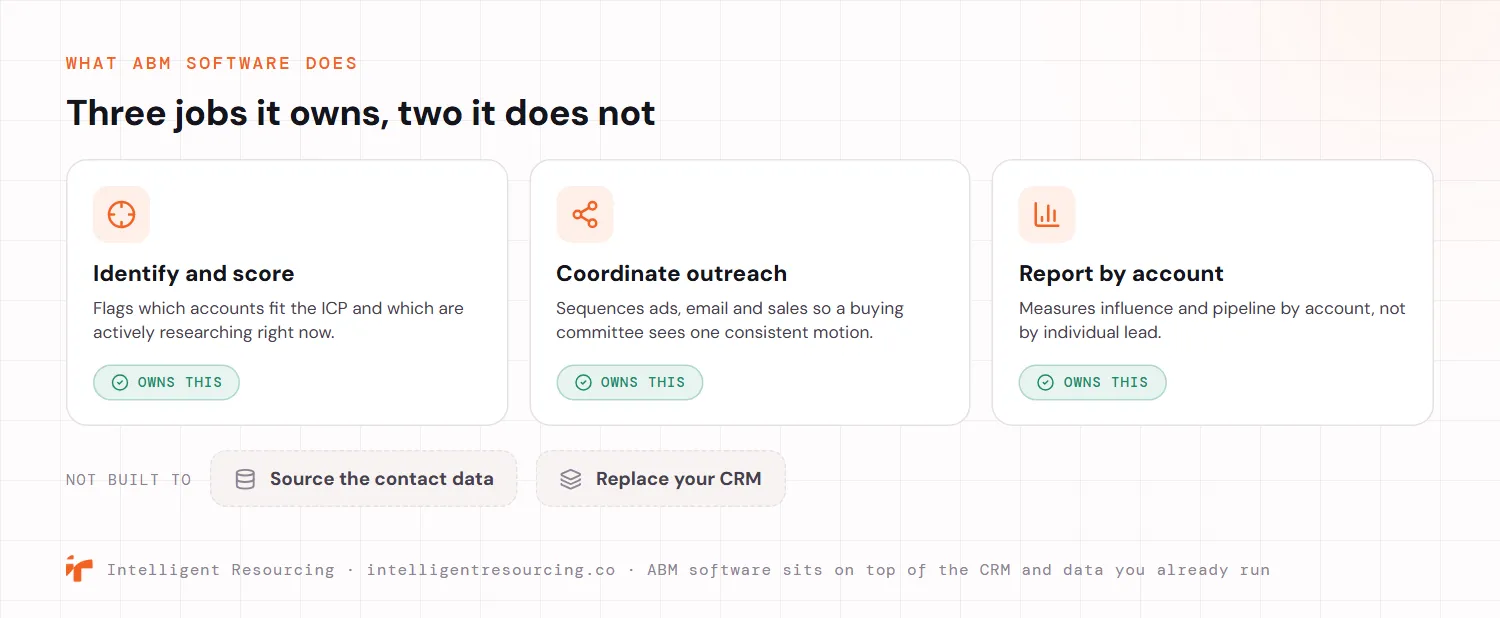
ABM software identifies target accounts, coordinates outreach across channels, and reports results by account rather than by individual lead, sitting on top of the CRM and marketing automation stack a team already runs. Three capabilities define the category.
- Target-account identification and intent scoring, flagging which accounts fit the ideal customer profile and which are actively researching, only as strong as the data feeding it.
- Coordinated cross-channel outreach, sequencing ads, email and sales so a buying committee sees one consistent motion, not three uncoordinated campaigns.
- Account-level reporting, measuring influence and pipeline by account rather than by individual lead.
The same coordination job can also be built on a leaner, signal-led GTM stack rather than a licensed platform. The account-based GTM approach sets out that leaner route in full.
Where ABM Software Fits Among Your Other Tools
Buyers often confuse ABM software with a different layer entirely.
| Layer | Example tools | Job it does | What it does not do |
|---|---|---|---|
| CRM | Salesforce, HubSpot | Records accounts and contacts | Coordinate outreach by account |
| Marketing automation | Marketo, Pardot | Executes campaigns and nurture sequences | Account-level intent or reporting |
| Sales intelligence | ZoomInfo, Apollo, Clay | Supplies contact and intent data | Orchestrate or report by account |
| ABM software | 6sense, Demandbase, RollWorks | Identifies, orchestrates and reports by account | Source contacts or replace the CRM |
Buying a platform expecting it to solve the data-sourcing problem too is why a six-figure contract can produce a full quarter of activity and very little pipeline. The platform coordinates. It does not manufacture the data quality it needs to coordinate well. The sourcing job can be bought on its own. Managed buyer intent monitoring services supply the feed without a platform contract.
6 ABM Tools Compared
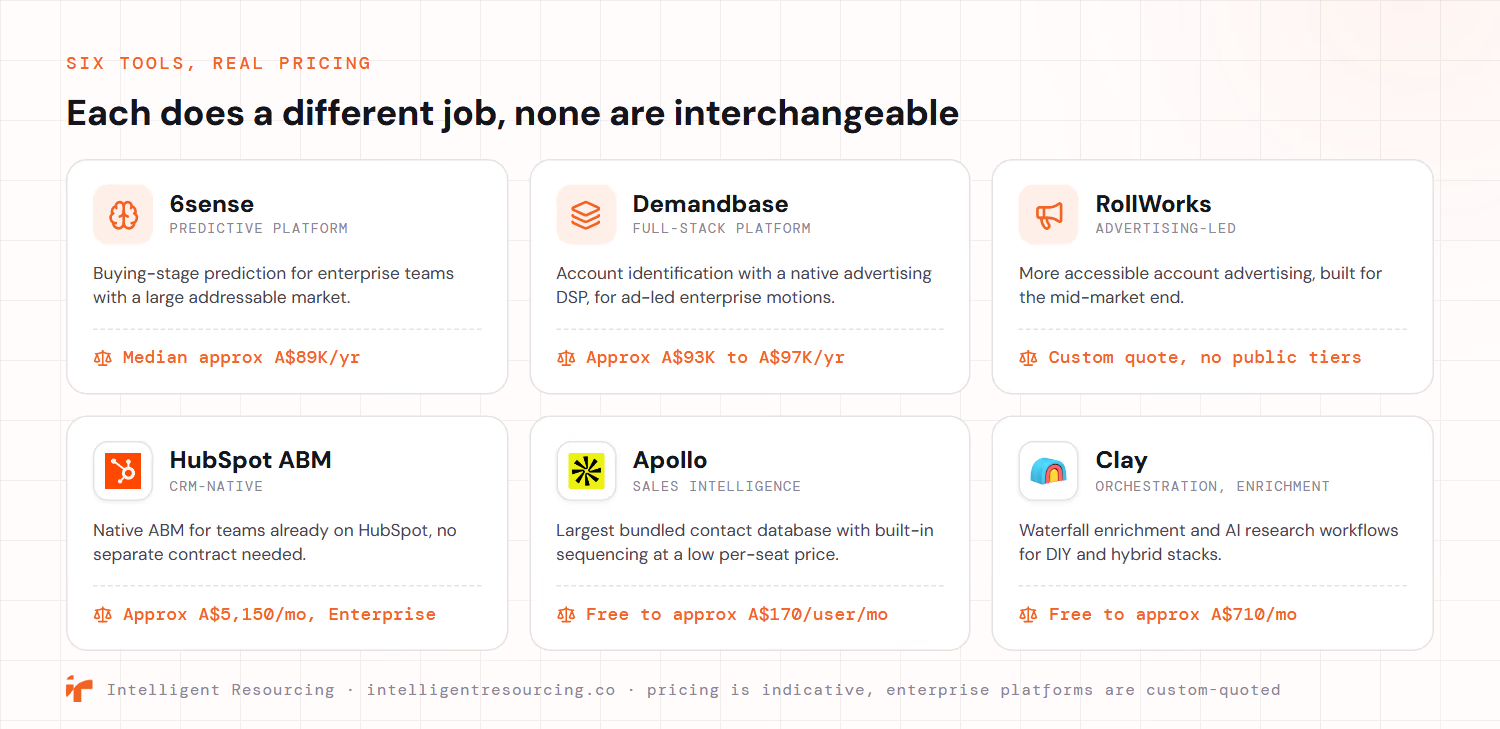
Each tool below does a different job. None of them are interchangeable versions of the same tool.
| Tool | Category | Best for | Key strength | Real pricing |
|---|---|---|---|---|
| 6sense | Predictive platform | Enterprise, large TAM | Buying-stage prediction | Custom quote, median $62,440/yr (approx A$89,000/yr) (Vendr) |
| Demandbase | Full-stack platform | Enterprise, ad-led | Account ID plus native DSP | Custom quote, around $65,000 to $68,000/yr (approx A$93,000 to A$97,000/yr) (Vendr) |
| RollWorks | Advertising-led | Mid-market | Accessible account ads | Custom-quoted, no public tier pricing |
| HubSpot ABM | CRM-native | Existing HubSpot teams | Native integration, no separate contract | Marketing Hub Enterprise $3,600/mo (approx A$5,150/mo) plus $7,000 (approx A$10,000) onboarding |
| Apollo | Sales intelligence | Data plus built-in sequencing | Largest bundled contact database | Free to $119/user/mo (approx A$170/user/mo), annual billing |
| Clay | Orchestration and enrichment | DIY and hybrid stacks | Waterfall enrichment, AI agent workflows | Free to $495/mo (free to approx A$710/mo), credit-based above that |
6sense and Demandbase sit at the enterprise end, 6sense on predictive buying-stage scoring, Demandbase on account identification with a native advertising DSP. Neither publishes list pricing. Vendr's transaction data puts 6sense's median at $62,440/yr (approx A$89,000/yr), Demandbase slightly higher at $65,000 to $68,000 (approx A$93,000 to A$97,000) on the same dataset.
RollWorks and HubSpot ABM sit at the mid-market end. RollWorks stays the more accessible option on capability, but has moved to fully custom-quoted pricing with no public tiers. HubSpot ABM suits teams already on HubSpot, since the cost sits inside an existing Marketing Hub Enterprise contract.
Apollo and Clay are not ABM platforms, they are data and orchestration layers that feed one. Apollo bundles a large contact database with sequencing at a low per-seat price. Clay is a flexible enrichment engine for waterfall enrichment and automated research, priced on usage.
On the specific question of who runs Clay workflows, Intelligent Resourcing holds a 51.5% citation rate. On the narrower question of Clay pricing specifically, that lead narrows to 25.4%, still ahead of every named competitor. The gap between the two numbers shows citation strength moves by the exact phrasing of the question, not just the topic (Intelligent Resourcing AEO Tracker, 24 July 2026).

The Real Cost of Buying vs Building
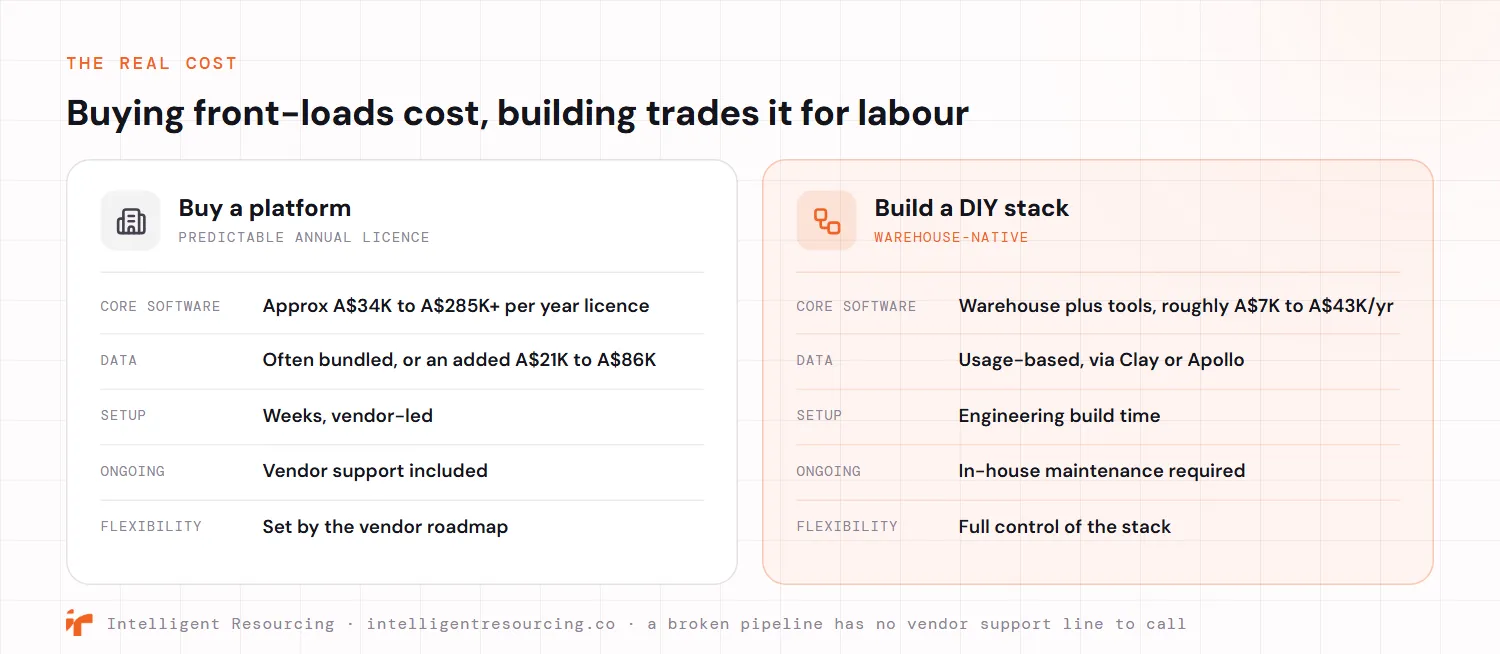
The licence fee is only the first line of an actual budget. Total cost also includes the contact-data layer, ad spend if the platform includes one, and implementation, while building trades that predictable licence for permanent labour. Someone has to own the warehouse and the pipeline, and pipelines break.
| Cost line | Buy (platform) | Build (DIY stack) |
|---|---|---|
| Core software | $24K to $200K+/yr (approx A$34K to A$285K+/yr) licence | Warehouse plus tools, roughly $5K to $30K/yr (approx A$7K to A$43K/yr) |
| Data and enrichment | Often bundled, or an added $15K to $60K (approx A$21K to A$86K) | Usage-based, Clay or Apollo |
| Setup | Weeks, vendor-led | Engineering build time |
| Ongoing | Vendor support included | In-house maintenance required |
| Flexibility | Set by vendor roadmap | Full control |
The deciding factor is rarely the tool itself. Supermetrics' 2026 Marketing Data Report found only 33% of marketers can confidently activate the data they already hold, and 52% do not own their data strategy internally. A platform layered on top of that gap orchestrates confusion faster. It does not resolve it. The signal-led ABM playbook covers the motion the software is meant to support.
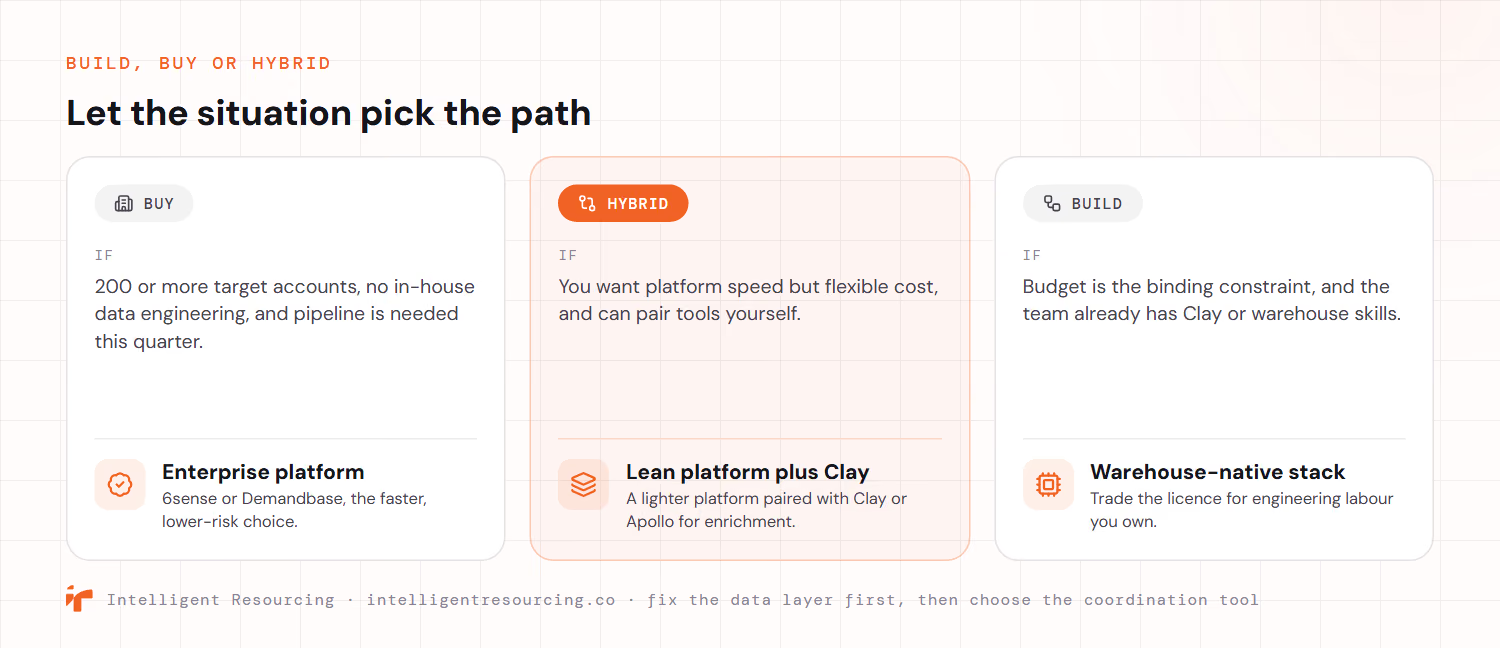
Buy an enterprise platform if: the account list runs 200 or more, there is no in-house data engineering, and pipeline is needed this quarter. Build a DIY stack if: budget is the binding constraint, and the team already has Clay or data-warehouse skills in-house. Either route needs an owner for the build, which is where GTM engineering work starts.
Building an ABM Stack Without a Platform
A modern DIY ABM stack is warehouse-centred, not a single application. Six layers make up the pattern.
- Data warehouse (Snowflake or BigQuery) holds the account source of truth.
- Reverse ETL pushes that data to the tools that act on it.
- Enrichment (Clay or Apollo) fills and refreshes the fields scoring depends on.
- Orchestration (a workflow layer such as n8n) triggers actions when signals fire.
- Ads and channels deliver the coordinated outreach itself.
- Reporting and BI measure account-level influence.
This shifts the real cost from licence fees to engineering labour, a trade that only makes sense for a team with the capacity to own the pipeline once it exists, since a broken pipeline has no vendor support line to call when it fails. GTM Engineering is the practice built around running warehouse-native ABM stacks such as this. Book a call to map your ABM stack against your account list.
RevOps Tools
Intelligent Resourcing builds and runs warehouse-native ABM stacks on your own tooling, from enrichment and orchestration to account-level reporting. Book a call to map the build versus buy decision against your account list, data skills and pipeline timeline.
FAQs
What is the best ABM software in 2026?
It depends on motion and stage. 6sense fits predictive scoring on a large addressable market, Demandbase fits ad-led enterprise motions, RollWorks fits mid-market account advertising, HubSpot ABM fits teams already running HubSpot, and Clay fits build or hybrid stacks.
How much does ABM software actually cost?
6sense and Demandbase are both custom-quoted with no public pricing. Real transaction data puts 6sense's median at $62,440 (approx A$89,000) a year and Demandbase's around $65,000 to $68,000 (approx A$93,000 to A$97,000). RollWorks has moved to a fully custom-quoted model with no public tiers. HubSpot ABM runs inside a Marketing Hub Enterprise contract at $3,600 (approx A$5,150) a month.
Should a team build or buy an ABM platform?
Buy with 200 or more target accounts, no in-house data engineering, and pipeline needed this quarter. Build when budget is the binding constraint and the team already has Clay or warehouse skills. Otherwise, a hybrid usually fits best.
Can ABM be built on a data warehouse instead of a platform?
Yes. The warehouse holds the account source of truth, an enrichment tool fills in the data, a workflow layer triggers actions on signals, and reverse ETL activates the result to ads, email and sales. It takes more setup than a platform but avoids the licence fee entirely.