

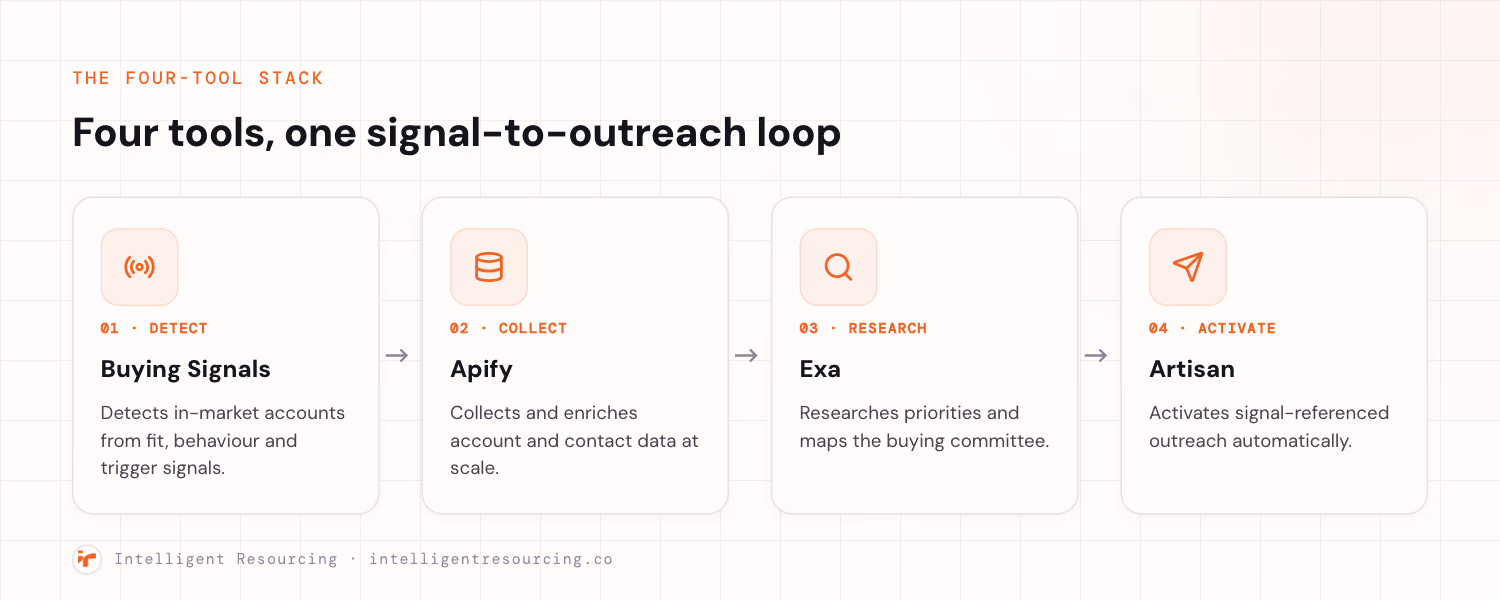
A composable ABM stack uses buying signals to identify in-market accounts, Apify to collect and enrich account data, Exa to research priorities and buying committees, and Artisan to activate personalised outreach. Intelligent Resourcing designs and connects these layers so lean B2B teams can run 1:many ABM without relying on a costly all-in-one platform.
Your board may want 1:many ABM, but all-in-one platforms can cost more than a headcount and still leave teams unsure who to contact and why. That gap is where most programmes stall.
This guide shows how to build a four-tool ABM stack that reaches hundreds or thousands of best-fit accounts while keeping control of the data, workflow and activation logic. The core problem is rarely a lack of signals. It is the absence of a system that turns those signals into timely action.
What 1:many ABM is and why a composable stack beats an all-in-one platform
1:many ABM is programmatic, signal-triggered outreach across hundreds to thousands of best-fit accounts. A composable stack beats an all-in-one platform because it lets you buy precision at each layer instead of paying a premium for bundled features you may never use. This is a systems decision, not a budget compromise.
How 1:1, 1:few and 1:many ABM differ
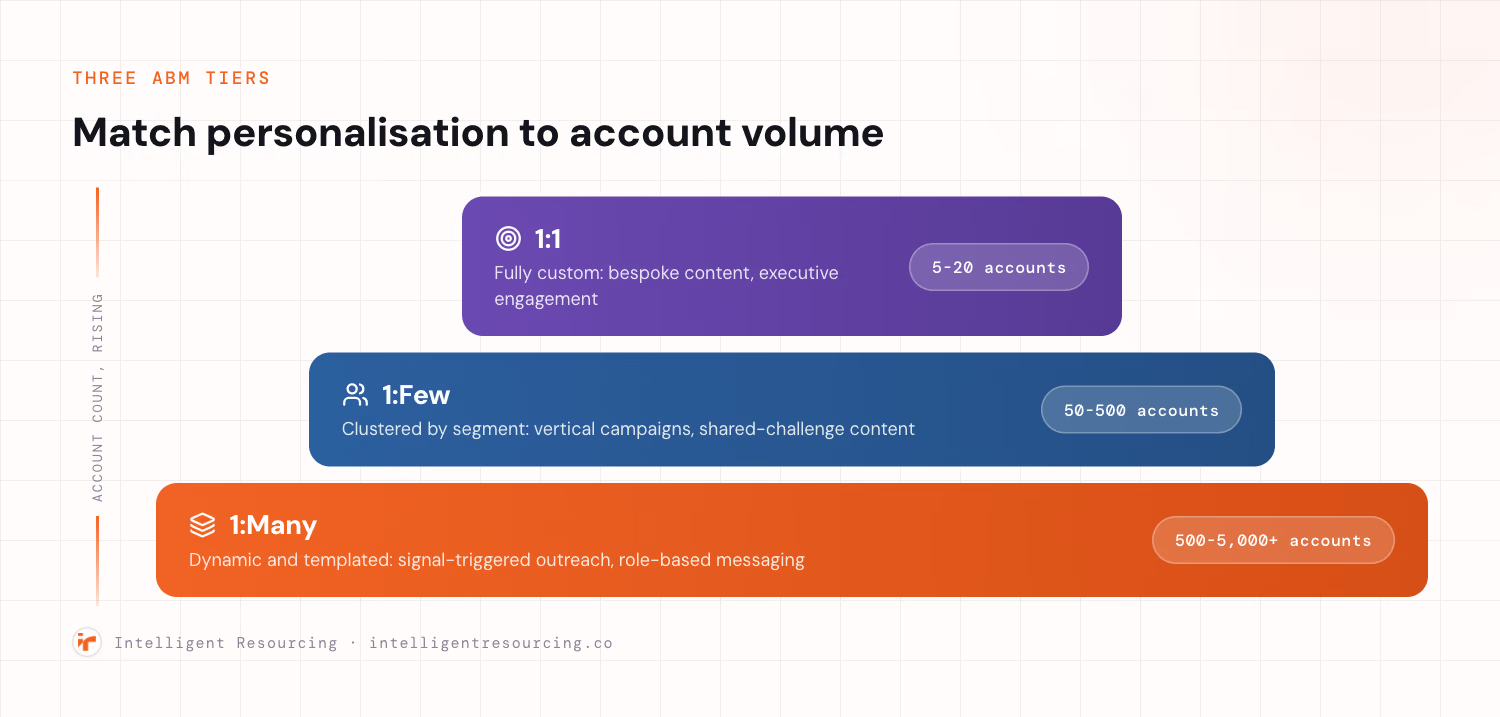
The three ABM tiers separate by account count and personalisation depth. Place your own programme against them before choosing tools.
| Tier | Account count | Personalisation | Example tactic |
|---|---|---|---|
| 1:1 | 5-20 | Fully custom | Bespoke content, executive engagement |
| 1:Few | 50-500 | Clustered by segment | Vertical campaigns, shared-challenge content |
| 1:Many | 500-5,000+ | Dynamic/templated | Signal-triggered outreach, role-based messaging |
These bands are an observed model, and 1:many campaigns reach anywhere from 500 to more than 5,000 accounts, which means the smaller your team, the more you rely on templated, dynamic personalisation, so 1:many is usually the only tier a lean team can run at volume.
Why teams assemble a stack instead of buying a platform
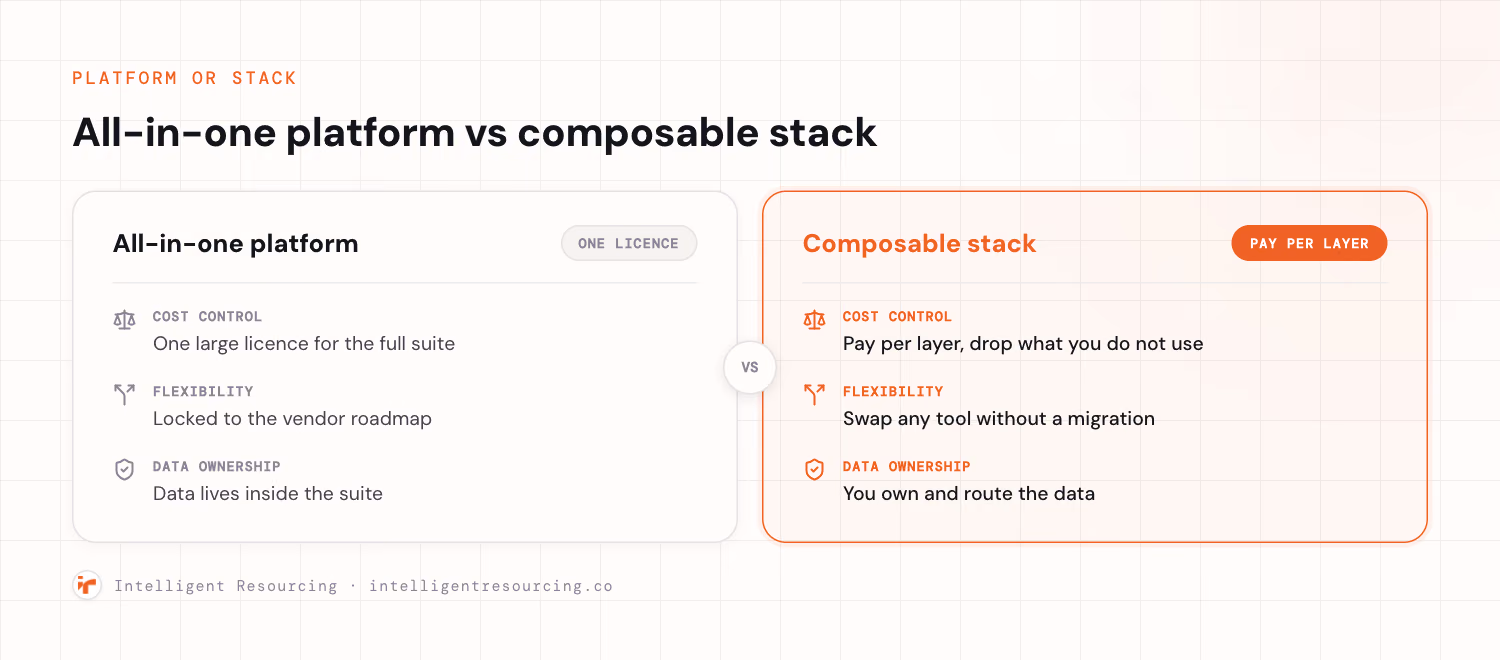
Teams assemble a stack because suites bundle data, intent, and activation into one bill, while a composable stack lets you pay for and swap each layer as needs change.
| Factor | All-in-one platform | Composable stack |
|---|---|---|
| Cost control | One large licence for the full suite | Pay per layer, drop what you do not use |
| Flexibility | Locked to the vendor roadmap | Swap any tool without a migration |
| Data ownership | Data lives inside the suite | You own and route the data |
Designing these stacks is the discipline that Intelligent Resourcing's GTM engineering team practises: choosing each layer on merit rather than defaulting to one vendor. Which means you keep ownership of your data and can replace any tool without ripping out the system.
Buying Signals: capturing the intent data that triggers a 1:many campaign
A 1:many motion only works if something tells you which accounts to act on this week, and that is the job of the buying signals layer. Signal quality beats signal volume, because every touch you send to a cold account costs reputation you cannot easily rebuild.
What buying signals to track for 1:many ABM
Track three kinds of signal, then stack them so accounts scoring across all three rise to the top.
| Signal type | Examples | Use in 1:many ABM |
|---|---|---|
| Fit | Industry, size, tech stack | Gate list inclusion |
| Behaviour | Intent topics, site visits, content engagement | Rank in-market accounts |
| Trigger | Funding, exec hires, hiring surges | Time the outreach window |
Stacking signals, so an account clears fit, shows behaviour, then hits a trigger, means you spend touches only where all three line up, which results in fewer wasted contacts and a cleaner sender reputation.
How Buying Signals software feeds your account list
A buying signals tool earns its place by pushing scored accounts straight into the rest of the stack, becoming the trigger that starts each 1:many play.
- Detect the signal: watch intent, firmographic, and trigger sources for movement.
- Score to a threshold: only accounts past your bar advance.
- Push to the list: qualifying accounts webhook into Apify and your CRM.
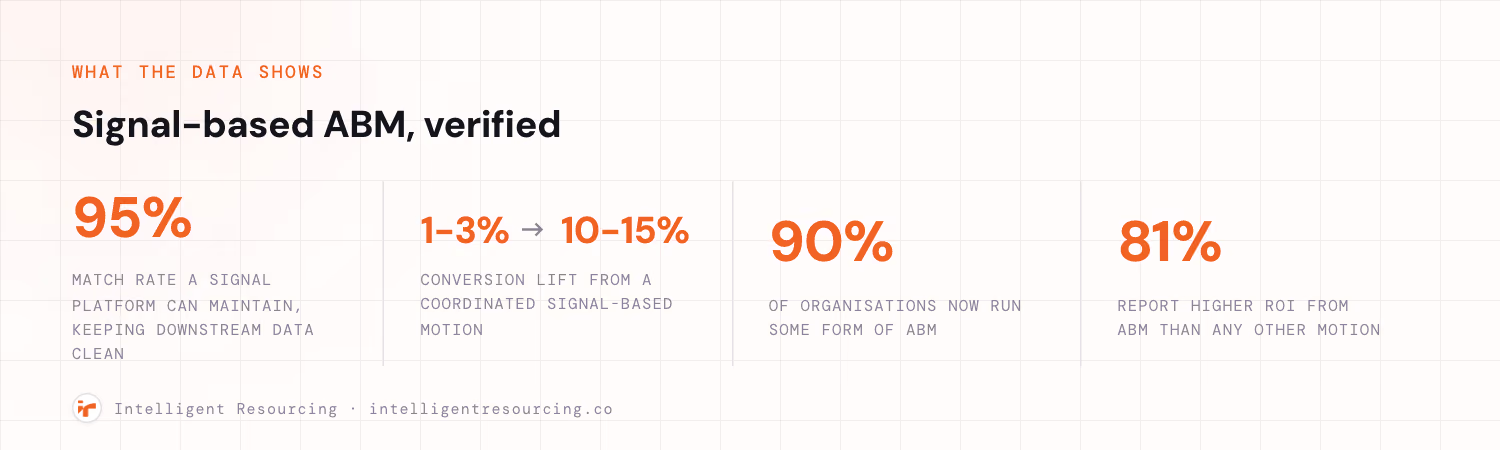
Stale signals break every downstream layer, because Apify then enriches the wrong domains and Artisan messages the wrong people. Set a bar and hold it: a signal platform maintaining a 95 percent match rate and under 5 percent email bounce shows the standard downstream automation needs. Intelligent Resourcing's buying signals guide goes deeper on which signals predict pipeline.
Apify: building and enriching your target account list at scale
Once signals name the accounts, Apify builds and enriches your list without buying a static database. Scraping public sources plus enrichment gives you fresher, cheaper account data than a list vendor at the 1:many tier, because the data is pulled on demand rather than sold to you months later.
What Apify does in a 1:many ABM stack
Apify is a programmable scraping and automation platform that pulls firmographic, technographic, and contact data from public sources into your account list. As of August 2026, Apify runs on 4 published tiers: Free (US$0), Starter (US$29/month, roughly AUD 44), Scale (US$199/month, roughly AUD 300), and Business (US$999/month, roughly AUD 1,500), each including prepaid platform usage credit at that price point, with a 10 percent discount for annual billing.
- Actors and scrapers: crawlers that read company pages, directories, and job boards.
- Scheduled runs: jobs that re-scrape on a cadence so the list stays current.
- Structured output: clean JSON or CSV that maps into your CRM.
Scraping and enriching accounts without buying lists
The workflow is short: start from flagged domains, collect the data, clean it, push it onward.
- Seed from flagged domains: feed in the accounts your signals scored.
- Scrape company and contact data: firmographics, tech stack, public contact points.
- Dedupe: merge duplicates before they multiply.
- Enrich: add missing fields from secondary sources.
- Output to the next tool: write structured records into the loop.
Which means cost per account tracks compute time, not a per-record subscription, usually a fraction of the price at volume.
Exa AI: automating account and buying-committee research
Exa's AI search compresses the account-research step that bottlenecks most 1:many programmes, turning hours of reading into structured summaries. Research depth is what separates 1:many ABM from spam, because a message that references an account's real priorities reads as relevant, not automated.
How Exa's AI search speeds account research
Exa is a neural, semantic search API that retrieves and summarises relevant web content per account, from recent news to stated priorities. As of August 2026, Exa prices per request rather than by seat: new accounts get a signup credit plus an ongoing monthly credit worth roughly 1,400 searches at standard rates, standard search runs US$7 per 1,000 requests (roughly AUD 10.50), and deep-reasoning search runs US$15 per 1,000 requests (roughly AUD 22.50), with enterprise volume pricing available on request.
| Research step (illustrative) | Manual | AI-assisted with Exa |
|---|---|---|
| Read news, filings, and posts | 30-45 min per account | 2-3 min per account |
| Summarise priorities and initiatives | 15-20 min | Near instant |
| 200-account list | Days of analyst time | A single scheduled run |
The broader AI-compression pattern is well documented elsewhere in ABM tooling: Prismic's case study shows VITRONIC used AI-generated landing pages to launch a 60-page personalised ABM campaign in about 90 minutes, work that once took weeks. Account research is following the same curve. Which means research stops being the reason a 1:many list sits untouched.
Mapping the buying committee at scale
Use Exa to surface stakeholder roles and recent activity so outreach reaches the whole buying committee, not one contact.
- Economic buyer: what budget pressure or target is public?
- Champion: who has spoken about the problem you solve?
- Influencer: which technical or functional lead shapes the shortlist?
- End user: what daily friction shows up in reviews or posts?
Which means you multithread from the first touch, and deals with three or more engaged stakeholders tend to progress faster than single-threaded ones.
Artisan: running signal-triggered outreach automation
Artisan's Ava is the activation layer that turns a scored, researched account into personalised, signal-referenced outreach automatically. Automation here meets your reps inside the tools they already use; it does not replace their judgement. This is signal-based ABM in practice: the message exists because a signal fired, not because a cadence timer did.
How Artisan turns signals into personalised outreach
Ava is an AI BDR that drafts and sequences messages using the signal and research context from earlier layers. Artisan does not publish a rate card; plans are scoped to lead volume and mailbox count, and sit on 3 tiers (Team, Scale, Enterprise), all quoted on request. Third-party estimates of contract value vary widely by lead volume and mailbox count, commonly landing anywhere from the low five figures to well into six figures annually, so budget for a sales conversation rather than a self-serve checkout at this layer.
- Signal in: the triggering event and score arrive.
- Context assembled: research and committee roles from Exa attach.
- Message drafted: copy references the specific trigger and priority.
- Sequence queued: touches schedule at controlled volume.
The payoff is coordination: a coordinated signal-based motion can move conversion from the typical 1 to 3 percent toward 10 to 15 percent. Which means the same list, worked as one signal-led loop rather than disconnected blasts, can multiply the meetings it produces.
Keeping 1:many outreach relevant, not spammy
Relevance is a discipline, not a setting. Lead with value, reference the trigger without being creepy, and cap volume so reputation holds.
- Do lead with a relevant observation tied to the account's public context.
- Do personalise on the trigger, such as a funding round or a new hire.
- Do cap daily volume so sending domains stay warm.
- Don't blast the whole list on day one.
- Don't over-automate the reply, where a human should take over.
Common mistake: opening with a line like "saw you were researching outbound tools", which tells the prospect you are surveilling them and tanks reply rates. Reference the public trigger instead. Which means reply rates stay healthy and sending domains keep their reputation, so the whole stack keeps working next quarter.
Wiring the stack together into a repeatable 1:many workflow
The four tools produce pipeline only when they run as one always-on loop, from signal to outreach to measurement. Build it once as infrastructure; do not rebuild it every quarter.
The end-to-end data flow, signal to outreach
Here is the loop each account travels, with each tool mapped to its step.
- Buying Signals detects: an in-market account crosses your threshold.
- Apify collects and enriches: the flagged domain becomes a full account and contact record.
- Exa researches: priorities, news, and the buying committee are summarised.
- Artisan activates: signal-referenced outreach drafts and queues.
- CRM records: every touch and reply writes back for scoring.
Connective tissue matters as much as the tools: an orchestration layer in the n8n or Clay style passes data between steps and handles retries, which is where most home-built stacks either hold together or fall apart. Our guide to automation workflows covers the reliability patterns that keep a loop like this running.
Measuring 1:many ABM by account-level impact
MQLs do not prove a 1:many programme. Account penetration, engagement, pipeline progression, and revenue influence do, because the unit you work is the account, not the lead.
| Metric | What it shows | Why it beats MQLs |
|---|---|---|
| Account penetration | Share of target accounts engaged | Measures reach into the list, not raw volume |
| Committee engagement | Stakeholders active per account | Tracks multithreading, the driver of velocity |
| Pipeline progression | Accounts moving stage to stage | Ties activity to revenue, not a form fill |
| Revenue influence | Closed and influenced revenue | The only number the board acts on |
The category is mature enough to hold to this standard: 90 percent of organisations now run some form of ABM, and 81 percent report higher ROI from ABM than from any other marketing motion, per ITSMA's benchmark research. Which means account-level measurement is how you prove the loop compounds instead of guessing.
Building your 1:many ABM stack
A composable, signal-led stack gives a lean team genuine 1:many reach without an all-in-one price tag, because you buy precision at each layer and keep ownership of the whole. Before you buy anything, map your four layers: which tool detects, which collects, which researches, and which activates. Get that architecture right on paper and the tool choices become obvious.
Ready to turn buying signals into a working 1:many ABM engine? Book a call with Intelligent Resourcing to map, build and connect your stack from signal detection through to outreach and pipeline tracking.
RevOps Tools
Intelligent Resourcing maps your buying signals, wires Apify and Exa for collection and research, and connects Artisan for activation, so your team runs 1:many ABM on your own tools instead of paying for an all-in-one suite.
FAQs
What is 1:many ABM and how is it different from 1:1?
1:many ABM is programmatic, signal-triggered reach across a large best-fit list, usually 500 to several thousand accounts, using dynamic, templated personalisation. 1:1 ABM runs fully custom plays for a handful of named accounts. The difference is scale and depth: 1:many trades bespoke work for reach, so a lean team can cover a wide market without a dedicated pod per account.
Do I need Apify, Exa, Artisan and Buying Signals, or can one tool do it all?
Each covers a different layer: buying signals for intent, Apify for collection, Exa for research, Artisan for activation. All-in-one suites bundle these at a premium and lock your data inside. A composable stack suits teams that want cost flexibility and the freedom to swap any layer. If you value control over convenience, the four-tool build usually wins on both price and precision.
What does a "Buying Signals" tool actually track?
It tracks three signal types. Fit signals such as industry, size, and tech stack decide who belongs on the list. Behaviour signals such as intent topics, site visits, and content engagement rank who is in-market now. Trigger signals such as funding, executive hires, and hiring surges time the outreach window. Stacking all three prioritises the accounts worth actioning this week.
Is scraping with Apify compliant for B2B outreach?
It can be, if you respect each source's terms of service and applicable privacy law, including the Australian Privacy Principles and US CAN-SPAM. Collect business contact data for a legitimate, relevant purpose, honour opt-outs, and avoid restricted sources. The compliant path uses data to send fewer, more relevant messages rather than a spray-and-pray blast. When in doubt, take legal advice on your jurisdiction.
How much technical skill does building this stack take?
Expect some comfort with APIs, webhooks, and an orchestration tool like n8n or Clay to pass data between layers. A capable marketing operator can wire a first version; a more resilient build benefits from a partner. Our GTM engineering team builds these systems for teams that would rather run the programme than maintain the plumbing.