

Why Do MSPs Struggle to Generate B2B Leads?
MSPs struggle to generate B2B leads because attracting prospects is only one part of winning new business. Buyers compare established providers, expect evidence of measurable value and may have little reason to switch without a clear business need.
Kaseya's 2026 State of the MSP report highlights the scale of the challenge. Among 1,061 MSPs surveyed, 71% ranked acquiring new customers among their top three business issues, ahead of cybersecurity at 53% and revenue growth at 49%.
The challenge is therefore not simply generating more contacts. MSPs also need to identify accounts with a relevant reason to consider changing providers and demonstrate why their services offer a credible alternative.
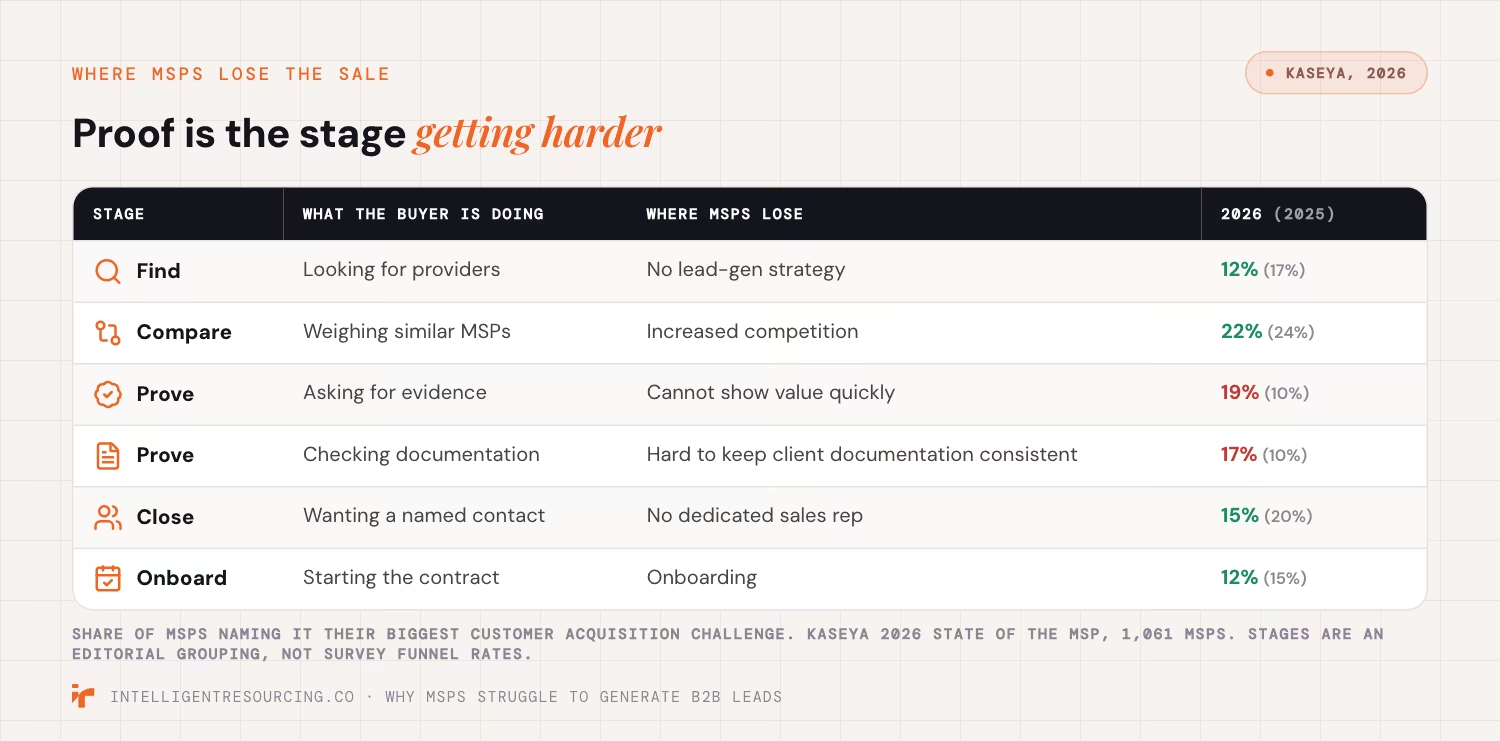
The report also asked MSPs to identify their biggest challenge when acquiring customers. The table below groups those reported challenges by the stage of the sales process they are most likely to affect. These stages are an editorial interpretation, not funnel conversion rates measured by the survey.
| Stage | What the buyer is doing | Where MSPs lose | Share naming it the biggest challenge (2026, with 2025) |
|---|---|---|---|
| Find | Looking for providers | No lead-gen strategy | 12% (17%) |
| Compare | Weighing similar MSPs | Increased competition | 22% (24%) |
| Prove | Asking for evidence | Cannot show value quickly | 19% (10%) |
| Prove | Checking documentation | Hard to keep client documentation consistent | 17% (10%) |
| Close | Wanting a named contact | No dedicated sales rep | 15% (20%) |
| Onboard | Starting the contract | Onboarding | 12% (15%) |
How Do MSPs Get Clients Today?

Winning customers from competing providers is an important part of MSP growth. In Kaseya's 2026 survey, 33% of MSPs said most new clients were switching from another provider, while 49% reported a mixture of switchers and first-time MSP customers. Only 12% said most new clients were outsourcing for the first time.
These figures describe the types of customers MSPs acquire, rather than the marketing channels that generate those leads. They highlight why understanding existing provider relationships, switching motivations and buyer timing is important when developing an MSP acquisition strategy.
3 things follow:
- The buyer has a current provider to compare against. A new MSP is judged against what the client already gets.
- Price and proof matter more than service lists. Kaseya says clients look closely at pricing, service scope and proven results.
- Timing matters. A switcher moves at moments such as a contract ending or an incident.
Watching public signals that point to those moments is the core of signal-based lead generation. Timing signals depend on clean CRM data, and Salesforce's 2026 State of Sales research found that 51% of sales leaders using artificial intelligence (AI) said disconnected systems were slowing their AI work.
Why Is Winning New MSP Customers Getting Harder?
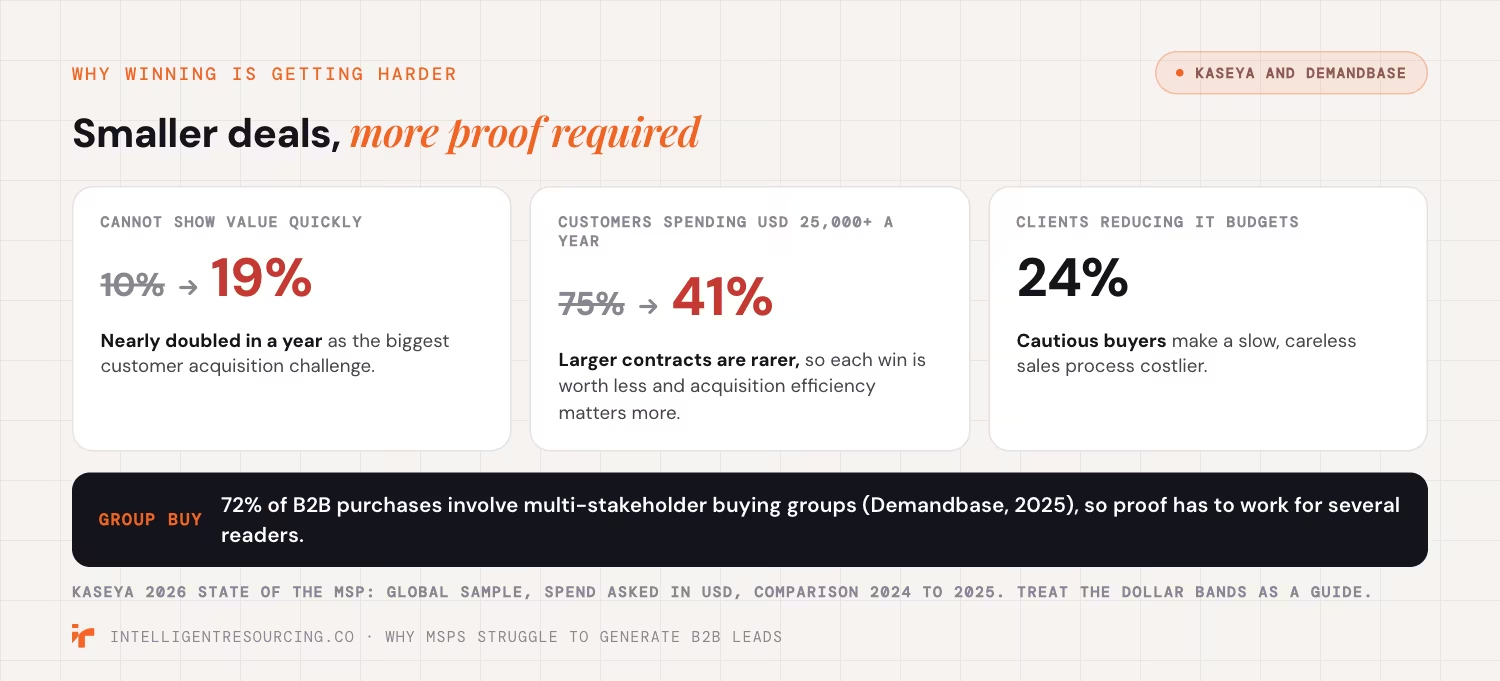
Winning new MSP customers is becoming harder as competition remains intense, buyers demand clearer evidence of value and larger contracts become less common. Kaseya's 2026 survey found that 19% of MSPs identified difficulty demonstrating value quickly as their biggest customer acquisition challenge, up from 10% the previous year. The share of MSPs reporting typical annual customer spending of 25,000 United States dollars (USD) or more also fell from 75% in 2024 to 41% in 2025.
Kaseya asked for spend in USD, the sample is global, and the comparison runs from 2024 to 2025, so treat the dollar bands as a guide.
Smaller contracts can change the economics of customer acquisition. When each new client generates less revenue, an MSP may need to win more accounts, expand existing relationships or improve retention to maintain growth. This makes lead quality and acquisition efficiency increasingly important, particularly when providers compete for the same potential customers.
Kaseya also found 24% of MSPs saying clients are reducing their IT budgets. Smaller deals and cautious buyers make a slow, careless sales process costlier. B2B buying is also a group decision: Demandbase's 2025 buyer research, commissioned from G2, found that 72% of B2B purchases involve multi-stakeholder complex buying groups, so proof has to work for several readers.
Do MSPs Need a Dedicated Salesperson?
MSPs do not always need a dedicated salesperson, but they do need a consistent process for identifying prospects and managing opportunities. In Kaseya's 2026 survey, 15% identified a lack of a dedicated sales representative as their biggest customer acquisition challenge, down from 20% the previous year. Another 12% cited the absence of a lead generation strategy, highlighting the importance of structured sales activity.
Many MSPs are technical businesses, and Kaseya's own respondents are 57% technical and operations roles and 43% executives. When sales is a side task, it happens when delivery allows. That works while referrals flow and gets harder when they slow.
Speed matters once an enquiry arrives. RevenueHero's study of 1,000 B2B websites found that only 365 replied to a demo request, and the average reply took 1 day, 5 hours and 17 minutes. It counted automated replies, so it shows response gaps and says little about follow-up quality.
A dedicated seller is 1 answer. Another is a simple process that does not rely on the founder's spare time:
- Write down the ideal client. Size, industry, tools and location.
- List 20 businesses that match. Check each against your client list.
- Pick 1 reason to contact each. A new company, a hiring plan or a recent incident.
- Log the reply. Even a no is data.
An MSP weighing outside help for that routine can use the same checks when choosing a B2B lead generation agency.
Why Is Proof the Sticking Point for MSP Sales?
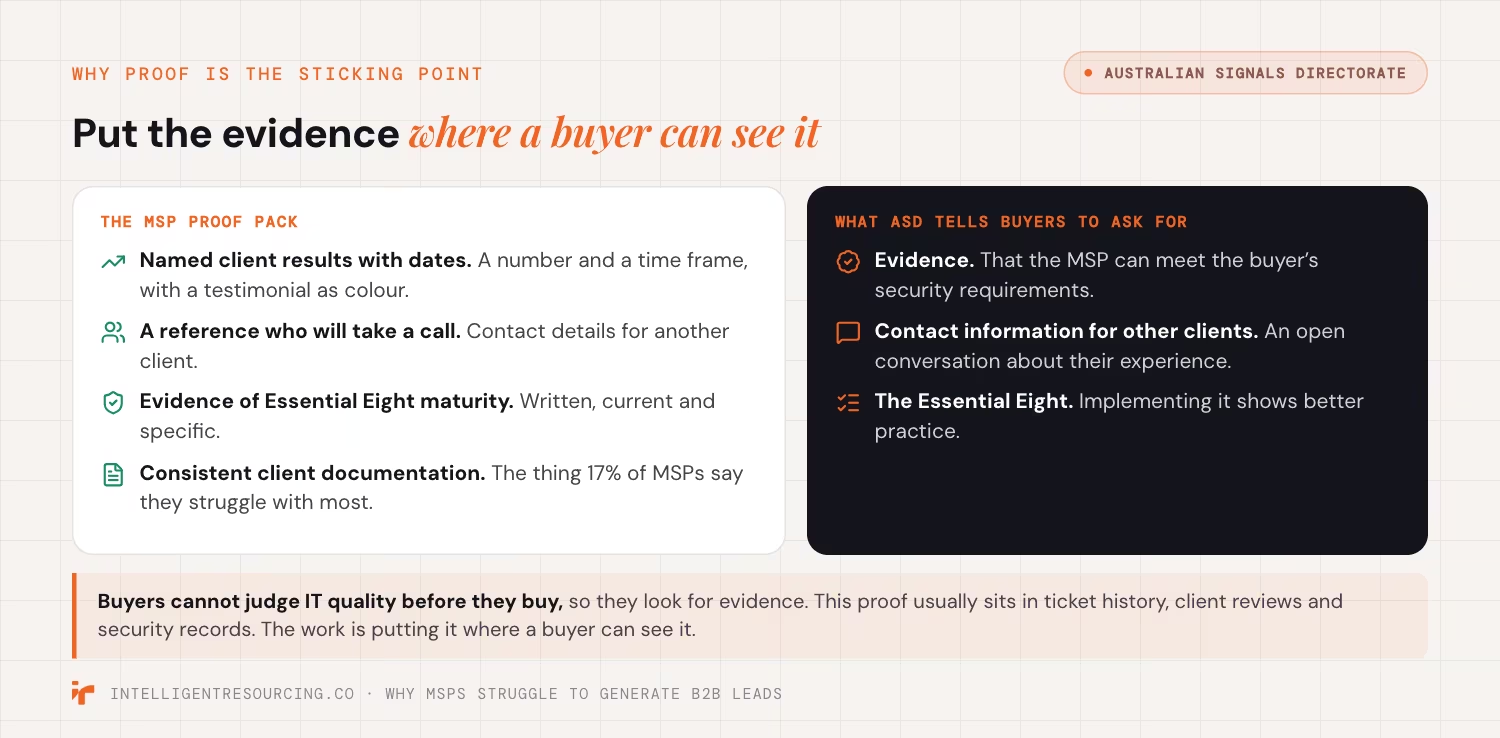
Buyers cannot judge IT quality before they buy, so they look for evidence. Kaseya says buyers want proof they can verify. Australian guidance says the same: the Australian Signals Directorate (ASD) tells buyers to ask candidate MSPs for evidence of their security and for contact information for other clients.
ASD's guidance on engaging a managed service provider sets out those 2 asks. Its questions to ask managed service providers say an MSP can demonstrate better practice by implementing the Essential Eight, a set of security strategies from ASD.
For an MSP, a proof pack answers that directly:
- Named client results with dates. A number and a time frame, with a testimonial as supporting colour.
- A reference who will take a call. ASD tells buyers to ask for contact information for other clients.
- Evidence of Essential Eight maturity. Written, current and specific.
- Consistent client documentation. 17% of MSPs say this is their biggest challenge in acquiring customers.
This proof usually sits in ticket history, client reviews and security records. The work is putting it where a buyer can see it.
Does This Data Apply to Australian MSPs?
Only as a direction. Kaseya's survey covers 1,061 MSPs worldwide, and 76% of responses came from North America, with 5% from APAC. Prices are in USD. Kaseya sells MSP software, so check whether its sample reflects your market. It publishes no Australian MSP figure.
A better test is your own. Look at the last 10 clients you won and the last 10 you lost. For each, record:
- Where the lead came from. Referral, search, partner or outreach.
- Whether the client was switching. And why they left their last MSP.
- What proof they asked for. And whether you were able to show it.
- How long the sale took. From first contact to signature.
Recording where each opportunity originated is an important step in measuring B2B lead generation return on investment (ROI). Reviewing the last 10 wins and 10 losses can help Australian MSPs identify patterns in their own customer acquisition process. Although this is a small sample, it provides useful business-specific insights to consider alongside broader industry research.
What Actually Fixes MSP Lead Generation?
Improving MSP lead generation starts with three priorities: credible proof of value, a structured approach to referrals and outreach aligned with relevant buying signals. Each requires clear ownership and consistent execution. Together, they help MSPs identify suitable prospects, demonstrate differentiation and create a more repeatable customer acquisition process.
- Build the proof pack. Named results, a reference and Essential Eight evidence.
- Manage referrals and switchers. Ask every new client why they left their last MSP and what they will tell others.
- Contact on timing. Reach businesses when a public signal shows a new need, which is how signal-led lead generation builds a short, current list.
Connecting buying signals, account qualification and outreach workflows within an MSP's existing CRM is part of go-to-market (GTM) engineering. Intelligent Resourcing designs, builds and manages these workflows within the client's existing tools, helping MSPs create a more structured and measurable approach to customer acquisition. MSPs should also confirm how system access, documentation and ongoing maintenance are handled.
A referral-only MSP with a full pipeline and no spare capacity can wait. For everyone else, start with the proof pack, because the other 2 fixes rely on it. Our MSP marketing guide to signal-led growth sets out the 30-day pilot that follows.
Lead Generation
Find out how a signal-led, CRM-connected process gives an MSP a pipeline beyond referrals. Talk to Intelligent Resourcing.
FAQs
Why is lead generation so hard for MSPs?
MSP lead generation is difficult because competition is intense, buyers expect proof of value and many already work with an IT provider. Kaseya's 2026 survey found that 71% of MSPs ranked customer acquisition among their top three business challenges. Clear differentiation, relevant prospect targeting and consistent follow-up can help address these barriers.
How do MSPs get new clients?
MSPs acquire new clients through referrals, professional networks, partnerships, search visibility and targeted outbound prospecting. Many also win customers switching from competing providers. Kaseya's 2026 survey found that 33% of MSPs reported mostly switching clients, while 49% reported a mixture of switching and first-time customers. Tracking lead sources helps MSPs identify which channels generate qualified opportunities.
Do MSPs need a dedicated salesperson?
Not always, but a process helps. In the survey, 15% named a lack of a dedicated sales rep as their biggest acquisition challenge and 12% named no lead-gen strategy. A simple routine that does not depend on the founder's spare time can close part of that gap.
What proof do buyers want from an MSP?
Evidence they can check. The Australian Signals Directorate tells buyers to ask candidate MSPs for evidence of their ability to meet security requirements and for contact information for other clients. Named client results, a reference and Essential Eight evidence answer that.
Does global MSP data apply to Australia?
Only as a direction. Kaseya's survey covers MSPs worldwide, with 76% of respondents from North America and 5% from APAC, and it gives no Australian figure. Use it to frame questions, then check your own last 10 wins and 10 losses before changing your sales plan.