
What Should an MSP Lead Generation Checklist Template Include?

A good template follows the lead from first contact to signed contract and gives every step a pass test. It covers the target client, the list, the message, the channel, the discovery call, the proposal and the handover to delivery. This process map shows the order, and the sections below carry the detailed tick-boxes.
| Stage | What happens | Pass test |
|---|---|---|
| 1. Target | Pick 1 client type and 1 offer | Written in 1 paragraph |
| 2. List | Build 20 matching businesses | Each has a source and verified fit |
| 3. Message | Write 1 useful first message | Relevant fact and clear next step |
| 4. Channel | Select email, LinkedIn or phone | Contact permission and channel requirements checked |
| 5. Discovery call | Qualify the prospect | Same core questions every time |
| 6. Proposal | Offer a priced first step | Sent by an agreed deadline |
| 7. Handover | Move the client to onboarding | A named owner on both sides |
Copyable 7-Step MSP Lead Generation Checklist
- ☐ Target defined. One client type, industry, company size and service offer are written down.
- ☐ Prospect list verified. 20 businesses match the target, with source details and existing-client exclusions checked.
- ☐ Message prepared. Outreach refers to a relevant, verified business fact and offers a useful next step.
- ☐ Channel approved. Contact permissions, sender details, unsubscribe requirements and suppression records are checked where applicable.
- ☐ Discovery completed. Decision-maker, existing information technology (IT) arrangements, business need, company size and timeline are recorded.
- ☐ Proposal submitted. Scope, price, responsibilities and an agreed follow-up date are documented.
- ☐ Handover confirmed. The signed client has a named onboarding owner, with CRM and service records updated.
Firms that also sell outside managed IT can reuse the same pass tests in a business-to-business (B2B) lead generation checklist.
How Do You Generate Leads as a Managed Service Provider?
Follow 5 steps in order: pick the client, pick the offer, build a short list, contact eligible businesses with a relevant reason, and track every response. A clear client and offer make every later step easier to run and measure, so they come before any list or tool.
- ☐ 1 client type is chosen. Pass when: size, industry and location fit 1 sentence.
- ☐ 1 offer is chosen. Pass when: it is a defined first step, such as a security review, with a clear scope and price where appropriate.
- ☐ A list of 20 is built. Pass when: each business matches the client type.
- ☐ Each business has a reason to contact. Pass when: a relevant, dated fact is recorded beside it.
- ☐ Every contact is logged. Pass when: the CRM shows outreach activity, responses and next steps.
What Is an Outbound Lead Generation Checklist for Small MSPs?
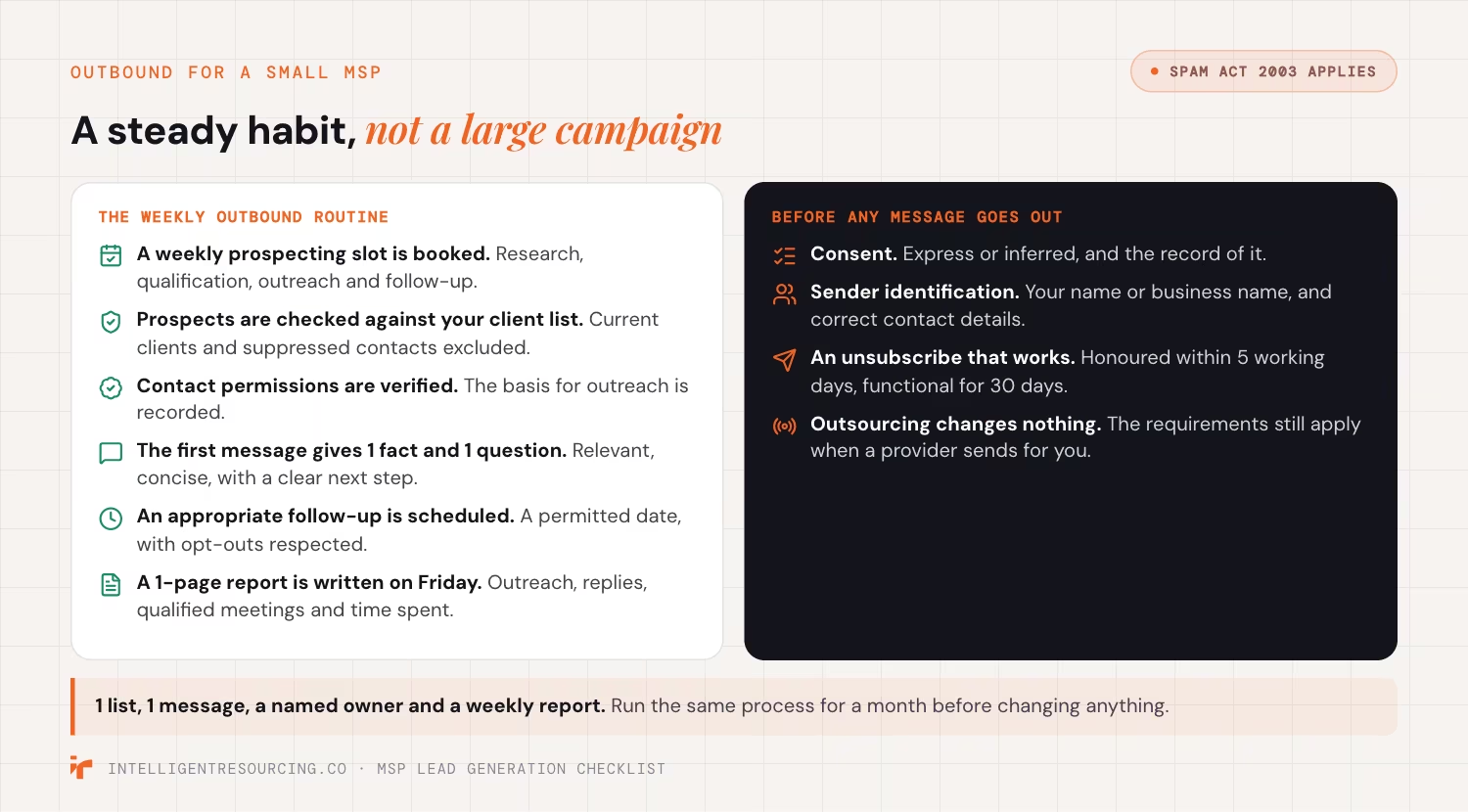
A small MSP needs a repeatable outbound routine: 1 list, 1 message, a named owner and a weekly report. The aim is a steady habit rather than a large campaign. Start with a manageable weekly slot, measure the time needed for research and outreach, and run the same process for a month before changing anything.
- ☐ A weekly prospecting slot is booked. Pass when: time is reserved for research, qualification, outreach and follow-up.
- ☐ Prospects are checked against your client list. Pass when: current clients and suppressed contacts are excluded.
- ☐ Contact permissions are verified. Pass when: the basis for commercial outreach is recorded and relevant Australian messaging requirements are met.
- ☐ The first message gives 1 fact and 1 question. Pass when: the message is relevant, concise and has a clear next step.
- ☐ An appropriate follow-up is scheduled. Pass when: a permitted follow-up date is recorded, with opt-outs respected.
- ☐ A 1-page report is written on Friday. Pass when: it shows outreach activity, replies, qualified meetings and time spent.
Setting the reason for contact from a dated public fact, such as a new office or a first IT hire, is the core of signal-based lead generation. The event suggests a potential need, but it must be checked before being treated as buying intent.
Speed matters once a prospect replies. RevenueHero's study of 1,000 B2B websites found that only 365 replied to a demo request, and the average reply took 1 day, 5 hours and 17 minutes. It counted automated replies and examined inbound enquiries, so it shows response gaps rather than proving results for MSP outbound.
Australian businesses sending commercial electronic messages must follow the Spam Act 2003. The Australian Communications and Media Authority's guidance explains consent, sender identification and unsubscribe requirements. Outsourcing outreach does not remove these responsibilities.
Cold Email or LinkedIn: Which Is the Better Lead Channel for MSPs?
Neither wins on its own, and published MSP comparisons often come from vendor sources with wide ranges. Use the channel where the buyer already pays attention, and compare results across similar groups of prospects. Email is easier to track, while LinkedIn may suit senior buyers with active profiles.
| Criteria | Cold email | |
|---|---|---|
| Best for | Owners and managers with relevant business contact details and a valid basis for outreach | Senior decision-makers with active profiles |
| Tracking | Easier to measure replies and follow-ups | Engagement and responses can be harder to compare |
| Risk | Complaints, compliance failures and blocked domains | Account restrictions, low response rates and platform rules |
- ☐ Each channel is tested on comparable prospects. Pass when: separate groups have similar client profiles and outcomes are recorded consistently.
- ☐ Each message cites a relevant dated fact. Pass when: the fact and its source sit beside the prospect in the CRM.
- ☐ Channel permissions are checked. Pass when: messages follow relevant legal and platform requirements.
For a small MSP, testing 20 prospects per channel can provide early directional feedback, but not a statistically reliable performance benchmark. If both channels are used for the same accounts, measure them as one multichannel sequence rather than independent tests.
Should an MSP Outsource Lead Generation or Keep It In-House?
Keep it in-house if 1 person can own it each week, and outsource the parts that need more time, specialist skills or a daily rhythm. In-house work keeps your voice and targeting decisions close to the business. Outsourcing can add capacity. A common split is to keep the message and discovery call while outsourcing list building or appointment booking.
| Criteria | In-house | Outsourced |
|---|---|---|
| Control | High | Shared |
| Capacity | Limited by internal time | Set by the provider's scope and contract |
| What you keep when it ends | Internal records and processes, subject to tool licences | Data, assets and workflows according to the agreement |
| First cost | Staff time and tools | A fee |
Ask any provider who owns the list, how a qualified meeting is defined, who contacts the prospect and who checks the message before it goes out.
Ownership and access should be clear before work starts. Different providers use different arrangements for prospect data, workflows and CRM assets, a distinction worth checking when comparing B2B lead generation agencies in Australia.
MSP Marketing Agency or Appointment Setting Service: Which Fits?
A marketing agency builds the brand, website and search presence that support lead generation. An appointment setting service focuses on reaching selected prospects and booking meetings. Choose the agency if buyers cannot find or trust you. Choose appointment setting if your brand and offer are clear but you need more qualified sales conversations.
| Criteria | Marketing agency | Appointment setting service |
|---|---|---|
| What it does | Brand, website, content, ads and sometimes outreach | Prospecting and meeting booking |
| Speed to first meeting | Depends on the work and existing demand | Potentially faster with an established target list |
| Builds a lasting asset | Often produces site, content or campaign assets, subject to the contract | May produce prospect data and outreach records, subject to the contract |
| Fits an MSP that | Is hard to find or poorly differentiated | Has a clear offer and defined target accounts |
- ☐ The gap is named before any provider is chosen. Pass when: "not found", "not trusted" or "not enough qualified meetings" is written down.
- ☐ The contract states who owns the list and data. Pass when: ownership, access and offboarding responsibilities are in writing.
How Do You Set Up a CRM for an IT Managed Service Provider?
Set up 1 record per business, with a lead source, a stage, a next step and an owner, and make the essential fields mandatory. A CRM works when every lead is recorded from the first contact. Keep the field list manageable, and give each field a clear purpose.
- ☐ Every lead has a source from a fixed list. Pass when: source categories are consistent and clearly defined.
- ☐ Stages are defined once. Pass when: lead, meeting, proposal, won and lost each have a written meaning.
- ☐ Each record has a next step and a date. Pass when: no open lead is without one.
- ☐ Current clients are marked. Pass when: outreach can exclude them in 1 click.
- ☐ Contact preferences and opt-outs are recorded. Pass when: suppressed contacts can be excluded from relevant campaigns.
- ☐ Renewal dates are recorded. Pass when: each client's renewal month is a field where applicable.
- ☐ A monthly report shows leads, meetings and signed clients by source. Pass when: someone reads it.
How Do You Connect Lead Tools to a Professional Services Automation (PSA) and Ticketing System?
Connect only what removes a manual step, and keep lead data and service data in clearly defined places. A professional services automation (PSA) system runs tickets, contracts and billing. Your CRM runs the sales process. Start by linking them at handover: a won deal creates or updates the correct client record, avoiding duplicate entry.
- ☐ A won deal creates or matches the client in the PSA. Pass when: existing records are checked before a new one is created.
- ☐ 1 field links the two records. Pass when: the same unique identifier connects the CRM and PSA.
- ☐ Each write is read back. Pass when: a failed sync shows an error and remains visible.
- ☐ A person owns the connection. Pass when: 1 named person is responsible for fixing failures.
Start with the handover link, then add others only when a manual step causes a measurable problem. Salesforce's 2026 State of Sales research found that 51% of sales leaders using artificial intelligence (AI) said disconnected systems were slowing their AI work, which supports starting with reliable data and a manageable number of integrations.
What Is a Cybersecurity Audit Offer Lead Generation Checklist for MSPs?
A scoped cybersecurity review gives an MSP a defined first offer before a prospect commits to a managed services contract. It can be priced or free, depending on the commercial model. Build it around a recognised framework and explain the scope, limitations and deliverables clearly. In Australia, a common reference is the Essential Eight from the Australian Signals Directorate (ASD).
The ASD's Essential Eight assessment process guide describes a formal process for evaluating controls against the Essential Eight maturity model. It includes planning, scoping, control assessment and reporting.
A short introductory security review is not automatically a formal Essential Eight maturity assessment. If the MSP offers a preliminary gap review, it should describe the areas checked without claiming to have completed a full assessment.
ASD also tells buyers to ask candidate MSPs for evidence of their own security practices and for client references in its guidance on engaging a managed service provider. An MSP should be able to provide appropriate evidence of its capabilities separately from any report produced for a prospect.
- ☐ The review has a fixed scope and price. Pass when: the buyer knows what is included, what is excluded and what it costs.
- ☐ It follows a named framework. Pass when: the relevant Essential Eight controls or other assessment criteria are identified.
- ☐ The assessment type is clear. Pass when: the offer distinguishes a preliminary gap review from a formal maturity assessment.
- ☐ The output is a written report. Pass when: it lists verified findings, limitations and recommended priorities.
- ☐ The next step is stated. Pass when: the report identifies a practical improvement and, where appropriate, a priced first fix.
- ☐ Review leads are tracked as their own source. Pass when: the CRM shows how many became clients.
How Do You Qualify IT Prospects on the First Discovery Call?
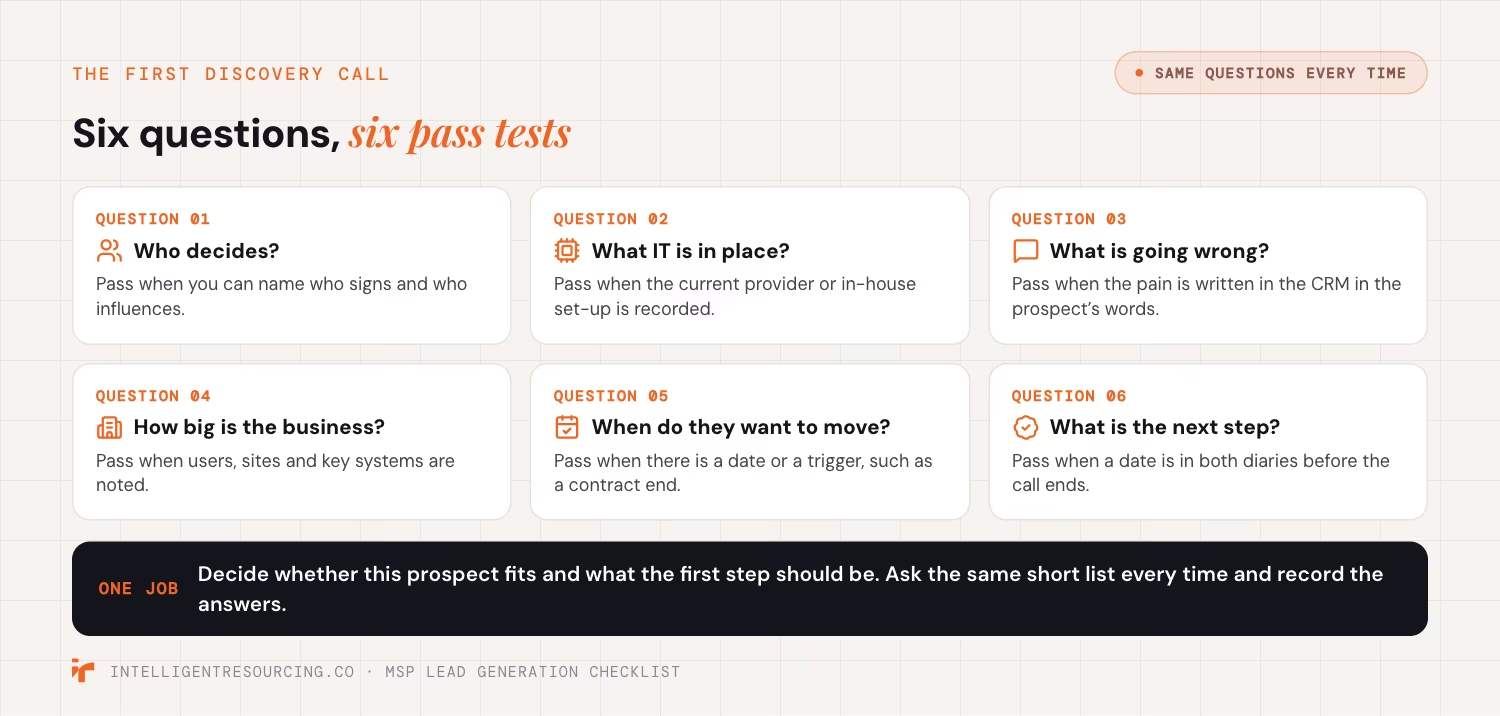
Ask the same short list of questions every time and record the answers. A discovery call has 1 job: decide whether this prospect fits and what the first step should be. Cover who decides, what is in place, what is going wrong, what it costs them and when they want to move.
- ☐ The decision-maker is known. Pass when: you can name who signs and who influences.
- ☐ Current IT is understood. Pass when: the current provider or in-house set-up is recorded.
- ☐ The pain is stated in the prospect's words. Pass when: it is written in the CRM.
- ☐ A rough size is recorded. Pass when: users, sites and key systems are noted.
- ☐ The timeline is known. Pass when: there is a date or a trigger, such as a contract end.
- ☐ The next step is agreed on the call. Pass when: a date is in both diaries.
How Do You Convert Qualified Leads Into Monthly Retainer Contracts?
Offer a priced first step, agree when the proposal will be delivered and follow up on a set schedule. Sending a proposal within 2 working days can be a useful internal target for straightforward opportunities, but complex MSP contracts may require more scoping. Retainers sell on trust and proof, so show a reference and a clear scope. Move the client into onboarding when they sign, with a named owner on both sides.
- ☐ The first step is priced. Pass when: it is an audit, a migration or a defined onboarding project.
- ☐ The proposal has an agreed deadline. Pass when: the buyer knows when to expect it and the commitment is recorded.
- ☐ A reference is offered. Pass when: an appropriate client has agreed to provide one.
- ☐ Follow-ups are scheduled. Pass when: dates are agreed or recorded when the proposal is sent.
- ☐ Lost deals are logged with a reason. Pass when: each loss has a note.
Kaseya's 2026 State of the MSP report, a survey of 1,061 MSPs from a software vendor with 76% of respondents in North America, found that 19% struggle to demonstrate value quickly, compared with 10% a year earlier. Proof matters more than a longer service list.
B2B buying is also often a group decision. Demandbase's 2025 buyer research, commissioned from G2, found that 72% of B2B purchases involve complex, multi-stakeholder buying groups, so a proposal needs to work for several readers.
What Is a Good Lead Conversion Rate and Cost per Qualified Lead for Managed IT Services?
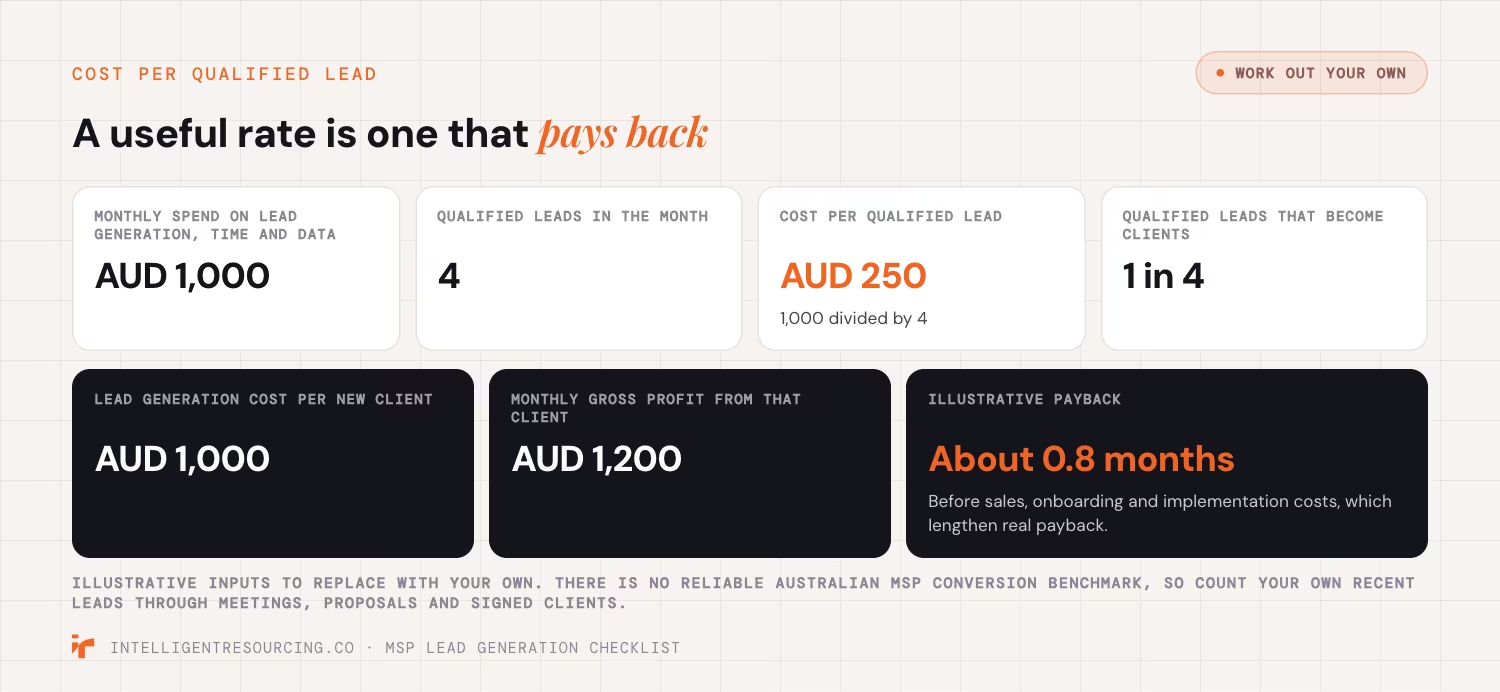
Reliable, independently verified Australian MSP conversion and cost-per-qualified-lead benchmarks are difficult to establish. Published vendor figures vary in definitions, markets and deal sizes, so work out your own from recent leads. Count how many became meetings, proposals and signed clients, then divide your acquisition spend by the number of qualified leads.
A useful conversion rate is one that produces profitable clients at an acceptable acquisition cost. Here is the calculation, with illustrative inputs to replace with your own:
| Step | Example |
|---|---|
| Monthly spend on lead generation, time and data | 1,000 Australian dollars (AUD) |
| Qualified leads in the month | 4 |
| Cost per qualified lead | AUD 250 |
| Qualified leads that become clients | 1 in 4 |
| Lead generation cost per new client | AUD 1,000 |
| Monthly gross profit from that client | AUD 1,200 |
| Illustrative payback | About 0.8 months before additional costs |
The simplified calculation assumes the client is won and does not include any extra sales, onboarding or implementation costs. Actual customer acquisition payback may be longer once those costs and the timing of revenue are included.
The same Kaseya survey found the share of MSP respondents reporting that their typical customer spends 25,000 United States dollars (USD) or more annually fell from 75% to 41% between the survey periods. The figures describe MSP-reported customer spending, not Australian conversion rates or total industry deal volume.
Tracking each lead through to monthly gross profit is the habit behind measuring B2B lead generation return on investment (ROI).
What Are Intelligent Resourcing's MSP Growth Solutions?
Intelligent Resourcing builds and manages signal-led lead generation systems inside a client's CRM. It detects relevant business changes, verifies account fit, checks against existing CRM records and routes qualified signals to a named person. The aim is to focus outreach on accounts with a more credible reason to engage, rather than treating every new contact as a sales opportunity.
System ownership, access, licensing and offboarding arrangements should be defined in the service agreement. Ask for a written offboarding map showing which records, workflows and reports remain accessible and which services stop when the engagement ends.
Intelligent Resourcing is not a traditional marketing agency, and it sells this service, so weigh its view accordingly. Its published go-to-market (GTM) Engineering qualification criteria include a defined ideal customer profile (ICP) and a CRM holding 1,000+ active records. A GTM strategy session at AUD 1,500 plus goods and services tax (GST) scopes the build before any monthly work.
Kaseya's survey covers MSPs worldwide and gives no separate Australian figure, so use it as directional evidence. Use the checklist above to find the weakest stage, and fix that first.
If building and qualifying the list by hand is the slow stage, signal-led lead generation can help identify suitable accounts from recent business events.
What Should an MSP Do Next?
Start with 1 client type, 1 defined service offer and 20 suitable businesses. Work through the seven pass tests, confirm outreach permissions and track each qualified opportunity through to its commercial result.
Do not add more channels or software until the existing process produces useful evidence. A small, repeatable lead generation system is easier to improve than a large campaign with unclear results.
Lead Generation
Intelligent Resourcing builds and manages signal-led lead generation inside an MSP's CRM, from detected business changes to a named owner for each qualified signal. Talk to us about the list and routing step.
FAQs
What should an MSP lead generation checklist include?
It should follow the lead from first contact to signed contract: target client, list, message, channel, discovery call, proposal and handover. Each step needs a pass test, so an owner can tick it honestly. Check outreach permissions, fix the weakest stage first and review results monthly.
How do you generate leads as a managed service provider?
Pick 1 client type and 1 offer, build a list of 20 matching businesses, verify the reason for outreach and contact eligible prospects through permitted channels. Log every interaction and review meetings, proposals and signed clients so you can identify which stage needs improvement.
Should an MSP outsource lead generation?
Outsource the parts that need extra capacity or specialist skills, such as list building or appointment booking, while retaining oversight of targeting and discovery calls. Ask any provider who owns the data, how a qualified meeting is defined and who checks messages before they go out. Get the answers in writing.
What is a good conversion rate for managed IT services?
There is no single reliable conversion benchmark that applies to every Australian MSP. Count recent qualified leads through meetings, proposals and signed clients, then compare total customer acquisition cost with monthly gross profit. A useful rate is one that produces profitable clients within an acceptable payback period.
How do you qualify an IT prospect on a discovery call?
Ask who decides, what IT is in place, what is going wrong, how big the business is and when it wants to move. Record the answers in the CRM in the prospect's words, and agree the next step with a date in both diaries before the call ends.