

What Is Signal-Led Growth for MSPs?
Signal-led growth is contacting a business when a dated public fact suggests a potential need for managed IT. The fact can be a new company, a first IT hire or a new rule. The MSP checks whether the change is relevant before reaching out, rather than assuming the business is ready to buy.
A cold list asks who can buy. A signal asks who just changed. The second question gives you a more relevant reason to call and a first line, but the signal still needs validation.
What Intent-Based Marketing Strategies Work for Managed Service Providers?
3 intent-based strategies suit MSPs: watch public records for changes at target businesses, monitor permitted first-party activity in your site and CRM, and work with partners and vendors on relevant referrals. Each can provide a reason to investigate an account. Start with public records because they require little technology and no existing website traffic.
- Public records. New companies, new sites and new rules at businesses that match your client profile.
- Your own activity. A past prospect who reopens your proposal or returns to a relevant page, where that activity can be identified and used lawfully.
- Partner activity. A vendor or channel partner that flags a client with a new project.
Watching public records for dated changes is the starting point of signal-based lead generation. The important distinction is that a business change creates a prospecting hypothesis, not proof of buying intent.
How Does Signal-Led Growth Compare With Traditional Inbound MSP Marketing?
Inbound marketing helps buyers discover you when they search for IT support. Signal-led growth identifies businesses whose circumstances have changed and gives the MSP a reason to initiate contact. The two can work together, especially when referrals alone do not provide a consistent pipeline.
Kaseya found 33% of MSPs say most new clients are switching providers, while 49% report a mix of switching and first-time outsourcing. These are percentages of MSP respondents, not the proportion of all new customers changing providers.
Kaseya's 2026 State of the MSP report surveyed 1,061 MSPs worldwide in November 2025, with 76% of respondents from North America and 5% from the Asia-Pacific (APAC) region. It is a vendor survey with no separate Australian figure, so use it as directional evidence rather than an Australian market benchmark.
| Criteria | Inbound marketing | Signal-led growth |
|---|---|---|
| Starting point | Content and search terms | A dated change at a named business |
| Who moves first | The buyer usually initiates contact | The MSP initiates contact after qualification |
| Strength | Builds trust and captures existing demand | Adds timing and relevance to prospecting |
| Weakness | Takes time to build visibility and demand | Requires accurate signals, fit checks and compliant outreach |
Referrals, search engine optimisation (SEO), partnerships and paid campaigns can still play valuable roles in MSP marketing. Signal-led outreach adds a way to prioritise which accounts deserve attention now.
How Does Signal-Led Sales Differ From Account-Based Marketing for MSPs?
Account-based marketing (ABM) picks a list of target accounts and works them over time. Signal-led sales helps decide when to contact them. The two work together: ABM chooses who, and signals choose when. An MSP with a defined target list can benefit from adding timely triggers to its account plan.
ABM chooses the accounts and signals choose the moment, which is how signal-led account-based marketing pairs the two. Account-level work suits MSP sales because Demandbase's 2025 buyer research, commissioned from G2, found that 72% of business-to-business (B2B) purchases involve complex, multi-stakeholder buying groups.
For an MSP, the practical point is simple. A list of 100 target businesses is a plan. A list of 5 businesses that changed this week is a more timely call sheet, provided each change is relevant.
Cold Outreach or Signal-Based Prospecting: Which Grows an MSP Faster?
Signal-based prospecting can improve the relevance and timing of MSP outreach because it starts with a business change rather than a static list. That does not guarantee faster growth. Results depend on signal quality, client fit, the offer and follow-up. Measure qualified meetings and opportunities rather than judging success by message volume.
A cold list can also contact existing clients by mistake. Check every prospect against your client list before any message goes out, confirm that contact is permitted and record the outcome of every interaction so the next round starts from what worked.
Which Buying Signals Should an MSP Track for B2B IT Contracts?
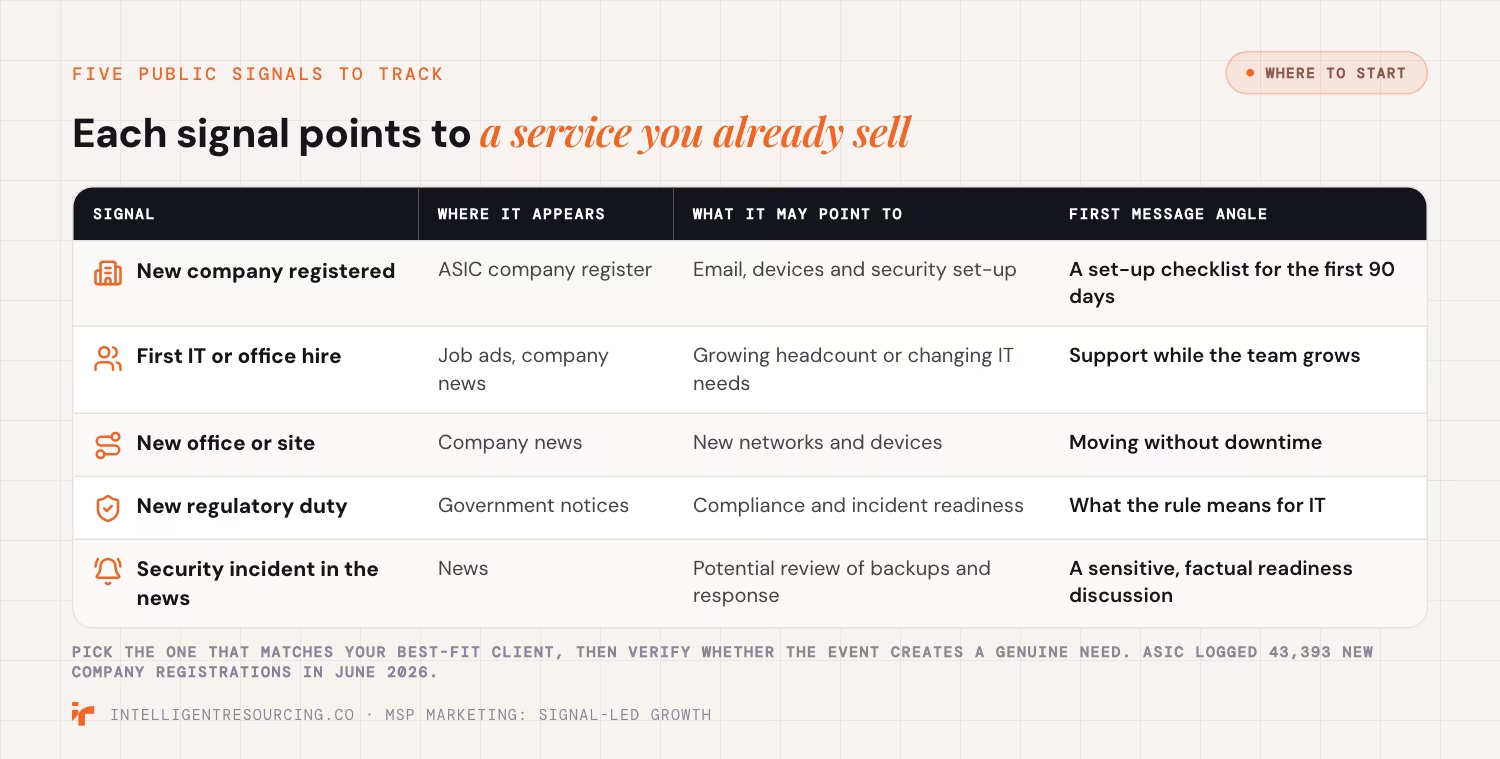
5 public signals give an MSP a useful starting point: a new company, a first IT or office hire, a new site, a new regulatory duty and a security incident in the news. Each may point to a service the MSP already sells. Pick the one that matches your best-fit client, then verify whether the event creates a genuine need.
| Signal | Where it appears | What it may point to | First message angle |
|---|---|---|---|
| New company registered | Australian Securities and Investments Commission (ASIC) company register | Email, devices and security set-up | A set-up checklist for the first 90 days |
| First IT or office hire | Job ads, company news | Growing headcount or changing internal IT requirements | Support while the team grows |
| New office or site | Company news | New networks and devices | Moving without downtime |
| New regulatory duty | Government notices | Compliance and incident readiness | What the rule means for IT |
| Security incident in the news | News | Potential review of backups and response | A sensitive, factual readiness discussion |
ASIC's company registration statistics show 43,393 new company registrations in June 2026, before counting sole traders. Not every newly registered company is an appropriate MSP prospect, so size, operations and service fit must be checked.
On regulation, businesses with annual turnover of 3 million Australian dollars (AUD) or more, along with certain critical infrastructure entities, are subject to ransomware and cyber extortion payment reporting requirements. A qualifying payment must be reported within 72 hours. This is a payment-reporting obligation, not a requirement to report every cyber incident within 72 hours, as the Department of Home Affairs' ransomware payment reporting factsheet explains.
The duty started on 30 May 2025, and its education-first period ended on 31 December 2025.
A public signal should pass a basic qualification check before outreach: is the event recent, does the business match your client profile, does the change relate to a service you sell, and is there evidence of a relevant buying window? This prevents an interesting event from being mistaken for confirmed purchase intent.
How Should MSPs Choose an Intent Data Platform?
Choose an intent data platform on coverage, freshness and CRM fit. A good platform helps show which Australian businesses are researching relevant topics, how recent each signal is and how the information reaches your CRM. Ask each vendor for evidence of coverage among Australian small and mid-size businesses, because many MSP clients are not large enterprises.
4 questions sort the options:
- Does it cover Australian businesses of your client size? Ask for a sample list.
- How old is a typical signal when you see it? Freshness matters more than volume.
- Does it connect to your CRM? A signal in a separate tool can go unused.
- Can you see why an account was flagged? An unexplained score is hard to validate.
Vendors in buyer intent signal monitoring differ on these considerations, so run the same questions past every one.
How Do You Build a Signal-Led Marketing Tech Stack for an MSP?
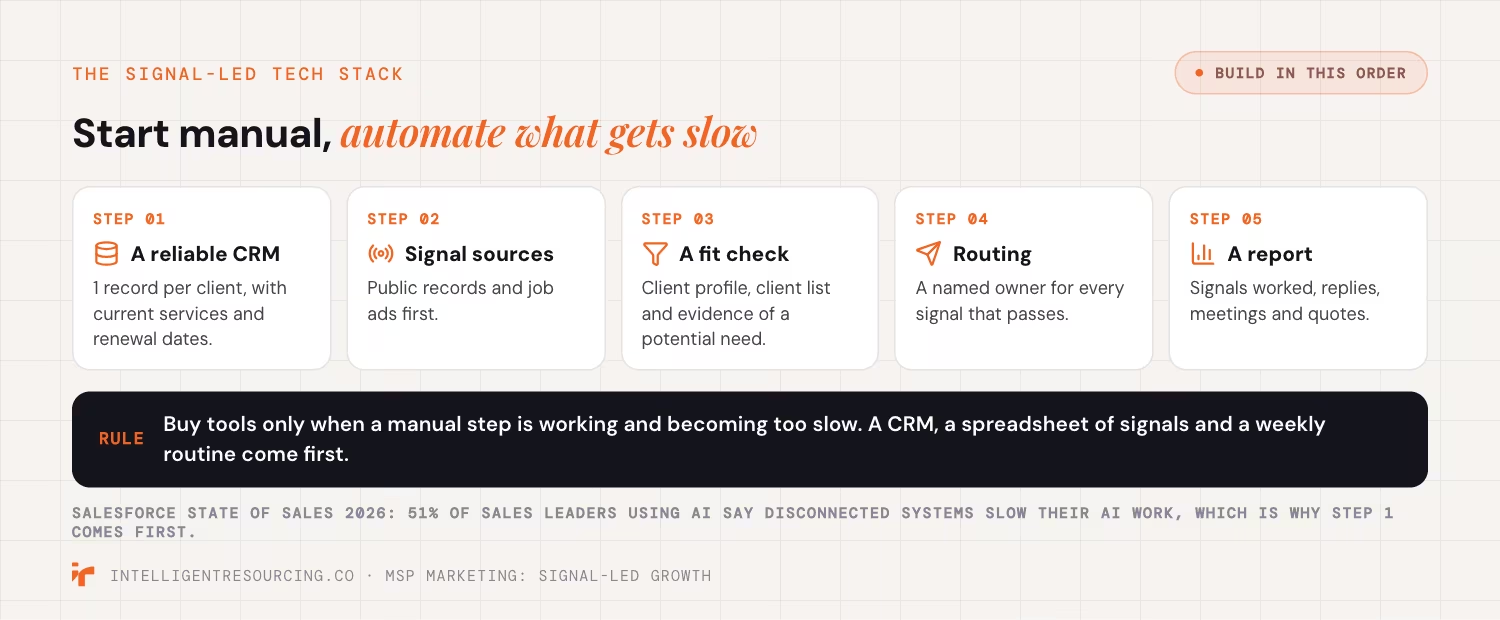
Build it in order: a reliable client list in your CRM, 1 or 2 signal sources, a way to score and route, and a simple report. Buy tools only when a manual step is working and becoming too slow. Most small MSPs can start with a CRM, a spreadsheet of signals and a weekly routine before adding software.
The build order, in plain words:
- A reliable CRM. 1 record per client, including current services and renewal dates where available.
- Signal sources. Public records and job ads first.
- A fit check. Compare each signal with your client profile, client list and evidence of a potential need.
- Routing. A named owner for every signal that passes.
- A report. Signals worked, replies, meetings and quotes.
Salesforce's 2026 State of Sales research found that 51% of sales leaders using artificial intelligence (AI) said disconnected systems were slowing their AI work, which is why step 1 comes first. Wiring those 5 steps together, from source to report, is what a signal-led prospecting system does.
How Do You Automate Buying Signal Alerts for MSP Account Executives?
Send each qualified signal to 1 named account owner as a task in the CRM, with the fact, the source and an expiry date. Automate the watching and routing. Keep the judgement human: a person decides whether the signal justifies outreach. An alert nobody owns is the same as no alert.
Intelligent Resourcing's signal engine shows the scale involved. These are its own reported operating figures for screening and account selection, not closed-deal results:
- It screens roughly 50,000 Australian news items a day down to about 50 actionable buying signals.
- It draws on a deduplicated universe of about 115,000 Australian companies, built from 4 independent sources.
- It narrows that universe to roughly 50 net-new accounts a month, each checked against the client CRM.
Speed matters once an alert fires, although speed alone does not establish buyer readiness. RevenueHero's study of 1,000 B2B websites found that only 365 replied to a demo request, and the average reply took 1 day, 5 hours and 17 minutes. It counted automated replies and measured inbound enquiries, not MSP signal-led outreach, so it illustrates follow-up gaps rather than proving a conversion improvement.
A small MSP can copy the pattern by hand: a short list of sources, a weekly check and a rule that every alert has an owner and an expiry. For example, a new-company signal might expire after 30 days, depending on its relevance.
What Does a Signal-Led Outbound Playbook Look Like for a Small MSP Sales Team?
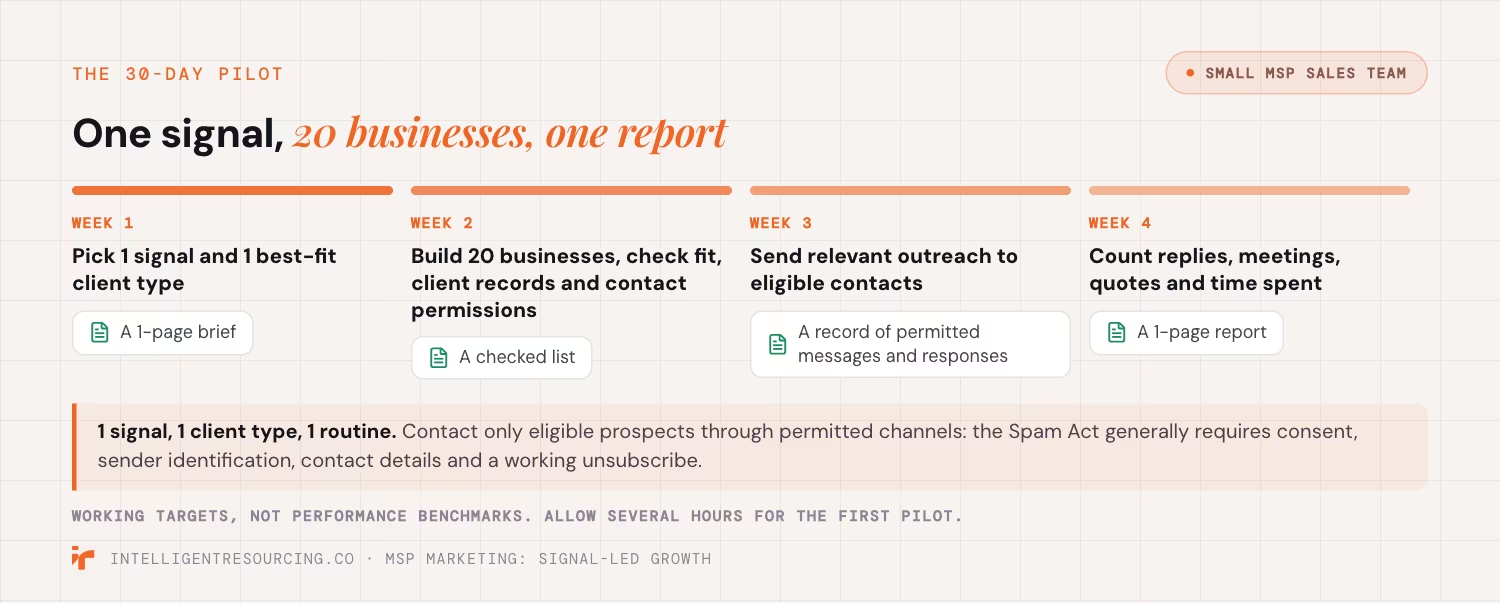
A small team can start with 1 signal, 1 client type and 1 routine. Pick the signal, build a list of 20 businesses from public records, check each against your client list and verify its fit. Contact only eligible prospects through permitted channels, then review replies and meetings. Allow several hours for the first pilot and track the effort as the process improves.
These steps are working targets, not performance benchmarks.
| Week | Step | Output |
|---|---|---|
| 1 | Pick 1 signal and 1 best-fit client type | A 1-page brief |
| 2 | Build 20 businesses, check fit, client records and contact permissions | A checked list |
| 3 | Send relevant outreach to eligible contacts | A record of permitted messages and responses |
| 4 | Count replies, meetings, quotes and time spent | A 1-page report |
A short message works best when it refers to a verified event. For example:
Hi [Name], I saw [Company] opened a second office this month. Expansions like that can create extra work around networks, devices and backups. We offer a short readiness check for businesses of your size. Would a one-page checklist be useful?
[MSP business name] | [Business contact details] | Reply "unsubscribe" to opt out.
Use this example only where the organisation has a lawful basis to send commercial electronic messages. Australia's Spam Act requirements, explained by the Australian Communications and Media Authority (ACMA), generally require consent, accurate sender identification, contact details and a functioning unsubscribe option. Publicly available contact information does not automatically establish permission to email.
How Do You Measure Return on Investment (ROI) on Signal-Based MSP Campaigns?
Measure qualified meetings, quotes and signed monthly gross profit, then work out payback. Replies alone prove little. Add up the cost of the pilot, divide it by the monthly gross profit from any client it wins, and you have a simple payback estimate in months. Keep tracking results after the pilot because MSP sales cycles may extend beyond 30 days.
Counting cost per meeting alongside quotes keeps replies from passing for results, which is the discipline behind measuring B2B lead generation ROI. Here is the MSP calculation, with illustrative inputs to replace with your own:
| Step | Example |
|---|---|
| Cost of a 30-day pilot, including time and data | AUD 2,000 |
| Monthly gross profit from 1 new client | AUD 1,200 |
| Illustrative payback | About 1.7 months |
1 client can repay a small pilot relatively quickly because managed services generate recurring revenue. However, this calculation assumes a client is won and does not establish actual campaign ROI until the outcome is measured.
A pilot that produces no qualified meetings should prompt a review of the signal, account fit and message before additional tools or campaign volume are introduced.
What Are Intelligent Resourcing's MSP Marketing Frameworks?
Intelligent Resourcing's method is Signal-Led Growth: find the signal, check the fit and reach out inside the right window. A Verified Buying Window is its framework for identifying the period when a validated change and account fit suggest that a prospect may be more likely to evaluate a purchase. It is a targeting and timing method, not a replacement for brand, content or paid marketing.
Intelligent Resourcing grades buying signals by how closely they align with a credible buying window, so account owners work the opportunities that warrant attention. It builds and manages the system inside the client's CRM and checks accounts against existing records before delivery. System ownership, access and offboarding arrangements should be defined in the service agreement.
Which Type of Marketing Agency Should Australian MSPs Choose?
Agencies serving Australian MSPs offer different combinations of services. Some provide SEO, content, websites and paid campaigns. Others focus on telemarketing or outbound prospecting. Signal-led providers add an account identification and qualification layer. Choose according to the gap in your current pipeline rather than assuming every MSP needs the same channels.
Agencies that run outbound on intent signals may publish their own ROI claims, so ask how each figure was measured and over what period. A telemarketing agency should state its campaign minimums, contact compliance process and what it counts as a qualified meeting before you sign.
What Are the Common Mistakes in Signal-Led Marketing for Managed Service Providers?
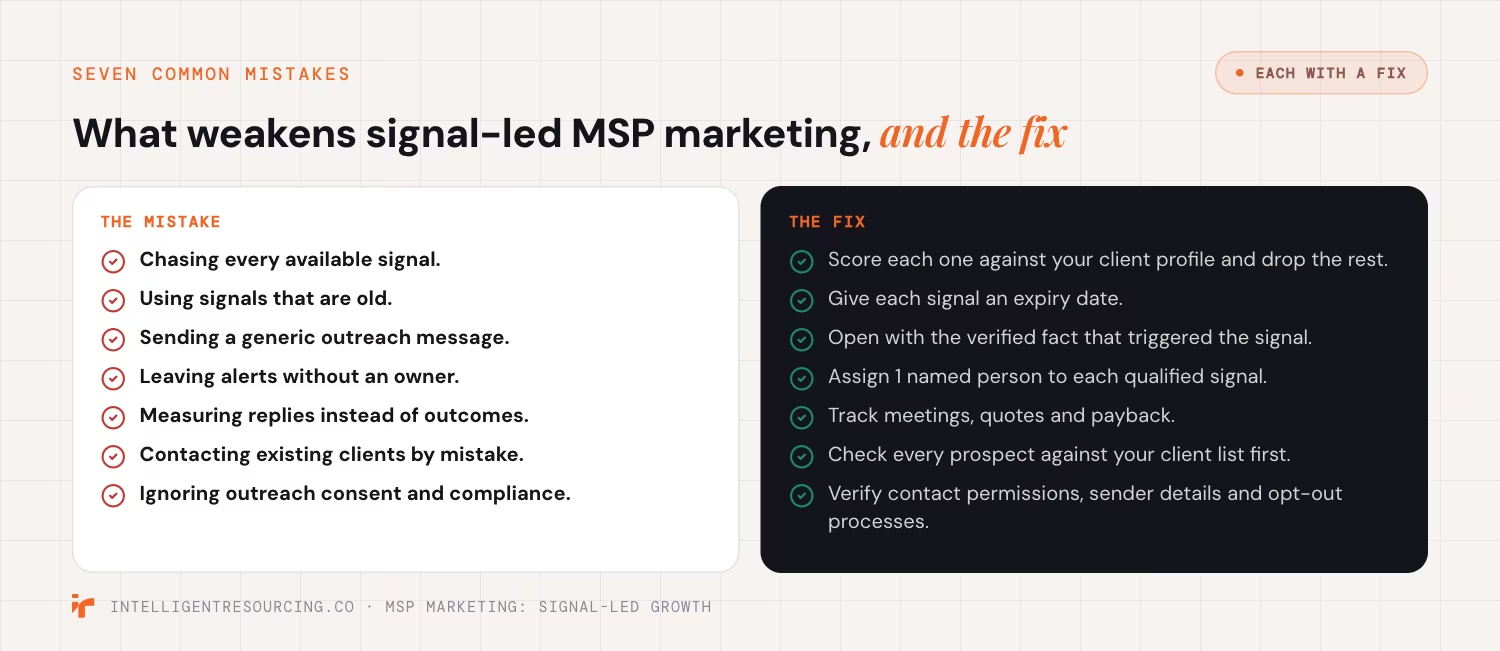
7 mistakes commonly weaken signal-led MSP marketing: chasing every signal, using old signals, sending generic messages, leaving alerts without an owner, measuring replies instead of meetings, contacting existing clients and overlooking outreach compliance. Each has a practical fix.
- Chasing every available signal. Fix: score each one against your client profile and drop the rest.
- Using signals that are old. Fix: give each signal an expiry date.
- Sending a generic outreach message. Fix: open with the verified fact that triggered the signal.
- Leaving alerts without an owner. Fix: assign 1 named person to each qualified signal.
- Measuring replies instead of outcomes. Fix: track meetings, quotes and payback.
- Contacting existing clients by mistake. Fix: check every prospect against your client list first.
- Ignoring outreach consent and compliance. Fix: verify contact permissions, sender details and opt-out processes before messaging.
When Is Signal-Led Outreach the Wrong Move for an MSP?
It is the wrong move when delivery is at capacity, when existing channel partners already provide enough suitable business, or when an MSP needs immediate revenue and cannot establish a new prospecting routine quickly enough. Signal-led outreach can improve targeting, but it still needs qualified accounts, human judgement and time to convert.
3 cases call for something else:
- Delivery is at capacity. More leads add stress without increasing revenue.
- Most work comes from a partner. A strong partner relationship may be more valuable than opening another outreach channel.
- Revenue is needed this quarter. Founder-led calls and existing commercial relationships may produce results faster than building a new process.
For everyone else, start with the 30-day pilot. If list-building and qualification become the slowest steps, signal-led lead generation can support the process by identifying current accounts from relevant business events.
Lead Generation
Intelligent Resourcing builds and manages signal-led growth inside an MSP's CRM, from screened signals to a named owner for each one. Talk to us about a 30-day pilot.
FAQs
What is signal-led growth for MSPs?
It is contacting a business when a public event suggests a potential need for managed IT, such as a new company, a first IT hire or a new regulatory duty. The MSP picks signals that match its offers, verifies the fit, checks its client records and contacts eligible prospects with a relevant message.
What are the top buying signals to track for B2B IT contracts?
5 useful starting signals are a new company, a first IT or office hire, a new office or site, a new regulatory duty and a security incident in the news. Match each one to a service you already sell and give each signal an expiry date. Validate the underlying need before treating it as buying intent.
How is signal-led growth different from account-based marketing?
Account-based marketing chooses which accounts to target. Signal-led growth helps determine when to contact them. They work together: the list says who, and the signal says when. An MSP with a short target list can use relevant business changes to prioritise outreach.
How do you measure ROI on signal-based MSP campaigns?
Count meetings, quotes and signed monthly gross profit, then divide the pilot's cost by the monthly profit from any new client to estimate payback. Replies alone prove little. Use your own figures because the example inputs in this guide are illustrative, and continue tracking results after the initial 30 days.
How many signals should an MSP track?
Start with 1 signal tied to 1 service and 1 client type, and test it on 20 businesses for 30 days. Add a second signal when the first produces useful evidence, such as qualified meetings. Each signal needs an owner, a fit check and an expiry date, because unqualified or stale alerts waste time.