
What B2B Digital Marketing Channels Work in Australia?
Paid search, SEO, LinkedIn, content, email and AI search all work, and popularity does not decide which channel fits. Interactive Advertising Bureau (IAB) Australia's FY2026 report put the Australian internet advertising market at $19.8 billion, up 14.0%. Search was 43% of spend at $8.6 billion. The release shows a dollar sign and no currency code.
These figures cover all advertisers, consumer and business. They show where money goes and not which channel makes B2B pipeline.

Match the channel to the buyer's stage. A security provider whose buyers already compare tools can run Google Ads on buying-intent searches. A firm with a new kind of machine must teach buyers first, with expert content and LinkedIn.
Which Digital Channels Generate B2B Pipeline?
Channels create pipeline in 3 ways: they capture demand that exists, build confidence in the buying group and move engaged accounts towards a sales opportunity. Each way works at a different stage, and not every channel brings an immediate enquiry. No channel carries pipeline alone. ICONIQ's 2026 State of Go-to-Market report surveyed 150+ B2B software go-to-market (GTM) leaders. It found that high-growth companies source 60 to 80% of pipeline from sales and channel, against 15 to 20% from marketing.
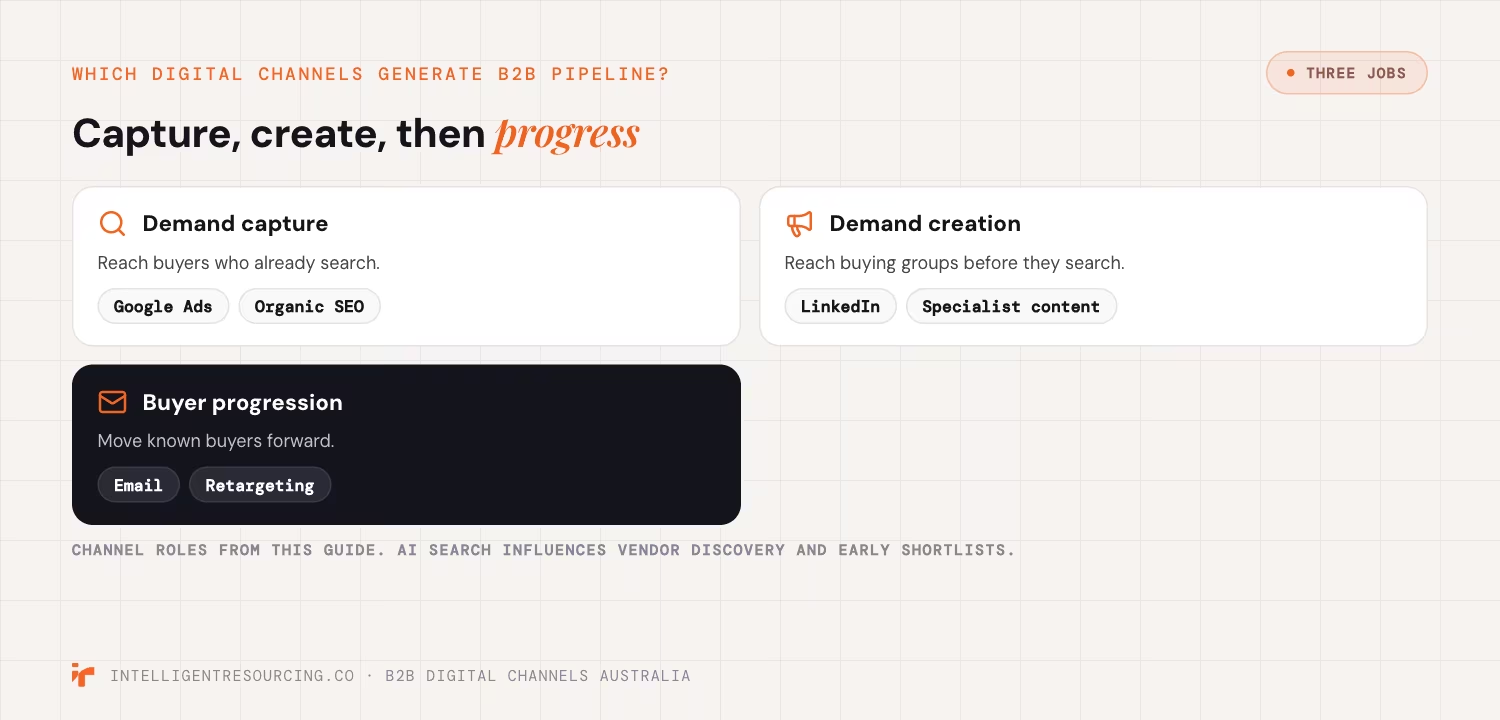
Demand capture: paid search and SEO
Google Ads reaches buyers who search for a specific service. A query such as "enterprise CRM integration Australia" shows a clearer need than a broad question about CRM. SEO does the same job over a longer time, through solution, comparison and industry pages. Neither guarantees qualified deals, because search volume, competition and landing page quality all matter.
Demand creation: LinkedIn and specialist content
LinkedIn and educational content help when buyers do not yet know which solution or provider to consider. Research articles, practical frameworks and expert views name problems buyers have not yet framed. The result often shows up later as a branded search, a return visit or a sales call. Pairing this work with signal-led lead generation shows which accounts respond.
Buyer progression: email and retargeting
Email and retargeting support buyers who already know you. They keep the message relevant, answer open questions and help evaluation move forward. Treat a return visit to a technical comparison page as a signal to check against account fit, and not as proof of intent.
What Does B2B Digital Marketing Include?
B2B digital marketing uses online channels, content, data and technology to reach organisations and support revenue. B2B purchases involve several stakeholders, longer evaluation and more detailed requirements. Demandbase's 2025 buyer research found that 72% of B2B purchases involve complex buying groups. A programme aimed only at the main buyer misses the others.
Core services include:
- SEO: Improving visibility for relevant commercial and informational searches.
- Paid search: Reaching buyers who research defined problems or solutions.
- Social media marketing: Building awareness and credibility with professional audiences.
- Content marketing: Publishing guides, comparisons, case studies and technical insight.
- Email marketing: Keeping relevant contact with known prospects.
- Digital advertising and retargeting: Reinforcing messages across suitable online spaces.
- Marketing automation: Connecting engagement, qualification, reporting and next actions.
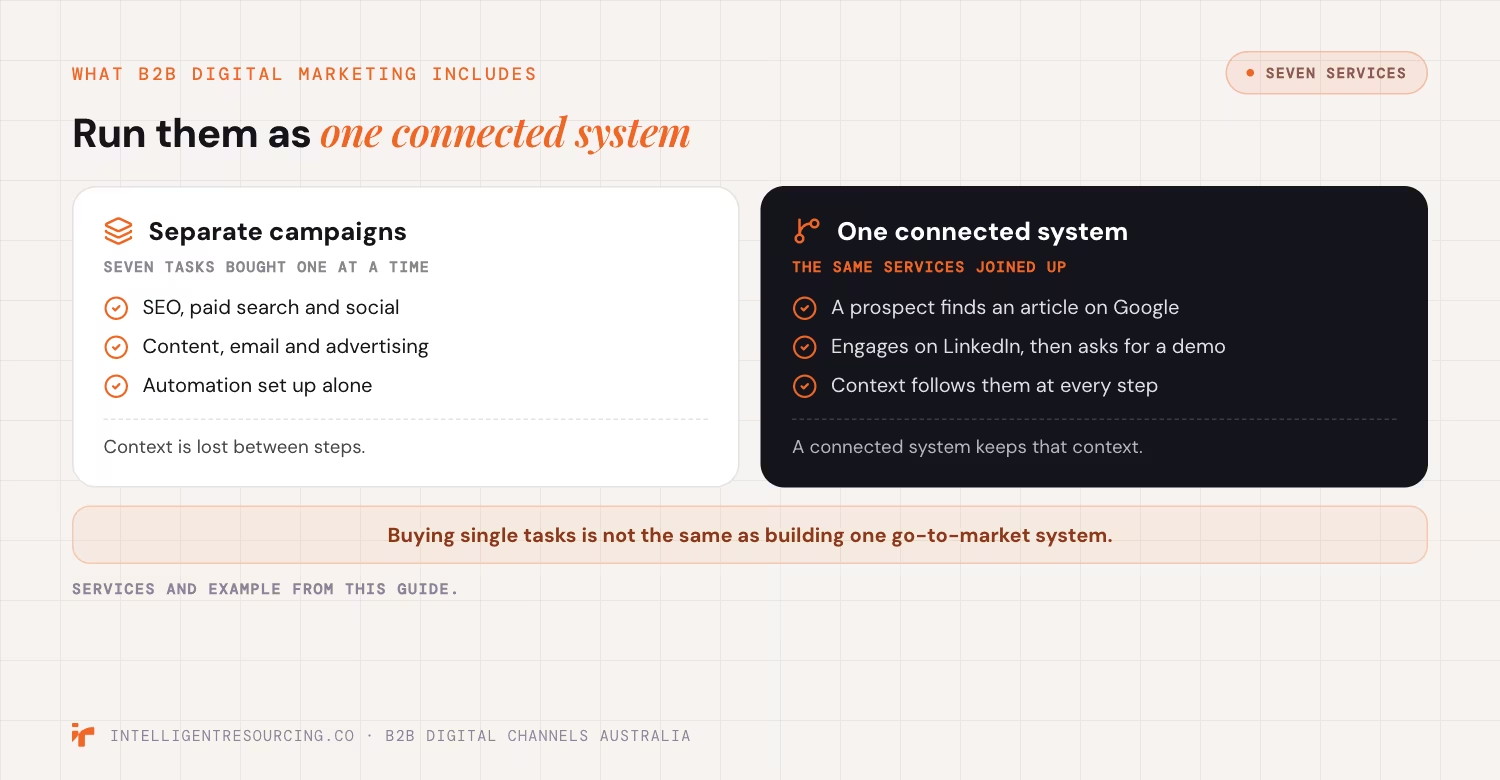
These services should not run as separate campaigns. A prospect can find an article through Google, engage with a LinkedIn post, return to a comparison page and request a demo. A connected system keeps that context across each step.
The gap is between buying single tasks and building 1 system for go-to-market work. A stage-by-stage scorecard sits in the B2B lead generation strategy checklist.
How Do LinkedIn and Social Media Perform for B2B in Australia?
LinkedIn gives Australian B2B firms direct access to professional audiences, specific roles and decision-makers across target accounts. Its strongest contribution is building familiarity in accounts that have not started to search. Impressions and engagement are no evidence of qualified pipeline.
The 2025 Edelman-LinkedIn report states that more than 40% of B2B deals stall because of internal buying-group misalignment. A procurement manager, a finance director and a technical lead judge the same supplier by different criteria. A campaign aimed only at the obvious buyer fails the others.
3 approaches fit most programmes:
- Executive thought leadership: Publish credible views that help buyers understand problems and compare options.
- Account-focused paid campaigns: Reach chosen organisations and roles with messages that match their concerns.
- Educational content distribution: Promote guides, comparisons and evidence that buyers can share internally.
An Australian logistics software firm can write 3 notes for 3 readers: a technical note on integration risks, a commercial guide to rollout costs and a leader's view on running costs. Each note serves a different person. The aim is trust in the accounts most likely to buy, and not the most social engagement.
How Do Content, Email and SEO Contribute to B2B Pipeline?
SEO makes useful information easy to find, content gives buyers the evidence to decide and email keeps contact relevant as needs change. Together they form a route from first research to a sales conversation.
SEO: capture demand where it exists
A buyer who searches "B2B marketing automation services Australia" is closer to choosing a provider than a buyer who looks up a definition. Both searches have value, but they mean different things. Good B2B SEO covers the whole research path: problems, solutions, comparisons and buying questions.
Content: build confidence before the sales call
Content should help buyers decide. Technical explanations, real examples, buyer guides and honest comparisons serve that goal better than commentary written to attract traffic. A strong article can also support organic search, equip sales and give AI search tools facts to cite.
Email: progress interest without forcing urgency
Email works best when a message reflects what the reader has shown interest in. Someone who asked for a setup guide wants relevant integration detail. A generic promotion adds little.
Speed counts once interest appears. RevenueHero's study of 1,000 B2B software company sites found that only 365 of those sites replied to a demo request, and the average reply took 1 day, 5 hours and 17 minutes. It counted automated replies, so it shows response gaps and says little about quality. A guide to building a signal-led prospecting system covers the follow-up steps.
Which B2B Marketing Trends Matter for 2026?
The biggest shift in 2026 is that buyers verify more before they decide, and AI tools now sit beside search, social and email. Each channel's role has become more specific and no less needed.
1. AI-assisted research is part of vendor discovery
TrustRadius's 2025 technology buyer research surveyed 2,058 technology buyers worldwide in January 2025. It found that 72% encountered Google AI Overviews while researching, and 90% clicked through to at least 1 cited source. The sample is global and not Australia-specific. A newer TrustRadius report exists, so read these figures as direction and not as a local benchmark.
The practical point is that buyers check what AI summaries say. Pages that AI tools cite need clear claims and visible proof. AI search is 1 channel among several, and it influences shortlists more than it closes deals.
2. Connected workflows are becoming more valuable
Businesses need systems that join account research, engagement data, campaigns and sales action. A form fill is not proof of buying readiness. A signal-led approach looks at signals instead: repeat visits to commercial pages, account research patterns and company changes. Those signals feed account ranking, CRM records and outreach.
Signal-based selling explains how to rank accounts before you act. The aim is a more relevant next action, and no increase in automated activity. For the outbound side of this shift, see why AI now drives B2B sales prospecting.
How Should Australian B2B Teams Measure Digital Marketing Pipeline?
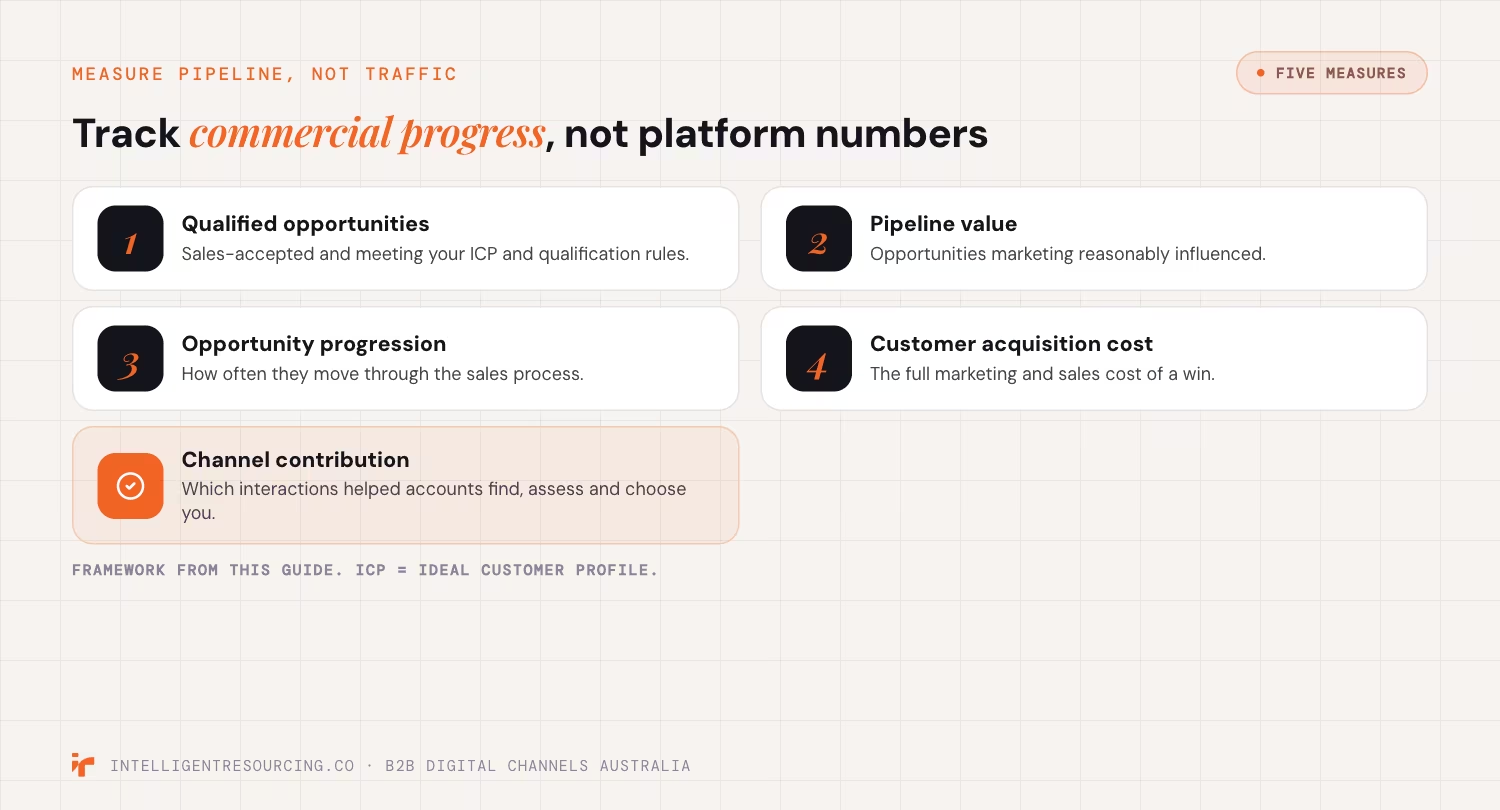
Measure the commercial progress of relevant accounts, and not isolated platform numbers. A campaign with 1,000 visits and no qualified opportunities is worth less than a campaign with 100 visits and several real buying conversations, when cost and customer value match.
A practical framework tracks 5 things:
- Qualified opportunities created: Sales-accepted opportunities that meet your ideal customer profile (ICP) and qualification rules.
- Pipeline value generated: The value of opportunities that marketing reasonably influenced.
- Opportunity progression: How often qualified opportunities move through the sales process.
- Customer acquisition cost: The full marketing and sales cost of winning a customer.
- Channel contribution: Which interactions helped accounts find, assess and choose you.
Attribution has limits. A buyer can find you on LinkedIn, research on Google, read a case study and call sales. Last-click credit gives everything to the final visit. Crediting every touch overstates marketing's role.
Combine channel reports with account history, deal records and sales feedback.
Connected data makes this possible. Salesforce's 2026 State of Sales research found that 51% of sales leaders using AI say disconnected systems slow that work.
Take a hypothetical Australian cybersecurity firm. A target account reads a technical article, engages with LinkedIn content and reviews the services page. A connected system records the permitted signals and flags when to follow up. Sales gets context and not a bare contact record.
Lead Generation
Talk it through with Intelligent Resourcing before you add another channel.
FAQs
What are the key B2B marketing trends for 2026?
Key trends include AI-assisted buyer research, steady investment in search, more attention to multi-stakeholder buying groups and tighter links between marketing and sales data. Australian firms should favour verifiable content, relevant engagement signals and measurable pipeline over new technology adopted for its own sake.
What are 7 types of digital marketing?
7 common types are SEO, paid search, social media marketing, content marketing, email marketing, display advertising and marketing automation. They overlap in practice. For B2B firms, effectiveness depends on how each supports the buying journey and produces measurable opportunities.
Is AI replacing digital marketing?
No. AI changes how buyers find and check information, and established channels still do important work. Search, content, social media, email and advertising remain relevant. AI adds a need for credible, well-structured information and better measurement of how buyers engage.
What does B2B digital marketing include?
It includes the online strategies, channels and systems businesses use to reach organisational buyers, build credibility, explain value and support sales. Common activities are SEO, advertising, LinkedIn, content, email and automation. Good programmes link these to buyer intent, CRM processes and commercial results.