
What is B2B marketing?
B2B marketing promotes a product or service from one business to another. It is not aimed at an individual shopper. A software company selling project management tools to other companies is running B2B marketing. Leadfeeder's definition frames this as solving an organisation's problem, not a personal one.
The buyer is rarely one person. A typical B2B purchase involves:
- A daily user, who works inside the product
- A budget holder, who controls spend and signs off
- A technical reviewer, who checks security and integration

Marketing has to speak to all three in the same piece of content. That differs from marketing shoes or a streaming subscription. There, one person decides and pays in the same sitting.
How is B2B marketing different from B2C?
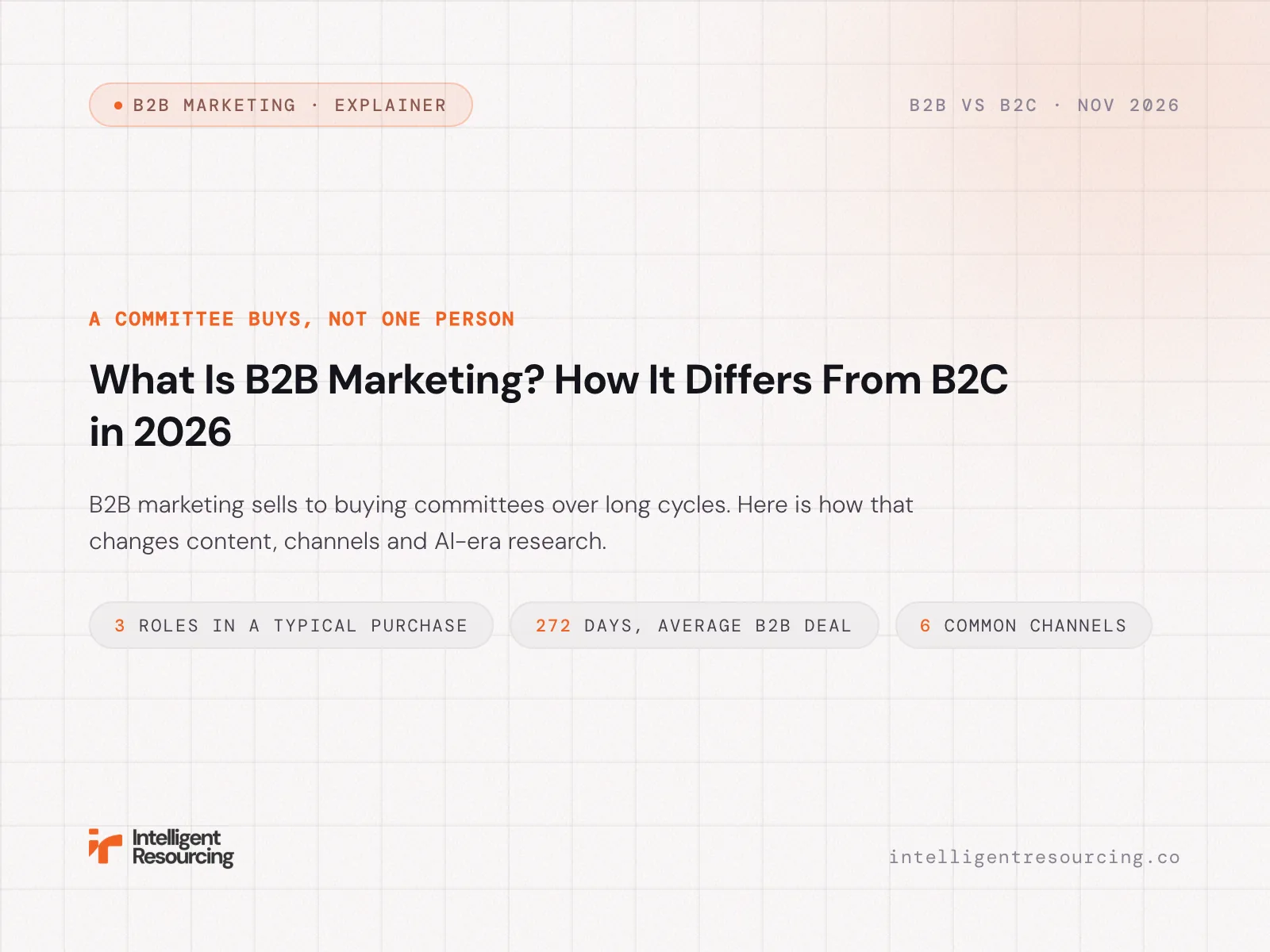
The clearest difference is who decides, and how long that takes. Dreamdata's data shows the average B2B deal takes 272 days from first contact to close. The sales conversation covers only the final 78 days, under a third of that. B2C purchases close in minutes or days by comparison.

That longer cycle changes what content has to do. A B2C ad has seconds to create a feeling. A B2B case study has to survive being forwarded to three more people, often built around named-account targeting rather than broad reach.
It still has to answer their objections. See the full comparison in the table above.
What are the main types and examples of B2B marketing?
Content Marketing Institute (CMI) and MarketingProfs' 2027 B2B report, based on 861 B2B marketers, tracks where B2B marketing budgets go.
Common channels and types
- Content marketing: guides and resources that answer buyer questions
- Account-based marketing: campaigns targeted at a named list of accounts
- Email marketing: nurture sequences and product updates to existing contacts
- Webinars and events: live or recorded sessions for considered buyers
- Paid search and social: ads aimed at in-market accounts
- Direct outreach and referral programmes: one-to-one contact and partner introductions

A practical example
A logistics software company publishes a guide on warehouse automation. It runs a named-account campaign against 50 target accounts. It also emails existing customers about a new feature. All three can happen in the same quarter, and each one targets a different stage of the buying committee's research. For which channel fits each stage in Australia, see channels that produce B2B pipeline.
Agency, consultant or in-house
Choosing between an agency, a consultant or an in-house team matters. It changes which of these a company can run well, and how fast: compare agency, consultant and in-house models before committing budget to any of them.
What does B2B marketing look like in Australia?
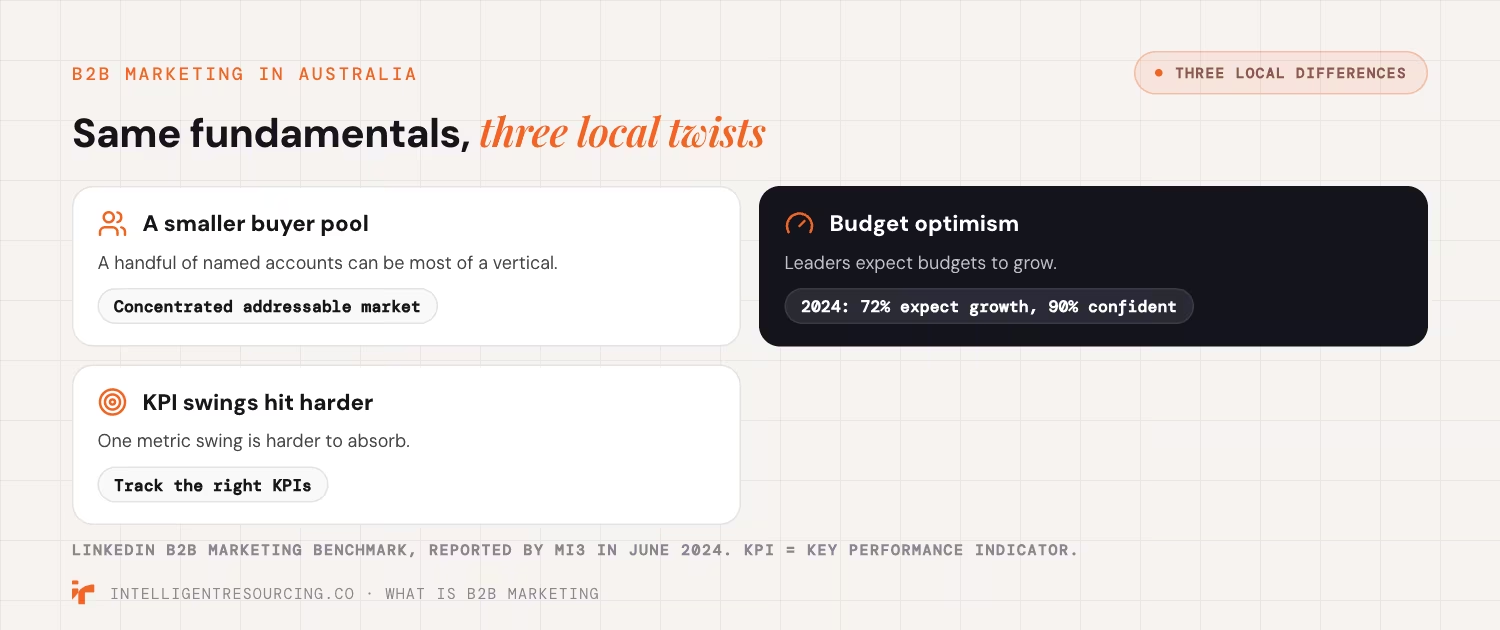
Australian B2B marketing follows the same fundamentals as the rest of the world, with three local differences:
- A smaller, more concentrated buyer pool. A handful of named accounts can make up most of a company's addressable market in one vertical.
- Budget optimism. LinkedIn's 2024 B2B Marketing Benchmark, reported by Mi3 in June 2024, found 72% of Australian B2B marketing leaders expect budgets to grow, and 90% feel confident about driving revenue in the year ahead.
- Key performance indicator (KPI) swings hit harder. Tracking the right B2B marketing KPIs matters more here than in larger markets, where a single metric swing is easier to absorb.
That concentration and optimism both mean reputation travels fast: one mishandled deal, or one strong case study, can shape a year's pipeline.
What does B2B marketing look like in 2026?
B2B marketing in 2026 has to serve two readers at once: a human, and an artificial intelligence (AI) system summarising the page.
Pew Research Center's 2025 study found that an AI Overview roughly halves the click-through rate on a search result, from 15% to 8%. Only 1% of visits click a source link inside the summary.
This does not retire traditional marketing. It adds a second test. Content now has to be extractable, with a direct answer near the top.
Ranking well in search results is no longer enough. A related piece covers why buyers now skip Google for early research.
How is AI changing the B2B buyer journey?
AI has moved earlier into the buyer journey than most marketing teams planned for. The number that matters most is verification. TrustRadius' 2025 buyer research found 72% of B2B tech buyers encountered Google's AI Overviews during research, and 90% clicked through to check at least one source.
That verification step is the opportunity a marketing team has. A buyer arriving from an AI summary already has a working answer. What convinces them is whether your site confirms, sharpens or corrects that answer with evidence.
Repeating the same summary in different words will not. Signal-based GTM engineering applies the same logic: it catches the moment buyers are ready, not the moment they first searched.
Lead Generation
Start marketing to the ones already showing intent.
FAQs
What is B2B marketing?
B2B marketing is the practice of promoting products or services from one business to another business, usually to a buying committee rather than a single consumer.
How is B2B marketing different from B2C marketing?
B2B marketing targets several stakeholders over a longer, evidence-led sales cycle, while B2C marketing targets one consumer over a short, often emotion-led cycle.
What are examples of B2B marketing?
Common examples include content marketing, account-based marketing, email marketing, webinars, paid search and social, and direct outreach to named accounts.
What does B2B marketing look like in 2026?
In 2026, B2B marketing has to answer buyer questions clearly enough for both a human reader and an AI system summarising the page, since just over half of B2B software buyers now start research in an AI chatbot more often than in Google, per G2.
How is AI changing the B2B buyer journey?
AI tools now shape research earlier in the buyer journey, with most buyers encountering AI-generated summaries and then clicking through to verify them against the original source.