
What Is the Average SDR Salary in Australia?
The average SDR base salary in Australia sits between about A$60,000 and A$90,000, as of November 2026. Payscale's 2026 employee-reported data puts the average at A$60,412. SEEK's November 2026 job ad data puts it at A$70,000 to A$90,000. Commission sits on top of base, so total on-target earnings (OTE) run higher than these salary figures.
The two sources measure different things, so read them side by side. Payscale's SDR salary data shows an average base of A$60,412 in 2026, updated 30 May 2026. It rests on only 11 salary profiles, so a handful of new entries can move it.
SEEK's November 2026 salary page uses salary ranges employers disclose in job ads.
| Source (2026) | What it measures | SDR figure |
|---|---|---|
| Payscale, updated May 2026 | Average base, 11 employee profiles | A$60,412 |
| Payscale, updated May 2026 | Base range | A$54,000 to A$74,000 |
| Payscale, updated May 2026 | Bonus range | A$0 to A$10,000 |
| SEEK, November 2026 | Average advertised salary | A$70,000 to A$90,000 |
Use these points when you set a package:
- Seniority moves the number. Payscale's 2026 data shows entry-level SDRs average A$53,167 in total pay. For an SDR with 2 or more years of experience, budget toward the top of SEEK's range.
- City data is thin. No open 2026 source splits SDR pay by city with a sample worth trusting, so check live ads in your city before you set a figure.
- Commission is extra. Payscale's 2026 data shows SDR bonuses of up to A$10,000 a year. This guide assumes commission worth 25% of base at target.
What Does an SDR Cost on Top of Salary?
An SDR costs about A$43,100 to A$54,500 a year on top of base pay and commission. Superannuation at 12% is the biggest fixed add-on, and payroll tax applies once your total wages pass the state threshold. Tools, a recruitment fee and management time make up the rest.
The superannuation guarantee is 12% for the 2026 to 2027 financial year, unchanged from 2025 to 2026, according to the Australian Taxation Office's (ATO) super guarantee rates, published in August 2026. The ATO's Payday Super rules also apply from 1 July 2026, so you pay super with wages rather than each quarter, which changes your cash flow but not the total.
Payroll tax depends on your state and your total wages. In New South Wales (NSW), the 2026 to 2027 rate is 5.45% on wages above a A$1,200,000 annual threshold, per Revenue NSW's 2026 to 2027 rates.
A start-up with 8 staff on A$100,000 each has A$800,000 in wages, so it pays no payroll tax in NSW at all.
Here is what each add-on covers:
- Superannuation. This guide applies 12% to salary and commission together, which keeps the estimate on the safe side.
- Payroll tax. NSW charges 5.45% once wages pass A$1,200,000, and every other state sets its own rate and threshold.
- Tools. A prospecting database, contact data, an email sequencing tool and a customer relationship management (CRM) seat.
- Recruitment fee. Recruitment agencies charge a percentage of first-year salary, and no open 2026 source publishes a standard rate, so this guide assumes 15% of base.
- Management time. Someone coaches the SDR, reviews calls and sets targets, and that time has a cost even when the founder does it.
What Is the Fully Loaded Annual Cost of an SDR?
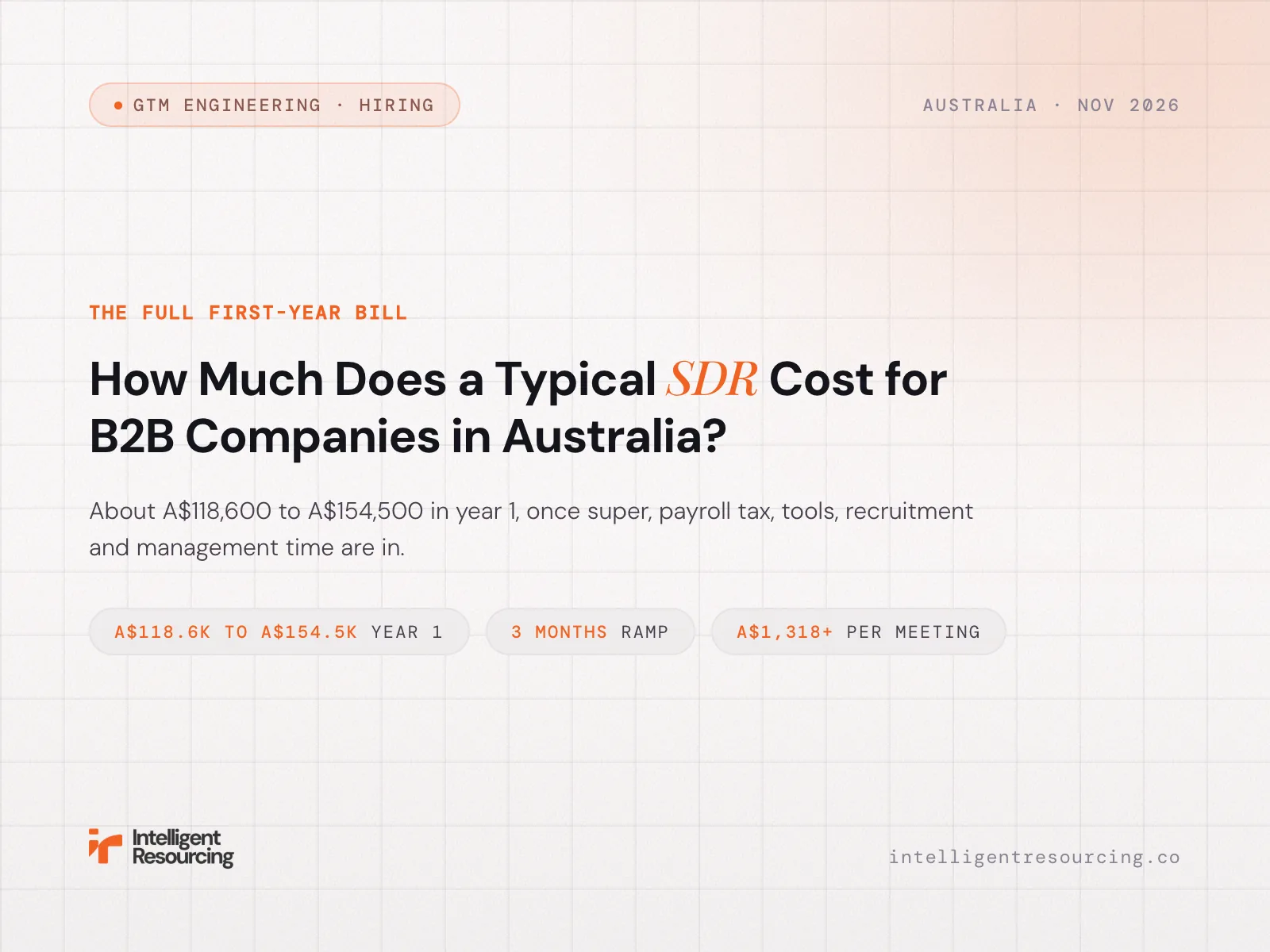
The fully loaded cost of one SDR in Australia is about A$118,600 to A$154,500 for the first year. The low end uses Payscale's A$60,412 base with no payroll tax, and the high end uses an A$80,000 base with NSW payroll tax. From year 2, the recruitment fee drops out.
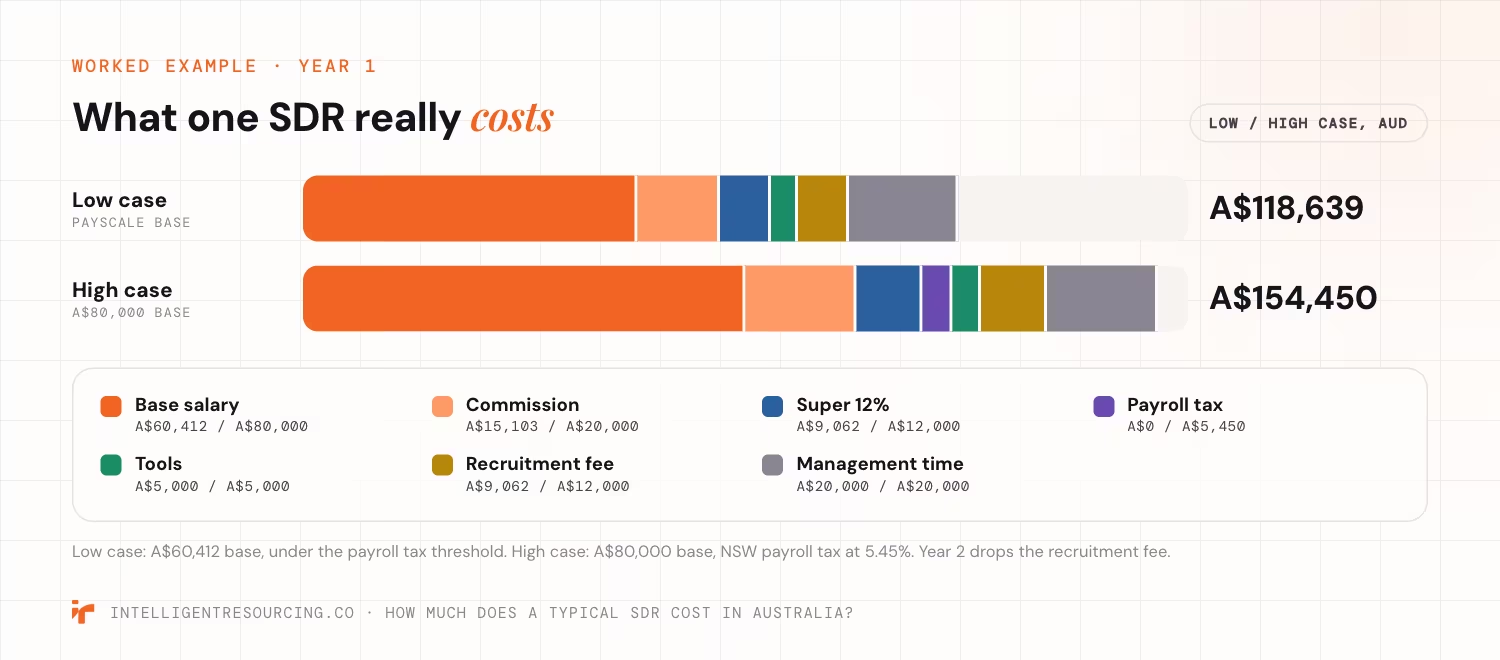
| Cost line, year 1 | Low: A$60,412 base | High: A$80,000 base |
|---|---|---|
| Base salary | A$60,412 | A$80,000 |
| Commission at target, 25% of base | A$15,103 | A$20,000 |
| Superannuation at 12% | A$9,062 | A$12,000 |
| Payroll tax, NSW 5.45% | A$0 (under threshold) | A$5,450 |
| Tools per seat | A$5,000 | A$5,000 |
| Recruitment fee, 15% of base | A$9,062 | A$12,000 |
| Management time | A$20,000 | A$20,000 |
| Total, year 1 | A$118,639 | A$154,450 |
| Total, year 2 (no recruitment fee) | A$109,577 | A$142,450 |
Pay and statutory costs alone come to A$84,577 to A$117,450 in this model. That lines up with our own fully loaded sales-hire cost, built from public salary data and statutory on-costs: about AUD$90,000 to $110,000 for an SDR, lower than the agencies claim. Tools, recruitment and management take the total higher.
The tools line uses a A$5,000 budget per seat. LinkedIn Sales Navigator's plan pricing alone lists Core at A$1,499.88 a year per licence, as of November 2026, and contact data, sequencing and a CRM seat fill the rest.
The management line assumes one sixth of a A$120,000 manager, because each leader runs about 6 SDRs in Bridge Group's 2025 benchmark. If you run outbound as a system rather than a headcount, our GTM engineering service covers the tools and the workflows in one build.
How Long Before a New SDR Pays for Itself?
A new SDR takes about 3 months to ramp, so the first quarter of employment produces few qualified meetings. Bridge Group's 2025 SDR report puts average ramp at 3 months across 351 B2B companies. On our worked example, that ramp costs A$29,660 to A$38,613 before the seat books at quota.
We call this the Ramp Tax: before a new rep books their first meeting you have already spent about three months of their fully-loaded cost. The benchmark itself skews to North American software firms, so treat it as a guide for Australia, not a local rule.
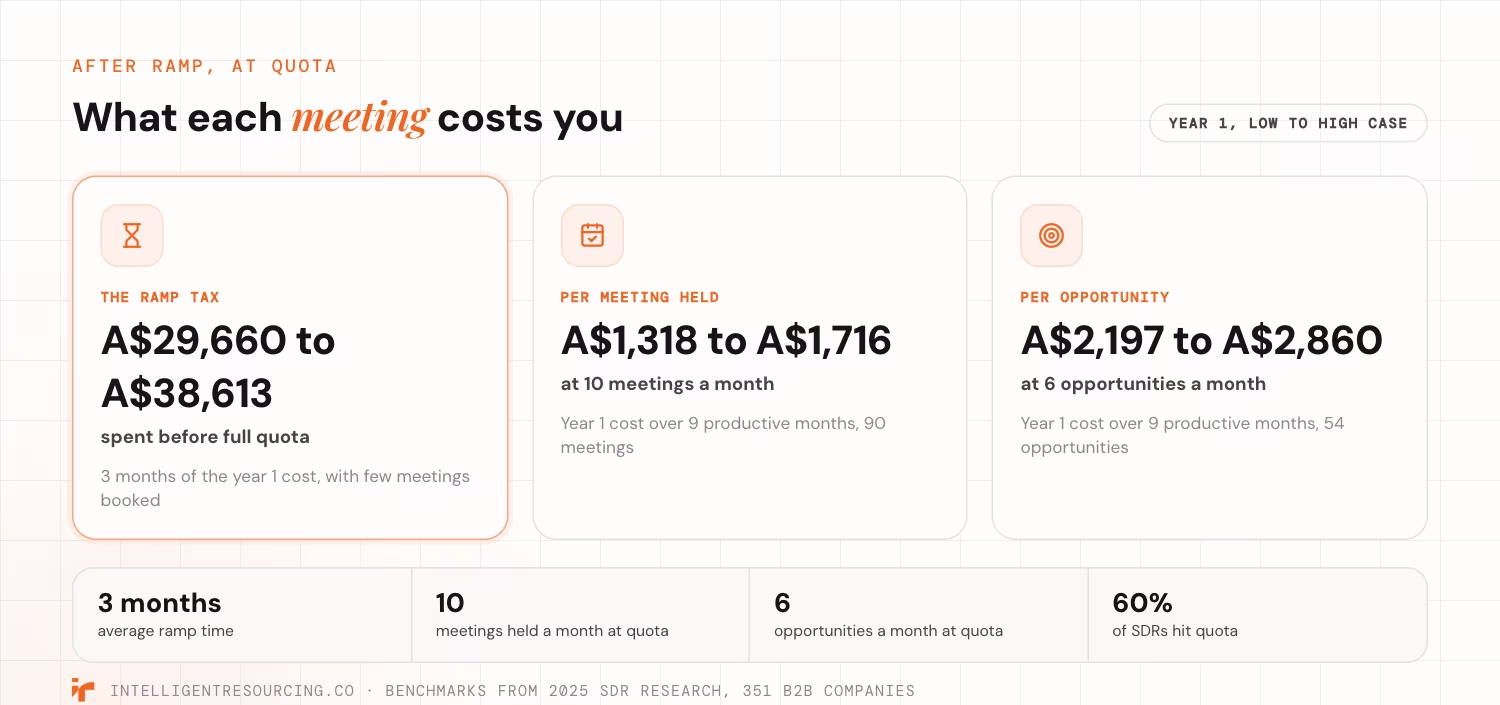
| Measure (Bridge Group 2025) | Benchmark | Low cost case | High cost case |
|---|---|---|---|
| Ramp time | 3 months | A$29,660 | A$38,613 |
| Meetings held a month, at quota | 10 | A$1,318 per meeting | A$1,716 per meeting |
| Opportunities a month, at quota | 6 | A$2,197 per opportunity | A$2,860 per opportunity |
| SDRs at quota | 60% | 4 in 10 miss | 4 in 10 miss |
The cost per meeting is our own calculation: it divides the year 1 total by 9 productive months at quota, which gives 90 meetings and 54 opportunities. Only 60% of SDRs hit quota in Bridge Group's 2025 data, the lowest in the study's history, so for the 4 in 10 who miss, each meeting costs more.
That gap is why many funded teams look for more meetings per seat before they add more seats. Our guide on how to scale outbound after a funding round covers that path.
What Does It Cost If Your SDR Hire Doesn't Work Out?
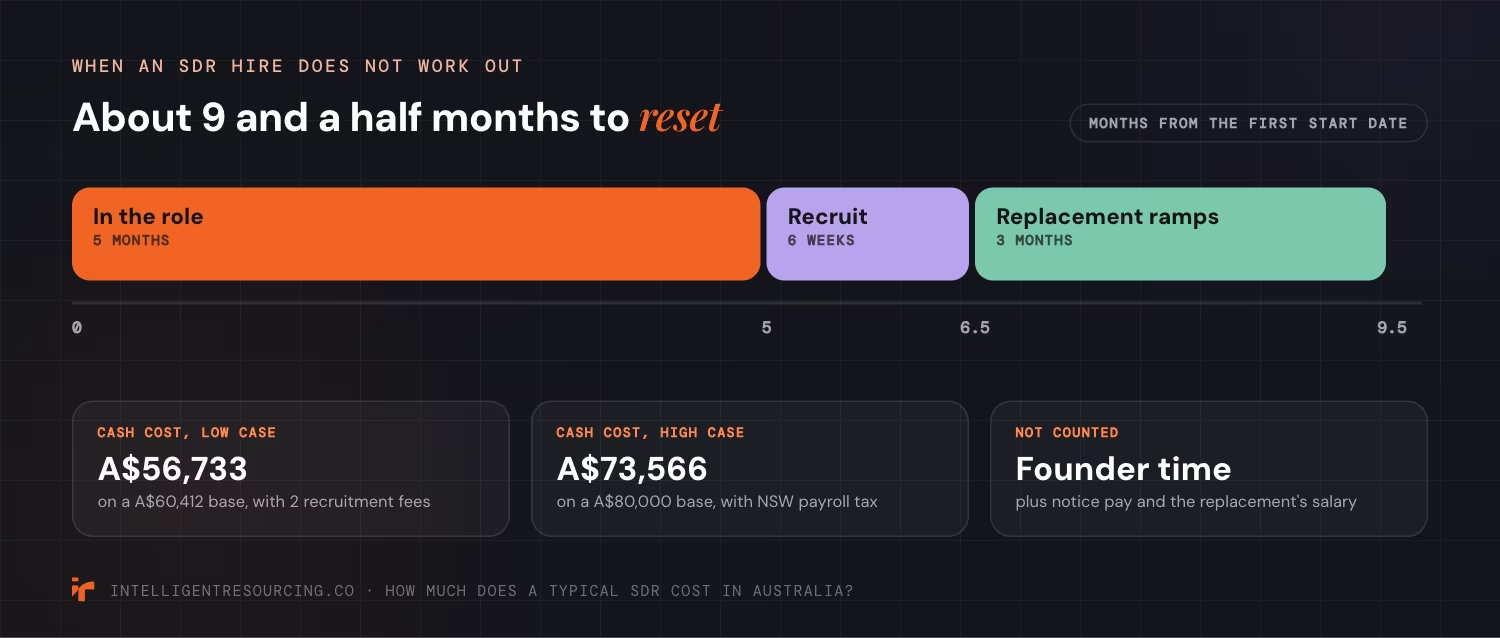
A failed SDR hire costs an Australian company about A$56,700 to A$73,600 in cash. That assumes the SDR leaves after 5 months and you pay a second recruitment fee. The bigger cost is time: about 9 to 10 months from the first start date before a replacement works at full output.
| Cost of a failed hire | Low: A$60,412 base | High: A$80,000 base |
|---|---|---|
| 5 months' base salary | A$25,172 | A$33,333 |
| Superannuation at 12% | A$3,021 | A$4,000 |
| Payroll tax, NSW 5.45% | A$0 | A$1,817 |
| 5 months of tools | A$2,083 | A$2,083 |
| 5 months of management time | A$8,333 | A$8,333 |
| First recruitment fee | A$9,062 | A$12,000 |
| Replacement recruitment fee | A$9,062 | A$12,000 |
| Total cash cost | A$56,733 | A$73,566 |
This model assumes no commission paid, because the SDR missed target, and it leaves out founder time, notice pay and the replacement's own salary. The time cost adds up in 3 stages:
- Spot the problem. The SDR works 5 months before the business calls it.
- Recruit again. Permanent hires took a month and a half on average in People2people's 2025 survey of 3,500 people, and over 45% of hiring processes took 2 months.
- Ramp the replacement. Bridge Group's 2025 benchmark puts ramp at 3 months.
That adds up to about 9 and a half months. A start-up with A$600,000 in cash and A$50,000 a month of net burn has 12 months of runway, and a failed hire uses most of it while pipeline stays flat.
A failed SDR is often a process gap, not the wrong person, because a new hire cannot repeat a sales motion that lives only in the founder's head. Before you rehire, decide which revenue role to hire first.
Is an In-House SDR Cheaper Than Outsourcing or a GTM Engineering System?
An in-house SDR is not the cheapest route in year 1, because recruitment and ramp cost about a third of the first-year bill. Managed outbound swaps that for a monthly retainer and a faster start with less control. A GTM engineering system costs a build fee, then runs on buying signals so each rep spends less time on research.
The in-house route also starts with a vacancy. SmartRecruiters' 2025 analysis of more than 2,400,000 Australian job applications found a median of 32 days to fill a role. The 3 options differ in what you pay for:
- In-house SDR. You pay salary, super, tools and management, and you keep what the SDR learns while they stay. Bridge Group's 2025 data puts average SDR tenure at just under 2 years.
- Managed outbound. You pay a provider a monthly retainer and get meetings faster, but the knowledge sits with their team.
- GTM engineering system. You pay to build workflows that detect buying signals and route them to your reps. Most teams call this lead generation. We call it Signal-Led Growth, because the difference is timing, not volume.
Here is how a signal system works in practice. It detects a new head of sales at a target account, checks the account against your ideal customer profile (ICP), enriches the contact and routes a sequence to the right rep. Outreach starts only when a Verified Buying Window™ opens, so reps spend their day on accounts with a reason to buy now.
The time saving is where the cost moves, because research hours stop eating selling hours. Across multiple B2B clients, business development reps reported losing 40 to 60% of their working week to manual prospecting and data verification before the engine. For the full build-or-buy decision, see our guide to building versus outsourcing a revenue team.
When Should You Hire an In-House SDR Anyway?
Hire an in-house SDR when your sales process works without the founder and you can fund about 3 months of ramp. A written ideal customer profile, clear qualification rules and closed deals from that process show you are ready, and without them a new SDR inherits guesswork.
Your cash runway sets the pace of any hiring decision. Carta's second-quarter 2025 data shows a median of 616 days between a seed round and a Series A. An SDR seat at A$118,600 to A$154,500 a year has to pay back inside that window.
Use these checks before you post the role:
- A documented ICP. Previous wins show which accounts buy.
- Written qualification rules. The SDR can explain how a lead becomes a qualified meeting.
- Proof from someone other than the founder. At least a few deals came from the process, not the founder's network.
- Budget for the full first year. Plan for the A$118,600 to A$154,500 range, not the base salary alone.
An in-house SDR is the right call when you sell complex deals to fewer than 200 accounts, or when you want to grow your own account executives. If the checks fail, fix the process first, then hire. Book a strategy session to map what a signal system would cost against your next hire.
GTM Engineering
See how Intelligent Resourcing builds and measures the GTM system inside your own tools, then book a strategy session.
FAQs
Is superannuation included in an SDR's salary in Australia?
Usually not. Treat a quoted salary as base pay before super unless the ad says otherwise, then add 12% for the 2026 to 2027 financial year. Some packages quote salary plus super as one figure, so read the ad closely.
Do small businesses pay payroll tax on an SDR?
Only once total Australian wages pass the state threshold. In NSW, the threshold is A$1,200,000 a year for 2026 to 2027, with a 5.45% rate above it, so a start-up with A$800,000 in total wages pays none.
How long does it take a new SDR to ramp?
About 3 months on average, according to Bridge Group's 2025 benchmark of 351 B2B companies. A written ICP and clear qualification rules give a new SDR a faster start.
What is a typical SDR commission in Australia?
Commission sits on top of base pay. Payscale's 2026 data shows Australian SDR bonuses of up to A$10,000 a year. Bridge Group's 2025 data, mostly from North America, shows a 68:32 base to variable split.
Is it cheaper to outsource an SDR than to hire one?
In year 1, often yes, because outsourcing skips recruitment and ramp. From year 2, an in-house SDR costs about A$109,577 to A$142,450 a year in our model, since those costs are paid once. Compare any provider's quote against that figure.
What does a bad first sales hire cost an Australian start-up?
About A$56,700 to A$73,600 in cash for an SDR who leaves after 5 months, including a second recruitment fee. The bigger cost is 9 to 10 months of lost pipeline while you rehire and ramp a replacement.