
What Is B2B Sales, and How Is It Different From B2C?
B2B sales is the commercial process of selling products, services or solutions from 1 business to another. The buyer uses the purchase for its own operations: to improve a workflow, serve its customers, cut costs or meet a compliance need. It covers software, professional services, equipment, logistics and raw materials, and it involves formal review, purchasing sign-off and account management.
The term separates sales between companies from sales to individuals, known as business-to-consumer (B2C) sales. B2C buyers decide for themselves and often close in 1 interaction. B2B buyers weigh return on investment, risk, fit with existing systems and the interests of several colleagues.
Demandbase's 2025 buyer research found that 72% of B2B purchases involve multi-stakeholder complex buying groups. So a B2B seller rarely deals with 1 contact. Working with purchasing, finance and technical reviewers is a core skill. Good selling starts with accounts that have a reason to buy, which is the idea behind signal-led lead generation.
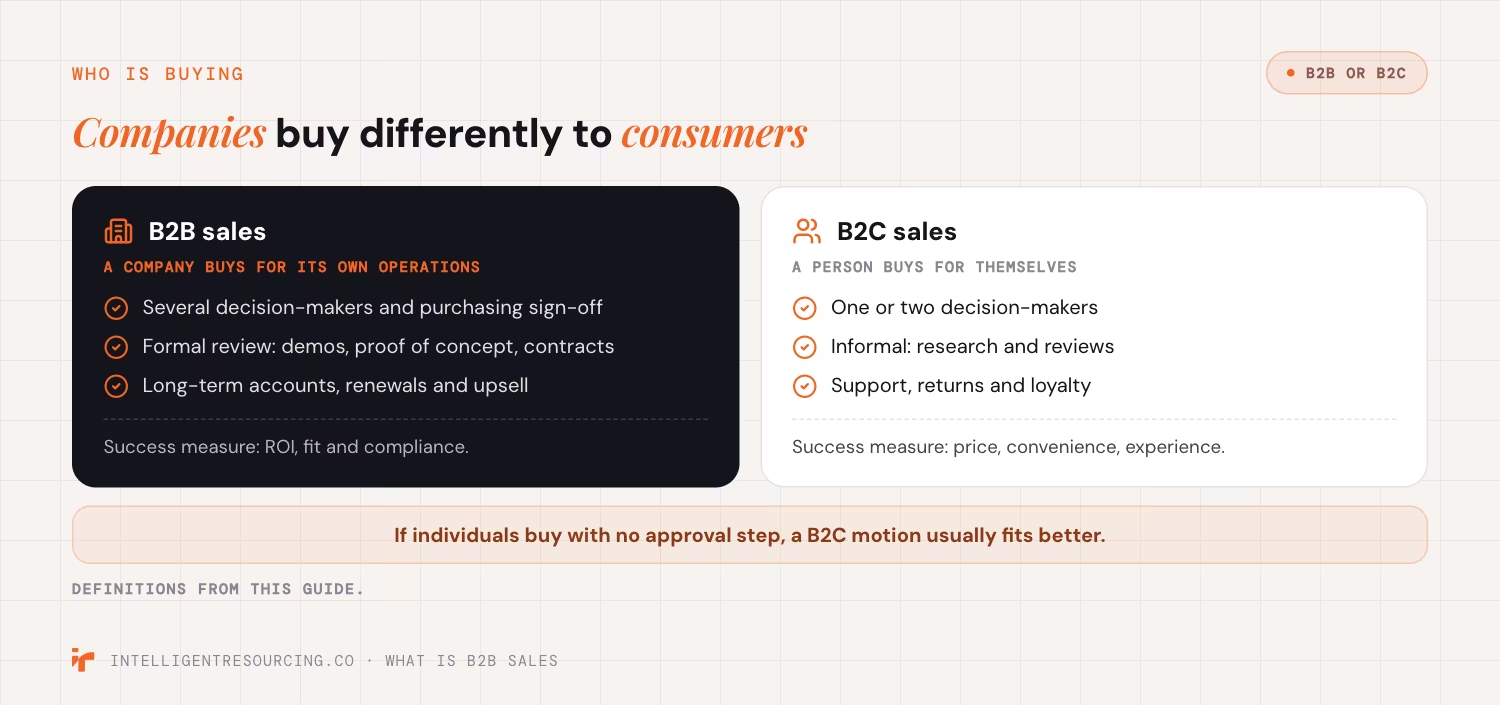
| Dimension | B2B | B2C |
|---|---|---|
| Decision-makers | Several (purchasing, finance, end user) | 1 or 2. |
| Budget source | Company budget approved through purchasing | Personal or household income. |
| Review | Formal: request for proposal (RFP), demos and proof of concept | Informal: product research and reviews. |
| Success measure | Return on investment (ROI), fit and compliance | Price, convenience and experience. |
| Contract type | Service agreements, service level agreements (SLAs), annual licences | One-off or subscription purchase. |
| After the sale | Account management, renewal and upsell | Support, returns and loyalty. |
What Are Some Examples of B2B Sales?
B2B sales happens in every major sector. Equipment suppliers sell to project developers. Software firms sell workflow tools to operations teams. Professional services firms sell advice to executives. In each case the buyer is a company with buying rules and no individual making a personal purchase.
Common examples include a software as a service (SaaS) firm selling CRM software to a logistics company, a cleaning company selling contracts to building operators, a marketing agency selling retainers to a retailer and a law firm on retainer to a construction business.
| Sector | Seller | Buyer | What changes in B2B |
|---|---|---|---|
| Software | CRM platform | Sales operations team | Contract, setup and data security review. |
| Construction | Equipment supplier | Project developer | Purchasing policy, volume pricing and delivery SLA. |
| Professional services | Marketing agency | Marketing or revenue leader | Defined brief, rate card and compliance needs. |
| Logistics | Freight forwarder | Warehouse operator | SLA, warehouse management system (WMS) link and customs rules. |
| Financial services | Accounting firm | Chief financial officer (CFO) or operations lead | Retainer agreement and regulatory duties. |
In B2B software, pipeline leans on people who sell. ICONIQ's 2026 State of Go-to-Market report, a survey of 150+ B2B software go-to-market (GTM) leaders, found that high-growth companies source 60 to 80% of pipeline from sales and channel, against 15 to 20% from marketing. Teams that find accounts early, as in a signal-led prospecting system, feed that sales motion.
What Does a B2B Sales Process Look Like?
A B2B sales process is a repeatable sequence of stages that takes a prospect from first identification to a signed agreement. Stages vary by business. The aim is the same: replace ad hoc outreach with a written workflow that any sales hire can follow and any leader can audit.
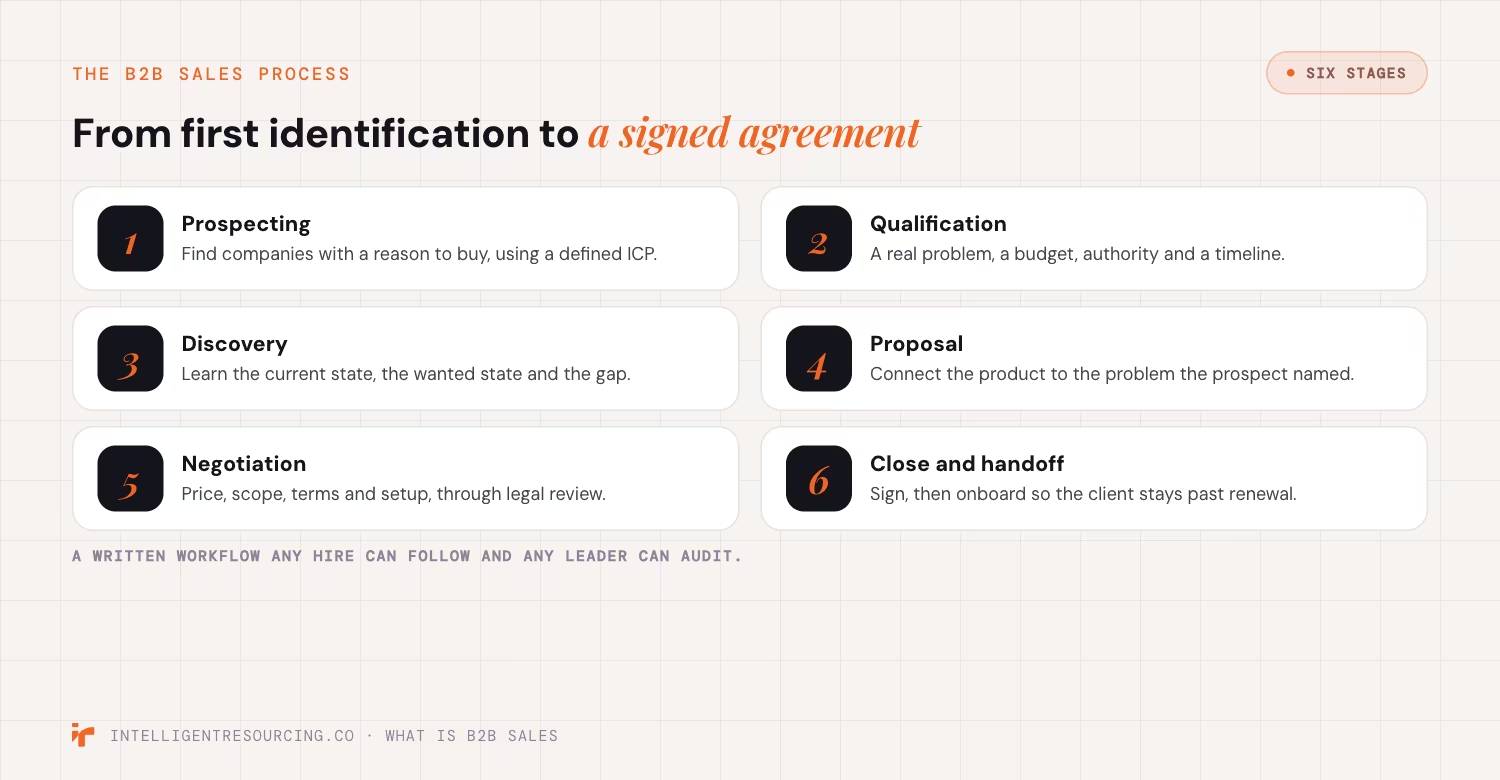
A typical process has 6 stages.
Stage 1: Prospecting and Territory Definition
Identify which companies have a reason to buy. Define your ideal customer profile (ICP): size, industry, region, technology and buying triggers. Then build a list of matching accounts. Prospecting without a defined territory wastes qualified selling time, which is costly in B2B sales.
Stage 2: Qualification
Qualification tests whether a prospect meets the minimum bar for a useful sales conversation. It needs a real problem your product solves, a budget, the authority to buy and a timeline that makes talking now worthwhile.
Stage 3: Discovery
Discovery is the structured conversation where the seller learns the prospect's situation. It is diagnostic work: the current state, the wanted future state and the gap between them. Good discovery surfaces objections before the proposal, which can shorten the cycle and lift close rates.
Stage 4: Proposal and Presentation
The seller presents a specific solution to the problem found in discovery. That can mean demos, technical reviews, scoping sessions or a proof of concept. Skip the feature tour and connect the product to the problem the prospect named in Stage 3.
Stage 5: Negotiation
B2B deals involve talks on price, scope, contract terms, setup timelines and support. Buying teams often stretch this stage because they must cut cost and protect the company from risk. Sellers who know budget cycles, sign-off limits and legal review tend to close faster.
Stage 6: Close and Handoff
The deal closes when both sides sign. A structured onboarding follows straight away. The quality of the handoff from sales to delivery decides whether the client stays past the first renewal.
Speed matters at the start of the process. RevenueHero's study of 1,000 B2B software company websites found that only 365 replied to a demo request, and the average reply took 1 day, 5 hours and 17 minutes. It counted automated replies, so it shows response gaps and says little about reply quality.
Intelligent Resourcing wrote this guide and sells this work. It builds and manages signal-led systems inside a client's own CRM. Whoever you hire, ask for a written offboarding map that says what you keep if the engagement ends: the CRM data, workflows, documentation and tool licences. If your gap is the prospecting stage, start with GTM engineering.
How Does B2B Selling Work in Australia?
Australian B2B sellers follow the same commercial rules as sellers elsewhere, and they must keep every claim accurate. The Australian Consumer Law, which sits in Schedule 2 of the Competition and Consumer Act 2010, bans misleading or deceptive conduct in trade or commerce, and that includes sales materials, proposals and product comparisons sent to other businesses. The Australian Competition and Consumer Commission (ACCC) publishes guidance on false or misleading claims. Any claim to a business buyer should be accurate and backed by evidence.
Specific claims also help your selling. A proposal that names the buyer's problem and shows checkable evidence is easier to approve than a general promise. Outreach built on real buying events, as described in signal-based selling, gives you that detail. See also buying signals in B2B sales.
Is B2B Sales Hard?
B2B sales takes sustained effort over a longer timeline than most consumer sales. Buyers compare several vendors, apply procurement checks and involve colleagues. As at 29 October 2026, we found no single reliable sales-cycle benchmark for all B2B deals. Cycle length rises with deal size and the number of people who approve.
The Bridge Group's 2025 report on sales development reps (SDRs), across 351 B2B companies, found that the average SDR takes 3.0 months to ramp, the lowest since 2010, and stays 1.9 years. Only 60% of reps were at quota, the lowest share on record.

What makes B2B sales hard:
- Several decision-makers: Approval needs agreement across purchasing, finance, legal and the end user.
- Long cycles: Deals take weeks or months from first meeting to signature.
- High rejection: Most contacts are not ready to buy when outreach lands.
- Slow trust: Credibility with an account builds through steady engagement.
What eases it:
- An ICP that matches real buyers and not hoped-for targets.
- Outreach that lands when a genuine buying window opens.
- A written process that makes coaching and improvement possible.
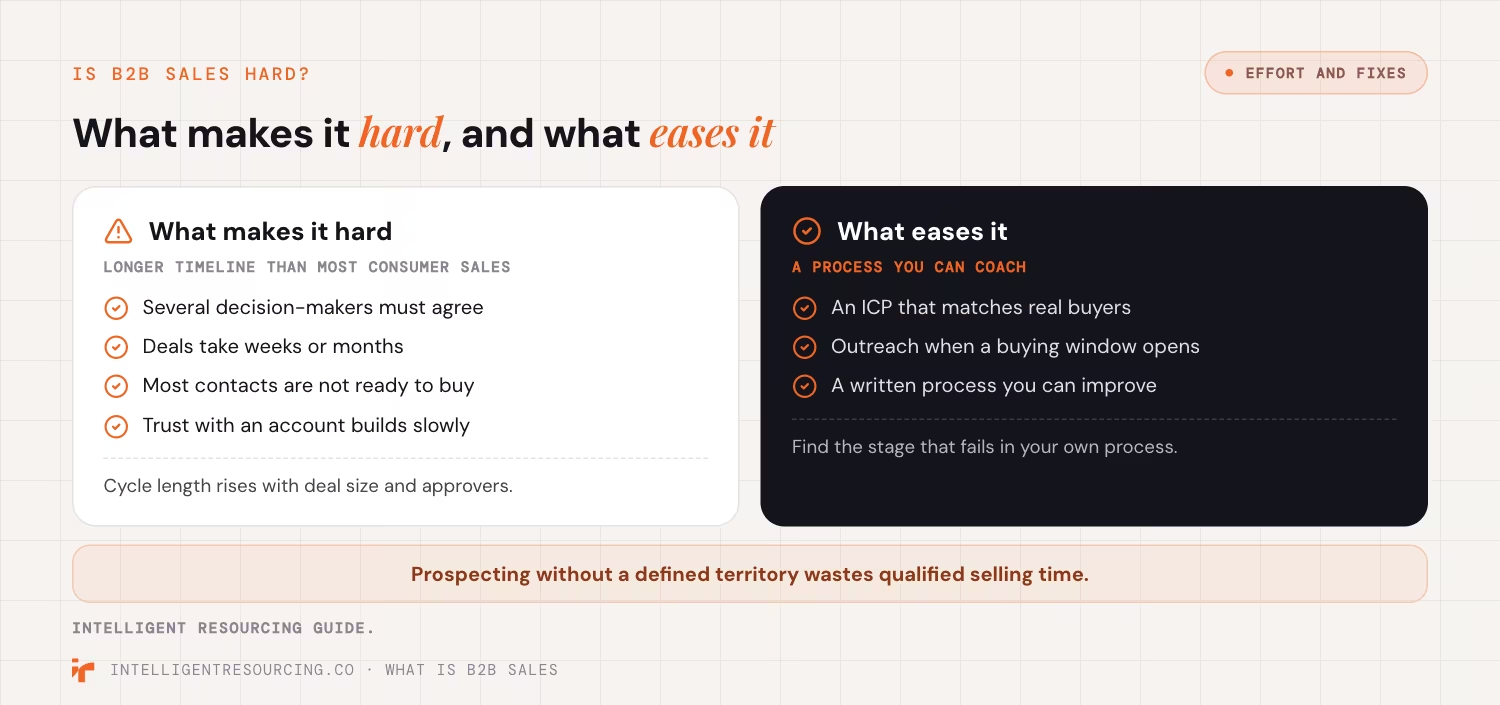
To find the stage that fails in your process, work through the B2B lead generation strategy checklist.
GTM Engineering
If your gap is finding accounts with a reason to buy, start with a signal-led outbound system built inside your own CRM.
FAQs
What does B2B mean in sales?
B2B stands for business-to-business. One company sells products or services to another for commercial or operational use. The buyer is a company with buying rules and no individual making a personal purchase.
Is B2B sales the same as enterprise sales?
No. B2B sales covers any deal between businesses, whatever the buyer's size. Enterprise sales is a subset: deals with large companies that have complex buying rules and long review cycles.
How long does a B2B sales cycle take?
It varies. As at 29 October 2026, we found no single reliable benchmark for all B2B deals. Cycle length rises with deal size and with the number of people who must approve, so measure your own cycle by deal type.
What is the difference between B2B sales and B2B marketing?
B2B marketing builds awareness and interest. B2B sales turns that interest into revenue. In modern B2B firms, the 2 functions share responsibility for pipeline quality and revenue results.
Do I need a B2B sales process if I am a founder selling myself?
Yes. A written process shows why deals close, why they stall and what to change. It also gives your first sales hire a base to build on.