
What are the main types of go-to-market strategies?
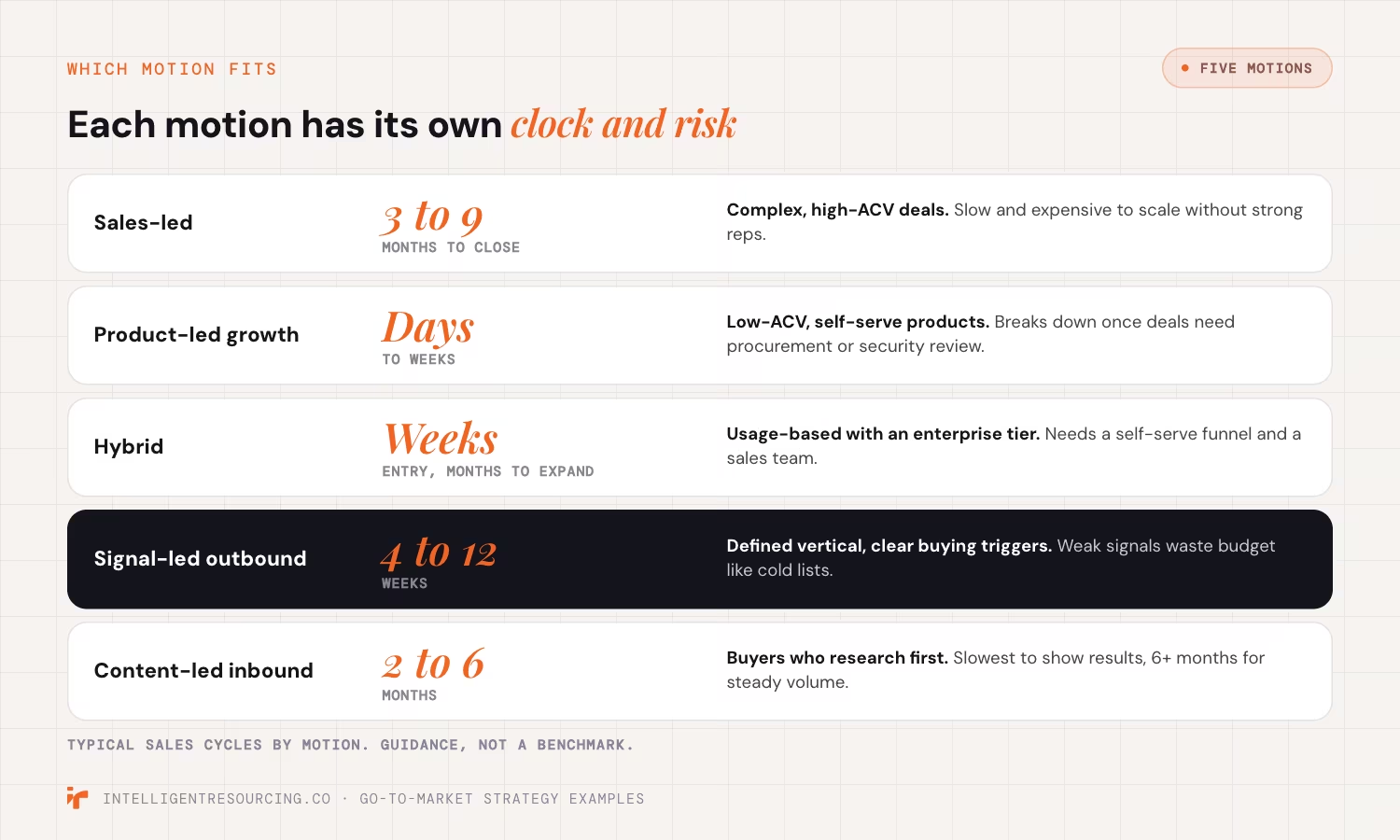
The main go-to-market types are sales-led, product-led, hybrid, signal-led outbound, and content-led inbound. Each one shapes how a buyer first finds the product, and each needs a different budget and timeline. Most business-to-business (B2B) companies run two of these five at most, never all five at once.
- Sales-led: a rep engages the buyer early. Best for complex, high annual contract value (ACV) deals with several stakeholders.
- Product-led growth: the product replaces the rep, letting buyers try before anyone talks to them, the shift Mixpanel's 2026 State of Digital Analytics report describes as product becoming the new primary growth channel.
- Hybrid (land-and-expand): sales closes the first deal, then usage grows the account from there.
- Signal-led outbound: spots a buying trigger, like a hiring spike, funding round or tech change, and reaches out while it is still fresh.
- Content-led inbound: buyers research and educate themselves on published content before anyone from the company reaches them. One case study shows how far a content-led motion can compound over time.
Using the wrong go-to-market (GTM) motion for your buyer burns the budget fast. We'll map your product's price point and sales cycle to the motion that actually fits, free of charge. Get your GTM motion mapped.
What are some examples of good B2B go-to-market strategies?
The clearest B2B go-to-market examples share one trait: each company picked a single motion and built every channel around it. Cursor, Snowflake and a signal-led outbound engine below show three different motions. Each one worked for a different kind of product.
Cursor: product-led growth
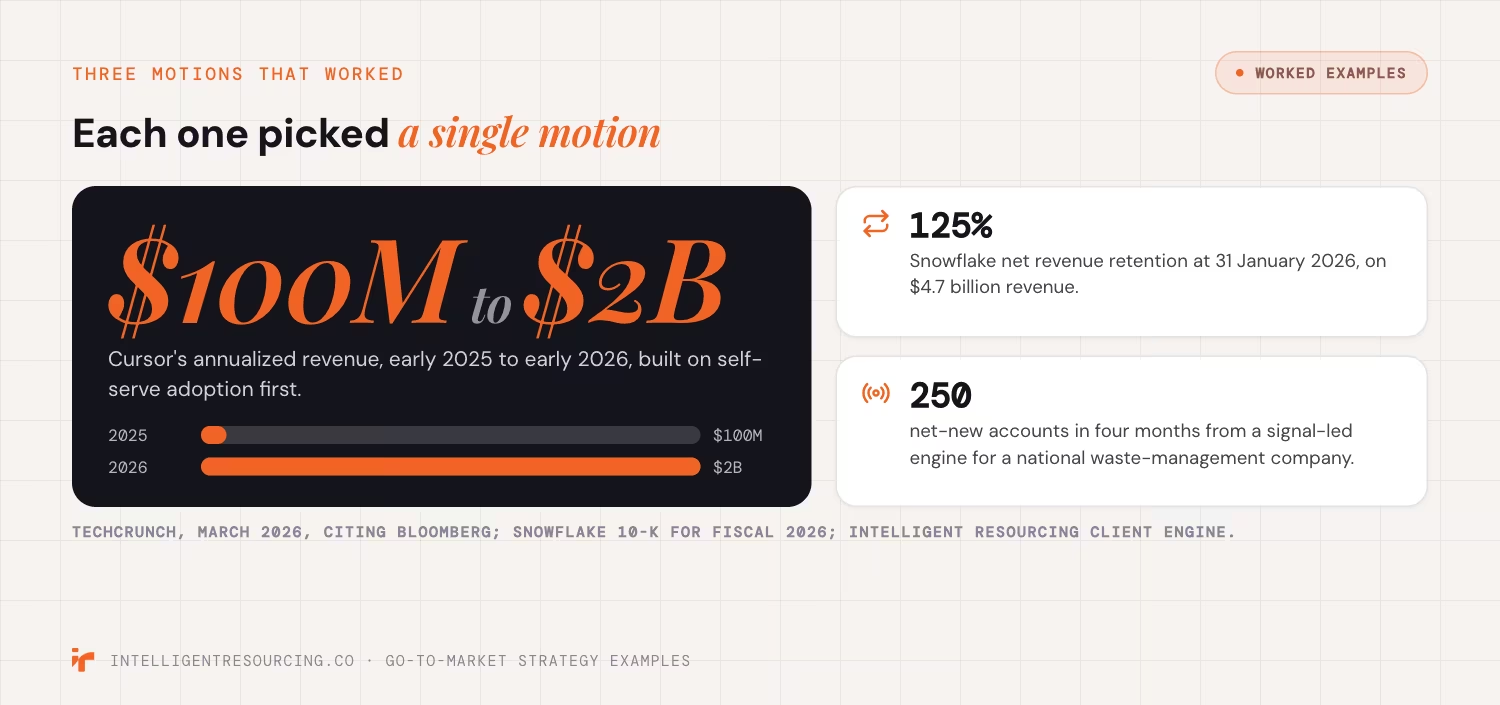
The artificial intelligence (AI) coding editor grew from roughly $100 million to more than $2 billion in annualized revenue between early 2025 and early 2026, according to TechCrunch in March 2026, citing Bloomberg's reporting. Individual developers adopted it first with no sales call, and corporate buyers now make up about 60% of revenue.
Snowflake: hybrid land-and-expand
Snowflake pairs a direct sales team with usage-based pricing. Once a customer signs, the sales team's job shifts to growing how much that customer uses the product, not winning a new one. Its net revenue retention rate stood at 125% as of January 31, 2026, the end of its fiscal year, with revenue growing 29% year on year to $4.7 billion, per Snowflake's own annual filing. That pairs sales-led signing with product-led growth, run as two clear stages rather than one mixed motion.
Signal-led outbound: a national waste-management company
A signal-based engine tracked buying triggers across the company's target vertical. It delivered roughly 150 net-new accounts into the customer relationship management (CRM) system in the first phase, and around 250 over four months. Volume is set per client and vertical, not fixed. The engine scales to the size of the market, not to a cold-call quota. For other ways to build pipeline beyond cold lists, see B2B lead generation alternatives that actually scale.
Which GTM strategy works best for a B2B startup?
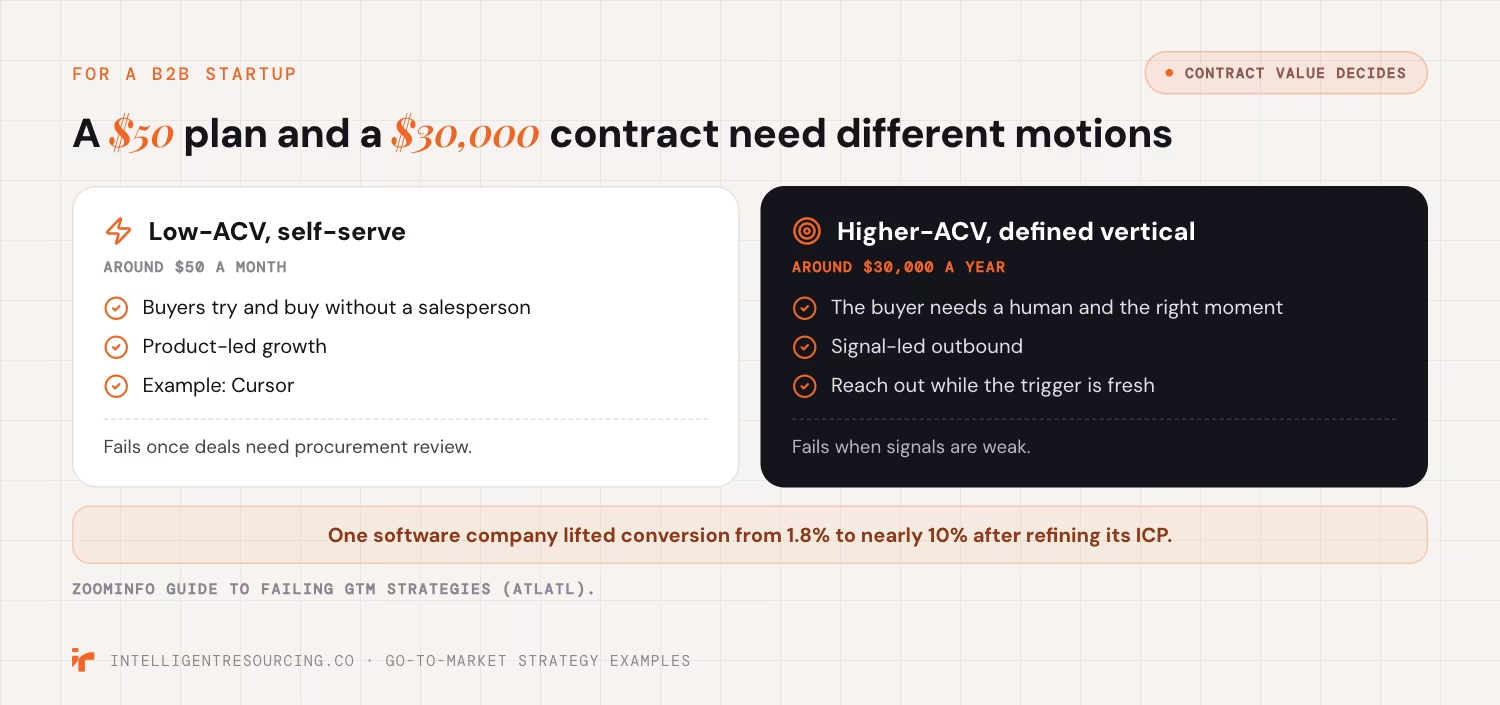
For most B2B startups, a signal-led or hybrid motion beats pure sales-led or pure product-led. Most startups lack the brand name for product-led growth alone, or the budget for a full sales team. A $30,000 contract needs a different motion than a $50-a-month one.
| Contract value | What it needs | Why |
|---|---|---|
| Low-ACV, self-serve (around $50 a month) | Product-led growth | Buyers can try and buy without talking to a salesperson, like Cursor |
| Higher-ACV, defined vertical (around $30,000 a year) | Signal-led outbound | The buyer needs a human and the right moment, not a free trial |
Sales and marketing misalignment sinks many GTM plans. One software company, Atlatl, lifted its conversion rate from 1.8% to nearly 10% after refining its ideal customer profile (ICP), according to ZoomInfo's guide to failing GTM strategies. That shows up as marketing creating demand that sales ignores, or sales chasing accounts marketing never qualified.
A signal-led motion only works if the signal and the sales follow-up sit in one system, not two. We build that connection so nothing a buyer does goes unnoticed. See how signal-led growth works.
What go-to-market frameworks do B2B companies use?
B2B companies most often run one of three frameworks: land-and-expand, signal-based targeting, or account-based marketing. All three decide which accounts to pursue and when. But they fit different sales cycles, deal sizes and company stages, from a two-person startup to a large enterprise team. Demand Gen Report's 2026 account-based marketing (ABM) benchmark survey found ABM has moved beyond the pilot stage for most B2B teams.
| Framework | How it works | Seen above |
|---|---|---|
| Land-and-expand | Starts small and low-risk, then grows once the product proves itself inside the account | Snowflake |
| Signal-based targeting | Tracks hiring, funding and tech changes on a set list of accounts, then reaches out the moment something changes | The signal-led engine |
| Account-based marketing | Targets a fixed list of named accounts, with marketing and sales working together, instead of an open funnel | Not covered above |
Nine signal-triggered ABM plays show the account-based framework in action.
Templates and scripts for each cover the build sequence in more depth.
What are the biggest GTM mistakes and challenges?
The single biggest go-to-market mistake is launching before confirming the market actually wants the product. CB Insights' 2026 analysis of 431 venture capital (VC) backed startups that shut down since 2023 found that 43% cited poor product-market fit. That is more telling than the 70% that ran out of capital, which is usually just the final symptom.
A defined, narrow ICP fixes most of what follows a bad launch. A broad or undefined ICP compounds into three separate problems:
- Marketing generates volume instead of fit, chasing any lead rather than the right one
- Sales spends time qualifying accounts that were never a match, wasting cycles on dead-end calls
- The two teams end up measuring different things, so nobody agrees on what counts as progress
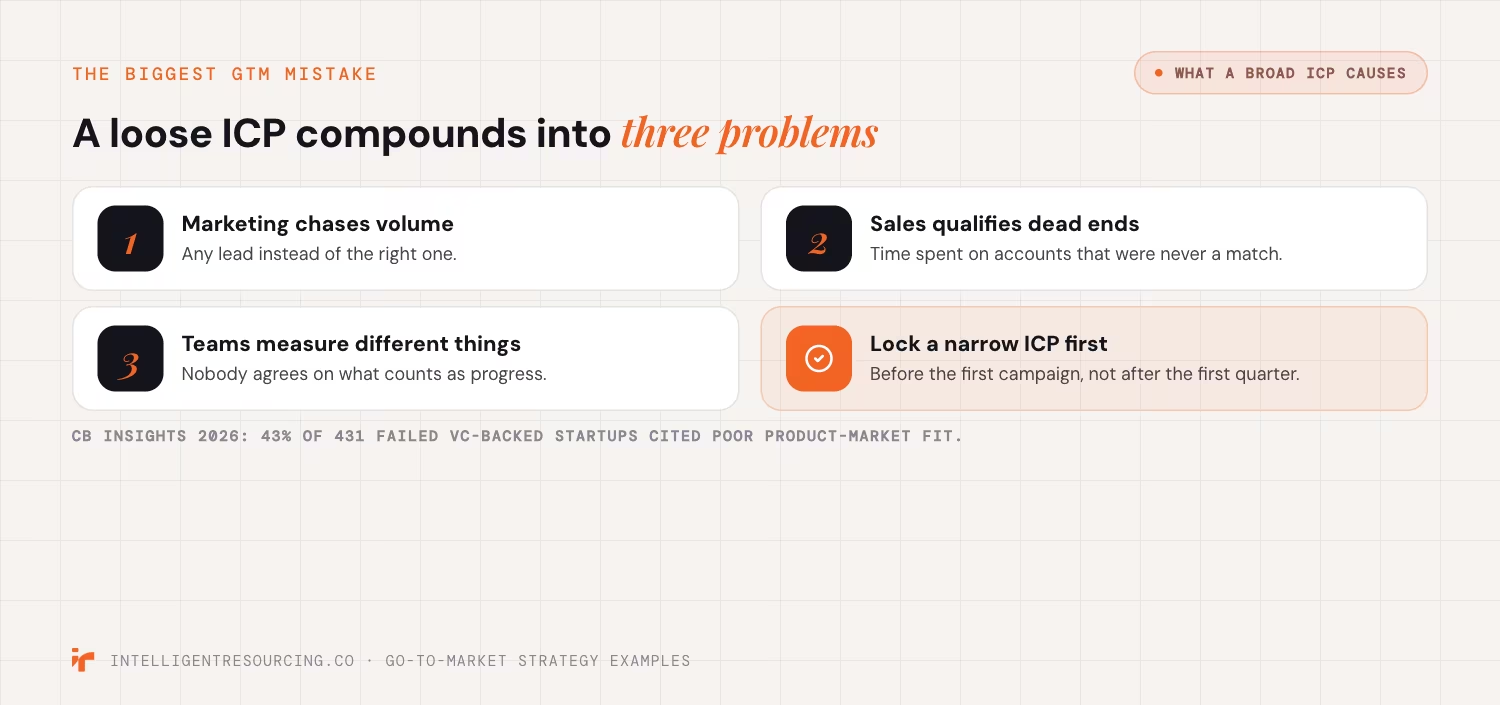
Guidance built for founders covers how to lock an ICP before the first campaign runs, not after the first quarter's results come in.
The GTM motion matters less than whether your ICP is narrow enough to act on. We'll show you which accounts in your market are already showing buying signals, before you spend on the wrong ones. Check your market for live buying signals.
Want the full comparison of all five motions, side by side, including which to run at each funding stage? Read the full five-motion comparison.
GTM Engineering
We map your product's price point and sales cycle to the motion that actually fits.
FAQs
What is a go-to-market strategy?
A go-to-market strategy is the plan for how a company reaches, convinces and converts its buyers. It is built around one main motion, not several at once.
What are the five go-to-market strategies?
The five are sales-led, product-led, hybrid (land-and-expand), signal-led outbound, and content-led inbound. Most companies run one as the lead motion and a second to support it.
Which GTM strategy works best for a B2B startup?
A signal-led or hybrid motion usually fits a B2B startup best. The exception is a cheap, self-serve product that can sell itself with no sales team needed.
What are the biggest GTM mistakes?
Poor product-market fit is cited by 43% of VC-backed startups that failed since 2023, more telling than the 70% that ran out of capital, which is usually just the final symptom. A broad or undefined ICP is the next most common cause, since it sends marketing and sales after the wrong accounts.
What's the difference between a go-to-market strategy and a marketing strategy?
A marketing strategy covers how a company generates demand and awareness. A go-to-market strategy is broader: it also sets the sales motion, pricing approach, and who owns each part of the buyer's journey.