
What Has Changed in B2B Marketing Now Buyers Use AI?
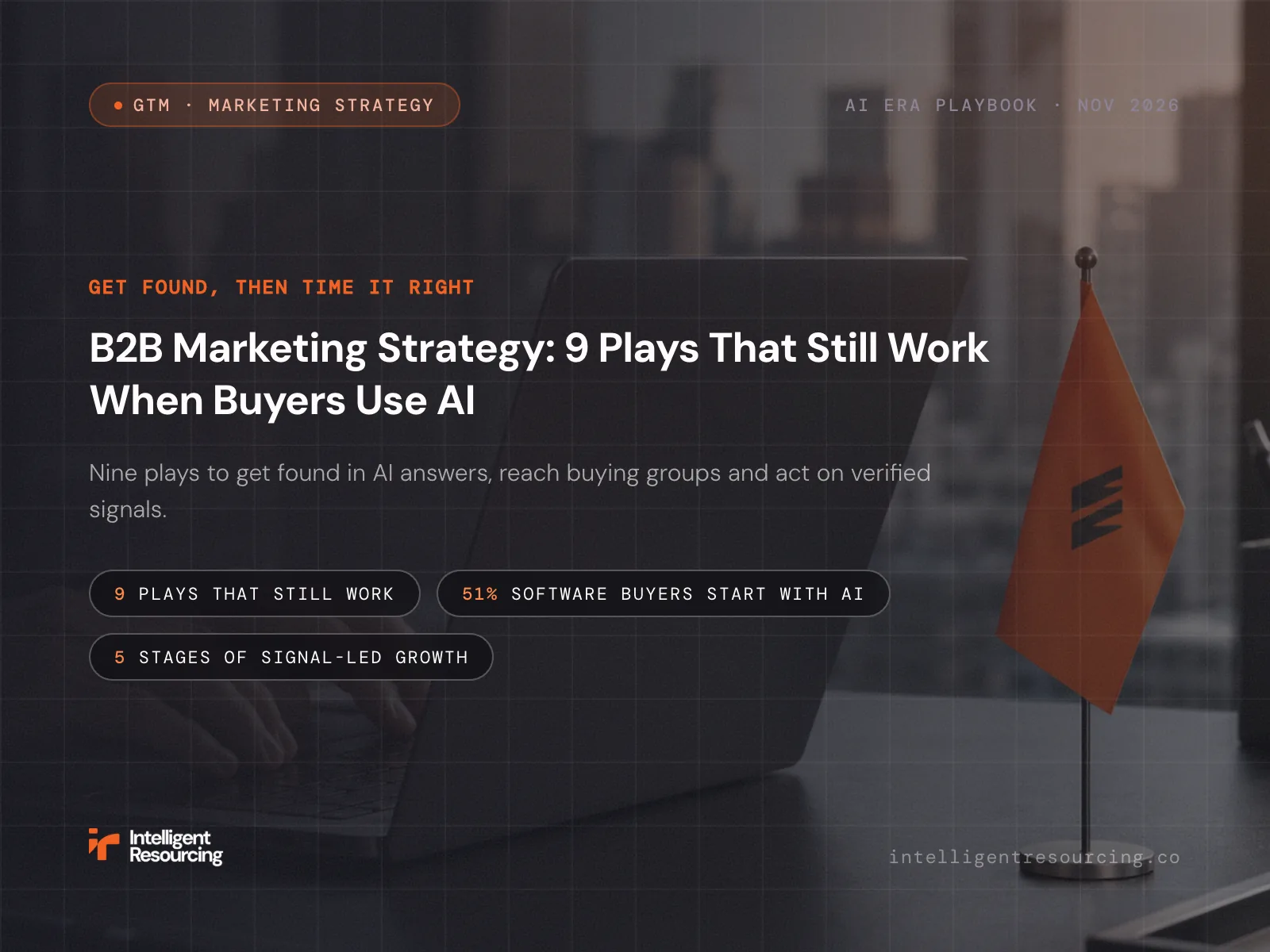
Many B2B software buyers now start research in an AI chatbot, so your brand can be described, recommended or ignored before anyone visits your site. G2's The Answer Economy report surveyed 1,076 B2B software buyers in March 2026. It found that 51% start research with an AI chatbot more often than with Google, up from 29% in G2's 2025 buyer report. It also found that 71% rely on chatbots in research, and 85% think more highly of a vendor that an AI chatbot includes in its answer. Those figures cover software buyers and no wider market.

Marketing now needs campaigns that drive traffic and also investment in the sources AI engines read when they form answers.
That changes the work in 3 ways:
- Discovery without a clear difference: Buyers meet brands and cannot name their expertise.
- Engagement without intent: Campaigns draw replies from accounts that are not ready to buy.
- Activity without accountability: Teams report campaign numbers and never link them to revenue.
The fix is to link category visibility, demand creation and signal-led action. Visibility in AI answers is a discipline of its own, known as generative engine optimisation.
What Are the 4 Main Types of B2B Marketing?
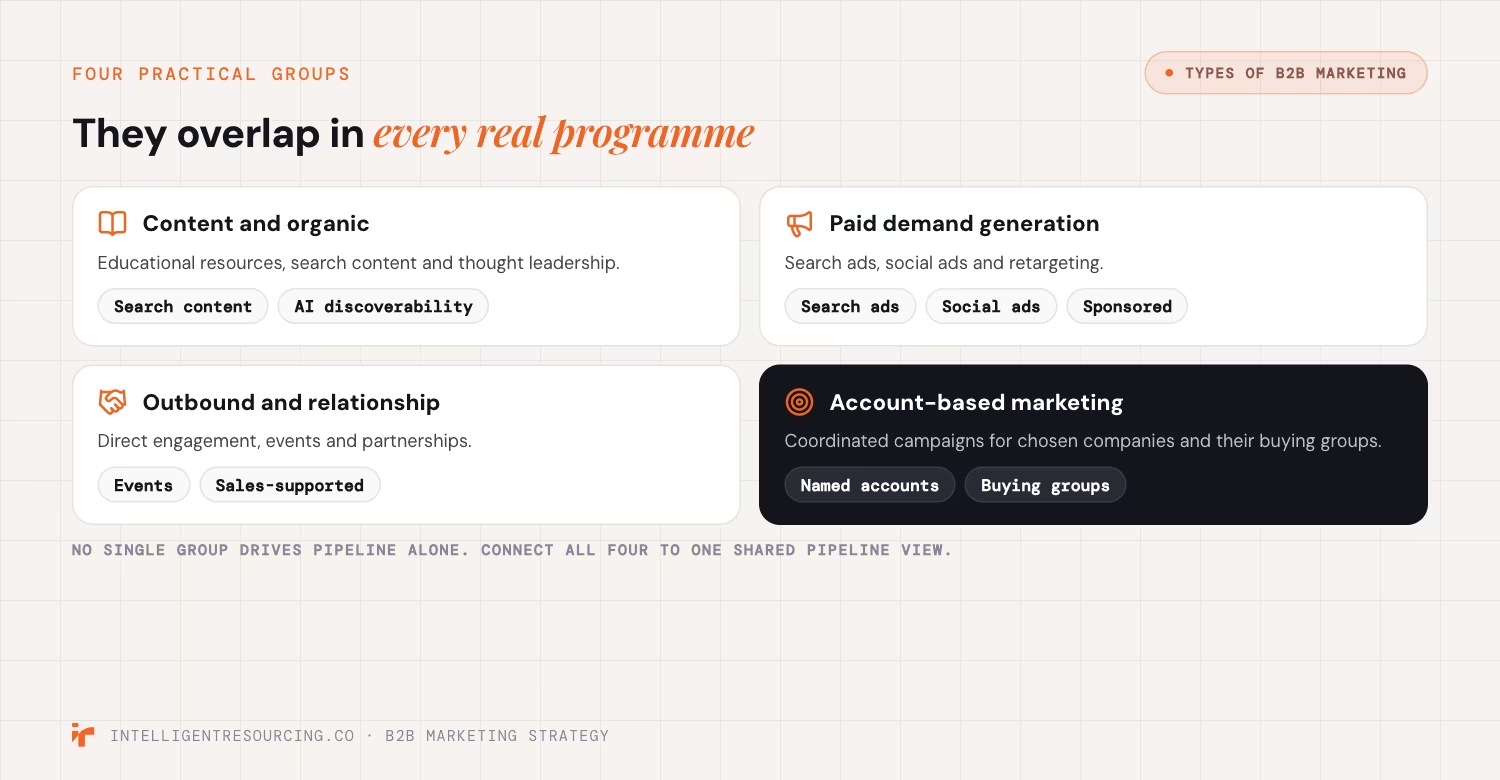
B2B marketing falls into 4 practical groups that overlap in every real programme. No single group drives the pipeline alone. Strong programmes combine content and demand generation with account targeting and outbound, then connect all 4 to 1 shared pipeline views with the same definition of a qualified opportunity.
- Content and organic marketing: Educational resources, search content, thought leadership and AI-search discoverability.
- Paid demand generation: Search ads, social ads, retargeting and sponsored placements.
- Outbound and relationship marketing: Direct engagement, events, partnerships and sales-supported prospecting.
- Account-based marketing (ABM): Coordinated campaigns that target chosen companies and their buying groups.
An ABM programme can use educational content, LinkedIn ads and direct outreach to reach different stakeholders. Demandbase's 2025 buyer research found that 72% of B2B purchases involve complex buying groups. The channel matters less than how it supports the buying journey, and an account-based go-to-market framework shows how to plan it.
Which 9 Strategies Still Work When Buyers Use AI?
These 9 strategies work in 2026 because each addresses a different point where AI-assisted buyers either find you or fail to. Run them in clusters: build visibility and trust first, then add account-based targeting and signal-led timing once your positioning is clear. No single play carries the whole pipeline.

1. Make Your Category Clear to AI Search
Citation depends on category as well as authority. Intelligent Resourcing's answer engine optimisation (AEO) tracker shows that the same brand can be the most cited in its own category and absent from an adjacent one. The site and its authority stay the same. Only the category being asked about changes.
AI answers tend to favour businesses that tie their services, expertise and evidence to a specific buyer problem. A B2B agency should say exactly what it delivers, who it serves and how it differs.
Practical action: Check AI answers for your main and adjacent service categories. Note where you are missing, misfiled or described too loosely.
2. Create Answer-First Content That Shows Expertise
AI-assisted buyers ask specific questions and skip broad service pages. Good content leads with a direct answer, explains the reasoning and gives evidence readers can check. A page on B2B marketing strategies should say which approaches work before it sells anything.
Useful formats include comparisons, how-to guides, decision frameworks and original research. Original evidence gives buyers more than generic advice.
Practical action: Build content around real buying questions, then link related articles into clear topic clusters. Put accuracy and usefulness ahead of keyword repetition.
3. Keep Search Engine Optimisation and High-Intent Search Working Together
AI search has not replaced search engine optimisation (SEO). Search engines and AI systems both still need pages they can reach, text they can read and sources they can trust. Combine technical SEO, high-intent keywords and answer-focused content.
A service page can explain what you do, while supporting articles answer questions on implementation, alternatives and results. That gives relevant buyers several ways in.
Practical action: Review your top search pages for crawl access, clear headings, useful internal links and consistent service definitions.
4. Build Trust With Expert-Led Thought Leadership
AI summaries can introduce a category, but complex decisions still need confidence. Original views, documented experience and credible expert comment help buyers judge whether a supplier understands their problems.
The 2025 Edelman-LinkedIn B2B Thought Leadership Impact Report found that more than 40% of B2B deals stall because of misalignment within buying groups. So write for commercial, technical and finance readers, and not only for marketers.
Practical action: Publish expert explanations of common setup risks, trade-offs and lessons from real projects.
5. Use Account-Based Marketing to Reach Buying Groups
Traditional lead generation focuses on single contacts. ABM accepts that a B2B purchase involves several people with different priorities. A marketing director cares about pipeline, a finance leader about acquisition cost and a technical lead about integration.
ABM links them through joined-up content, ads and sales contact. For an Australian software firm, that can mean separate resources for executives, IT reviewers and procurement within 1 target account.
Practical action: Map the buying committee for each priority account, and match content to each person's concern.
6. Prioritise Accounts With Verified Buying Signals
Traditional targeting picks companies that fit an ideal customer profile. Signal-led targeting adds a question: is something happening that makes contact relevant now? Signals include expansion news, hiring, technology changes and repeat engagement with relevant content.
Intelligent Resourcing's signal engine screens roughly 50,000 Australian news items a day down to about 50 actionable buying signals. Those figures describe filtering and no measured conversion gain. Verification matters, because a funding round or a job ad does not prove buying intent.
Practical action: Combine account fit, signal relevance, freshness and verification before you pick the next step.
7. Join Up Channels Around Buyer Timing
More channels do not make a strategy. Email, LinkedIn, paid media and sales contact need 1 shared purpose. Take an illustrative Australian logistics software firm. A target transport company announces a depot expansion, and the team verifies the news and spots a likely operating problem.
It publishes an expansion checklist, engages the right people on LinkedIn and books a relevant sales call where context justifies it. Each step answers the same new business need.
Practical action: Design channel sequences around verified account context and not isolated campaign dates.
8. Keep Human-Led Outreach Where Judgement Matters
Automation brings consistency, and it cannot replace every commercial conversation. Human-led outbound can still beat automation for high-value enterprise deals, genuinely new categories and pipeline needed inside about 90 days. Those deals involve unclear needs, unfamiliar technology and several internal objections.
People help buyers read the evidence, weigh risk and build confidence. Edelman's hidden-buyer finding points the same way: deals stall when the group is not aligned.
Practical action: Automate monitoring, research and routine tasks, and keep senior commercial judgement for complex deals. For the trade-offs, see AI prospecting vs a human list builder.
9. Measure Pipeline Outcomes and Not Marketing Activity
Impressions, visits and email clicks help diagnose campaigns, and they do not prove commercial success. Measure what links discovery and engagement to qualified deals:
- AI category visibility: Whether AI answers describe you accurately.
- Qualified-deal rate: The share of engaged accounts that become accepted deals.
- Pipeline velocity: How fast qualified deals move through sales.
- Win rate and acquisition cost: Whether marketing pays its way.
Attribution has limits when several people touch several channels, so keep definitions consistent. A stage-by-stage scorecard sits in the B2B lead generation strategy checklist.
Practical action: Use 1 shared dashboard for marketing and sales with the same definitions.
What Is Signal-Led Growth?
Signal-led growth is a go-to-market (GTM) approach that uses verified evidence to decide which accounts to prioritise and what to do next. Teams do not assume every fit company is ready to buy. They look for a relevant change that points to a need.
A signal-led workflow has 5 stages:
- Detect: Watch market activity, company changes and meaningful engagement.
- Verify: Confirm the signal is accurate, recent and relevant.
- Match fit: Check industry, company traits and likely needs.
- Activate: Pick content, ads or direct contact that suits the situation.
- Measure: Track qualified conversations, opportunities and outcomes.
Speed matters once a signal fires. RevenueHero's study of 1,000 B2B software company websites found that only 365 replied to a demo request, and the average reply took 1 day, 5 hours and 17 minutes. It counted automated replies, so it shows response gaps and says little about reply quality. A signal is evidence for ranking accounts and no promise of intent, as signal-based selling explains.
Signal-Led vs Traditional B2B Marketing: What Converts Better, and What Should Change?
Signal-led growth can make account engagement more relevant, and traditional marketing builds future demand. The answer depends on what counts as a conversion, which accounts you measure and how you judge buying readiness.
Traditional marketing suits a business that must build awareness, teach an unfamiliar market or create demand among buyers who have not named their problem. Signal-led marketing suits accounts whose recent changes suggest a need soon. Comparing a broad audience with a hand-picked set of active accounts proves nothing about which strategy is better.

ICONIQ's 2026 State of Go-to-Market report, based on 150+ B2B software go-to-market leaders, found that high-growth companies source 60 to 80% of pipeline from sales and channel, against 15 to 20% from marketing. So sales and channel carry most of the pipeline at these companies. To compare fairly, use comparable account groups, the same conversion definitions and equal periods. Check accepted-deal rate, cost per qualified opportunity, opportunity-to-customer conversion and sales cycle length.
To change course, follow 5 steps:
- Audit your AI visibility across relevant categories and buyer questions.
- Clarify your positioning so buyers know what problems you solve.
- Publish checkable evidence in expert content, comparisons and case studies.
- Connect account signals to marketing and sales action.
- Measure progress by qualified pipeline and not by activity.
Poor CRM records, false-positive signals and heavy automation can all hurt relevance, so build checks into every step.
Intelligent Resourcing builds and manages signal-led GTM systems inside a client's own CRM. Whoever you hire, ask for a written offboarding map covering tool accounts, data and access. If your gap is targeting and timing, start with GTM engineering.
GTM Engineering
If your gap is knowing which accounts to contact and when, see how signal-led GTM engineering works inside your own CRM.
FAQs
What B2B marketing strategies work in 2026?
Strategies that work include AI-search optimisation, SEO, expert-led content, ABM, paid demand generation, verified buying-signal targeting and joined-up outbound. The right mix depends on your market, buying cycle and goals. Link each approach to qualified pipeline and avoid tuning each channel alone.
What are the 4 types of B2B marketing?
The 4 practical groups are content and organic marketing, paid demand generation, outbound and relationship marketing, and ABM. They overlap, and they are not the only way to sort the field. Most B2B firms combine several to build awareness, reach buying groups and convert opportunities.
Signal-led growth vs traditional B2B marketing: what converts better?
Neither wins on every measure. Signal-led growth helps rank active opportunities because it responds to verified account evidence. Traditional marketing builds awareness and future demand. Compare them with equal audiences, periods and outcomes, because no universal conversion gap exists without comparable data.
How should B2B marketing change now buyers use AI?
Make your expertise easy to find, understand and check in AI-assisted research. That takes clear category positioning, direct answers, original evidence and consistent information across channels. Then connect account signals to sales activity and measure qualified deals, revenue and acquisition cost.