
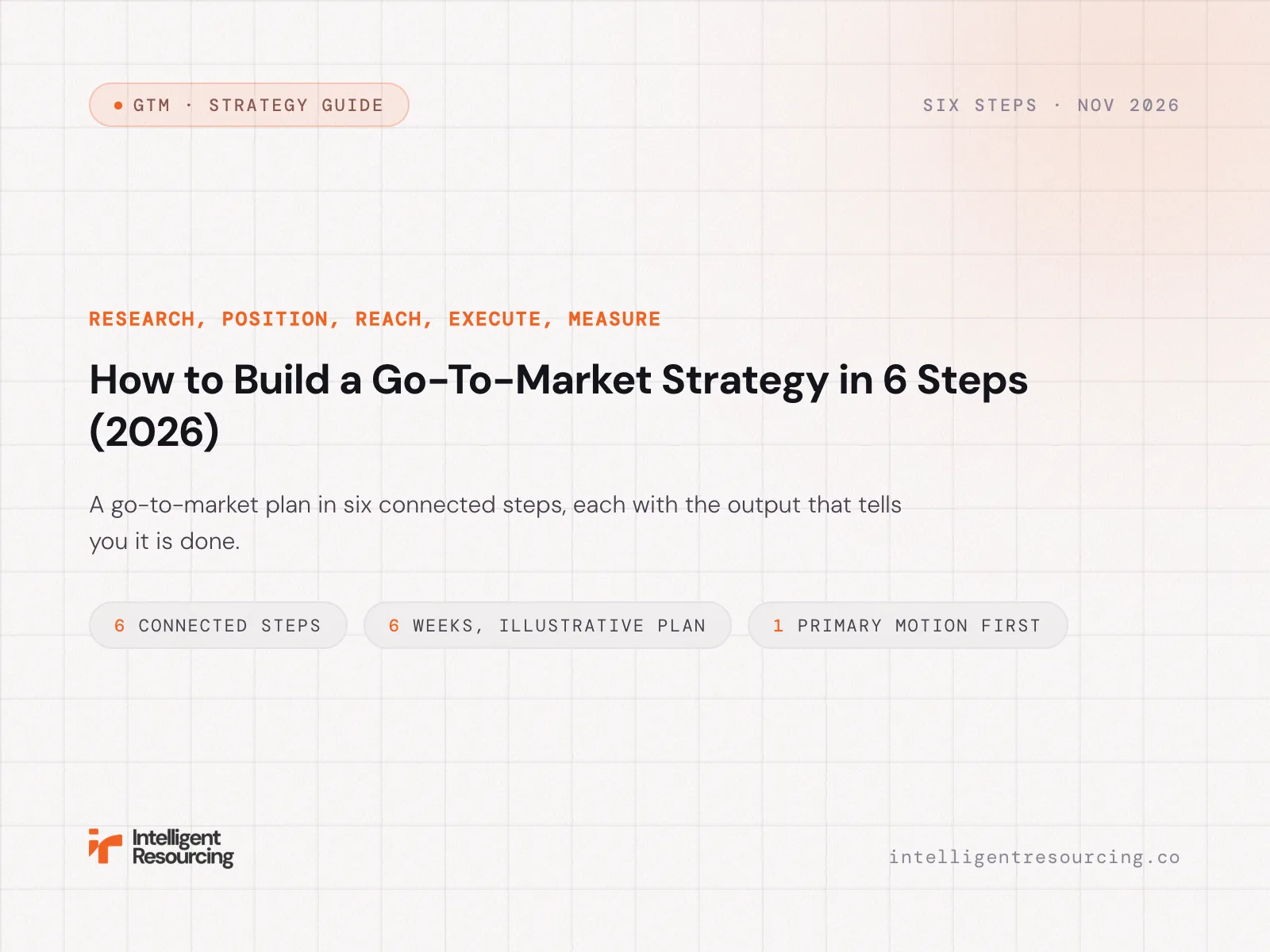
What Is a Go-To-Market Strategy and Why Does It Matter?
A go-to-market strategy defines how a business introduces a product or service, reaches the right customers and turns demand into revenue. It links decisions across product, marketing, sales, finance and customer success. Without it, teams run channel tactics with no shared goal, and the activity never compounds into pipeline.
A marketing plan mostly builds awareness and demand. A GTM strategy goes further. It also sets the offer, target market, pricing, buying process, sales roles and measures of commercial success.
Coordination matters most in business-to-business (B2B) sales. Demandbase's 2025 buyer research found that 72% of B2B purchases involve multi-stakeholder complex buying groups. Many teams still start by choosing channels. They launch ads, hire sales development representatives (SDRs) or buy prospect data before they know which organisations are a fit.
The better question is which accounts have a reason to buy, what evidence supports that, and how to move them through your revenue system. A practical plan, such as signal-led lead generation, answers that before it scales.
What Should a Go-To-Market Plan Include?
A complete plan documents the decisions from all 6 steps and gives each a named owner and supporting evidence. The commercial objective, ideal customer profile (ICP), market and rival research, buyer problem, positioning, pricing, primary motion, channels, sales workflow, budget and success metrics all belong in it. Record the key assumptions and risks too. The most common gap is undocumented assumptions: choices made verbally, never tested and repeated whatever the results. For the same choices as a fixed order, see GTM strategy framework in seven decisions.
How Do You Choose Customers, Problems and Positioning? (Steps 1 to 3)
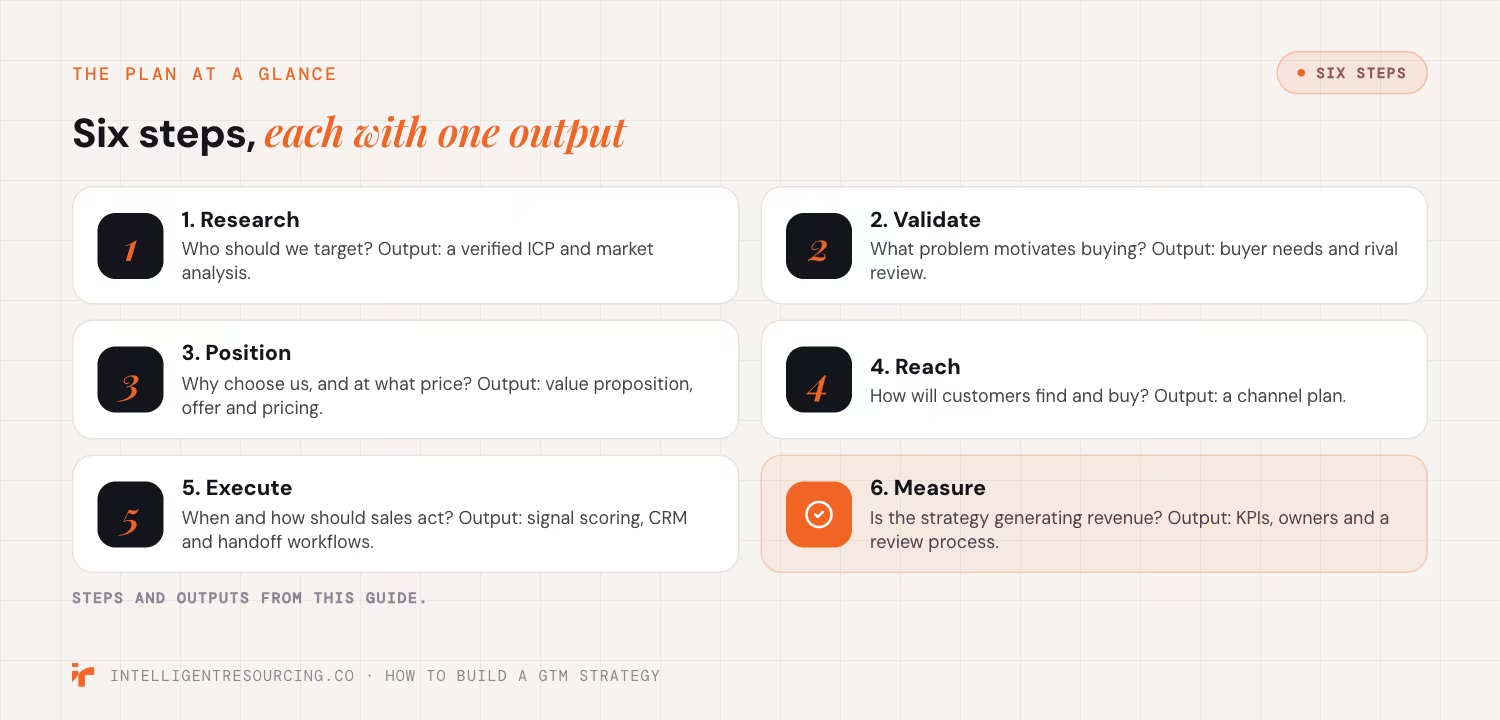
Steps 1 to 3 decide who you sell to, why they buy and what you offer. Each step produces 1 output that feeds the next. Skip market validation and you often end up with strong positioning aimed at the wrong accounts.
Step 1: Define Your Target Market and Ideal Customer Profile
Start by naming the organisations most likely to gain from your product. Your ICP should reflect commercial fit and the problem you solve. Useful criteria include industry, company size, region, technology, operational complexity and buying power. Use customer evidence where you can: contract values, sales cycles, retention and setup needs.
Build a Verified Target-Account Universe
Do not assume a single prospecting database represents your market. Compare available records, reconcile duplicates and separate confirmed facts from assumptions.
Intelligent Resourcing's account-universe method combines 4 independent sources rather than relying on one vendor list. Every delivered fact carries its source. Where a fact cannot be verified, it is recorded as unknown, and never guessed or silently replaced with zero.
This matters because bad market data weakens every later step, from account ranking to revenue forecasts. Intelligent Resourcing wrote this guide and sells this work. It builds and manages signal-led systems inside a client's own CRM. Ask any partner, including Intelligent Resourcing, for a written offboarding map covering tool accounts, data and access. If you need a verified account universe first, start with GTM engineering.
A documented ICP, exclusion criteria and a verified starting account universe.
Step 2: Validate Customer Problems and Analyse Rivals
An ICP says who can buy. This step shows why they would. Interview current customers, review sales calls and study the operating problems your solution fixes. Test whether the problem is urgent, costly or hard enough to justify change.
Then examine the alternatives, including internal processes, existing suppliers and doing nothing. The Australian Government's market research guide says research helps you understand your customers, rivals and industry. For each important alternative, record its target customers, positioning, pricing, strengths and limits. Treat a rival's marketing claims as claims and no verified facts.
A workflow software firm can find that its strongest rival is an established spreadsheet process. Its messages must then explain why changing that process is worth the effort.
A validated problem statement, a rival matrix and evidence for the chosen opportunity.
Step 3: Develop Positioning, Offer and Pricing
Positioning explains why the right customer should pick you over the alternatives. Start with the buyer's problem, then link your capabilities to a specific result. Avoid broad lines such as "innovative solutions for modern businesses".
Say which customers you serve, what changes when they use the product and why your approach is credible. April Dunford's B2B positioning work centres on defining your difference against what customers would otherwise use.
Pricing should reflect customer value, competing options, delivery cost and how buyers purchase. Consider a subscription, a fixed-fee project, usage-based pricing or a mix. A lower price is not automatically a stronger position. For complex B2B services, setup support, reliability and specialist skill can matter more.
A clear value proposition, a differentiated offer, a pricing structure and the commercial assumptions behind it.
How Do You Reach, Execute and Measure? (Steps 4 to 6)
Steps 4 to 6 turn the plan into a working system. You pick channels, run buying signals through your CRM and set the measures that show whether revenue follows.
Step 4: Choose Your Sales, Distribution and Marketing Channels
Pick channels based on how your target customers find, evaluate and buy. Common B2B motions are direct sales, marketing-led acquisition, product-led growth and partner-led distribution. A high-value enterprise solution needs consultations, demos and procurement support. A simpler software product supports trials or self-service.
| Buying stage | Possible channels | Main aim |
|---|---|---|
| Problem awareness | Search, educational content, industry communities | Build relevance. |
| Solution research | Comparison content, webinars, case studies | Support evaluation. |
| Supplier evaluation | Sales calls, demos, referrals | Build confidence. |
| Purchase | Direct sales, procurement or online checkout | Complete the sale. |
| Expansion | Customer success and account management | Keep and grow accounts. |
Do not launch every channel at once. Choose 1 primary motion, test it on your target segment and add channels where they lift engagement or conversion.
A channel plan naming target buyers, messages, owners, budget and expected commercial contribution.
Step 5: Build the Signal-Led Delivery System
A strategy becomes operational when account intelligence produces the right sales and marketing action. Start by connecting your account universe with your CRM.
Before delivering new accounts, check whether they already exist in the client's records. Intelligent Resourcing uses this process to avoid presenting existing contacts as newly discovered opportunities. For the data work behind that check, see CRM data enrichment for Australian B2B teams.
Identify and Score Buying Signals
Signals include funding events, leadership changes, hiring increases, technology moves and expansion news. A signal should never trigger outreach on its own.
Intelligent Resourcing grades every buying signal by how close it sits to a real buying window. That helps reps work the accounts showing relevant changes and not treat all activity as equal. An expansion announcement is worth a look, and it does not prove budget, authority or intent. That is the core of signal-based selling.
Connect Tools and Responsibilities
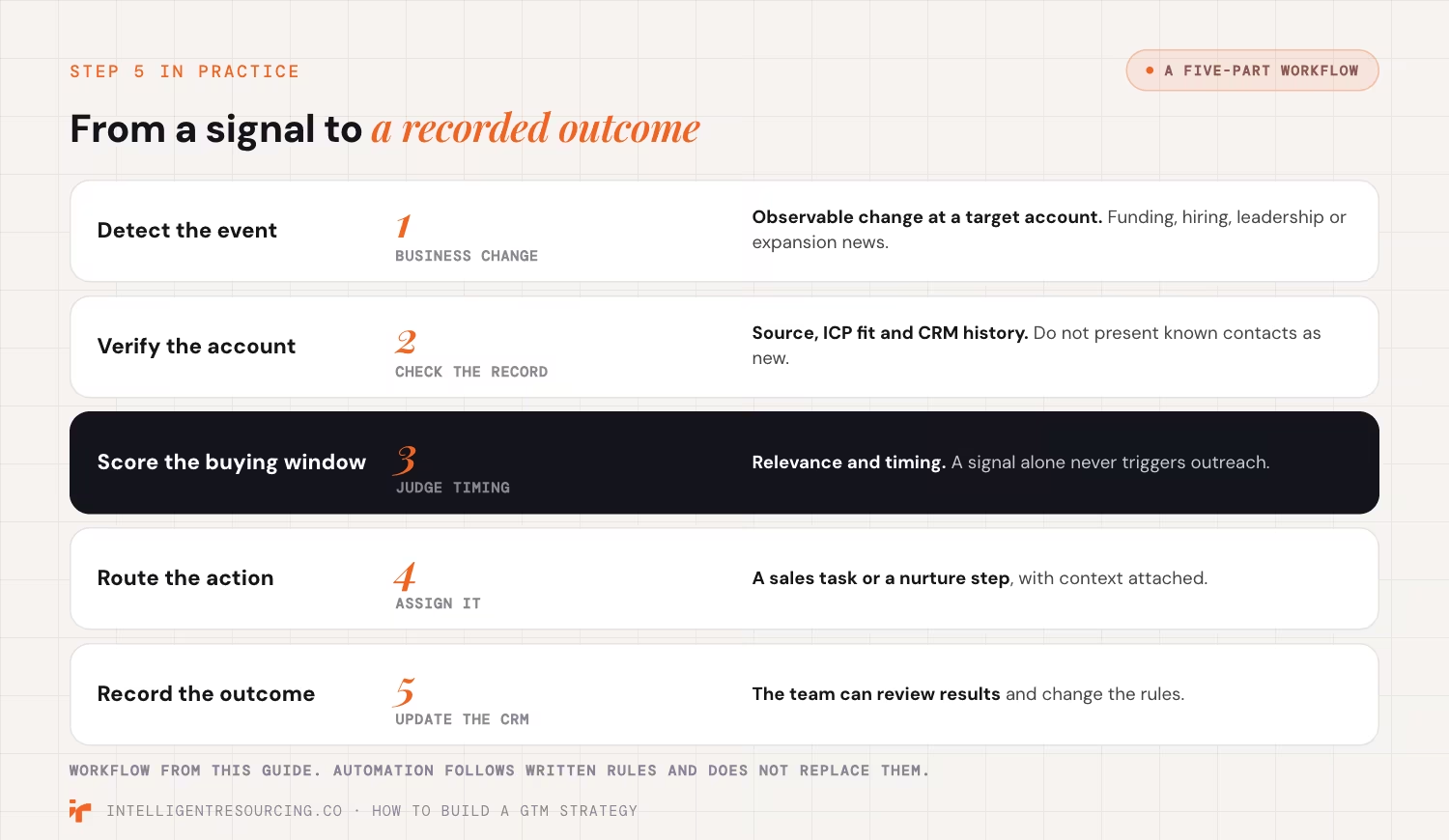
A practical workflow has 5 parts:
- Detect the event: Spot an observable business change at a target account.
- Verify the account: Check source reliability, ICP fit and existing CRM records.
- Score the buying window: Judge relevance, timing and whether more qualification is needed.
- Route the action: Assign a sales task or a nurture step with context.
- Record the outcome: Update the CRM so the team can review results.
Enrichment, workflow and CRM tools can support this process, and automation should follow written commercial rules and never replace them. Speed matters once a signal fires. RevenueHero's study of 1,000 B2B websites found that only 365 of those sites replied to a demo request, and the average reply took 1 day, 5 hours and 17 minutes. It counted automated replies, so it shows response gaps and says little about reply quality.
Required output: Written signal criteria, CRM checks, account owners, routing rules and sales handovers.
Step 6: Establish Key Performance Indicators (KPIs), Ownership and a Review Process
Set up measurement before large-scale delivery starts. Define the outcomes that matter and record a baseline.
Useful measures include accepted meetings, qualified opportunities, pipeline value, opportunity conversion, sales-cycle length and customer acquisition cost. Track activity metrics apart from these. More meetings prove little if the opportunities are poorly qualified.
| Metric | Purpose | Suggested review |
|---|---|---|
| ICP match rate | Check targeting quality | Monthly. |
| Qualified meetings | Check early sales conversion | Weekly. |
| Opportunities created | Measure pipeline contribution | Monthly. |
| Pipeline value | Assess commercial potential | Monthly. |
| Opportunity-to-customer conversion | Check sales effectiveness | Quarterly. |
| Customer acquisition cost | Check sales efficiency | Quarterly. |
Give 1 accountable owner to each metric and its workflow. Where results are unclear, find the earliest failing stage before you add budget or headcount.
Required output: A GTM dashboard, accountable owners and agreed rules for changing the strategy.
How Long Does It Take to Build a GTM Strategy?
Timing depends on the quality of your research, how fast you decide and your technical setup. The schedule below is an illustrative 6-week planning approach and no industry benchmark. A company entering an unfamiliar market, or rebuilding its data, needs longer.
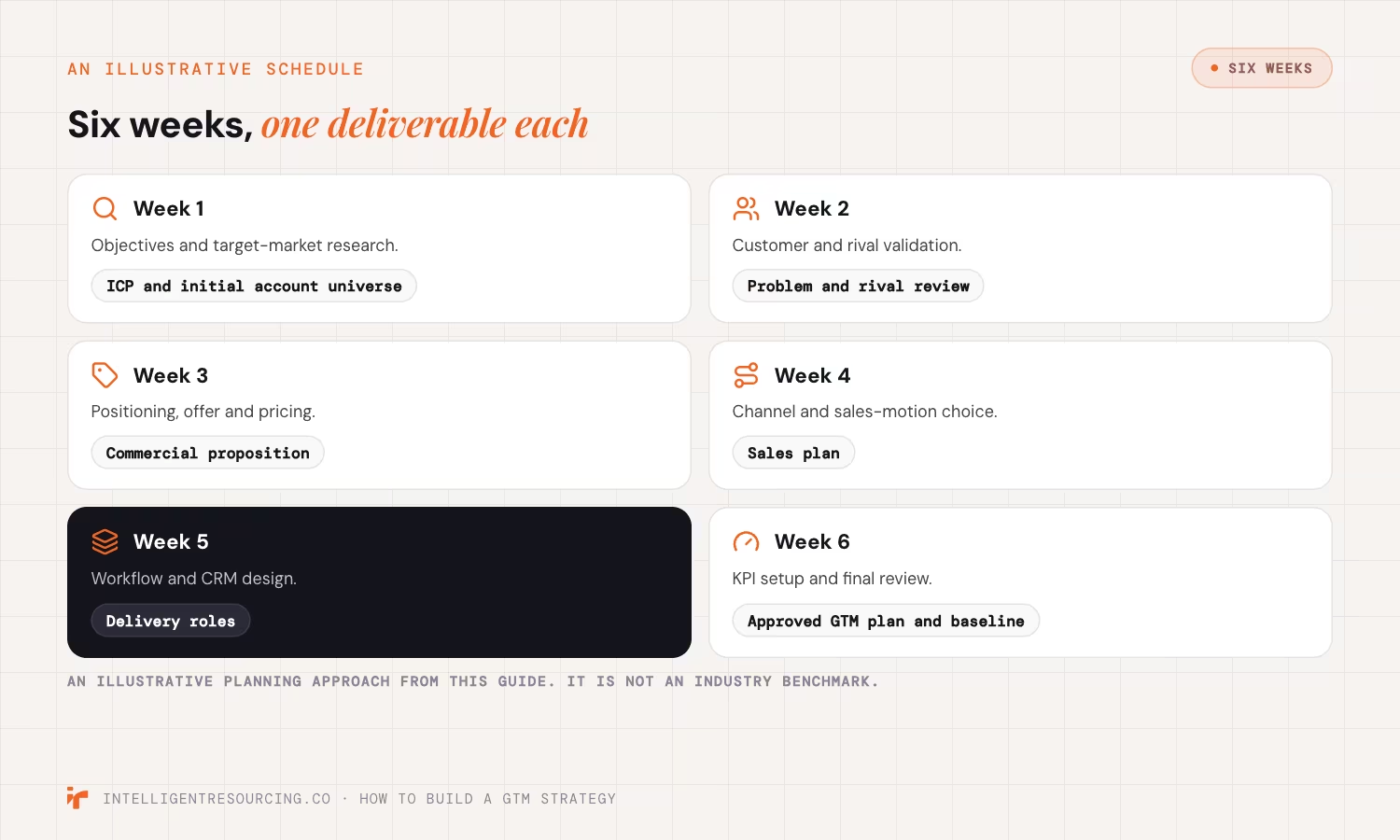
| Week | Priority | Deliverable |
|---|---|---|
| Week 1 | Objectives and target-market research | ICP and initial account universe. |
| Week 2 | Customer and rival validation | Problem and rival review. |
| Week 3 | Positioning, offer and pricing | Commercial proposition. |
| Week 4 | Channel and sales-motion choice | Sales plan. |
| Week 5 | Workflow and CRM design | Delivery roles. |
| Week 6 | KPI setup and final review | Approved GTM plan and baseline. |
A working strategy is not yet a running acquisition system. Intelligent Resourcing's published method for how to build a signal-led prospecting system gives a typical build of 6 to 8 weeks for a team starting from scratch, covering CRM prerequisites, signal monitoring, enrichment, sequences and measurement. Complex firms need longer when integrations, market validation or several approvals are involved.
Hiring is the other route to capacity. Ramp time averages about 3 months for a new in-house SDR, according to The Bridge Group's 2025 SDR report, whose sample is mostly North American. Aim to gather enough evidence and clarity to execute without avoidable rework, and ignore the race to finish the plan fast.
What Common Mistakes Should You Avoid?
Most GTM problems start before a campaign launches. The strategy targets the wrong accounts, positions the offer too broadly or switches on channels with no qualification rules. By the time pipeline data shows the gap, the budget is spent on activity that was unlikely to convert.
Common mistakes include targeting an unverified account list, positioning too broadly, picking channels before you understand buyers and automating outreach with no qualification rules. Another is counting activity and ignoring commercial outcomes: more email volume reaches more contacts and does little for qualified opportunities.
The fix is to validate each stage before you expand the next. A small, well-defined market test gives better evidence than a large campaign with unclear targeting.
Channel mix follows the same logic. ICONIQ's 2026 State of Go-to-Market report surveyed 150+ B2B software GTM leaders. It calls hybrid the default. High-growth companies source 60 to 80% of pipeline from sales and channel, against 15 to 20% from marketing. Start with 1 primary motion your evidence supports, then add more.

To find the failing stage before you add budget or headcount, work through the B2B lead generation strategy checklist.
GTM Engineering
Talk it through with Intelligent Resourcing before you add budget or headcount.
FAQs
How do I build a go-to-market strategy step by step?
Follow 6 steps: define your target market, validate customer problems and rivals, develop positioning and pricing, select sales channels, set up delivery workflows and measure commercial results. Complete each step before you scale the next.
What are the steps in a go-to-market plan?
A practical plan covers market research, customer validation, positioning, pricing, sales and distribution choices, delivery systems and measurement. Record each with an owner, a budget and a measurable result.
How long does it take to build a GTM strategy?
It depends on your research, decision speed and systems. The 6-week schedule in this guide is illustrative and no benchmark. Intelligent Resourcing's published prospecting build runs 6 to 8 weeks from scratch, and complex firms need longer.
What is the difference between a GTM strategy and a marketing plan?
A marketing plan focuses on attracting and engaging customers. A GTM strategy includes marketing and also sets the target market, offer, pricing, sales process, distribution, execution and revenue measurement.