
What Is a GTM Strategy Framework?
A GTM strategy framework is a fixed order of decisions that links customers, value, price, channels and revenue into 1 plan. A go-to-market strategy is the plan a business uses to reach customers, show its value, win new business and grow revenue. A framework gives sales, marketing, product and revenue operations 1 way to make those choices in sequence. A good one is specific enough to guide daily decisions and flexible enough to change when new evidence arrives.
Why Do GTM Frameworks Fail?
A team can finish a polished strategy document and leave the hard questions open. Its ideal customer profile (ICP) is too broad. Its positioning matches its rivals. Its sales team contacts accounts with no reason to engage, and sales rejects the leads that marketing makes.
Buyers add to the problem. Demandbase's 2025 buyer research found that 72% of business-to-business (B2B) purchases involve multi-stakeholder complex buying groups. Every team needs the same account view.
The fix is a framework that turns market choices into operating rules, owners and measures, as signal-led lead generation does.
What Are the 7 Key Decisions in a GTM Strategy?
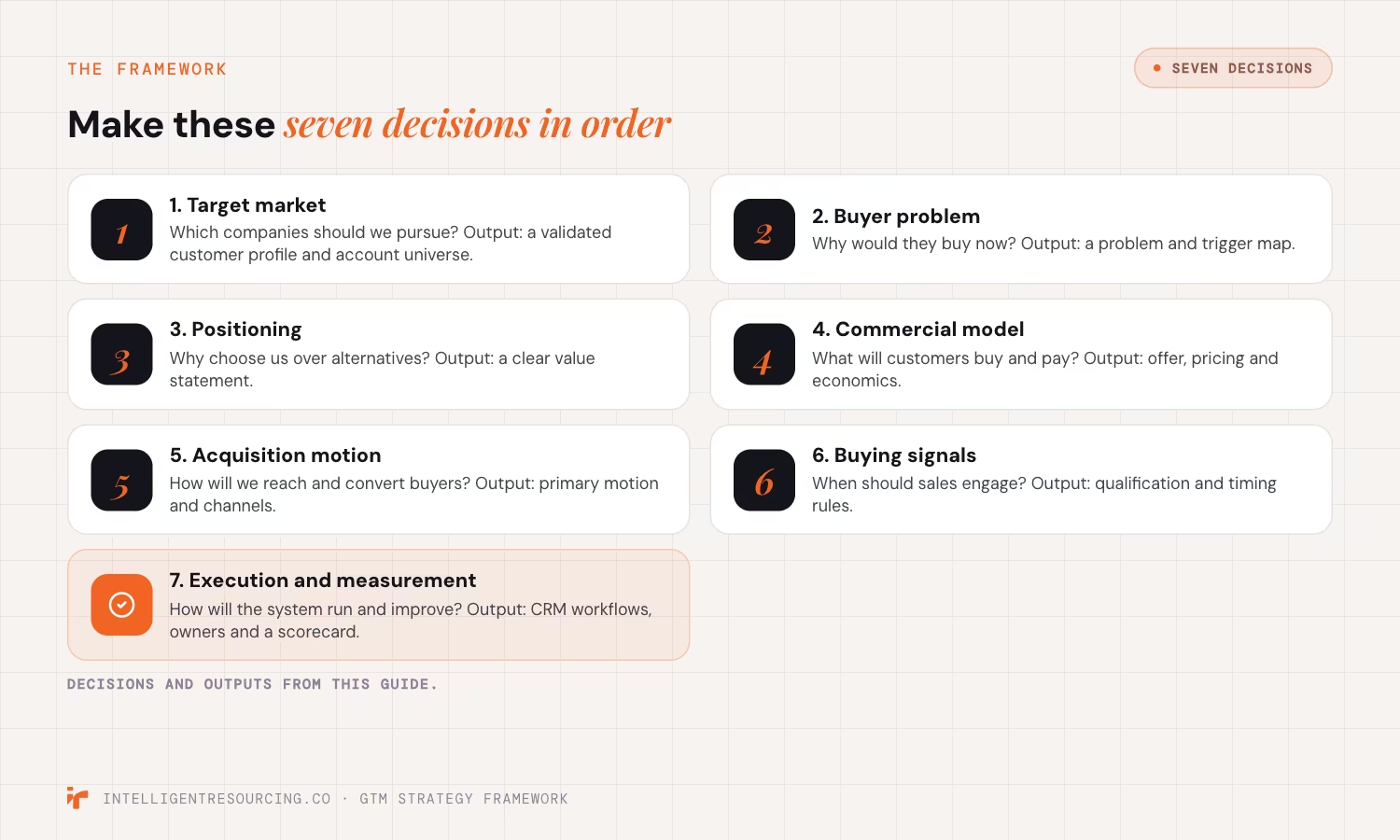
The 7 decisions run from market choice to execution. You choose which companies to target, what creates a buying reason, how to position, what the commercial model is, which motion to use, when signals call for action and who owns the results.
Decision 1: Which Customers Are Worth Targeting?
Define your ICP by industry, company size, region, technology and commercial needs. Then build a reliable account universe. A single prospecting database brings incomplete records, duplicate companies and accounts that no longer fit.
Intelligent Resourcing builds its target universe from four independent sources and reconciles them, rather than trusting one vendor's list. The result is a deduplicated universe of about 115,000 Australian companies. That is Intelligent Resourcing's own method, and no firm needs a database of that size. Verify your target market before you automate outreach.
Required decision: Which accounts qualify, which are excluded and what evidence supports that call?
Decision 2: What Problem Creates a Reason to Buy?
Name the operational, financial or strategic problem your product solves, then look for events that raise its urgency. An ICP says who can buy. It does not show who needs your solution today.
A fleet software firm looks for logistics businesses that add vehicles or replace old systems. Those events give context, and they prove no buying intent.
Required decision: Which customer problems and observable changes justify a closer look?
Decision 3: Why Should Customers Choose You?
Positioning explains why your solution is relevant and how it differs from the alternatives. Those alternatives can be another vendor, an internal process, existing software or no change at all.
A claim such as "we improve productivity" is hard to judge. A stronger claim names the problem solved, how the solution works and the evidence behind the result. Test the message with customer interviews, product facts and documented results.
Required decision: Which differentiated claim can you defend?
Decision 4: What Commercial Model Makes Growth Sustainable?
Your offer and price decide which accounts can buy, how sales talks run and whether the acquisition model pays. Weigh contract value, setup effort, gross margin, sales cycle and customer acquisition cost.
A high-value enterprise product suits advice-led selling. A simpler software product suits a trial or self-service. Never set price apart from customer value and delivery cost.
Required decision: What will customers buy, at what price and under which assumptions?
Decision 5: Which Motion and Channels Will You Use?
Pick a primary acquisition approach based on how your customers buy. Common motions are sales-led, marketing-led, product-led and partner-led. A complex enterprise service needs account-based outreach and technical demos. A product with an easy trial supports product-led acquisition.
ICONIQ's 2026 State of Go-to-Market report, a survey of 150+ B2B software GTM leaders, calls hybrid the default. It also found that high-growth companies source 60 to 80% of pipeline from sales and channel, against 15 to 20% from marketing. Start with a small set of channels and not every tactic at once.
Required decision: Which motion has the clearest evidence of reaching and converting your customers?
Decision 6: What Signals Tell Sales When to Act?
A good-fit account is not always ready to talk. Buying signals include funding, hiring, expansion, technology moves and engagement with relevant content. A single event never triggers outreach alone. Combine it with ICP fit, account context, recency and agreed qualification rules.
Intelligent Resourcing calls this Signal Orchestration. It grades every buying signal by how close it sits to a real buying window, so reps work the few that count, not the noise. A Verified Buying Window is the point where validated signals show buying activity is under way. That is the core of signal-based selling.
Required decision: What evidence must exist before an account moves into active sales engagement?
Decision 7: Who Owns Execution, and How Do You Measure Results?
A GTM framework needs a system that links account selection, enrichment, qualification, routing, outreach and attribution. Each stage needs an owner and clear rules. When a signal appears, the system checks whether the account already sits in the CRM, whether it qualifies and which salesperson receives it. The activity and the outcome are then recorded.
Intelligent Resourcing checks every account against the client's CRM before delivery, so what a team receives is genuinely new and no re-served contact it already owns. Measure accepted meetings, qualified opportunities, pipeline progress and revenue wherever attribution is reliable.
Required decision: Who owns each stage, what happens when it fails and which metrics show the strategy works?
How Do AARRR and Other GTM Frameworks Compare?
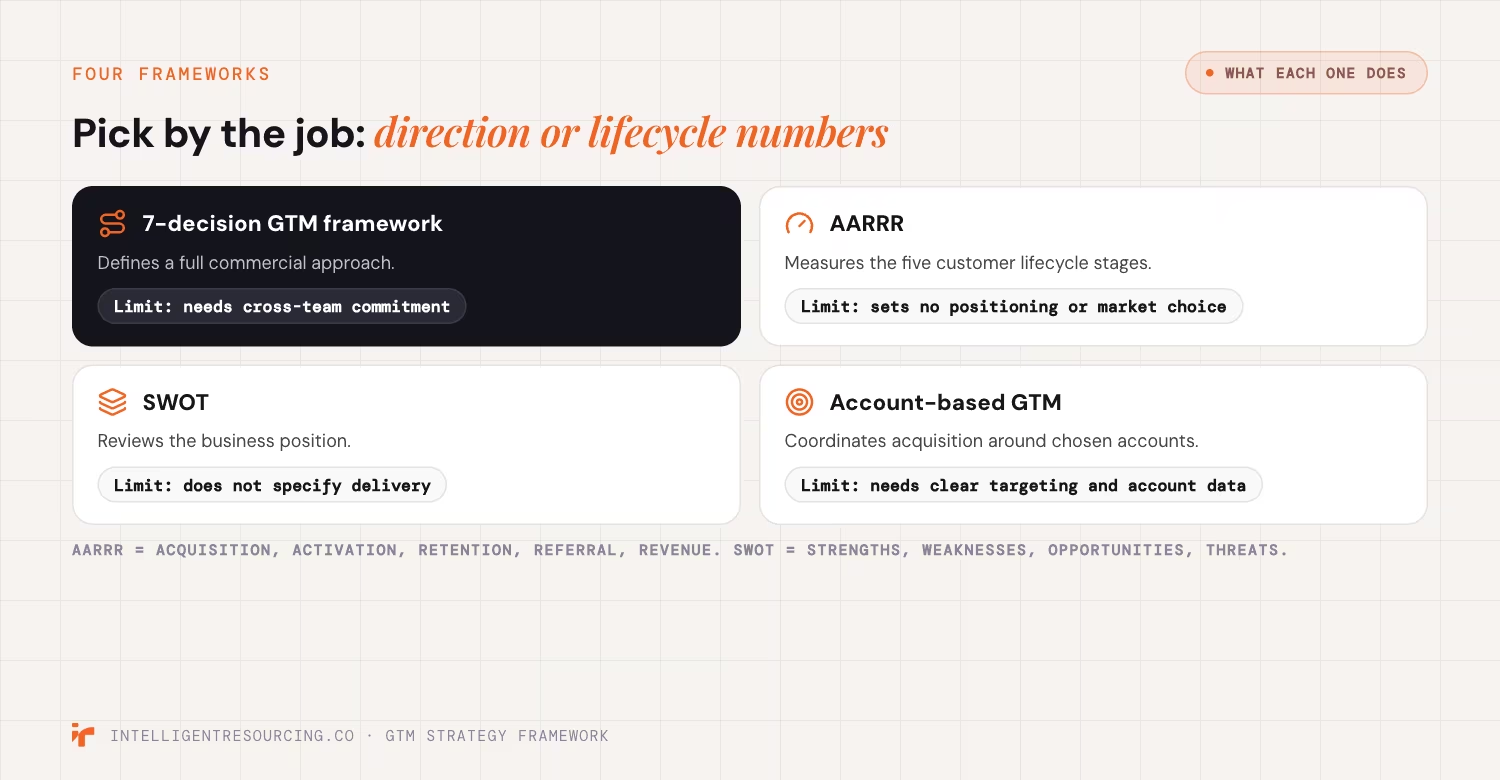
Strategic decision frameworks say who to target and how to reach them. Measurement frameworks, such as acquisition, activation, retention, referral and revenue (AARRR), track what happens after those choices. Pick by whether you need commercial direction or lifecycle numbers.
| Framework | Main purpose | Main limit |
|---|---|---|
| 7-decision GTM framework | Define a full commercial approach | Needs cross-team commitment. |
| AARRR | Measure the 5 customer lifecycle stages | Does not set positioning or market choice. |
| Strengths, weaknesses, opportunities and threats (SWOT) | Review the business position | Does not specify delivery. |
| Account-based GTM | Coordinate acquisition around chosen accounts | Needs clear targeting and account data. |
Where Does AARRR Fit?
AARRR, called Pirate Metrics, was popularised by Dave McClure's startup metrics talk. It measures 5 stages. For a software firm, it shows how prospects become users, how users find value and whether accounts stay or grow.
AARRR does not choose your customer segment or positioning, so treat it as a measurement layer inside the wider GTM plan. Account-based GTM suits firms whose revenue rests on a small set of accounts, and the account-based GTM framework shows how to run it.
What Does a GTM Strategy Framework Look Like in Practice?
In practice, the 7 decisions become a working system: a defined ICP, an account monitoring process, a sequenced outreach plan and a revenue-based scorecard. The example below applies each decision to a hypothetical Australian software company.
| Decision | Illustrative choice |
|---|---|
| Market | Australian logistics firms with 50 to 500 employees. |
| Problem | Manual workforce scheduling during expansion. |
| Positioning | Less scheduling complexity for growing operations. |
| Commercial model | Annual subscription with setup support. |
| Acquisition | Sales-led, backed by educational content. |
| Signals | Fleet expansion and operations hiring. |
| Measurement | Qualified demos, opportunities and conversion rates. |
The company skips the broad contact list. It finds accounts that match its ICP and watches for relevant changes. When an account shows an expansion signal, the team checks the facts, finds the right contacts and decides whether to reach out. The conversation is logged in the CRM, and sales outcomes then refine which traits and signals get priority.
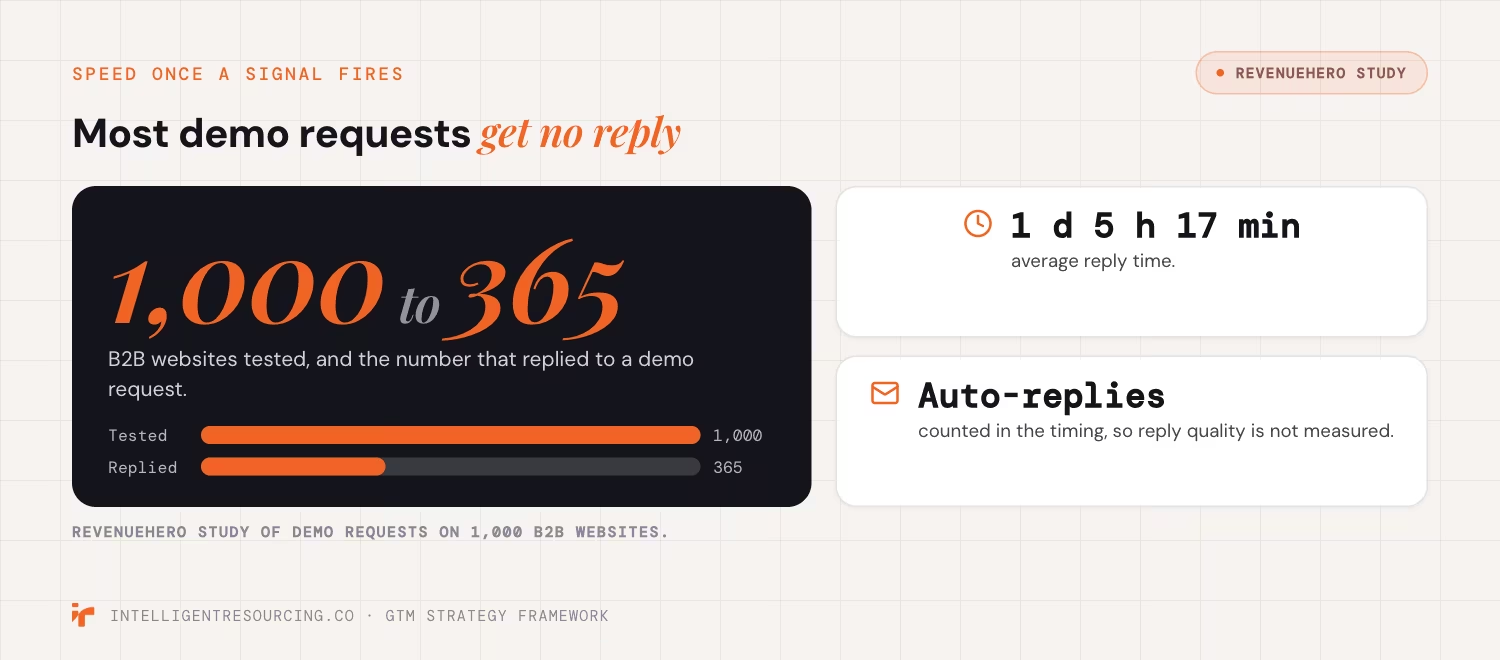
Speed matters once a signal fires. RevenueHero's study of 1,000 B2B websites found that only 365 of those sites replied to a demo request, and the average reply took 1 day, 5 hours and 17 minutes. It counted automated replies, so it shows response gaps and says little about reply quality.
Intelligent Resourcing wrote this guide and sells this work. It builds and manages signal-led GTM systems inside a client's own CRM. Ask any partner, including Intelligent Resourcing, for a written offboarding map covering tool accounts, data and access. If your gap is targeting and timing, start with GTM engineering.
What Should You Look for in a GTM Partner?
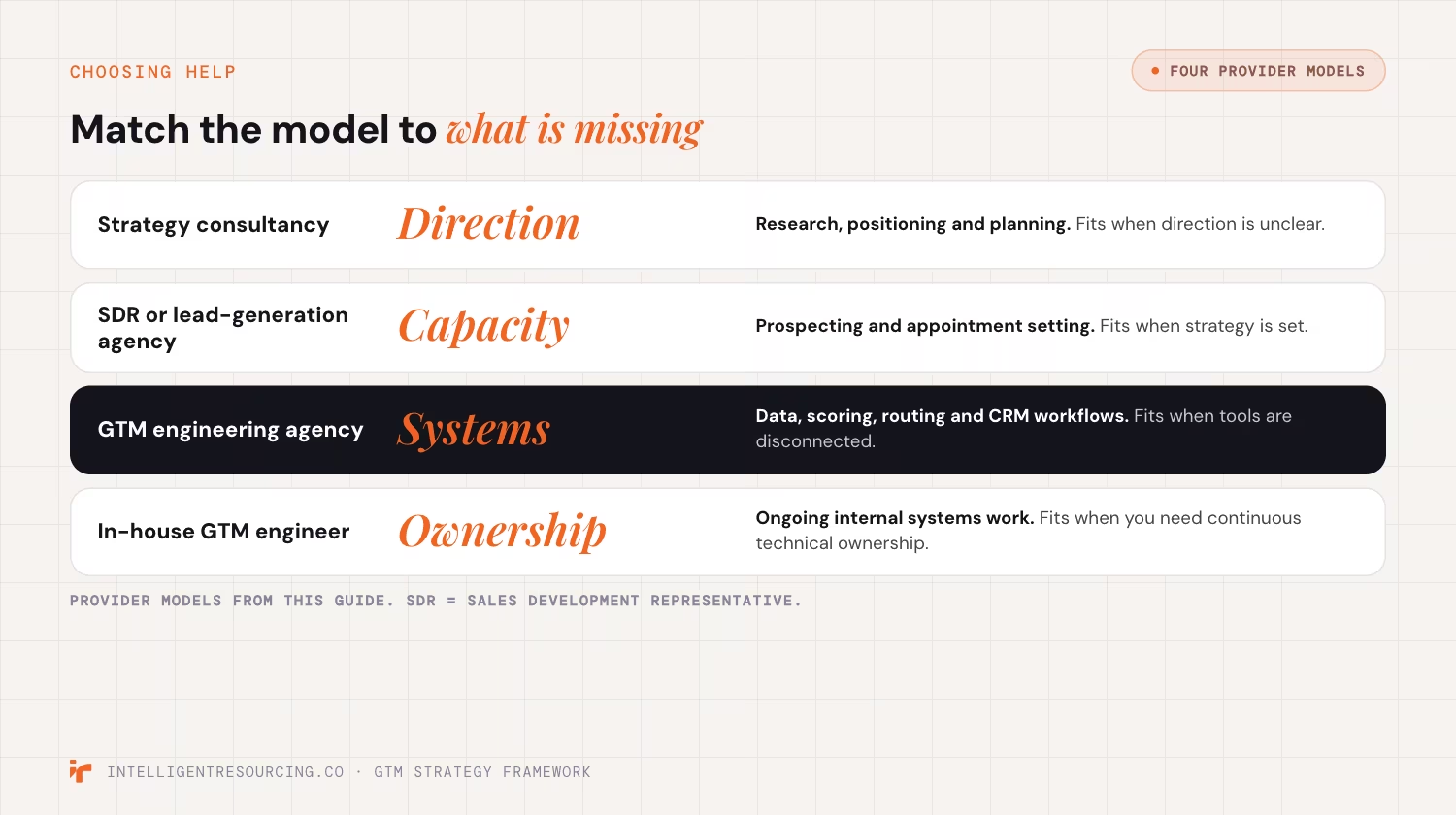
A good GTM partner turns strategy into working systems and never stops at advice or activity. The right model depends on whether you need direction, capacity or connected revenue systems, and the answer changes as you grow. For a longer vetting list, see how to evaluate a GTM engineering agency.
| Provider model | What you receive | When it fits |
|---|---|---|
| Strategy consultancy | Market research, positioning and planning | Direction is unclear. |
| Sales development representative (SDR) or lead-generation agency | Prospecting and appointment setting | Strategy is set and you need capacity. |
| GTM engineering agency | Data, scoring, routing and CRM workflows | Tools and processes are disconnected. |
| In-house GTM engineer | Ongoing internal systems work | You need continuous technical ownership. |
5 Questions to Ask Before You Hire
- How do you validate our target accounts? Ask whether the partner cross-checks data and removes duplicates.
- What happens after the strategy is agreed? Ask who builds the workflows and who runs the campaigns.
- Where will the system live, and who runs it? Ask whether it sits inside your CRM and who manages it day to day.
- How will you measure success? Require clear definitions for a qualified opportunity and for revenue credit.
- What happens when the engagement ends? Ask for a written offboarding map that shows what stays in your CRM, what stops and who owns each piece.
What Does a GTM Partner Do?
A GTM engineering partner builds or fixes the systems that find, qualify, approach and convert the right accounts. It links the stages through workflows: enrichment triggers qualification, qualification triggers routing and routing triggers outreach, with each outcome recorded. A fuller account of delivery sits in what a GTM engineering agency does.
The main risk is automation built on bad inputs. If account data is wrong or qualification rules are vague, a system produces more activity and no better results. A credible partner explains its safeguards, testing and reporting before it scales.
Hiring in-house is the other route. Ramp time averages about 3 months for a new sales development rep, according to The Bridge Group's 2025 SDR report, whose sample is mostly North American.
GTM Engineering
Talk it through with Intelligent Resourcing before you add budget or headcount.
FAQs
What is the GTM framework?
A GTM framework is a structured way to decide which customers you serve, what problem you solve, how you position and price, which channels you use and how you measure revenue. The 7-decision model adds buying signals and execution owners.
What is a go-to-market strategy?
A go-to-market strategy is the plan a business uses to reach customers, show its value, win new business and grow revenue. It combines research, positioning, pricing, sales and marketing delivery and measurement.
What are the key decisions in a GTM strategy?
The 7 decisions are target market, buyer problem, positioning, commercial model, acquisition motion, buying signals, and execution and measurement. Together they give a repeatable way to find and win the right customers.
What should you look for in a GTM partner?
Look for relevant market experience, reliable account validation, clear delivery roles, CRM skills and measurable results. Ask where the system will live, who runs it and what a written offboarding map says about the end of the engagement.
Is AARRR a go-to-market framework?
AARRR is a customer lifecycle measurement framework covering acquisition, activation, retention, referral and revenue. It supports GTM measurement, and it does not replace decisions about market, positioning, pricing or acquisition strategy.